
Introduction
Human-centered design (HCD) is a participatory problem-solving approach that creates solutions that are desirable, feasible, and viable within a specific context. It has been defined as a process that cultivates empathy, ideas, prototypes, and iterative testing with participants (IDEO.org, 2015). Increasingly, researchers are adopting HCD to address health inequities by elevating lived experience and community knowledge (Bazzano et al., 2017; Chen et al., 2020). HCD is different from other participatory processes because of its emphasis on tangible methods, its focus on mindsets, and the expectation of learning alongside those impacted by the outcome (Chen et al., 2020; IDEO.org, 2015; Lyon & Koerner, 2016). HCD tools translate participatory values into structured, iterative cycles of inquiry that make collaboration visible and actionable.
Culturally responsive research (CRR) is socially conscious, strengths-based, and reflexive. It aligns with participatory research paradigms by positioning community members as partners in inquiry, rather than “subjects” of study (Gilbert & Pasque, 2025; Jordan & Hall, 2025). While CRR and participatory research share commitments to equity, relationality, and community leadership, CRR uniquely emphasizes cultural specificity and transformation at every stage of inquiry (Rodriguez et al., 2011).
Though participatory research and HCD share commitments to shared power, equity, and lived experience, the specific mechanisms through which HCD operationalizes CRR principles have not been clearly articulated. This gap limits participatory researchers’ ability to intentionally integrate HCD as a culturally responsive tool. This brief report addresses that gap by offering one of the first conceptual mappings of HCD to a CRR framework. We argue that HCD’s participatory and iterative nature positions it as a promising complement to CRR.
Overview of Culturally Responsive Research
CRR views inquiry as a site of knowledge co-construction and prioritizes cultural participant agency and transformation (Berryman et al., 2013; Hall, 2020). alexander and Pasque (2022) outline three guiding tenets for CRR: transformation, specificity, and expansion where transformation refers to sustained social change through the prioritization of participant knowledge and iterative reflection of the research process (Hurtado, 2022); specificity highlights the importance of context and culture and how interconnected both are with participants; and expansion refers to the ways culturally responsive research is dynamic, such as culture itself, and the view that “good scholarship . . . should be evolving and dialogical such that it invites more exploration of and discussion about the topic at hand" rather than viewed as something that is “final” ( e alexander & Pasque, 2022). In using these tenets, researchers are called upon to adopt cutting-edge, community-driven methods that foster practical change and amplify cultural strengths.
Overview of Human-Centered Design
HCD can be understood as a repeatable process, a set of adaptable tools, and mindsets grounded in empathy and collaboration. It seeks to create solutions informed by the context, desires, and constraints of those most affected, foregrounding lived experiences (IDEO.org, 2015). According to IDEO.org, the HCD process unfolds through three iterative phases — inspiration, ideation, and implementation — collectively emphasizing learning from and designing with people. In the inspiration phase, researchers seek to deeply understand communities and the challenges they face. The ideation phase engages diverse individuals to generate and test ideas, synthesizing insights into design principles. Finally, implementation involves piloting, refining, and scaling solutions through real-world feedback to identify lessons learned and inform ongoing iteration (IDEO.org, 2015). Within each of these phases there are specific HCD methods. While very plentiful, well-known examples include Journey Mapping and Co-creation which are often used during the ideation phase. Journey maps are visual tools that help identify key moments for a product, experience, or service from beginning to end (IDEO.org, 2015). They are useful during inspiration, ideation, and implementation phases and can be created by design or research team members, participants, or a combination of both. Next, a co-creation session is when people proximate to the problem (intended beneficiaries, implementers, funders, etc.) are convened to generate ideas, make initial versions of solutions, provide feedback, and design prototypes or solutions alongside the design or research team members.
We argue that HCD can operationalize the tenets of CRR set forth by alexander and Pasque to enable research that is participatory, culturally grounded, and action-oriented. Much like HCD, CRR enacts research through iterative and relational discourse across different approaches, progressing towards equity and justice (E. alexander & Pasque, 2022). HCD can extend CRR in participatory research by offering structured tools that make participation tangible throughout the research process. Specifically, HCD promotes transformation by positioning participants as experts and redistributing decision-making power to co-create knowledge (Chan, 2018); advances specificity by grounding inquiry in the unique contexts, values, and lived experiences of participants, leading to culturally relevant insights and interventions (Bartlett et al., 2021; Blazey et al., 2023; Mukherjee et al., 2022); and embodies expansion through its ongoing, dialogic cycles of learning and adaptation — reflecting culture’s evolving nature and rejecting static notions of “final” knowledge ( e alexander & Pasque, 2022).
In this brief report, we explore how HCD methods reflect CRR principles — transformation, specificity, and expansion — and provide a pathway for participatory inquiry in health research. We outline our process for identifying HCD methods within qualitative studies and suggest ways researchers can intentionally apply HCD as a culturally responsive approach. Using structured tools ensures CRR principles are embedded consistently and rigorously, supporting intentional design and practical adaptation across projects.
Methods
We conducted an exploratory review of peer-reviewed literature to identify HCD methods used in participatory, qualitative health research that align with culturally responsive research (CRR) principles. In January 2024, the first and third authors searched PubMed, APA PsycInfo, and Google Scholar for studies at the intersection of HCD and qualitative health research. Our goal was to generate an illustrative sample, not a comprehensive scoping review, to understand how HCD has been applied in culturally responsive ways. Articles included detailed qualitative research methods, focused on a health topic, and included “design thinking”, “human-centered design”, or “user-centered design” in titles or abstracts.
Each article was reviewed for the rationale for selecting an HCD approach or methods, the specific HCD methods applied (IDEO.org, 2015), and the study purpose, outcomes, and implications. Co-authors EC, VR, and JOM developed a coding schema to extract data consistently. In addition to the HCD methods applied, they recorded the stage in the qualitative research process in which they were used (i.e., data collection, data analysis, or synthesis).
Through iterative discussions, the co-authors also analyzed which HCD methods, if any, demonstrated CRR tenets — transformation (did the method position participants as experts, redistribute decision-making power, or co-create knowledge?), specificity (did the method ground inquiry in the unique contexts, values, and lived experiences of participants?), and expansion (did the method promote ongoing, dialogic cycles of learning and adapting or reject static notions of “final” knowledge?) ( e alexander & Pasque, 2022). Disagreements were resolved by consensus. In efforts to practice true CRR, we approached this work through the positionality of qualitative researchers who share a commitment to participatory, community-engaged approaches to public health inquiry. Several authors (EC, VR, and JO) have previously conducted research and scholarship focused on human-centered design in public health, which informed our interest in examining how HCD aligns with culturally responsive research; throughout the analysis, we engaged in discussion and reflection to critically consider how these experiences shaped our interpretations. Finally, all authors synthesized findings through iterative discussions, reflecting on positionality and disciplinary perspectives to ensure cultural responsiveness. This process inspired development of the journey map tool described below.
Results
We identified fourteen studies (see Table 1) that applied HCD in qualitative health research and all applied HCD in ways aligned with at least one of the three tenets of CRR, showcasing how HCD can operationalize CRR within participatory research. Seven studies used HCD for its participatory engagement, ability to capture lived experiences, and attention to context (e.g., Kia-Keating et al., 2017; Leos et al., 2023). One study (Cheng et al., 2023) highlighted HCD’s role in promoting trust and reducing stigma, while two others (Hopkins et al., 2023; Szymanski et al., 2023) described it as a contextually and culturally relevant approach, underscoring its alignment with culturally responsive research.
Across studies, HCD methods were used in different ways across data collection, data analysis, or the generation of outputs. Some methods illustrated one of the three CRR tenets — transformation, specificity, or expansion — while others embodied all three. Table 1 summarizes these methods by reference to illustrate how HCD operationalizes culturally responsive principles at different stages of the qualitative research process. The table also provides a brief description of each of the HCD methods per IDEO’s framework (IDEO.org, 2015). Although this analysis was not intended to be comprehensive, it offers illustrative examples of how HCD methods can advance culturally responsive research across varied contexts. The sections below elevate examples of HCD methods used to exemplify one or more CRR tenets.
Human-centered design methods that exemplify tenets of CRR in qualitative health research
We identified several HCD methods that reflected the three different tenets of CRR: transformation, specificity, and expansion, and provide some examples here. Transformation was evident in Kia-Keating et al.'s (2017) use of Conversation Starters to prompt reflection in a violence-prevention project among Latinx youth in the United States. Conversation Starters put ideas in front of people to spark their reactions and further conversation (IDEO.org, 2015). Kia-Keating et al. combined community-based participatory research and HCD in their study and paired youth photos from an affiliated photovoice project alongside thought-provoking questions (What do these pictures say about our community? What vision for change do these pictures suggest? What memories do these pictures bring up for you? What do you see in these pictures?) around the room during a community forum (Kia-Keating et al., 2017). This approach positioned youth as experts and fostered iterative reflection, illustrating transformation through creativity and shared authorship ( e alexander & Pasque, 2022).
Specificity emerged in Leos, Chen & Jagannathan’s (2023) use of Card Sorts to explore adolescents’ needs for sex education. Card sorts offer decks of cards with words or images to participants so that they can organize (e.g. sort, prioritize, order) the cards in some way (IDEO.org, 2015). In Leos, Chen & Jagannathan’s study, teens were presented with cards and asked to complete ranking and sorting activities during interviews. The cards included possible responses to the following questions: Who are you most comfortable talking to about sex and relationships? Where do you feel safe talking about these topics? What sexual health topics are you most interested in learning about? Participants were instructed to move the cards to answer the questions and then discuss their choices. This method illuminated context-specific barriers around discussing taboo topics, demonstrating how HCD can uncover cultural nuances and guide sensitive inquiry.
Finally, expansion was embodied by Ospina-Pinillos et al. (2019), who used Rapid Prototyping with youth, caregivers, and health professionals to co-design a Spanish-language digital mental health platform in Australia. Rapid prototyping is the act of generating multiple, quick, low-cost initial versions of ideas with the purpose of getting feedback from participants and iterating (IDEO.org, 2015). In their multi-phase project, the research team developed an initial version of the platform. To get feedback, they invited young people, health professionals, and supportive others to 90-minute one-on-one user testing sessions where each user was paired with a researcher. Researchers then enacted a think-aloud protocol where users were prompted to try the prototype. Researchers observed the user as they completed four tasks (create an account and log in, find the Need Help Now button, explore the dashboard of results, and book an appointment) and wrote down questions that users asked the researchers (Ospina-Pinillos et al., 2019). Resulting feedback and observations prompted two additional phases of prototyping. Iterative feedback cycles shaped interface, content, and functionality, exemplifying learning-through-design and continuous adaptation.
Two methods, Journey Mapping and Co-Creation, most comprehensively reflected all three tenets. Journey mapping visualizes participants’ lived experiences, making invisible processes visible while acknowledging multiple realities (IDEO.org, 2015). Aizobu et al. (2023) used this tool to map enablers and barriers to HIV self-testing and van Schalkwijk et al. (2023) used it to represent the experiences and needs of patients with a specific coronary disease, revealing transformation (centering participant voice), specificity (capturing contextual realities), and expansion (generating new insights). Aizobu et al. (2023) synthesized qualitative results in a journey map using the following moments: attract, purchase, use, confirmatory testing, link to HIV care and treatment, link to HIV prevention, and reporting. van Schalkwijk et al. (2023) organized their results into the following phases: symptom onset, pre-diagnostic, diagnostic, post-diagnostic and presented touchpoints, themes and actions, emotions, needs, and design challenges for each phase. With regards to Co-Creation, Leos, Chen & Jagannathan (2023) held co-creation sessions with teens where participants were asked to design their original, ideal solutions of an mHealth app that would increase their access to high-quality information about adolescent sexual health. Using printed handouts with blank cell phone screens and markers, participants created their versions and then presented their ideas to the group and shared feedback on each others’ ideas. Drawings were collected and analyzed and used to inform future prototypes for their project. Again, this application of co-creation highlighted transformation (centering youth voices), specificity (elevating context-specific ideas and suggestions), and expansion (ideas for future ideas and testing).
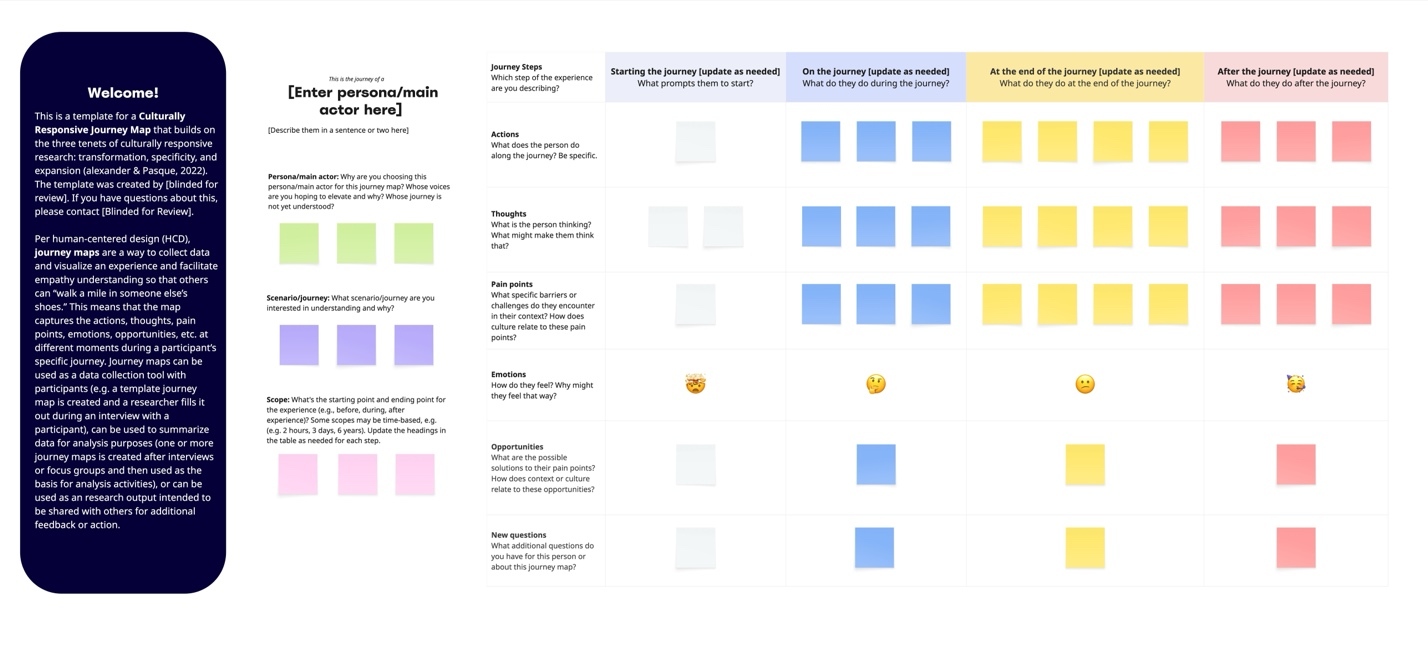
During our team’s analysis, we also created a Culturally Responsive Journey Map (CRJM) (Figure 1). Our analysis highlighted how the journey map method could embody the three CRR tenets, prompting us to create a sharable tool to guide researchers’ strategy and thinking in applying these tenets.
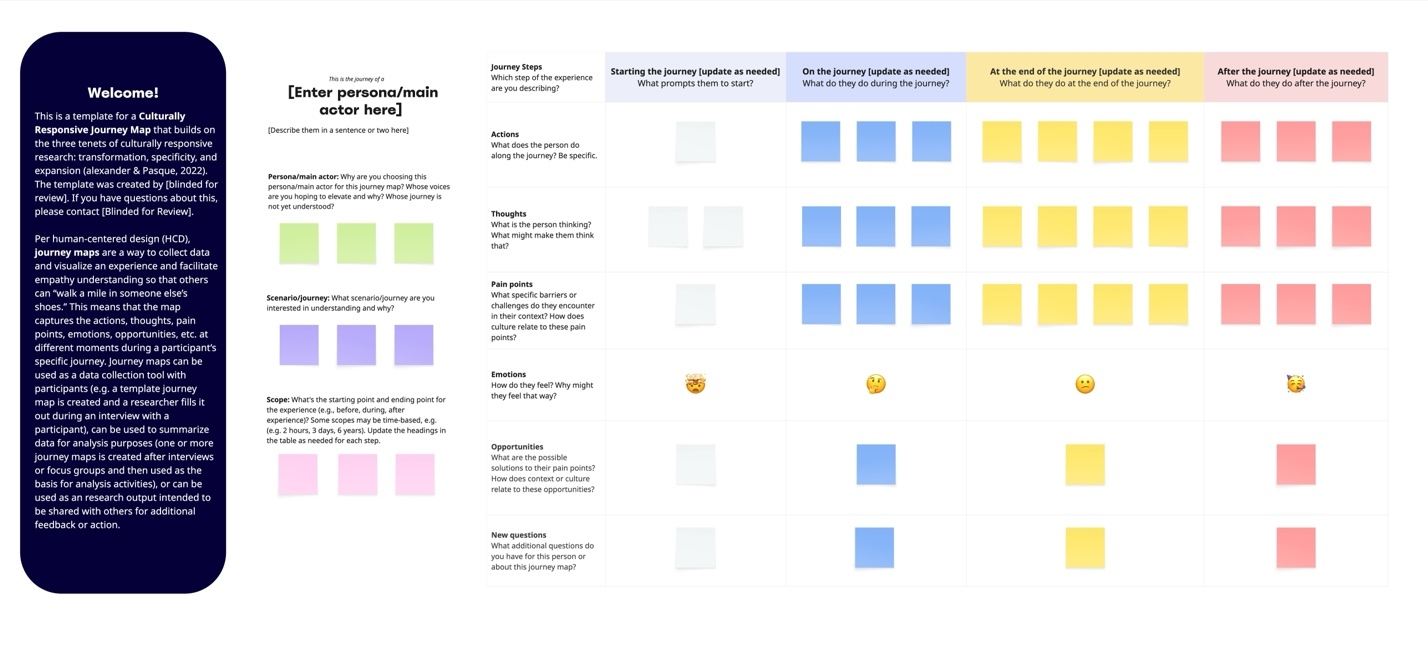
The purpose of the CRJM is to provide a structured way for researchers to document and elevate the lived experience of a key actor and reflect on multiple key moments. The journey map embeds specificity by requesting information on pain points and opportunities related to context and culture, highlights transformation by showcasing participant experiences and encouraging researcher reflection across different categories (e.g. thoughts, emotions), and embodies expansion by prompting ideas for opportunities and new questions. The tool can be used at various research stages (e.g., recruitment, data collection, analysis, dissemination) individually or collaboratively to support participatory, culturally relevant research. To access the digital version of this template, go to: https://tinyurl.com/crjmlink.
Discussion
Tensions and Challenges Applying HCD to Culturally Relevant Research
Human-centered design can advance culturally relevant research by centering people in both design and inquiry, challenging traditional hierarchies, and emphasizing the interplay between context, culture, and lived experience. Its iterative, participatory nature promotes reflexivity and sustained engagement across all research stages, demonstrating clear overlap with CRR and participatory research approaches. However, applying HCD to CRR within the participatory sciences presents ethical and practical challenges that warrant consideration.
Researchers must intentionally implement HCD methods with attention to transformation, specificity, and expansion; as using a method such as Journey Mapping without such intentionality risks losing its culturally responsive value. HCD is best suited for action-oriented projects aiming to generate tangible, context-specific solutions that elevate community voices and redistribute decision-making power (Chen et al., 2020). Though rarely the case in participatory research, HCD may be less appropriate for projects with abstract goals or limited tolerance for iteration and uncertainty.
Because HCD requires deep, ongoing engagement, researchers must ensure participants, particularly those from marginalized or overburdened communities, are willing, able, and interested to sustain involvement. This engagement should be equitably compensated to reflect participants’ expertise and time. Additionally, some populations may find the “fail fast” or “learn by doing” ethos uncomfortable or misaligned with their lived realities.
Practically, implementing HCD within participatory research faces several constraints. High-quality training in both HCD and CRR remains limited in MPH and health-related doctoral programs (Abookire et al., 2020; Romero & Donaldson, 2024), and accessible online resources vary in quality. HCD may also demand greater time, funding, and infrastructure than traditional qualitative methods due to its iterative ideation and prototyping phases — core to transformation and expansion ( e alexander & Pasque, 2022). Finally, if conducting research online, methods such as Brainstorming or Journey Mapping often rely on digital platforms like Miro, which can create participation barriers for those with limited technological access or literacy (Chen et al., 2023). That said, these participation barriers can be anticipated and addressed through different strategies.
Recommendations
To advance HCD as an emerging subfield in CRR, we recommend actions at both researcher and system levels. At the researcher level, we urge adoption of reflexive tools — such as our Culturally Responsive Journey Map — to ensure consistency and quality in applying HCD methods through a culturally responsive lens. This tool does more than visualize experiences; it provides a structured way to determine when HCD aligns with project goals, select appropriate methods, and uphold cultural integrity. Using a common tool fosters coherence across projects and strengthens the field’s capacity to operationalize CRR principles through design.
In addition, academic and funding systems should expand access to high-quality HCD training, either by building in-house expertise or sponsoring external opportunities. Training should emphasize HCD’s alignment with CRR — centering community voices, fostering co-creation, and supporting action alongside knowledge generation. Funders should also expect iterative, prototyping phases and provide flexibility for adaptation, recognizing that culturally responsive design research evolves through continuous learning.
Conclusion
Human-centered design places participants at the center of research and can be applied as a culturally responsive approach within participatory traditions. It treats participants as experts, acknowledges culture as dynamic, and adapts in real time to lived experience. By engaging researchers and participants as partners, HCD promotes transformation and responsiveness throughout the research process.