Introduction
Working with CYP as co-researchers provides unique and valuable insight into lived experiences of school and education (See Haines Lyon et al., 2024; Schäfer & Yarwood, 2008). However, it is also recognised that more work needs to be done on understanding how CYP feel about engaging with co-research within school settings, the dynamics between youth co-researchers and their peers and to explore the potential for co-research to contribute to more democratic learning environments. This tutorial contributes to this debate by sharing an emotion-based resource developed throughout several youth co-research projects, all based in the north of England, UK, that encouraged exploration of youth researchers’ experiences of engaging with co-research. The youth researchers shared insights into the valuable elements of the experience, and highlighted areas where they had felt uncomfortable or unsure during the research, leading to discussions around the development and support needed for future projects. The report concludes with a letter entitled ‘Dear Headteacher’, framing youth co-research as a catalyst for creating more democratic spaces within English schools.
Ethics approval & research context
Ethical approval was granted by a University Ethics Committee. Information and informed consent forms were given to all youth co-researchers and their parents or guardians. Inspired by Lomax, Smith and Walsh’s digital resources (2020) the author presented a video explaining the project and how the consent and anonymity processes would work. Process consent was discussed throughout the project and youth co-researchers were introduced to the research process through a children as researchers’ methodology (Fielding, 2001; Kellett, 2005). Influenced by Youth Participatory Action Research frameworks (Fine, 2018), the focus became about facilitating a space where both adult and youth researchers could work in a dialogic way to share insights and generate ideas for the research project. Across three English educational settings pupils, who were aged between 7 and 18 years old, were invited to take part in a funded research project exploring school toilets. The topic of ‘school toilets’ was set by the university and external funders, but each group of youth researchers chose their own research questions and collaboratively built their projects to suit their individual schools. The project was developed to teach research skills and to explore the possibilities for democratic co-research spaces within the current English school system. The findings of the youth co-research projects are detailed elsewhere (Green et al., 2025).
The term technical adult researcher (Proefke & Barford, 2023) is used within this article and is understood to be the adult who has university qualifications, research training and the resources to develop research projects. The term youth researcher was chosen by a group of young people who were engaged with the co-research and is understood to be the CYP who engage with research processes, undertake research training and who apply ethical principles to their own research projects.
Using emotions to understand youth co-research
It has been well documented that a failure to properly listen to CYP, or tokenistic youth involvement, can give rise to dissatisfaction with participatory processes (Lundy, 2018; Mannion, 2007; Proefke & Barford, 2023). Research has also indicated that the recent rise in school councils and youth voice initiatives does not always equate to valuable or valued youth input (Mayes et al., 2019; Proefke & Barford, 2023). Within the context of UK schools, Crook (2021) suggests that there has been a significant narrowing of educational experiences where children and young people can express views and engage in meaningful decision making. Understanding this, the technical adult researcher took an approach to the research that surfaced emotions, scrutinised the relationships and attempted to recognise how the context would influence the research (Fielding, 2007; Mannion, 2007). Kaya Aabye and colleagues (2021) suggest that the more we question, observe and research our emotions, the more we can learn about situated knowledge, societal behaviour and our individual and shared experiences. Within the research we were able to take a closer look at the co-research space, through emotion words, and reflect upon the lived experience of those occupying the co-research space and the child-adult relations within it (Mannion, 2007, p. 406).
The emotion-based resource
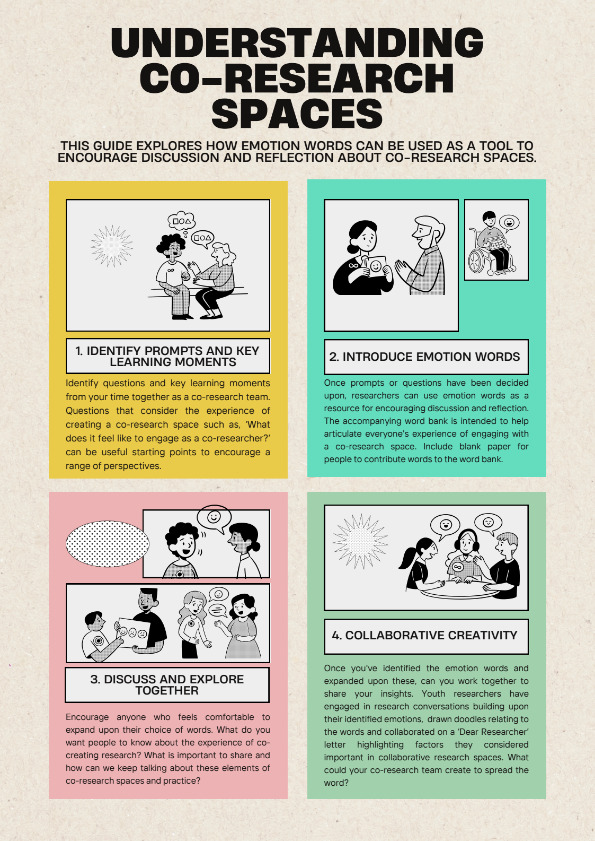
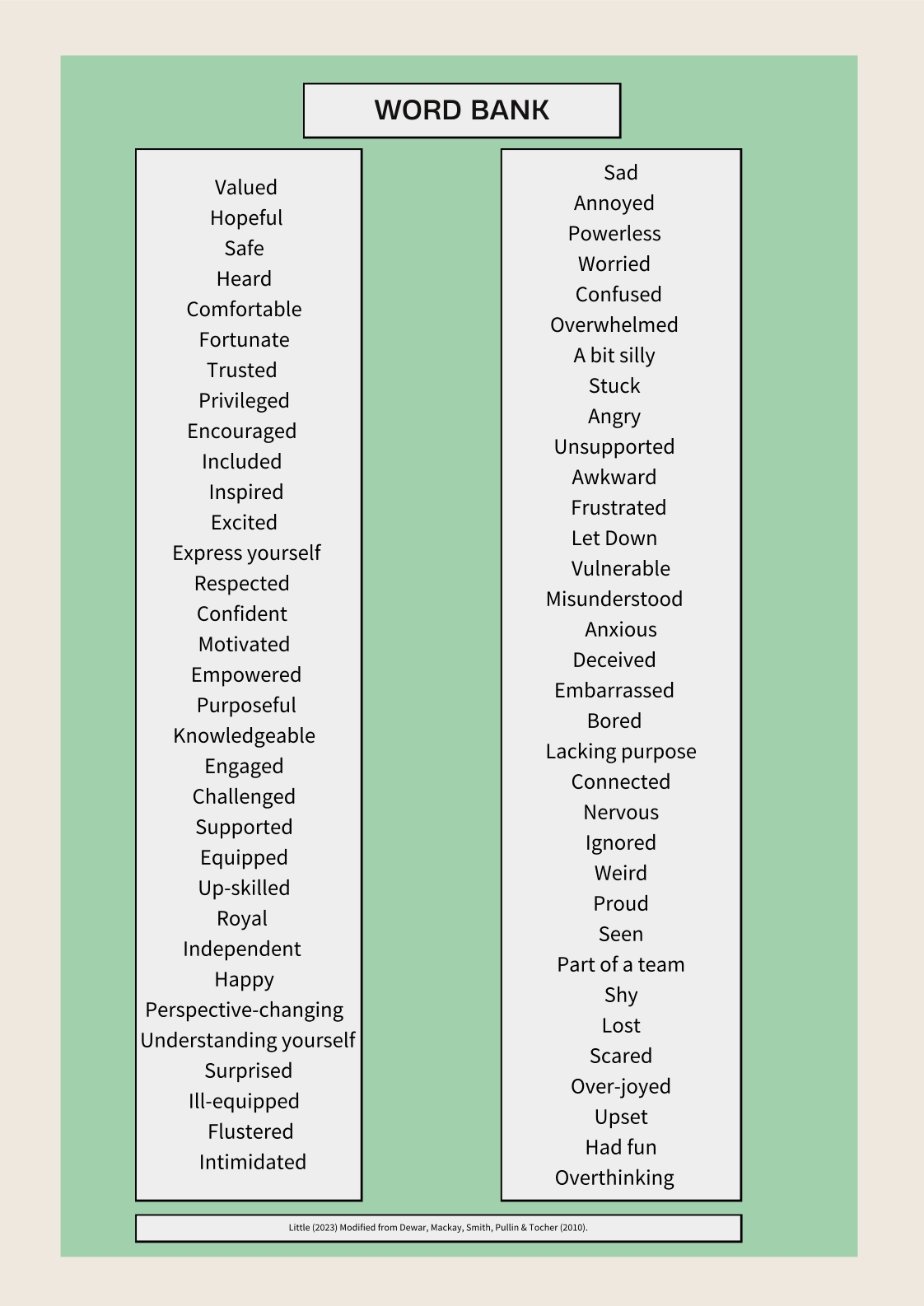
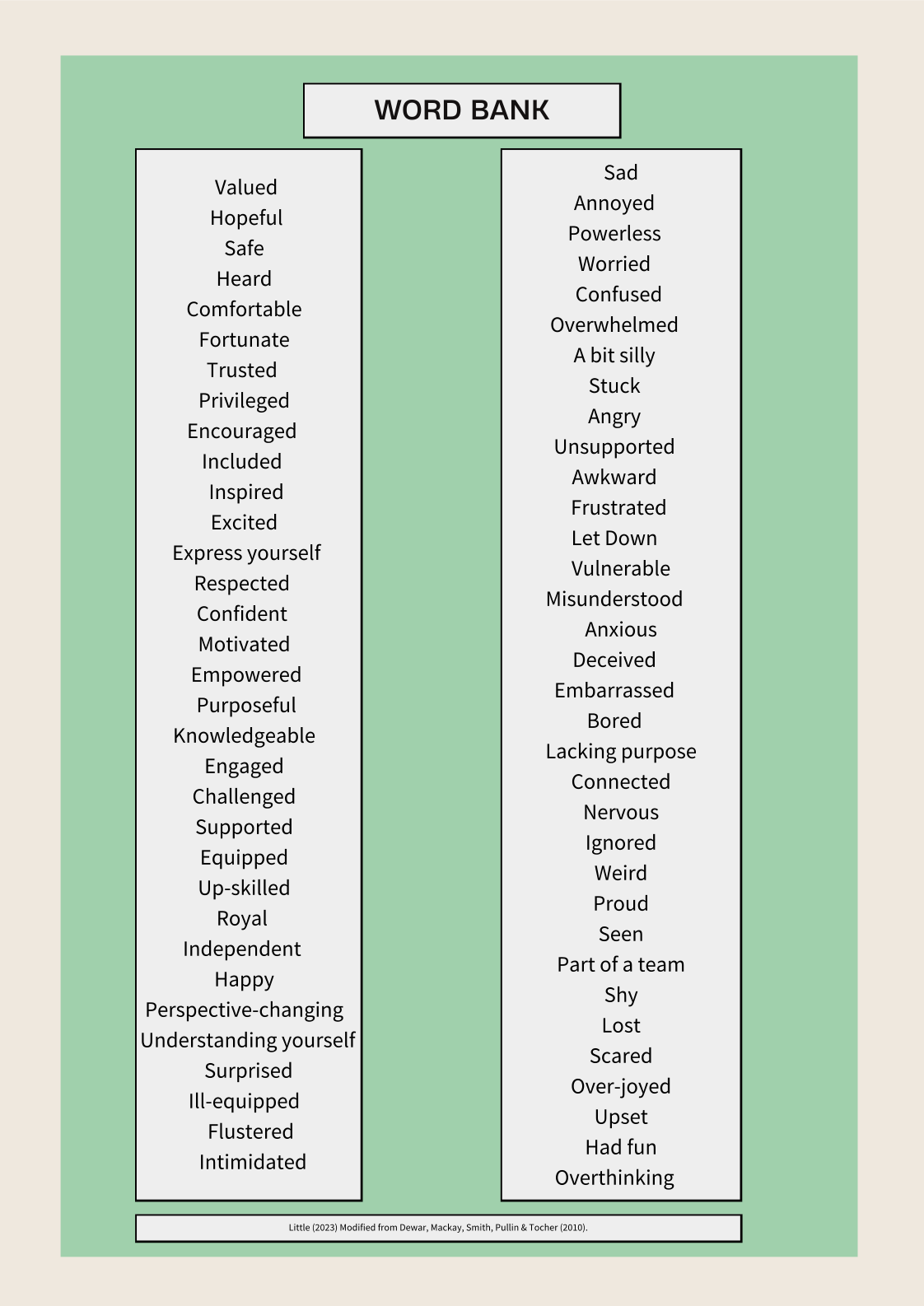
The emotion-based resource (Appendix 1 & 2) builds upon Dewar et al’s (2010) use of ‘emotional touchpoints’ and emotive words to explore compassionate care with participants. Dewar and colleagues developed the resource to enable ‘practitioners to see in a more balanced way both the positive and negative aspects of an experience’ (Dewar et al., 2010, p. 29) but importantly is an adaptable resource to use with people of all ages. The resource provides youth researchers with a range of emotion words that are often used to describe outcomes in relation to elevating voice, such as ‘heard’, ‘included’ and ‘engaged’, and ‘misunderstood’; ‘let down’ and ‘frustrated’ are offered as counter language for describing the experience (Appendix 2). The resource is designed to be used within sessions that explore the experience of co-research from youth researchers’ perspectives. Within these sessions the technical adult researcher can start with a simple timeline of events e.g. Introduction, consent, doing peer research, the research sessions, sharing the research, or provide specific questions that the youth researchers can choose from such as ‘What has it been like to become a youth researcher?’. Providing prompts in this way enables the youth researchers to reflect on the research process and highlight important moments. Youth researchers are invited to select from these as prompts to explore their experience of co-research. In research projects where ample time is allocated for evaluation and reflection, I would encourage researchers to build the timeline of the research journey entirely with youth researchers, to further develop the participatory nature of the research. Within each project blank strips of paper were included for the youth researchers to add their own key moments, questions or emotion words, and the resource is continuously adapted to include language that youth researchers use in discussions. The emotion words may only tell part of the story, so further discussion of the tensions and successes of each project are crucial. In each research project to date, the emotion-based resource has served as a catalyst for further discussion.
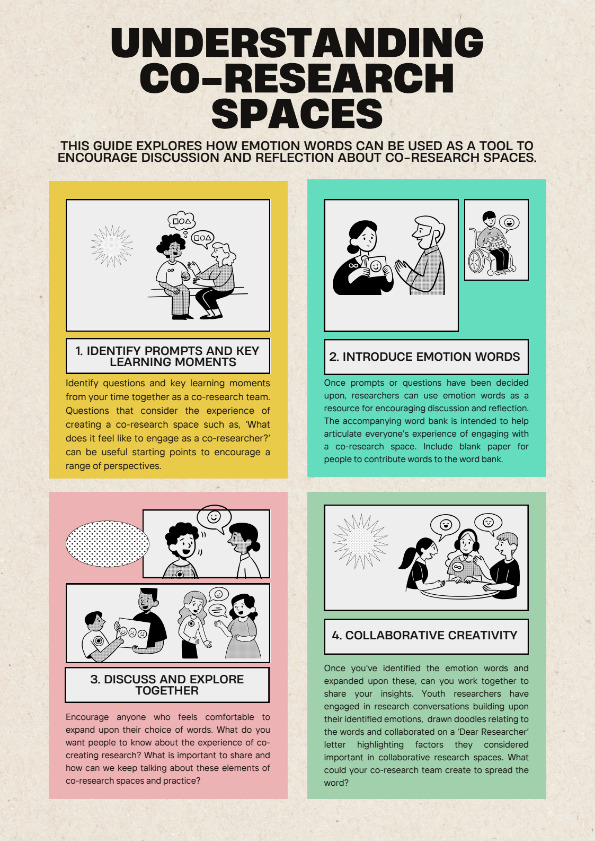
Step 1 – Identify learning prompts and key learning moments
Sharing a timeline with youth researchers is a great starting point for the research team to begin to identify key moments. To date, I have always used prompt questions alongside any timeline, such as ‘What does it feel like to engage as a co-researcher?’, and these questions are usually laid out for the youth researchers to choose from. When I utilised this resource in a secondary school, with pupils aged 13-15, five out of the seven youth researchers shared that they wanted to start by choosing emotion words relating to their experience of presenting the findings to senior school staff, chosen from the timeline point ‘sharing your research’.
Step 2 – Introduce emotion words
Once prompts or questions have been decided upon, technical adult researchers can use emotion words as a resource for encouraging discussion and reflection. The accompanying word bank is intended to help articulate everyone’s experience of engaging with a co-research space. Offering youth researchers the chance to browse the words meant that they chose ones that resonated with how they felt rather than just what had happened. Within the sixth form setting, with youth researchers that were 16 and 17, we used the questions and emotions words as part of our focus group discussion. Using the resource in this way enabled the youth researchers to work to find the ‘right’ words to discuss their individual, as well as their collective, experiences.
Step 3 – Discuss and explore together
When using the resource, I often witness youth researchers taking the time to unpick their word choice and intimately exploring why it might have felt that way, often highlighting what they would do differently next time and why that mattered. Technical adult researchers can encourage anyone who feels comfortable to expand upon their choice of words, or to use any medium they wish to share their insights. Within the secondary school project, as the conversation deepened around their feelings about presenting to senior staff, and the power imbalances that presented themselves, one youth researcher used a clay figure to represent their own ideas. They used ‘Bob’, the clay figure, to be a representative of the collective voice, and animated him sharing powerful statements about the research to the other group members. Bob told us that ‘teachers should listen’, that ‘toilets should be clean’ and ‘all ideas should be valued’.
Step 4 – Taking the insights forward
Across the three schools involved in this research, it was clear that the insights that emerged could inform future spaces for co-research. At the sixth form, the youth researchers drew on their emotion words and discussion notes to build a presentation for an academic audience, shaping their reflections into a confident argument about why academics should pursue more co-research projects. At the secondary school, four of the youth researchers used the notes from our reflection session to write a blog for an academic journal, with minimal editing from the technical adult researcher, which told the story of their participatory co-research journey. A letter created by two of the primary school youth researchers is included in the following discussion section, the intention of this letter was to communicate the value of co-research to school staff.
Using the resource at Fox Lane school
Although this resource was used as part of the reflection and evaluation within all three UK schools, the discussion shared in this tutorial stems from one primary school where the co-research team included six pupils, aged between 7 and 11 years, with a range of socio-economic backgrounds. The pseudonym for this school is Fox Lane school. The youth co-researchers at Fox Lane school engaged with research sessions that occurred for one hour a week, over a period of 10 weeks. I chose to use Fox Lane as the example within this tutorial due to the way the youth researchers built upon their use of the emotion-based resource to present their experience for a wider audience, in the letter titled ‘Dear Headteacher’.
Step one – Identifying key moments
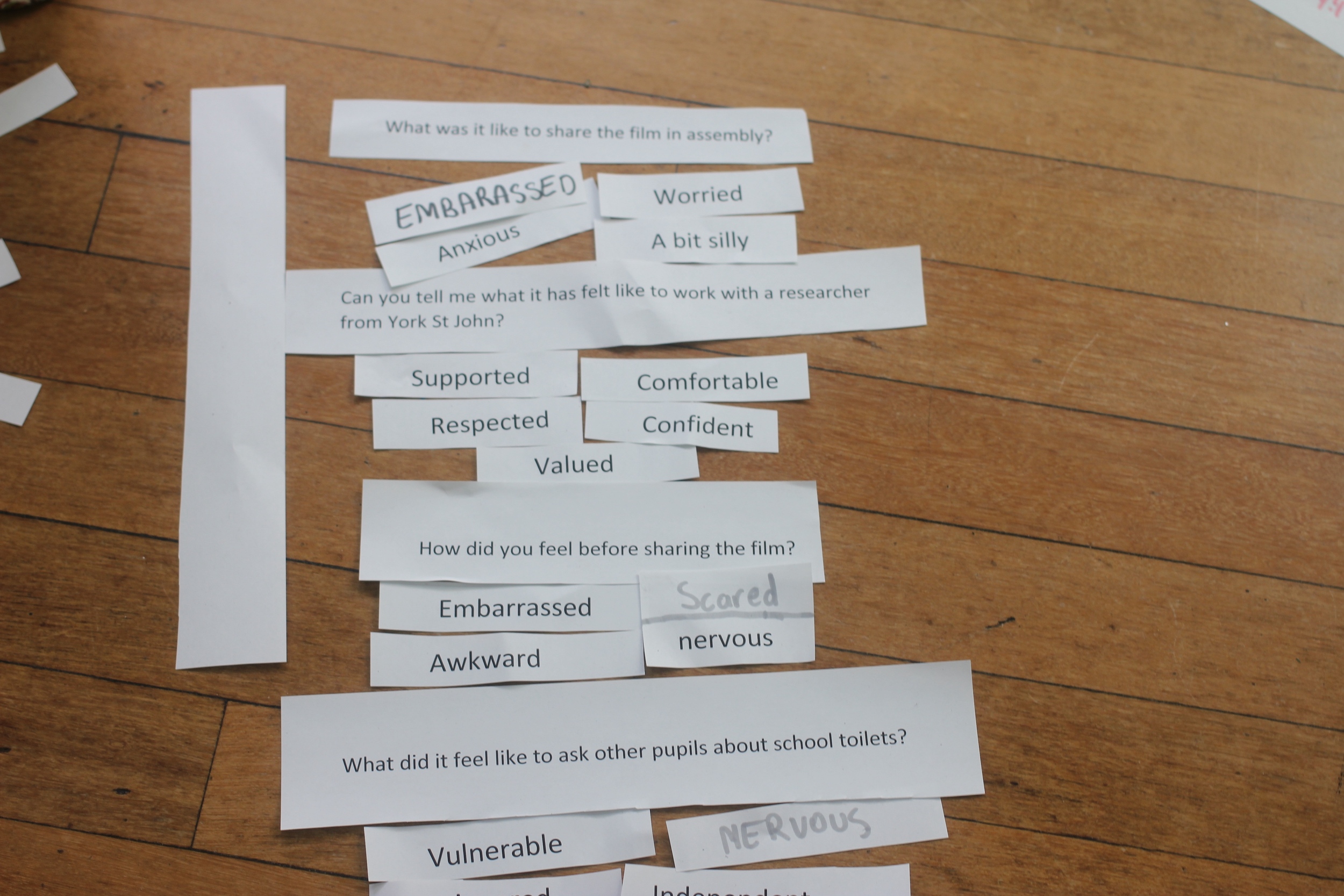
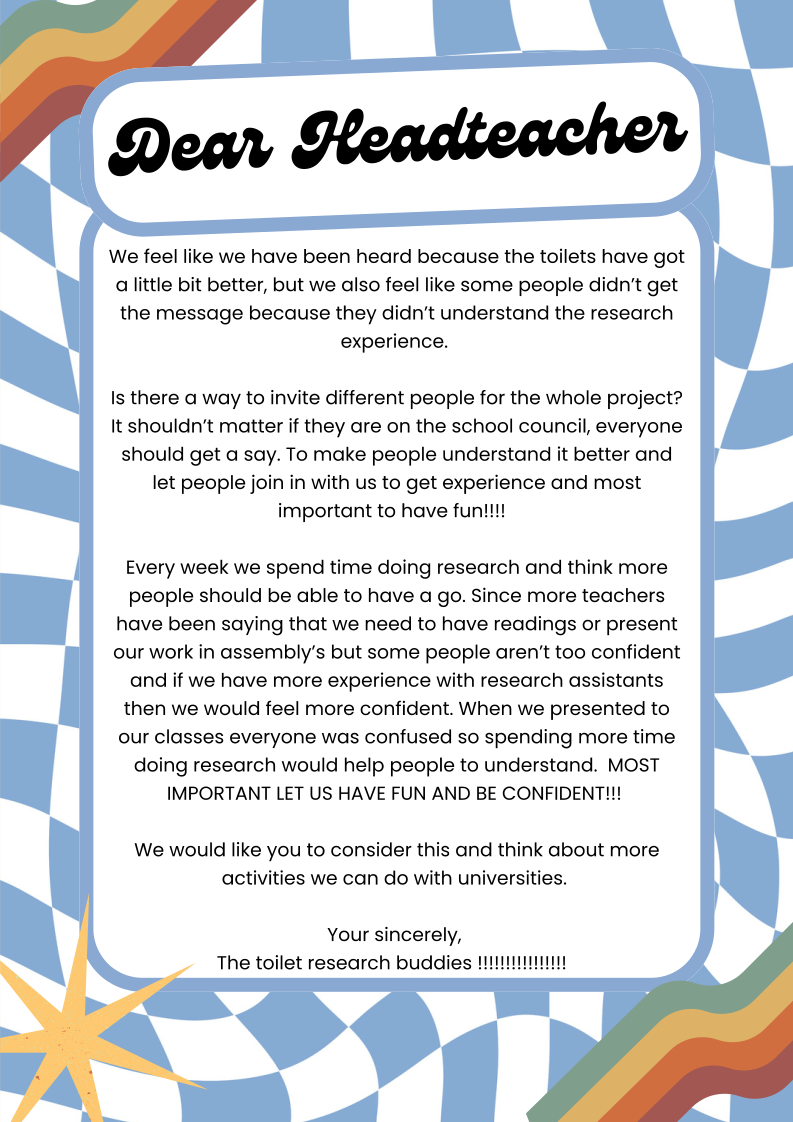
Before the project at Fox Lane school was due to conclude, the youth researchers were invited to reflect upon their experience in a session held for collective discussion. I had compiled a brief timeline of our research journey, and a list of prompt questions that the youth researchers could choose to explore. An example point on the time line was ‘Joining the research team’ and an example question was ‘Can you tell me what it has felt like to become a youth researcher?’. Starting the session by reflecting upon the timeline helped the youth researchers to work with the technical adult researcher to pinpoint critical or important moments in the research process, akin to Dewar et al’s (2010) ‘emotional touchpoints’. The key moments that emerged in step one were ‘presenting in assembly’ and ‘choice of school council pupils’. During our reflection session the timeline, prompts, and emotion words were laid out, either on the floor or across tables, and youth researchers were invited to talk individually into a microphone, draw and doodle their ideas onto sheets of paper, or work together to ‘interview’ each other about their experience of joining a co-research team. The youth researchers each chose questions or points on the timeline that felt relevant to their journey and expanded upon these by choosing emotion words that felt significant (Image 1).
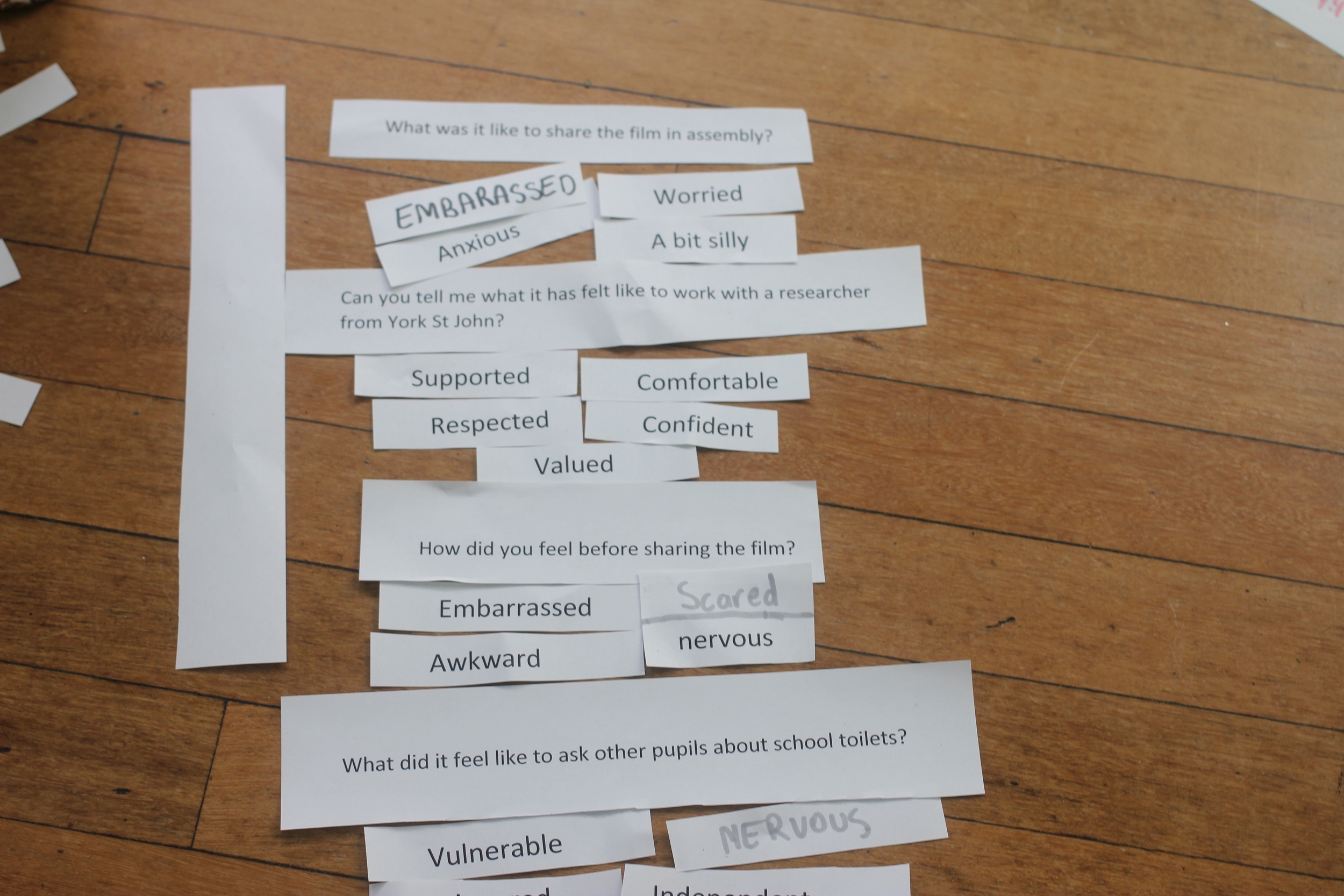
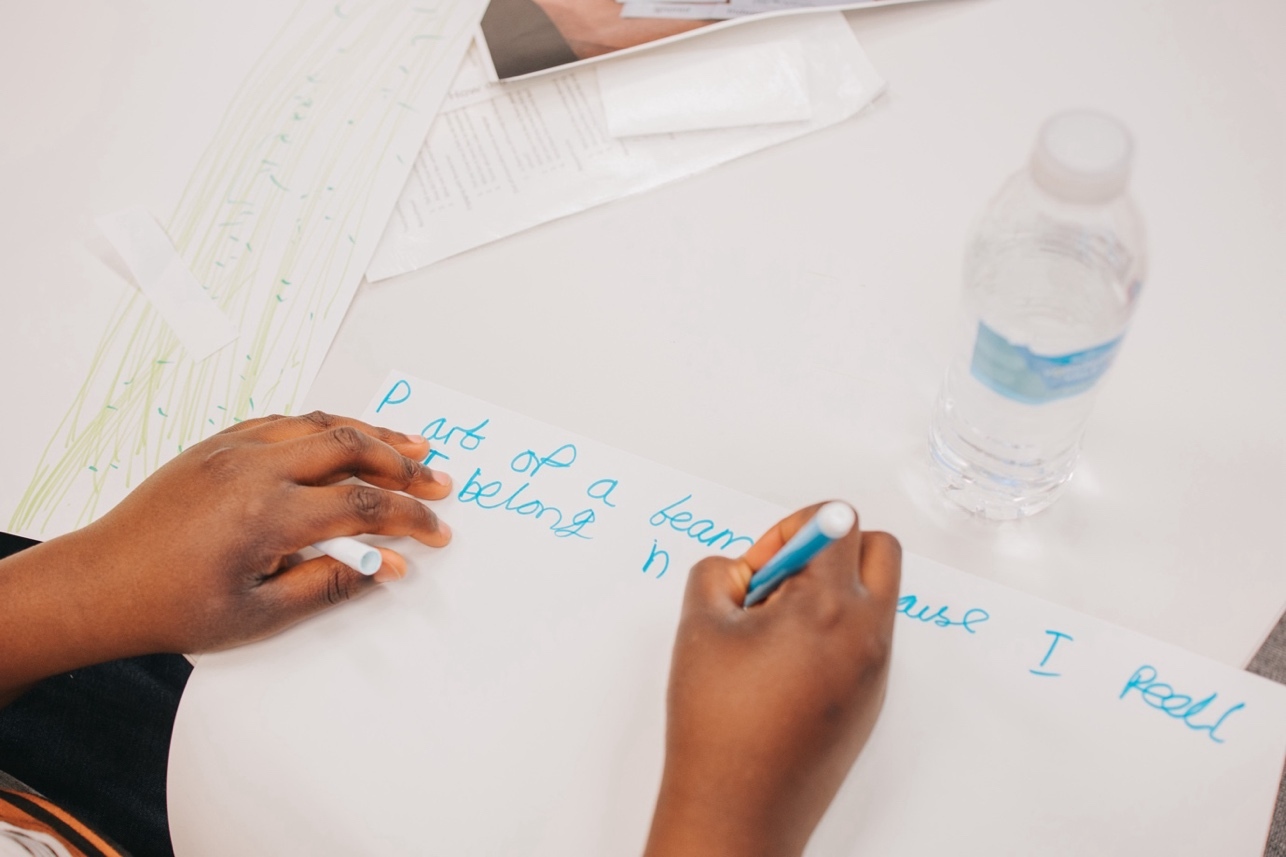
Step two – ‘Part of a team because I feel I belong’
When using the resource, the youth researchers often chose initial words that then enabled them to discuss their experience in more depth. The word ‘valued’ was chosen when discussing, ‘Can you tell me what it has felt like to work with a (university) researcher?’ (Image 1), but it was also discussed in relation to how their voice was received within the co-research space, with one youth researcher suggesting their experience within the sessions left them feeling ‘respected, valued and included’. Exploring this in a wider discussion, one youth researcher expressed that feeling valued meant feeling ‘part of the team because I feel I belong’ (Image 2). Another youth researcher highlighted how the relational approach adopted by the technical adult researcher had encouraged initial emotions to subside and transform, ‘I felt nervous because we didn’t know, we’ve never met (author), but now we’ve got used to her I feel a lot better now’. These insights emphasize how the relational values and principles that were held, and enacted, were vital in creating a meaningful space for youth co-research that aimed to directly address particular articles of the UNCRC (1989).
Allowing space for youth researchers to add to the reflective and evaluative tool enabled them to actively choose what they reflected upon, and which elements they evaluated within the research project. One youth researcher wrote out their own question, ‘How did you feel during the research?’ choosing ‘nervous, privileged, purposeful and heard’, also adding ‘overjoyed’ to the word bank for future use. Expanding upon these choices, Rumpelstiltskin (chosen pseudonym) explained:
‘I felt overjoyed and purposeful because I’ve had lots of fun in the, doing the research, and purposeful because lots of people have listened to us when we did the assembly. I’ve felt heard because, again, lots of people have listened to us. I felt privileged because when we did the assembly not only teachers, and not only students listened to us, like everyone listened to us. I felt nervous because I knew some people wouldn’t listen.’
This example shows that the youth researchers were able to identify how elements of their experience, such as engaging with the adult researcher and the impact of the co-research space, were positive, yet we can also see how youth researchers identified more nuanced and complicated emotions that were present within the project.
Step 3 – Peer engagement with co-research
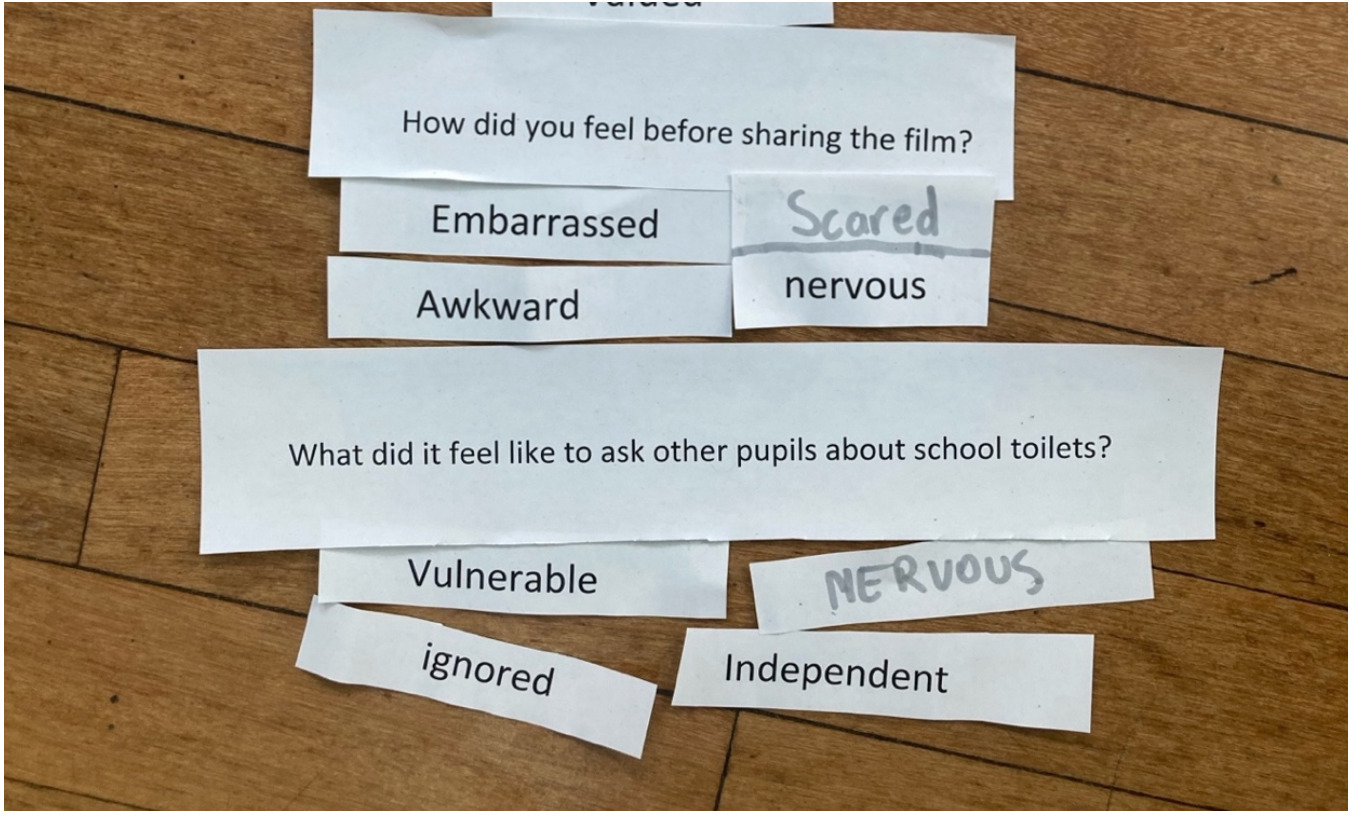
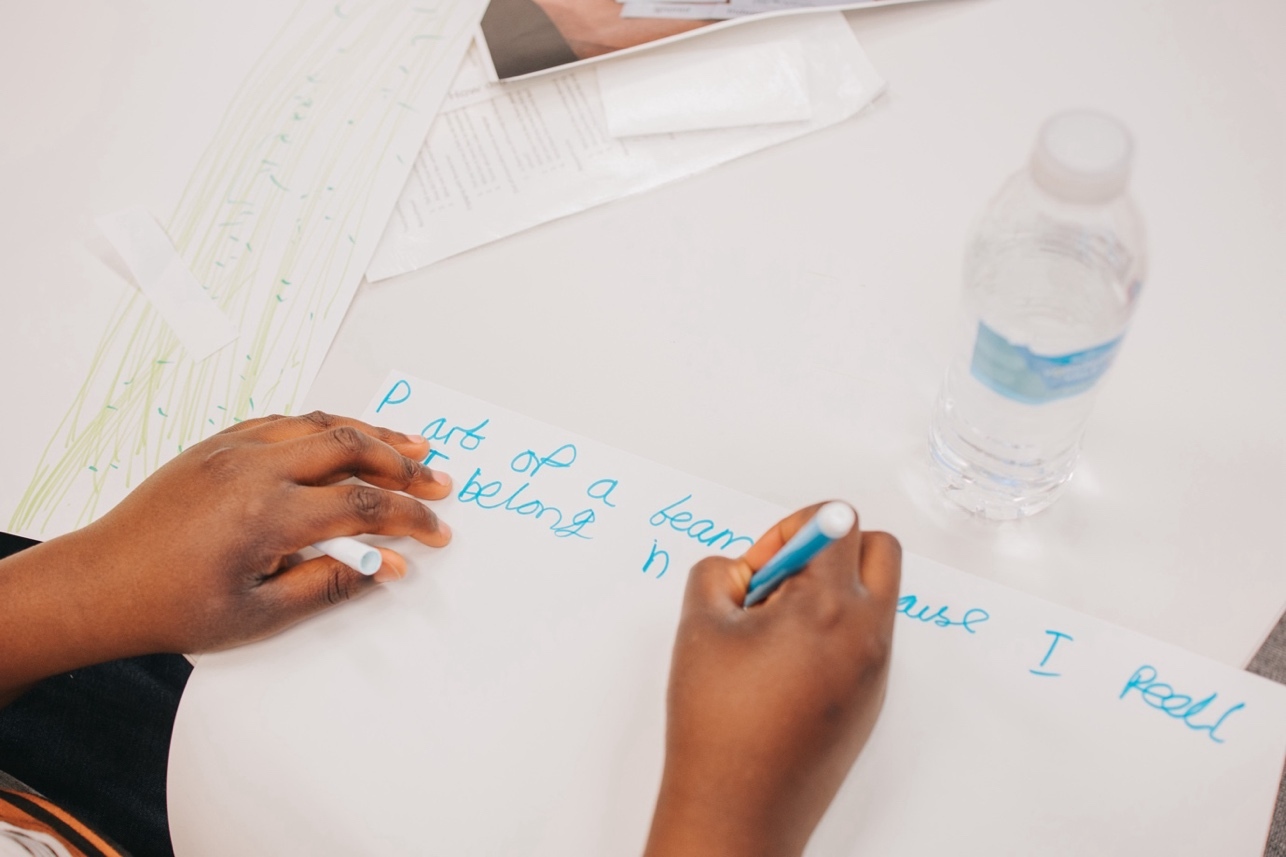
In seeking out youth researchers’ perspectives and reflections through the emotion-based resource we were able to identify the dynamics of conducting research amongst school-based peers. For example, one youth researcher chose ‘scared, nervous, embarrassed and awkward’ in response to the question ‘What did it feel like to ask other pupils about school toilets?’. Max (chosen pseudonym) expanded upon this, ‘Like, people think we are interested in what people do in the toilet rather than making them better’. Interestingly it was the dissemination element of this research project that stood out for the youth researchers, with each youth researcher choosing ‘embarrassed’ as an emotion in response to the question, ‘What was it like to share the film in assembly?’. November (chosen pseudonym) spoke about the worry associated with presenting findings to other pupils:
‘It was a bit embarrassing because people would probably laugh, and it was a bit embarrassing about toilets as well. And I was a bit worried because, like, when people was laughing, I was a bit worried. And I was overthinking because I didn’t know if I was going to say the words right when it was my speech.’
The emotion words chosen within this reflective session highlighted the tensions felt by youth researchers when engaging with an extra-curricular or out of the ordinary activity amongst peers. Acknowledging that they felt ‘vulnerable’, ‘nervous’, ‘independent’ and at times ‘ignored’ (Image 3) when conducting research amongst their peers, enabled further conversation about how technical adult researchers could manage these tensions in the future. The insights and ensuing discussion show how this kind of emotion-based resource can be used as an evaluative tool to support participatory researchers to pay attention to the messy complexities of research encounters (Gallacher & Gallagher, 2008).
Step 4 – Dear Headteacher
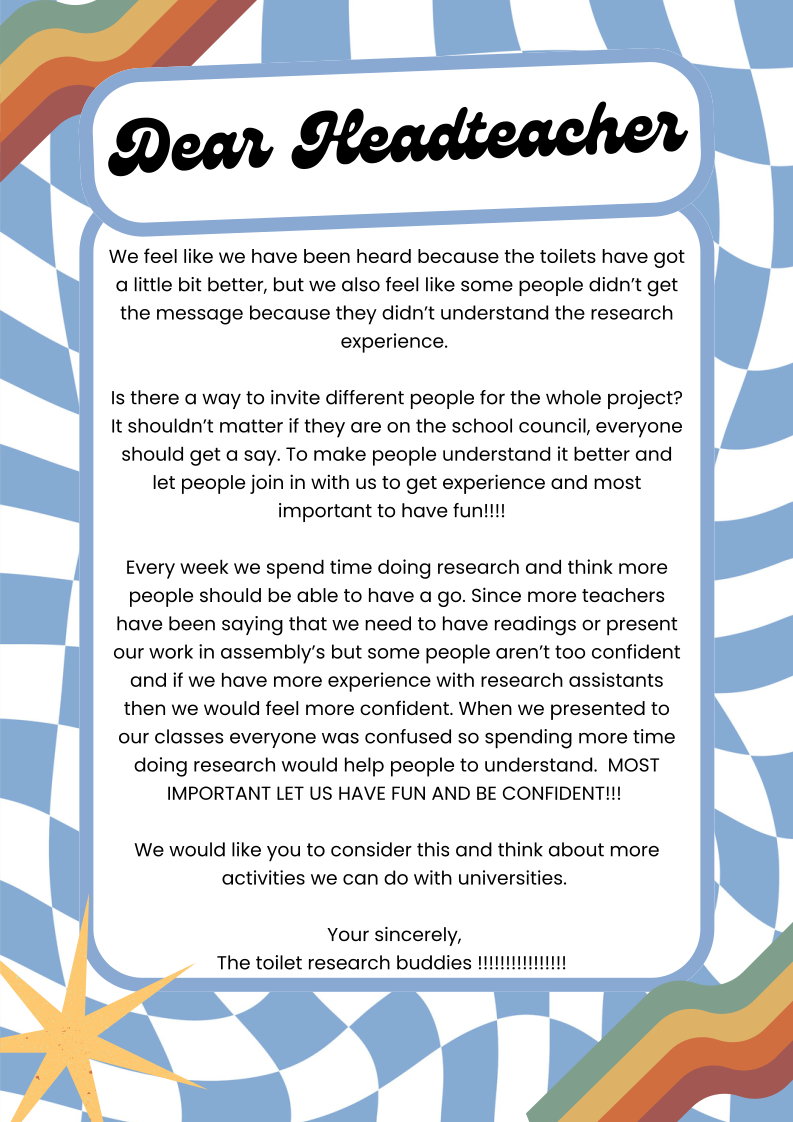
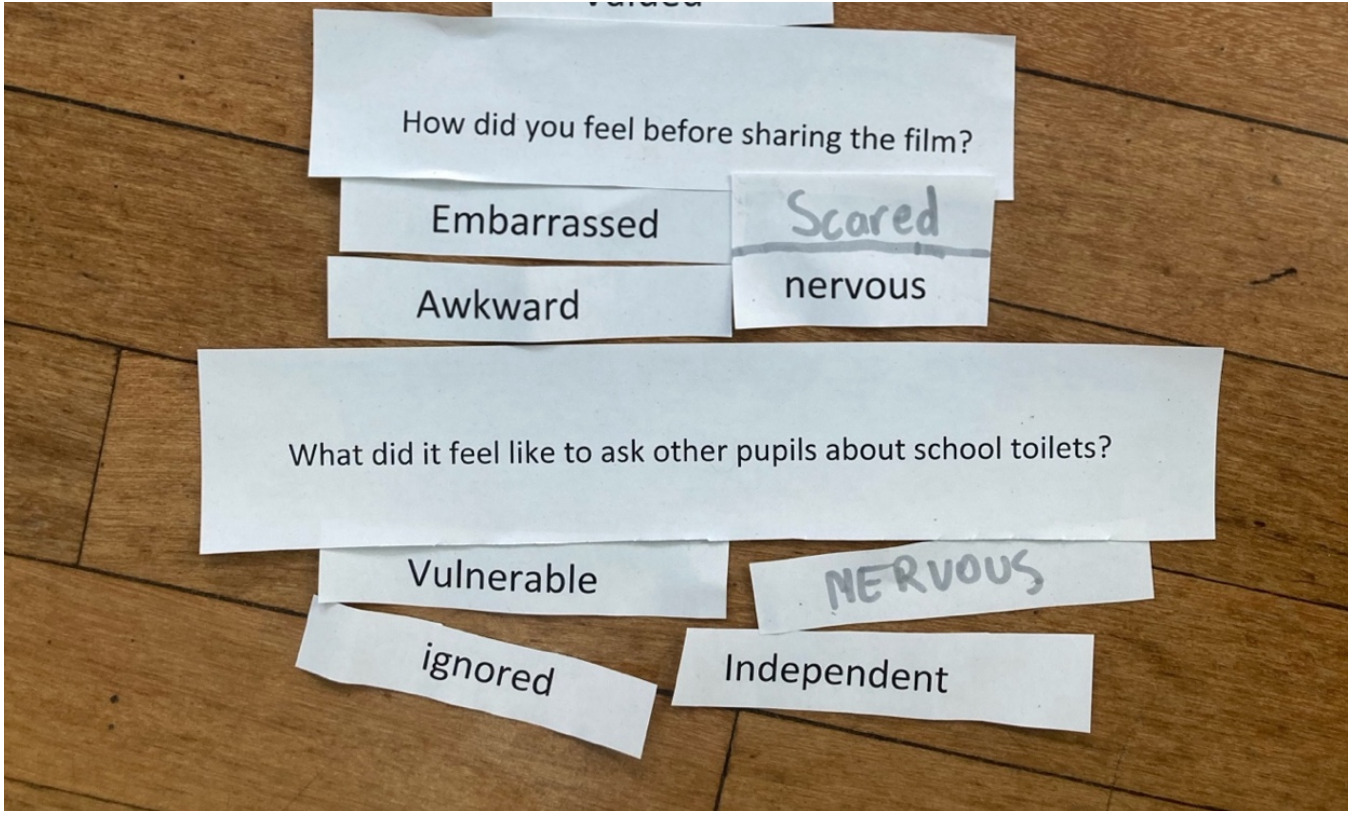
After sharing insights and collectively discussing why they had chosen certain emotions, as a co-research team we began to think about why it would be important to share these thoughts, feelings and emotions about co-research, and how we could do it. The youth researchers all agreed that if they were to do another research project, they would direct it at staff rather than pupils and it was this desire to engage adult gatekeepers that led to the development of the ‘Dear Headteacher’ letter (Below and Appendix 3). The youth researchers spoke of not wanting the research to end abruptly after they had disseminated their findings within their school and they identified wanting more CYP to experience engaging with research. Two of the youth researchers, aged 8 and 11, worked together to use the notes, words and recordings to compile a letter directed for their own headteacher that also held ambitions to spark ongoing conversations about what it takes to engage youth researchers, why it is important and what adults can put into practice when working with youth researchers. The youth researchers identified how their project had the potential to inspire other pupils in their school, and beyond, and wanted to explore how they could make this happen.
The importance of articulating experience
Articulating the experience of engaging with co-research is tough, there is no straight forward answer to describe the experience, but the more we engage with others and make connections about our experiences through language, the more we can learn and understand (Brown, 2021). Evaluating and reflecting upon the co-research experience using the emotion-based resource has encouraged youth researchers, many who have had little to no experience of co-inquiry, to identify feelings and emotions associated with their involvement in the project.
Through continual reflection and adaptation of this resource with youth researchers I am drawn to a vital point raised by Satchwell et al, where they remind us of Heidegger’s words, ‘Every enquiry is guided beforehand by what is sought’ (Heidegger, 1962, p. 24 in Satchwell et al., 2020, p. 881). The predetermined list of emotion words has the potential to guide the responses of the youth researchers, as does providing a list of prompts or questions. The language used could encourage youth researchers to respond in a particular way and has the obvious limitation of only a small amount of specific emotion vocabulary chosen. It is crucial that researchers explain the resource in an honest and open way, sharing in the exploration of the experience and encouraging reciprocal openness. If used well, the resource can become a starting point for change-making discussions. I approach the evaluation and reflection sessions at the end of each co-research project with a view to them being ‘launching pads for ideas, actions, plans and strategies to initiate social change’ (Cammarota & Fine, 2010, p. 6). The voices of the youth researchers are not left within a research report for academic eyes only, the intention is that they are part of the call for change in creating more co-inquiry and democratic approaches to education, pedagogy and research within schools.