
INTRODUCTION
Dementia-inclusive community development has emerged as a pressing public health, social policy, and methodological priority, particularly in rural and small-urban regions where aging populations, geographic dispersion, and uneven access to geriatric and psychosocial services intersect. In Canada, many communities continue to experience fragmented dementia-related supports, limited culturally responsive programming, and persistent stigma surrounding cognitive decline. These challenges are especially pronounced in rural region such as Interior British Columbia, where communities frequently rely on localized, relationship-based infrastructures rather than specialized institutional systems to support older adults and care partners. Such conditions underscore the need for participatory, community-embedded research approaches capable of addressing stigma, fragmentation, and delayed help-seeking while fostering local capacity and ownership (McNeil et al., 2016; Reed et al., 2018).
Participatory action research (PAR) has increasingly been recognized as an appropriate methodological orientation for addressing such complexity, particularly in health and aging contexts where experiential knowledge, relational trust, and sustained engagement are central to meaningful change (Abelson et al., 2016; Giunta & Thomas, 2015). PAR emphasizes conducting research with communities rather than on communities, foregrounding shared inquiry, reflexive learning, and co-created social change. However, despite its emancipatory ambitions, conventional PAR approaches often remain heavily dependent on verbal articulation, structured dialogue, interviews, and cognitively demanding forms of participation. Such methodological assumptions may unintentionally marginalize individuals living with dementia, whose communication, memory, and emotional expression may not align with linear or language-dominant research processes.
Arts-based research (ABR) offers a complementary epistemological and methodological orientation, foregrounding embodied, affective, and relational ways of knowing that extend participation beyond verbal articulation and linear recall (Marsh, 2019; Rieger et al., 2023). ABR recognizes artistic, embodied, sensory, and affective practices as legitimate forms of inquiry and knowledge production rather than merely supplementary engagement techniques (Leavy, 2020; Lenette, 2022; McNiff, 2018). Within this landscape, creative practices such as storytelling, music, movement, visual art, and theatre are understood as modes through which participants communicate relational, emotional, experiential, and tacit forms of knowing that may not emerge through conventional qualitative methods alone. Particularly in dementia research, arts-based methodologies have demonstrated significant potential for facilitating inclusion, relational participation, emotional attunement, and community connection while reducing communicative barriers associated with cognitive decline (Marsh, 2019; Rieger et al., 2023).
At the same time, existing participatory dementia research continues to face several important methodological gaps. First, many community-based dementia initiatives remain short-term, project-based interventions rather than sustained participatory infrastructures embedded within everyday community life. Second, arts are frequently treated instrumentally—as therapeutic or recreational supports—rather than as epistemological and methodological practices capable of shaping how knowledge itself is generated, interpreted, and mobilized. Third, relatively little research has examined how participatory dementia methodologies function in rural and small-urban contexts characterized by limited resources, dispersed populations, and heterogeneous community infrastructures. Finally, despite growing interest in dementia-friendly communities, fewer studies have examined how participatory and arts-based methods can support iterative implementation, community adaptation, and systems-level learning across diverse local settings.
Within this context, Memory Cafés have gained international recognition as informal social spaces designed to support people living with dementia and their care partners through social interaction, peer support, and community engagement. Existing Memory Café models commonly emphasize psychosocial well-being, stigma reduction, and social inclusion (Bøen et al., 2012; Greenwood et al., 2017). However, comparatively little scholarship has conceptualized Memory Cafés as participatory research infrastructures or as sites of collaborative knowledge production. Even fewer studies have examined how Memory Cafés may function as ongoing methodological environments in which arts-based participation, reflexive inquiry, and community co-learning occur simultaneously.
Our current study responds to these gaps by positioning arts-based Memory Cafés as core methodological platforms within a multisector participatory action research initiative conducted across Interior British Columbia. Rather than locating dementia-related engagement primarily within institutional or clinical settings, the present study intentionally embedded Memory Cafés within trusted, everyday community spaces, including libraries, recreation centres, Indigenous community health centres, churches, community halls, and local restaurants. This deliberate de-medicalization of engagement sought to reduce anticipatory anxiety, foster relational trust, and normalize participation through environments associated with creativity, belonging, and everyday social life rather than illness and assessment (Tran et al., 2025).
Importantly, the current Memory Café model extended beyond conventional support programming by treating participation itself as a sustained methodological process. Community members, persons living with dementia, care partners, artists, clinicians, facilitators, students, and organizational partners collectively shaped the evolution of activities, accessibility adaptations, and facilitation approaches over time through iterative co-design and reflexive dialogue. Recruitment strategies further reflected this participatory orientation. Rather than relying primarily on institutional referral systems, outreach occurred largely through publicly visible posters and invitations placed within everyday community settings, accompanied by the intentionally inclusive statement: “Memory Cafés welcome those with cognitive decline and dementia, their caregivers, their families, and their community who cares.” In this sense, the invitation itself functioned as an intervention, communicating relational openness, collective responsibility, and accessibility before participants entered the research space (Nguyen-Truong et al., 2025).
Arts-based modalities—including collaborative visual art; music-making and singing; storytelling circles; playback and improvisational theatre (i.e., short plays developed by community theatre groups in response to issues emerging from participants’ experiences); dance and movement; calligraphy; museum-curated artifact tables; and healthy food and refreshments tailored for older adults in alignment with the 14 modifiable risk factors associated with cognitive decline (Livingston et al., 2024)—structured each Memory Café. Collectively, these practices enabled communication and meaning-making through sensory, affective, and embodied channels, consistent with research demonstrating the role of music, rhythm, and collective creativity in social bonding, affect attunement, and relational cohesion (Kreutz, 2014; Pearce et al., 2015; Volgsten & Pripp, 2016; Weinstein et al., 2016). Among Indigenous participants and community partners, storytelling emerged as particularly significant as both a cultural and epistemological practice rooted in relationality, intergenerational transmission, and community knowledge systems (Rieger et al., 2023).
Clinicians, including nurses, physicians, and allied health professionals, participated alongside artists, facilitators, and community members within these arts-based environments. Rather than occupying traditional expert-driven clinical roles, clinicians functioned relationally—as participants, observers, navigators, and supports embedded within community interaction (Tran et al., 2025). This integration enabled early trust-building, informal navigation support, and more accessible conversations surrounding dementia and aging without positioning diagnosis or assessment as the primary entry point into participation.
Simultaneously, the Memory Cafés functioned as iterative community design spaces in which participants collaboratively identified and tested low-cost dementia-friendly adaptations. Through ongoing discussion and observation, participants co-developed practical responses to environmental, communicative, and relational barriers, including simplified signage, sensory-friendly lighting, conversational supports, spatial modifications, and accessibility-oriented facilitation techniques. These adaptations circulated across participating sites, contributing to cumulative organizational learning and community readiness.
This paper presents a methodological account of the arts-based Memory Café model as a participatory action research infrastructure for dementia-inclusive community development. Specifically, the paper examines how arts-based Memory Cafés operationalize relational participation, reflexive co-learning, embodied knowledge production, and iterative community adaptation across diverse rural and small-urban settings. In doing so, the study contributes to ongoing methodological debates within participatory action research and arts-based research concerning inclusion, ethics-in-practice, epistemology, co-analysis, relational facilitation, and the scalability of community-embedded participatory infrastructures.
THEORETICAL AND CONCEPTUAL FOUNDATIONS
Participatory Action Research and Relational Participation
This study is grounded in Participatory Action Research (PAR), which positions individuals and communities most affected by a social issue as active contributors to knowledge production, collective learning, and social change rather than passive recipients of services or externally generated expertise (Abelson et al., 2016; McNeil et al., 2016). Within PAR, knowledge is understood as relational, situated, and action-oriented, emerging through iterative cycles of participation, reflection, adaptation, and collaborative inquiry.
A central premise of the current study is that participation should be understood as a process of relational continuity rather than a discrete event. Much participatory dementia research relies on episodic forms of engagement, such as consultations, advisory groups, or short-term co-design activities. While valuable, these approaches may not adequately capture the gradual development of trust, familiarity, confidence, and relational comfort required for meaningful inclusion among persons living with dementia and their care partners. In contrast, the Memory Café model conceptualizes participation as an evolving process shaped through repeated interaction, adaptive responsiveness, and sustained relational presence over time.
Arts-Based Inquiry as Epistemology and Method
The study also draws on Arts-Based Research (ABR), which recognizes creativity, embodiment, sensory engagement, narrative expression, and affective interaction as legitimate forms of inquiry and knowledge production (Leavy, 2020; Lenette, 2022; McNiff, 2018). Rather than treating artistic activities as supplementary engagement tools, this perspective understands creative practices as methodological mechanisms through which participants generate experiential, emotional, relational, and contextual knowledge.
Music, storytelling, visual art, movement, and theatre create opportunities for participation that extend beyond verbal articulation and cognitive recall. These modalities facilitate forms of emotional attunement, memory activation, identity expression, and collective meaning-making that may remain inaccessible through interviews or structured discussions alone (Clayton, 2012; Levitin et al., 2018; Marsh, 2019). Artistic engagement can therefore reveal relational dynamics, embodied experiences, and affective dimensions of participation that expand conventional understandings of data and knowledge production.
This orientation is particularly important in dementia-inclusive research, where dominant methodological traditions often privilege verbal coherence, cognitive recall, and individual forms of participation. By foregrounding embodied and relational ways of knowing, arts-based inquiry creates more inclusive pathways for participation and recognizes communication as a multidimensional social practice.
Methodological Gaps in Dementia-Inclusive Research
Despite growing interest in participatory and arts-based approaches, several important gaps remain within dementia research. First, many initiatives continue to rely on short-term engagement structures rather than sustained participatory infrastructures embedded within community settings. Consequently, limited attention has been paid to how participation, trust, and agency develop through ongoing relationships and repeated interaction.
Second, artistic practices are frequently framed as therapeutic or recreational supports rather than as methodological and epistemological practices in their own right. This instrumental framing can obscure the ways in which creative engagement generates relational, affective, and embodied forms of knowledge while redistributing expertise among participants, practitioners, and researchers.
Third, dementia-friendly community research has largely focused on urban and institutionally resourced environments, with comparatively less attention devoted to rural, semi-rural, and small-urban contexts. These communities often face unique challenges, including service fragmentation, transportation barriers, workforce shortages, geographic dispersion, and heightened stigma associated with social visibility.
Finally, the integration of Participatory Action Research, Arts-Based Research, implementation science, and relational ethics remains underdeveloped. While implementation frameworks often emphasize fidelity and standardization, participatory approaches prioritize emergence, adaptation, and local ownership. Similarly, although dementia scholarship increasingly emphasizes relational ethics, relatively few methodological studies demonstrate how ethical commitments are operationalized through facilitation, adaptation, co-analysis, and community governance practices.
Memory Cafés as Participatory Research Infrastructure
The current study responds to these gaps by conceptualizing Memory Cafés as participatory research infrastructures rather than solely as support programs or social interventions. Within this framework, Memory Cafés function as durable community environments where participation, creativity, reflection, implementation, and collective learning occur simultaneously.
This conceptualization involves three interconnected shifts. First, participation is understood as relational continuity, enabling trust-building, iterative adaptation, and the gradual emergence of participant agency. Second, arts-based practices are positioned as epistemic resources that support embodied, affective, and dialogic forms of inquiry. Third, implementation perspectives are integrated to examine how accessibility practices, community innovations, and local adaptations evolve across settings while maintaining shared participatory principles.
Consequently, our Memory Café model operates at the intersection of three complementary traditions: Participatory Action Research, which emphasizes collaborative inquiry and community ownership (Abelson et al., 2016; Nguyen-Truong et al., 2025); Arts-Based Research, which foregrounds creativity, embodiment, and relational ways of knowing (Leavy, 2020; Marsh, 2019); and community-engaged implementation research, which focuses on adaptation, sustainability, and systems learning (Giunta & Thomas, 2015; Reed et al., 2018).
Together, these perspectives support a shift from viewing Memory Cafés as psychosocial support activities toward understanding them as participatory infrastructures for dementia-inclusive community development. This framework provides the conceptual foundation for examining how relational participation, embodied knowledge production, ethical responsiveness, and community adaptation can be operationalized within arts-based participatory action research.
RESEARCH METHODS
This study employed a Participatory Action Research (PAR) design integrating Arts-Based Research (ABR) as both a methodological orientation and a set of community-engaged research practices. The study was designed to operationalize participation, reflexivity, co-learning, and community ownership through sustained collaboration among persons living with dementia, care partners, artists, clinicians, educators, volunteers, and community organizations (Abelson et al., 2016; McNeil et al., 2016; Reed et al., 2018). Rather than treating participation as a component of data collection, community engagement served as the primary mechanism through which knowledge generation, implementation, and local systems learning occurred.
A key objective was to develop a Memory Café model that balanced methodological consistency with local adaptability. The approach responded to calls for more operationalized participatory methodologies capable of being adapted across diverse dementia-inclusive community contexts.
Participatory Action Research and Community Co-Design
Consistent with PAR principles, the study was conducted with participants rather than on them. Persons living with dementia, family care partners, artists, clinicians, volunteers, youth participants, and community organizations were engaged as contributors to planning, implementation, reflection, and adaptation.
Community involvement began prior to individual Memory Café events through local planning processes guided by a collaboratively developed Memory Café Community Application and Planning Guide. The guide supported local co-design by addressing partnership development, venue selection, accessibility considerations, transportation supports, volunteer recruitment, intergenerational engagement opportunities, and artistic programming.
Implementation relied heavily on relationship-building and community partnerships. Local organizers worked with municipalities, schools, healthcare organizations, faith communities, arts groups, libraries, museums, businesses, and seniors’ organizations to develop contextually appropriate Memory Café models. This relationship-centred approach reflected the study’s emphasis on community ownership and participatory governance.
Arts-Based Memory Cafés as Research Infrastructure
Within the Action Research Mobilization (ARM) initiative, Memory Cafés were conceptualized as recurring participatory research infrastructures rather than stand-alone support events. Across communities, they functioned simultaneously as dementia-inclusive interventions, arts-based knowledge-generating environments, implementation laboratories, and reflexive participatory spaces.
Arts-based modalities varied according to local resources and participant interests and included storytelling, music, movement, visual art, playback theatre, reminiscence activities, museum-curated artifact interactions, memory-box construction, calligraphy, yoga, tai chi, and improvisational communication exercises. These activities supported multiple forms of participation and knowledge production. Storytelling facilitated identity expression and relational sharing; music and movement promoted emotional engagement and social participation; visual and tactile activities enabled non-verbal expression; and theatre-based approaches supported collective reflection on caregiving and dementia experiences.
One illustrative example involved collaboration with a local theatre troupe that facilitated an exercise titled Embodying Moments. Participants shared lived experiences that were immediately interpreted through improvised performance involving movement, dialogue, and music. This approach emphasized relational witnessing and collective interpretation while generating rich observational and reflexive insights regarding caregiving, emotional resonance, and community meaning-making.
Study Sites and Sampling Strategy
Our study was conducted across 26 communities in British Columbia using a purposive, place-sensitive sampling strategy designed to capture variation in geography, service infrastructure, demographics, and community capacity. Participating communities included regional urban centres, suburban municipalities, rural communities, and remote locations across Interior British Columbia. Examples included Kelowna, Kamloops, Penticton, Princeton, Vernon, Lake Country, Cawston, Keremeos, Naramata, Oliver, and Summerland. Several Memory Cafés were also hosted in Indigenous-serving settings and Indigenous health centres.
Place was treated as an active methodological variable influencing participation, accessibility, implementation feasibility, and community adaptation. This diversity enabled examination of how Memory Cafés functioned under differing social, organizational, and infrastructural conditions.
Operational Structure of Memory Café Sessions
Most Memory Café gatherings followed a semi-structured format lasting approximately two to four hours. Although activities varied across communities, sessions commonly included: (i) arrival and relational welcome; (ii) shared refreshments or communal meal; (iii) artistic or intergenerational activities; (iv) lived-experience storytelling or keynote presentations; (v) arts-based workshops and creative activities; (vi) facilitated discussion or question periods; (vii) informal social interaction and resource navigation; and (viii) closing reflections and feedback.
Events were hosted in a variety of community venues, including recreation centres, churches, schools, community halls, local restaurants, local-owned hotels and resorts, theatres, senior’s centre, and Indigenous community spaces. Organizers prioritized accessibility, familiarity, and community support when selecting venues. Facilitation occurred through interdisciplinary collaboration rather than hierarchical leadership. Artists, clinicians, volunteers, facilitators, and researchers worked alongside one another within shared community environments. Clinicians participated as relational supports and resource navigators, while artists served as facilitators, creative collaborators, and contributors to interpretation and adaptation.
A distinctive feature of the model was its emphasis on intergenerational and community-wide participation. For example, the Grand Forks Memory Café hosted 107 participants at a local curling rink, integrating readers’ theatre performances by elementary school students, a musical theatre production, lived-experience storytelling, panel discussions with clinicians and persons living with dementia, educational activities regarding modifiable dementia risk factors, and community dialogue concerning dementia-friendly local development. The event also incorporated practical supports including community transportation, accessible catering, memory-box activities, volunteer coordination, and outreach to neighbouring rural communities. Youth groups, schools, museums, businesses, and community organizations regularly contributed to Memory Café activities, expanding participation beyond caregiver–patient relationships and reinforcing dementia-inclusive community development as a collective responsibility.
Memory Café facilitation operated through collaborative interdisciplinary coordination rather than hierarchical professional leadership. Artists, clinicians, volunteers, facilitators, and researchers worked alongside one another within shared community spaces. Clinicians participated not primarily as diagnosticians or authoritative experts, but as relational supports, observers, navigators, and contributors to informal conversation and trust-building. Artists simultaneously functioned as facilitators, methodological collaborators, and co-analysts whose observations and creative practices shaped ongoing adaptation and interpretation.
Data Collection and Documentation
Data collection occurred through multiple overlapping methods aligned with the arts-based PAR design. Data sources included: (i) participant observation; (ii) reflexive field notes; (iii) informal conversations; (iv) participant feedback forms; (v) post-session debrief discussions; (vi) artistic and performative outputs; (vii) observational documentation of relational dynamics and accessibility adaptations; and (viii) community planning and implementation materials.
Artistic outputs were not analyzed as isolated aesthetic products detached from social context. Rather, they were interpreted relationally in connection with the interactions, emotional responses, embodied participation, facilitation dynamics, and collective meaning-making processes through which they emerged. Field observations focused not only on verbal content, but also on affective attunement, participation rhythms, social synchronization, improvisational adaptation, environmental accessibility, emotional expression, and interactional dynamics occurring throughout sessions. In music and movement activities, facilitators and researchers documented phenomena such as rhythmic participation, emotional resonance, social bonding, and spontaneous interaction.
Participant quotations reported in the findings were derived from multiple forms of documentation, including feedback forms, field notes, informal conversations, public discussions, and post-session reflections. These contributions were treated as forms of participatory interpretation that informed ongoing adaptation of Memory Café design and facilitation.
Reflexivity, Co-Analysis, and Ethics-in-Practice
Reflexivity constituted a formal methodological component throughout the project. Following Memory Café sessions, facilitators, artists, clinicians, volunteers, and researchers participated in structured debrief discussions examining participant responses, emotional dynamics, accessibility concerns, facilitation challenges, ethical tensions, and emergent opportunities for adaptation. Reflexive conversations occurred both immediately following events and through ongoing planning meetings across sites.
Rather than positioning reflexivity as an individual researcher activity, the study adopted a collective approach in which multiple stakeholders contributed to interpretation. Community feedback directly influenced subsequent decisions regarding venue selection, transportation planning, activity pacing, accessibility modifications, facilitation approaches, and artistic programming.
Co-analysis therefore occurred through iterative and distributed processes rather than formalized coding workshops alone. Community feedback directly influenced subsequent implementation decisions, including venue selection, transportation planning, pacing of activities, intergenerational engagement strategies, facilitation structures, accessibility modifications, and selection of artistic modalities. For instance, repeated participant requests for more storytelling opportunities, caregiver dialogue, and practical dementia-navigation support led several communities to expand lived-experience panels and informal discussion components in subsequent Memory Café iterations.
Given the involvement of persons living with dementia, the study adopted an ethics-in-practice approach emphasizing relational accountability, ongoing assent, participant comfort, and emotional responsiveness. Consent was treated as a continuous relational process rather than a single procedural event. Participation in artistic activities remained voluntary, and participants retained agency regarding the sharing of stories, performances, and creative outputs beyond individual Memory Café sessions.
FINDINGS: COMMUNITY, RELATIONAL, AND METHODOLOGICAL OUTCOMES
Across the 2023–2025 study period, the arts-based Memory Café pilots engaged diverse communities including urban centres, suburban municipalities, semi-rural regions, rural communities, and remote locations. Collectively, the Memory Cafés brought together persons living with dementia, family and informal caregivers, artists, clinicians, educators, youth volunteers, municipal organizations, cultural institutions, and community members within shared creative environments. Rather than generating a single bounded intervention outcome, the findings demonstrate layered relational, social, ethical, and methodological effects that unfolded iteratively across communities and over time.
Our findings presented here conceptualize impact as relational, distributed, and cumulative. Consistent with the participatory and arts-based orientation of the study, analysis focused on social connection, experiential learning, accessibility, co-production, and community adaptation rather than solely on individual-level behavioural or clinical change. The following findings were generated through participant observation, reflexive field notes, post-session debrief discussions, participant feedback forms, storytelling exchanges, artistic engagement, implementation materials, and situated participant narratives collected across participating sites.
Relational Belonging, Storytelling, and Social Connection
One of the most consistent findings was the creation of relational belonging and emotional safety. Participants repeatedly described the Memory Cafés as environments where stigma, fear, and isolation associated with dementia were reduced, enabling more open and reciprocal forms of interaction. Across communities, participants emphasized that the cafés allowed them to reconnect socially and participate in community life in ways not commonly experienced within formal healthcare settings.
Arts-based activities—particularly music, storytelling, theatre, and collaborative creative practices—served as relational catalysts. Observational notes documented frequent instances of laughter, spontaneous conversation, eye contact, rhythmic participation, and emotional responsiveness among participants who had initially appeared hesitant or withdrawn. Music-based activities were especially effective in supporting memory recall, emotional engagement, and social interaction. Participants frequently moved from passive observation to active participation through singing, storytelling, and shared creative expression.
Participant reflections reinforced these observations. One participant explained: “We need to not isolate ourselves. So, we need a community that we can get around in.” Another noted: “This was a good first step for me and I would go to another further on.” Such comments suggest that participation was experienced less as service utilization and more as re-entry into community life.
Storytelling modalities generated relational and identity-oriented forms of participation, particularly within Indigenous-serving and rural contexts where oral narrative traditions and relational accountability were strongly emphasized. Also, storytelling emerged as a particularly important mechanism for knowledge exchange and social connection. Narrative sharing occurred through informal conversations, lived-experience presentations, reminiscence activities, playback theatre, poetry, and intergenerational dialogue. Persons living with dementia, caregivers, clinicians, volunteers, artists, and community members all contributed stories that circulated horizontally throughout the cafés.
Participants frequently described hearing others’ experiences as validating and de-isolating. Reflections such as “The stories resonated with me and my experiences with my dad” and “Loved hearing from people with lived experience” illustrate how storytelling supported empathy, recognition, and social learning. A particularly powerful example emerged when participants listened to a speaker living with dementia discuss maintaining purpose and quality of life following diagnosis. One attendee reflected: “How is it possible to stay alive and live good quality of life after a diagnosis of Alzheimer’s though?… your guest speaker is showing that it is possible to have a whole new life.” This comment demonstrates how lived-experience storytelling challenged deficit-oriented assumptions about dementia and created opportunities for hope, reframing, and collective learning.
Playback theatre further expanded these processes by transforming participant stories into improvised performances. Participants noted that creative and performative formats facilitated more open conversations about dementia, caregiving, grief, uncertainty, and stigma. As one participant observed: “The play definitely hit on exactly the events, feelings and frustrations of my situation with my loved one with dementia.” Another reflected: “The play seemed to relax the group and then the question period was very honest and informative.” Together, these findings suggest that storytelling and creative expression functioned as participatory mechanisms through which experiential knowledge, emotional validation, and collective understanding were generated.
Arts-Based Participation and Knowledge Production
Different artistic modalities supported distinct forms of participation and meaning-making. Music and movement activities facilitated emotional expression, rhythm-based participation, and social connection. Visual and tactile activities—including collaborative art-making, memory boxes, calligraphy, and artifact engagement—supported slower-paced and non-verbal forms of interaction. Storytelling practices enabled participants to connect personal experiences with broader histories of caregiving, community life, and cultural identity.
Playback and improvisational theatre created opportunities for participants to collectively witness, reinterpret, and emotionally process caregiving experiences. Importantly, no single artistic modality proved universally effective. Rather, the strength of the Memory Café model lay in its adaptive and multimodal structure, which allowed communities to select and modify activities according to local contexts, participant preferences, and available partnerships. These findings reinforce the role of arts-based practices not merely as engagement tools but as methodological mechanisms that generated embodied, relational, and affective forms of knowledge.
Community Capacity Building and Dementia-Friendly Development
At the community level, the Memory Cafés contributed to broader dementia-friendly awareness, local capacity development, and social learning. Across sites, participants reported improved understanding of cognitive decline, increased awareness of community resources, reduced fear surrounding diagnosis, and greater confidence in discussing dementia openly within public settings.
The Memory Cafés frequently functioned as connective infrastructures linking participants to healthcare providers, local organizations, support groups, cultural institutions, volunteer networks, and informal peer relationships. This connective role was especially significant in rural and semi-rural communities where specialized dementia services were limited or geographically inaccessible.
For example, the Grand Forks Memory Café brought together healthcare providers, schools, local businesses, museums, libraries, public health representatives, seniors’ organizations, theatre groups, and municipal stakeholders within a single event structure. Participants subsequently identified practical needs including caregiver support groups, transportation accessibility, dementia-friendly retail practices, accessible public infrastructure, and improved local education surrounding dementia-responsive interaction.
Participants also consistently valued opportunities to engage informally with clinicians and health professionals within non-clinical settings: “It was most helpful to have a panel of professionals there willing to answer questions.” Others reflected: “I liked that this Memory Café gave me tips and ideas about what to do in the early stages of dementia.” These reflections reinforce the finding that embedding clinicians within arts-based community environments lowered barriers to engagement while supporting earlier and less stigmatized forms of information-seeking and support.
Intergenerational participation emerged as another significant finding across several Memory Café sites. Youth volunteers, elementary school students, university students, theatre groups, and younger community members frequently participated alongside older adults, caregivers, clinicians, and facilitators.
These encounters generated reciprocal learning processes rather than one-directional educational interactions. Younger participants frequently reported increased empathy, comfort, and understanding regarding dementia, while older participants emphasized the emotional significance of being seen, heard, and valued by younger generations.
At the Grand Forks Memory Café, elementary school students contributed through readers’ theatre performances and presentations regarding modifiable dementia risk factors. Facilitators observed that youth participation shifted the atmosphere of several cafés away from narrowly health-focused programming toward broader community celebration and inclusion. These intergenerational dynamics redistributed expertise within the participatory environment. Persons living with dementia and caregivers frequently became educators, storytellers, and mentors for younger participants rather than solely recipients of support. Artists and community members similarly functioned as relational and methodological leaders alongside clinicians and researchers, challenging conventional distinctions between professional expertise and lived experience.
Intergenerational participation further strengthened community learning. Youth volunteers, students, theatre groups, and younger community members participated alongside older adults and caregivers, creating opportunities for reciprocal education and empathy-building. Participants living with dementia frequently became educators, storytellers, and mentors rather than solely recipients of support, thereby redistributing expertise across the participatory environment.
Methodological Learning, Adaptation, and Relational Accountability
From a methodological perspective, the findings demonstrate the value of Memory Cafés as adaptive participatory infrastructures rather than fixed intervention models. Variation across communities—in venue selection, artistic modalities, facilitation structures, transportation access, and organizational partnerships—generated important learning opportunities rather than methodological inconsistency.
Our reflexive documentation consistently highlighted the importance of flexibility, responsiveness, and local adaptation. Attendance patterns, accessibility needs, transportation challenges, volunteer capacity, room configuration, and activity pacing influenced participation differently across communities. Rather than imposing rigid procedural standardization, organizers adapted implementation practices in response to participant feedback and local circumstances.
Several recurring challenges also emerged, including transportation barriers, volunteer fatigue, funding constraints, facilitator workload, and the logistical complexity of coordinating multisector partnerships. These tensions were addressed through ongoing adaptation and collaborative problem-solving rather than strict procedural enforcement.
Our findings also underscore the importance of place-based sensitivity and relational accountability within participatory dementia research. Indigenous-serving, rural, and remote communities surfaced distinct histories, social dynamics, cultural practices, and infrastructural barriers shaping participation and engagement.
Participants repeatedly emphasized the importance of culturally safe, community-led, and relationally accountable engagement practices. In several Indigenous and rural contexts, storytelling and shared creative activities enabled participation in ways that formalized interview-centred approaches may not have supported as effectively. These findings therefore reinforce a central argument of the study: equity within participatory community research is enacted through situated adaptation, relational trust-building, local partnership development, and responsiveness to community-defined priorities rather than through methodological uniformity.
Collectively, the findings demonstrate that arts-based participatory action research can function simultaneously as a community intervention, methodological framework, implementation strategy, and ethical practice. The Memory Café model created opportunities for social connection, knowledge exchange, community capacity building, and methodological innovation while supporting dementia-inclusive community development across diverse settings.
DISCUSSION AND IMPLICATIONS
Our findings demonstrate that arts-based Memory Cafés function as participatory research infrastructures capable of supporting dementia-inclusive community development across urban, suburban, rural, and remote settings. By embedding dementia-related engagement within trusted community spaces and engaging persons living with dementia, care partners, artists, clinicians, youth, volunteers, and community organizations as co-participants, the Memory Café model blurs conventional boundaries between research, service delivery, and community life (Abousifein et al., 2024; Nguyen-Truong et al., 2025).
Rather than functioning solely as support programs or community outreach initiatives, the Memory Cafés simultaneously operated as relational infrastructures, arts-based epistemological spaces, and mechanisms for social intervention. In doing so, the study extends existing scholarship on arts-based PAR by demonstrating how participatory infrastructures can evolve beyond episodic engagement toward durable, community-anchored systems of relational learning, collaborative adaptation, and dementia-inclusive community development. Figure 1 presents the conceptual and participatory infrastructure model emerging from the findings and discussion of this study. The model positions arts-based Memory Cafés at the centre of a dynamic relational ecosystem situated at the intersection of theoretical, methodological, and practical contributions. Rather than conceptualizing Memory Cafés as isolated programs or therapeutic interventions, our model illustrates how they function as sustained participatory infrastructures that simultaneously support community engagement, knowledge co-creation, ethical practice, and systems-level learning. Participation, in this sense, is shaped by contextual factors including cognitive vulnerability, caregiver well-being, geography, cultural adaptation, and community partnerships. In turn, these conditions influence how relational participation, arts-based inquiry, ethical practice, and community learning are enacted across settings.
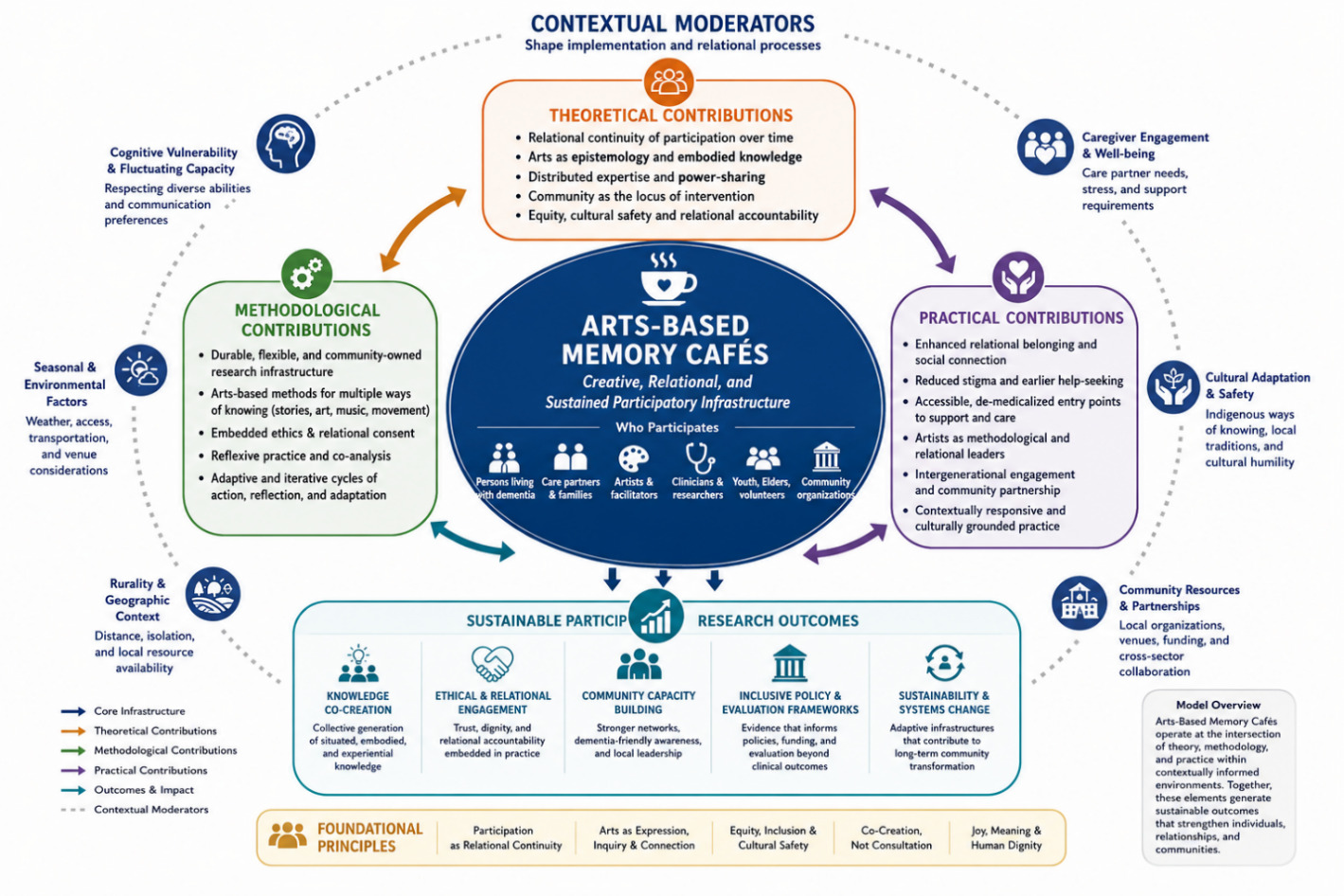
The model demonstrates that the effectiveness and evolution of Memory Cafés are shaped by multiple contextual moderators, including cognitive vulnerability and fluctuating capacity, caregiver engagement and well-being, seasonality and environmental conditions, geographic and rural contexts, cultural adaptation and safety, and community partnerships and resource availability. These contextual dimensions influence how participation unfolds across different communities and reinforce the importance of adaptive, place-sensitive implementation.
Our model also emphasizes that meaningful impact within arts-based participatory action research emerges not through rigid standardization or narrowly defined intervention outcomes, but through sustained relationships, creative engagement, reflexive adaptation, and collaborative participation embedded within community life. The model therefore synthesizes the study’s broader argument that arts-based Memory Cafés operate simultaneously as methodological frameworks, relational environments, ethical infrastructures, and community-based mechanisms for dementia-inclusive social transformation.
Trust-Building and De-Medicalized Engagement
One of the central contributions of the Memory Café model lies in its ability to create psychologically safe and relationally accessible spaces for initial engagement prior to formal clinical interaction. Conventional dementia pathways often position assessment, diagnosis, or cognitive screening as the first point of entry into care systems. Such pathways may unintentionally intensify anticipatory anxiety, reinforce stigma, or discourage early engagement, particularly in rural and small-community settings where concerns surrounding visibility and social labeling may be heightened.
In contrast, the Memory Cafés facilitated entry through conversation, storytelling, music, theatre, shared meals, and creative participation. Clinicians participated not primarily as evaluators or diagnostic authorities, but as listeners, collaborators, and community participants engaging alongside others within arts-based environments. This relational repositioning reduced traditional power asymmetries and fostered trust-building processes that unfolded incrementally over time (McNeil et al., 2016; Tran et al., 2025).
Our findings therefore extend existing literature on participatory engagement in community health by demonstrating how arts-informed and relationally grounded environments may scaffold more accessible and less stigmatized pathways into dementia-related support systems. Participants and care partners frequently described relief in discussing concerns without fear of immediate clinical escalation or judgment. The cafés functioned as relational buffers that softened transitions into formal healthcare systems while privileging community-preferred and socially embedded forms of engagement.
This finding is particularly significant when situated alongside broader critiques of biomedicalized dementia care pathways, which have historically prioritized diagnosis and symptom management while paying comparatively less attention to relational belonging, emotional safety, and community participation. The study therefore contributes to emerging scholarship advocating for more relational and community-integrated approaches to dementia support by illustrating how de-medicalized environments can facilitate earlier trust-building and more sustained engagement.
Arts as Method, Medium, and Intervention
The findings further reinforce growing arguments within Arts-Based Research (ABR) that artistic practice constitutes not simply a communication tool or engagement strategy, but a distinct epistemological and methodological mode of inquiry (Henderson et al., 2025; Marsh, 2019; Vaajoki et al., 2023). Throughout the Memory Cafés, arts-based modalities generated stories, metaphors, emotional expressions, embodied interactions, and collective memories that illuminated dimensions of dementia experience often inaccessible through conventional interviews or survey-based methods.
Across the Memory Cafés, artistic modalities generated stories, emotional expression, embodied interaction, and collective reflection that illuminated dimensions of dementia experience often inaccessible through conventional interview-based methods. Arts-based practices functioned simultaneously as: (i) research methods supporting participation and knowledge generation; (ii) relational media shaping interaction and meaning-making; and (iii) community interventions fostering connection and inclusion.
The findings also support broader theoretical claims regarding embodied and affective knowledge. Artistic participation enabled participants to communicate experiences, emotions, and relational understandings that could not always be articulated discursively. Playback theatre, music, movement, and visual practices frequently facilitated forms of participation that transcended linear verbal communication, particularly among individuals experiencing cognitive or communicative challenges. This challenges instrumentalist assumptions within both dementia research and participatory inquiry that continue to privilege verbally articulated and individually produced knowledge over collective, sensory, and embodied ways of knowing.
Storytelling was especially significant in this regard. Consistent with scholarship emphasizing narrative as relational and epistemic practice (Schuurman et al., 2025), storytelling within the Memory Cafés functioned not merely as personal disclosure, but as a mechanism for empathy, co-learning, collective interpretation, and identity affirmation. Among Indigenous participants and community partners, storytelling also reflected culturally grounded forms of relational accountability and intergenerational knowledge-sharing, further reinforcing the importance of place-sensitive and culturally situated participatory practice.
Reframing Participation as Relational Continuity
One of the study’s most significant theoretical contributions lies in its reconceptualization of participation as relational continuity rather than episodic consultation. Much participatory research literature continues to conceptualize engagement through discrete moments of involvement, such as advisory meetings, interviews, focus groups, or co-design workshops. While these approaches remain valuable, the findings suggest that meaningful participation in dementia-inclusive research often emerges through repeated and sustained interaction over time.
Across the Memory Cafés, trust, familiarity, agency, and participation developed incrementally through recurring gatherings, shared creative practice, and ongoing relational presence. Participants frequently became more comfortable contributing stories, initiating interaction, or shaping activities only after repeated attendance and growing familiarity with facilitators and other participants. This temporal dimension extends existing PAR scholarship by foregrounding the role of continuity, repetition, and relational accumulation in the co-construction of knowledge (Abelson et al., 2016; McNeil et al., 2016). In contexts involving cognitive vulnerability, participation may be less accurately understood as a singular event and more appropriately conceptualized as an evolving relational process shaped by emotional safety, predictability, accessibility, and interpersonal trust. Our findings therefore challenge procedural understandings of participation rooted primarily in formal consultation and suggest that relational infrastructures themselves may constitute a prerequisite for meaningful co-production in dementia-inclusive research contexts.
Distributed Expertise and Community as Intervention
The findings also contribute to theoretical debates surrounding expertise, agency, and vulnerability within participatory research. Persons living with dementia were not positioned solely as research participants or care recipients; they actively functioned as storytellers, facilitators of meaning, educators, artists, mentors, and contributors to collective interpretation. This also destabilizes dominant deficit-oriented assumptions frequently embedded within dementia discourse and extends emerging scholarship emphasizing the epistemic legitimacy of persons living with dementia within participatory inquiry (Liu et al., 2023; Rieger et al., 2023).
Expertise within the Memory Cafés was distributed relationally rather than hierarchically. Clinicians contributed medical knowledge, artists shaped relational and aesthetic dynamics, caregivers provided experiential insight, and persons living with dementia offered situated understandings grounded in lived experience. Youth participants similarly contributed energy, empathy, and intergenerational dialogue. This distributed model of expertise reflects broader PAR commitments to power-sharing and co-governance while also expanding understandings of who can legitimately contribute to knowledge production in cognitively inclusive research environments.
Our findings also indicate that artistic engagement played a key role in enabling this redistribution of expertise. Through storytelling, theatre, music, and collaborative creative activity, participants could contribute meaningfully without relying exclusively on formalized verbal explanation or professionalized discourse. Artistic participation therefore became a mechanism through which authority and interpretive legitimacy were more equitably shared.
Methodological Implications
Methodologically, the study demonstrates the value of durable participatory infrastructures capable of supporting ongoing cycles of action, reflection, adaptation, and ethical responsiveness. Unlike time-limited interventions, Memory Cafés provided continuity for iterative learning and relationship-building across changing participant needs and community conditions.
The findings also reinforce relational understandings of ethics and reflexivity. Ethical practice extended beyond procedural consent to include accessibility, pacing, participant comfort, emotional responsiveness, and ongoing assent. Similarly, reflexivity was operationalized collectively through debrief discussions, participant feedback, collaborative interpretation, and iterative adaptation.
These findings suggest that rigor within arts-based participatory research is achieved not through rigid standardization but through relational accountability, transparency, responsiveness, and adaptive coherence across contexts.
Practical and Policy Implications
The findings indicate that arts-based participatory infrastructures can strengthen social connection, dementia-friendly awareness, and community capacity while supporting more inclusive pathways into care and support systems. Sustained investment in community partnerships, transportation supports, volunteer networks, arts programming, and skilled facilitation appears particularly important in geographically dispersed and resource-variable communities.
The study also highlights the importance of recognizing artists as methodological collaborators and contributors to knowledge production rather than peripheral facilitators. This has implications for research funding, interdisciplinary collaboration, and evaluation frameworks.
At a policy level, the findings challenge narrowly biomedical approaches to dementia support by demonstrating the value of community-based, relational, and arts-informed infrastructures. Evaluation systems focused exclusively on individual clinical outcomes may overlook important outcomes related to social participation, trust-building, community capacity, and collective well-being.
Limitations and Future Directions
Several limitations warrant consideration. The study was situated primarily within Interior and Northern British Columbia, limiting broader geographic generalizability. The participatory and arts-based design also prioritized contextual responsiveness over strict procedural standardization, making direct cross-site comparison challenging. Participation fluctuated across communities due to health conditions, caregiving responsibilities, transportation access, weather, volunteer availability, and seasonal factors. Co-analysis processes were also unevenly distributed across sites depending on local capacity and participation patterns.
Additionally, the study intentionally prioritized relational, methodological, and community-level outcomes over long-term instrumental measurement. Future research should therefore examine longitudinal impacts on caregiver resilience, community capacity, organizational adaptation, social connectedness, and quality of life.
Further investigation is also needed regarding Indigenous and cross-cultural adaptations, intergenerational participatory models, inclusive approaches to co-analysis, and the evolving professional role of artists within participatory health research. Additional policy-oriented research examining sustainable funding structures, relational evaluation frameworks, and community-embedded dementia support systems would further strengthen understanding of how participatory arts-based infrastructures can be sustained and adapted across diverse settings.
CONCLUSION
This study demonstrates that arts-based Memory Cafés function as participatory infrastructures through which knowledge, relationships, ethical practice, and community capacity are co-produced. Across diverse communities in British Columbia, Memory Cafés created accessible and relationally grounded environments where persons living with dementia, care partners, artists, clinicians, volunteers, youth, and community organizations engaged in storytelling, creative practice, dialogue, and collective learning.
The study advances scholarship in Participatory Action Research and Arts-Based Research by demonstrating that artistic engagement functions simultaneously as epistemology, methodology, relational medium, and social intervention. Music, storytelling, theatre, visual art, movement, and collaborative creative practice generated embodied, affective, and relational forms of knowledge that extended beyond conventional interview-centred approaches.
A key contribution of the study is the reconceptualization of participation as relational continuity. Meaningful engagement emerged through repeated interaction, trust-building, familiarity, and co-presence over time. Within contexts of cognitive vulnerability and social stigma, these relational infrastructures enabled inclusive participation, ethical responsiveness, and shared ownership of inquiry.
The findings further demonstrate the value of de-medicalized and community-embedded approaches to dementia engagement. By locating participation within everyday community spaces, the Memory Café model reduced barriers associated with stigma while fostering dialogue, social connection, and dementia-friendly community development.
Ultimately, our study argues that arts-based participatory action research offers more than an alternative methodology for dementia research. It provides a framework through which research, community development, creative practice, and social participation can occur simultaneously. By foregrounding creativity, reciprocity, embodied participation, and relational continuity, the Memory Café model illustrates how participatory research can support more inclusive, ethical, and sustainable approaches to dementia-inclusive community development.