Introduction
Work constitutes a primary but often underappreciated social determinant of health (SDOH) (Armenti et al., 2023; Frank et al., 2023; Marmot et al., 2008). Work influences health through specific mechanistic pathways: work provides opportunities for material consumption (i.e., produces income that can be used to secure housing and determine neighborhood residence); work shapes the conditions that determine the exposure and severity of physical, chemical, ergonomic and biological exposures at the workplace; and the work-life balances relationship (Adetunji & Obeng-Gyasi, 2024; Bartley & Blane, 2023). Precarious work is characterized by job situations with irregular hours or hourly pay, low wages, insufficient health insurance or access to healthcare, the inability to speak freely to an employer, or lack of clarity around who the employer of record is, and/or limited or no work-life balance (Benach et al., 2016; Burgard & Lin, 2013; Tompa et al., 2007). People who are low income, women, Black, Indigenous, People of Color (BIPOC), and immigrants disproportionately engage in precarious work. In low income, Black and Latine communities with high proportions of workers engaged in precarious work, individual and community health are impacted by mechanistic pathways associated with work precarity (Bodin et al., 2020; Eisenberg-Guyot et al., 2020; Kreshpaj et al., 2020). It is important for communities with high proportions of precariously employed workers to understand how work functions as a SDOH. The Greater Lawndale Healthy Work (GLHW) Project is a community-based participatory research (CBPR) project at the University of Illinois Chicago Center for Healthy Work that explores work as a SDOH at the neighborhood level and produces evidence for community-led, place-based interventions to promote healthy work. Our community-academic research team created the Greater Lawndale Lotería (GLL), an evidence-informed, historically grounded and worker-justice themed educational game to shift knowledge, attitudes and beliefs among Greater Lawndale (GL) residents about work as a SDOH and to share our action research findings. The GLL functions both as a vehicle to disseminate our research findings using participatory methods to community members and as a popular education intervention to raise critical consciousness on work as a SDOH in GL. In this paper, we describe our process of creating the GLL and present findings from our mixed-methods evaluation of the GLL as a community intervention.
Work as a SDOH at the Neighborhood Level
Our CBPR team conceptualizes the neighborhood as an underutilized yet impactful level of intervention on workers’ health. We believe that community norms around work (i.e., work ethic, perceived worker power and work expectations) and employment conditions (including limited employer accountability) contribute to the persistence of precarious work. Workers engaged in precarious work are more likely to experience more days in poor physical and mental health and more days with limitations in their daily activities due to health problems (Bhattacharya & Ray, 2021).
Connecting Individual Experiences and Structures of Power
It is commonly recognized that SDOH—the conditions in which people are born, grow, live, work, and age, and access to power, money and resources—disproportionately shape health outcomes (Braveman et al., 2011; Solar & Irwin, 2010). Housing stability, food security, work opportunities, educational access, childcare access, transportation access, environmental exposures, and experiences of discrimination all influence the health and well-being of communities. These SDOH are shaped by structural drivers, such as social and public policies, embedded in our socio-political context (Solar & Irwin, 2010; World Health Organization, 2008). Despite their central importance, SDOH continue to be overlooked, intentionally obscuring the role of structural drivers in shaping health. Rather than focusing on social factors, individual responsibility—such as diet, exercise, behavior or lifestyle choices are overemphasized and become dominant narratives that depoliticize health, shifting attention away from systemic inequities rooted in white supremacy, colonialism, racism, capitalism and patriarchy (Alang et al., 2021; Beckfield & Krieger, 2009; Davis, 1981; Fanon, 1961; Feagin & Bennefield, 2014; Packard, 2016). Within this framing, SDOH are erased, obscuring the pathways to disrupt structural inequities. As a result, individuals may internalize health struggles as personal failures rather than manifestations of structural injustice (Fanon, 1965; Freire, 1993).
To disrupt these dominant paradigms, public health advocates and community organizers develop strategies and tools that raise critical consciousness and re-politicize health, making connections between individual experiences and broader structures of power. One way to do that is through popular education.
Popular education
Public health efforts increasingly seek creative and culturally centered strategies to engage individuals in dialogue about structurally driven inequities to foster critical awareness for collective action. Culturally grounded approaches rooted in popular education epistemology and pedagogy, emphasizing self-reflection and dialogue among those most affected by inequities to critically examine social conditions and identify actions for collective liberation, are essential for advancing health equity and community engagement in Black, Indigenous, People of Color (BIPOC) communities (Wiggins, 2012). Game-based approaches are often used as popular education especially for younger age groups (Rivard, 2024).
Lotería, Spanish for “lottery”, is a game of chance akin to bingo, and offers a culturally based way to elicit conversation and raise critical consciousness. Traditionally played with illustrated cards representing objects, animals, and people, Lotería is widely recognized among Latines as a source of play and connection. By adapting the images and themes of Lotería to highlight SDOH, the GLL can serve as an engaging tool to raise critical consciousness by connecting SDOH with the lived experience of community residents.
We sought to produce a worker justice-themed, evidence informed, historically grounded GLL based on research findings from a community-based participatory research project in two Chicago neighborhoods to disseminate our findings to the partner community and inform critical dialogue to shift knowledge, attitudes and beliefs among community residents on work and health at the neighborhood level, while promoting the recognition of healthy work as a social justice priority at the neighborhood level.
Background
The GLHW Project is a CBPR study within the UIC Center for Healthy Work, a Centers for Disease Control and Prevention (CDC) National Institute of Occupational Safety and Health (NIOSH)-funded Total Worker Health® program. The mission of the Center for Healthy Work is to turn unhealthy work into healthy work. Healthy work is characterized by work that is free from safety and health hazards, pays a stable, fair wage, has a consistent schedule, allows workers to have a voice in the workplace, offers benefits, and allows for time with family, friends and community. We do this by contributing to community and system changes in local, state and national programs and policies that promote jobs with healthier working conditions and that provide more people with fair employment and decent work. The GLHW Project works in partnership with residents and community-based organizations in two Chicago neighborhoods on the southwest side, North Lawndale and Little Village (together forming the Greater Lawndale area). These contiguous Chicago neighborhoods are predominately Black and Latine, respectively. North Lawndale is 76.8% Black with 13.6% of the population unemployed. Little Village is referred to as the Mexico of the Midwest due to the large proportions of Mexican immigrant residents (39% of the population is foreign born) and a lower unemployment rate of 8.5%, just higher than the Chicago rate of 7.9% (Chicago Health Atlas, n.d.).
The GLHW Project was formed to better understand how work impacts community health and to identify community solutions to promote worker health. We use action research to build power, equity and community capacity in Greater Lawndale. The GLHW Project is governed by the GLHW Project Council comprised of community-academic partners and led by two community-chairs. The GLHW project uses an adapted mixed methods sequential, iterative exploratory action research design to explore work as a SDOH. Since 2010, we have used concept mapping, focus groups, survey research methodology, interview methodology, photovoice methodology, action research strategies and popular education approaches to create and pilot community interventions to promote worker health at the neighborhood level. Our conceptual framing (Hebert-Beirne et al., 2017, 2023) and findings are published elsewhere (Bonney et al., 2022; Forst et al., 2020; Grant et al., 2024; Hebert-Beirne et al., 2018, 2021; Velonis et al., 2020).
Our participatory research is principled, in that we adhere to a set of values that informs our research activities. These are explained in-depth in (Hebert-Beirne et al., 2023) and include:
1. We co-develop community-led interventions that build community capacity.
2. Our work is asset oriented. We avoid language such as “at risk,” “vulnerable,” or “target.”
3. We commit to language justice, which allows everybody’s voices to be heard, and deepening our commitment to equalizing power dynamics.
4. We use ecological thinking. Our interventions are at the systems, community level, not putting onus on workers to make social change.
5. Students and community partners are equal research partners.
6. We commit to equitable dissemination of our findings, giving credit where it is due.
7. We prioritize the development of the counter-narrative; worker testimonies and stories are valuable sources of data.
8. Our research should be healing; the healing component should come from the people in the community.
9. We commit to praxis (theory, action, and reflection) (Freire, 1993). Being in the community informs theory; being on the ground informs our thinking. Being present is the only way to identify solutions. Decisions remain in the community so we must be more present in the community.
10. We commit to ongoing co-learning. CBPR needs to be fully understood to be transformative.
In order to stay committed to these principles, our community-academic leadership team commits to ongoing reflexivity aligned with our shared theoretical framework informed by an adaptive feminist and public health critical race praxis lens (Ford & Airhihenbuwa, 2010). With this lens we seek to address research hierarchies, center equity and social justice in our research, commit to the recognition that the dismantling of racism is central to health equity, expand vocabulary used to discuss complex racial, class, gender, and sexuality concepts and challenge racial and white supremacist hierarchies. As evidenced above, we employ action research methodologies that move beyond unmuting marginalized voices by centering knowledge at the margins as a site of resistance and power (hooks, 2000).
Methods: Four-Stage Process Guide
Led by a community-academic subcommittee, we used a four-stage popular education method to develop the GLL for participatory dissemination of our research findings: planning, preparation, implementation and evaluation. A central output of this work was the development of a Process Guide that documents each stage in the process. The guide was intentionally created as a methodological output to support replicability of our evidence-informed product and contribute to participatory methods and praxis. The sections that follow describe how these four stages were operationalized in the co-development of the GLL.
Forming the Team
The GLL was developed through a collaborative effort between community-academic partners in GL and UIC School of Public Health. The original idea for the game came from the senior author of this paper and was further developed by community and academic partners on a subcommittee of the GLHW Project Council. Subcommittee members were identified to guide the development, implementation and evaluation of the game. The subcommittee was comprised of three community partners, one student, two staff and one faculty. The GLHW Council itself is comprised of, on the community side, GL residents, community health workers, healthcare and social service non-profit leaders and worker center leaders; and on the academic side, university staff, undergraduate and graduate students, and faculty from the divisions of Community Health Sciences and Environmental and Occupational Health Sciences. The subcommittee held regular meetings to develop the following protocol documents: goals and objectives, logic model, budget, timeline and an evaluation plan. Using the protocol documents as a template to further develop the GLL, the subcommittee met consistently over approximately two years, engaging in a community-centered process to design, implement and evaluate the GLL. Along the course of the two years, the subcommittee sought guidance during the GLHW Quarterly Council meetings for ongoing feedback and support.
Developing the GLL Components
The themes of the cards, low wage and precarious work situations in GL and neighborhood landmarks (to emphasize the place-based nature of the game), were identified through our community action research. The GLHW Project Outreach Coordinator (senior author) and student partner (second author) drafted a list of 54 cards for the game. The list was then informed by the American Community Survey U.S. Census data and findings from the Greater Lawndale Healthy Work Survey (Bonney et al., 2024) to characterize the most salient work situations in GL. The list underwent extensive review by the subcommittee to ensure that it was grounded in both evidence and community feedback, and that the two neighborhoods were equally represented across the cards.
Evidence-informed and asset-based educational narratives were co-written for each card by Alison Dickson, a labor rights researcher and activist with an extensive community and academic background in workers’ rights, with extensive input and editing from subcommittee members across multiple drafts to ensure a balance of readability across multiple literacy levels and accuracy. Each narrative included at least one out of the four components: details on work precarity, emphasis on community assets, specific GLHW Project research findings (e.g., findings on characteristics of work at the neighborhood level and neighborhood perceptions of work), local labor rights’ history and workers’ rights information.
A community partner on the subcommittee identified a North Lawndale-based artist, Ronica Hicks, to create the illustrations for each card. The criteria for artist selection were residency in Greater Lawndale and demonstrated commitment to the neighborhoods. The subcommittee engaged in a co-creative process with the artist, providing general descriptions and, when relevant, photographs to guide the illustrations, while also participating in shared decision-making through iterative feedback on successive drafts.
An accompanying educational and instructional booklet was drafted by the subcommittee and graphically designed by Theodora Salazar, an artist with roots in Little Village, who was identified through the support of a community partner. As with the narratives and illustrations, the subcommittee provided feedback to the artist through multiple iterations of the booklet. The booklet includes additional findings from the GLHW Project about work precarity in Greater Lawndale and instructions to play the game.
All materials were translated into Spanish to stay aligned with the GLHW Project values of language justice, a concept developed at the Highlander Research and Education Center that affirms the rights for individuals to communicate in their preferred language, while addressing power imbalances that shape whose language is valued. It goes beyond simple translation and interpretation to promote equitable participation, collective access and self-determination in multilingual spaces (Aire, 2020). A professional translator, Sylvia Escarcega, provided the translation, and subcommittee members edited the translation for readability. A group decision was made to use gendered pronouns over gender neutral pronouns in the Spanish material because the gendered pronouns were perceived as more recognizable to community partners.
After finalizing the game content, the GLHW Project Manager (first author) arduously sought a multi-person copyright to align with the GLHW Project values of co-authorship. The team faced several administrative and legal challenges to convince the University of Illinois Board of Trustees to expand the copyright by including the creators of the game in the copyright statement. The subcommittee consulted with several individuals within UIC, including an academic partner in the UIC Law School and a senior leadership university administrator with deep connections in North Lawndale, to provide insights on how to move within the university to advocate for a copyright statement that acknowledges the collective effort and ownership of the game.[1] With the guidance of many partners, a multi-person creative commons copyright was ultimately developed to issue the two artists and translator co-ownership and authorship of the game, provide individuals the ability to print, play, and distribute the game for non-commercial purposes, and create the ability for individuals and community groups to freely adapt the game for educational purposes.
The community-academic GLHW Project subcommittee administered a mixed methods evaluation plan which involved a brief post-game survey and an interactive qualitative reflexive group exercise called Head, Heart and Feet, that asks participants to reflect on what they learned in playing the game (Head), what they felt after playing the game (Heart), and what they were called to do, also known as praxis, (Freire, 1993) from becoming aware of the injustice of precarious work (Feet).
Basic descriptive statistics were calculated for the survey results. For the Head, Heart and Feet responses basic qualitative data analysis techniques were used to identify themes. Data from both the piloting and projection efforts were combined for qualitative data analysis purposes.
The responses were coded into Head, Heart and Feet (following the questions that were asked during the piloting and projections). After data had been coded for emerging themes of the different sections, a third iteration of coding was conducted to finalize the themes. After all data had been coded and then thematically analyzed, a final summary of analysis was provided for the three sections (Head, Heart and Feet).
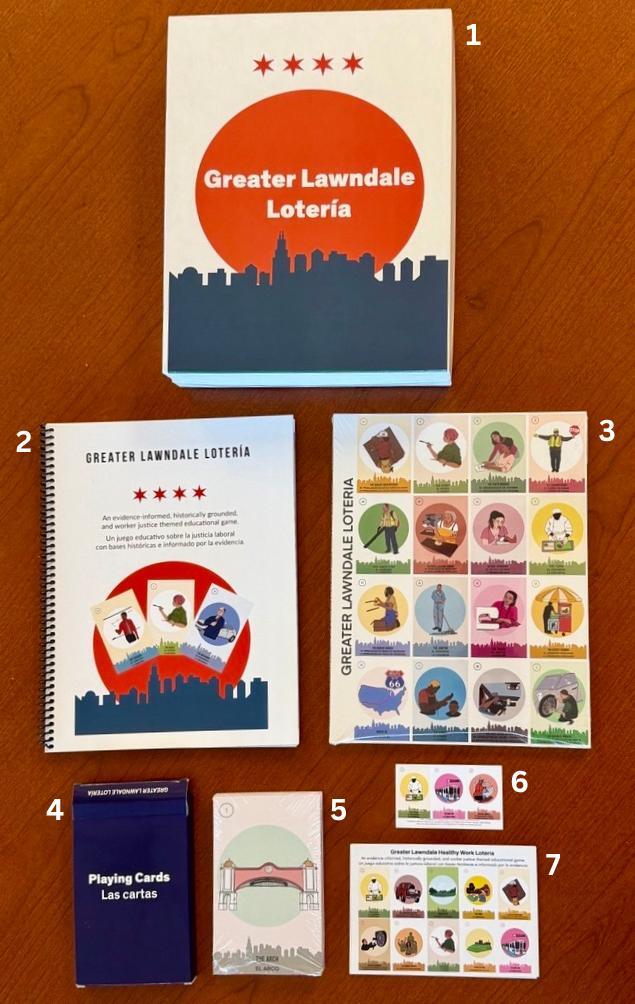
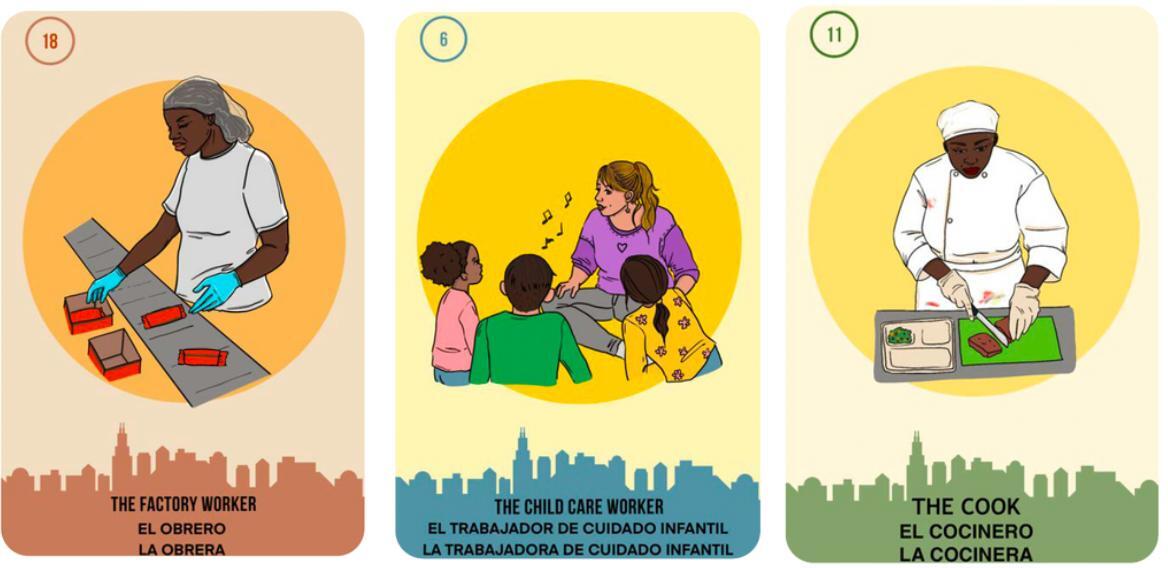
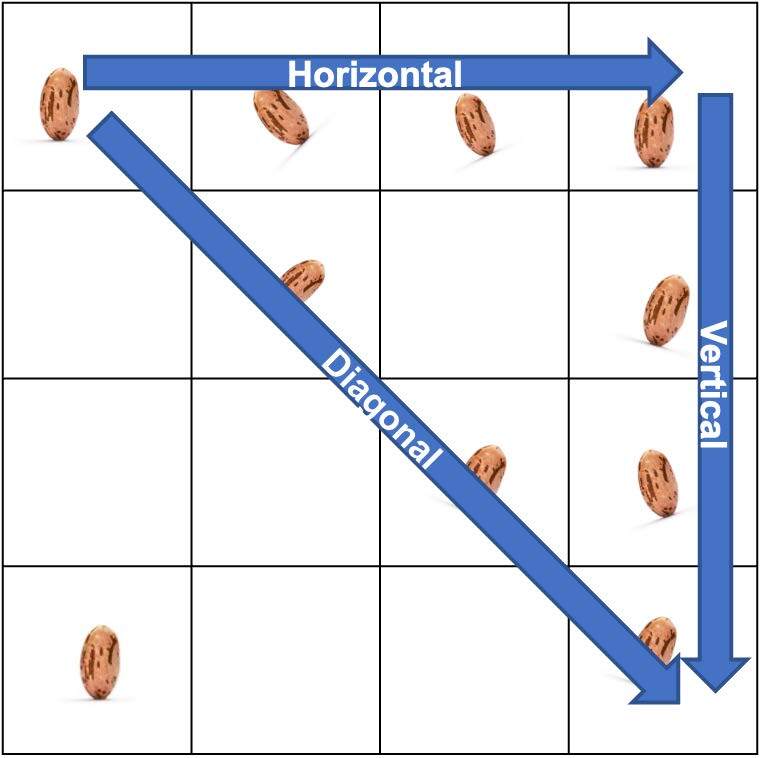
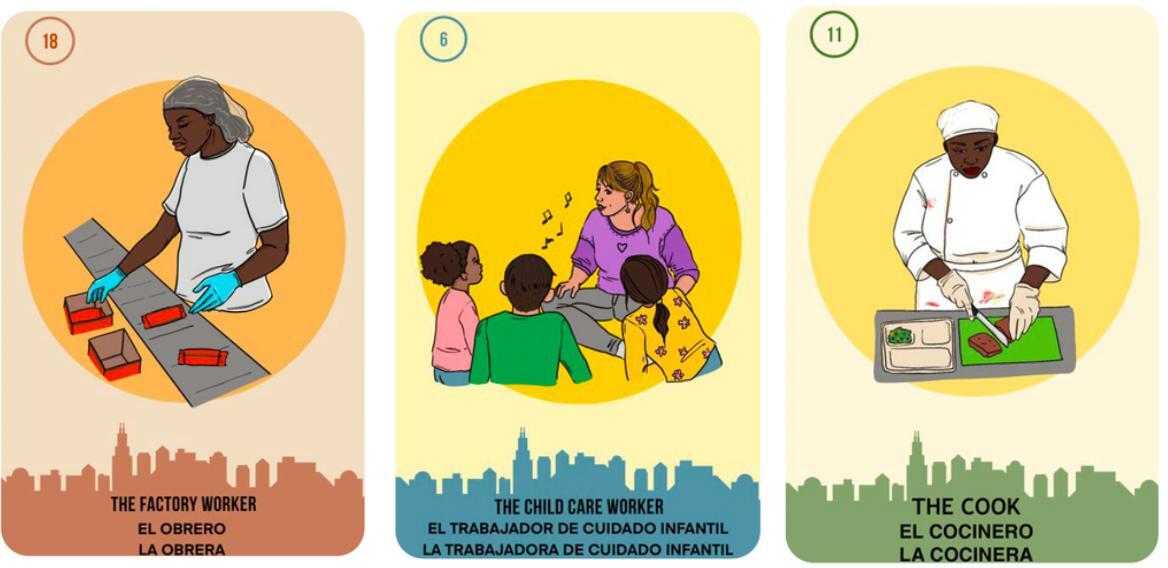
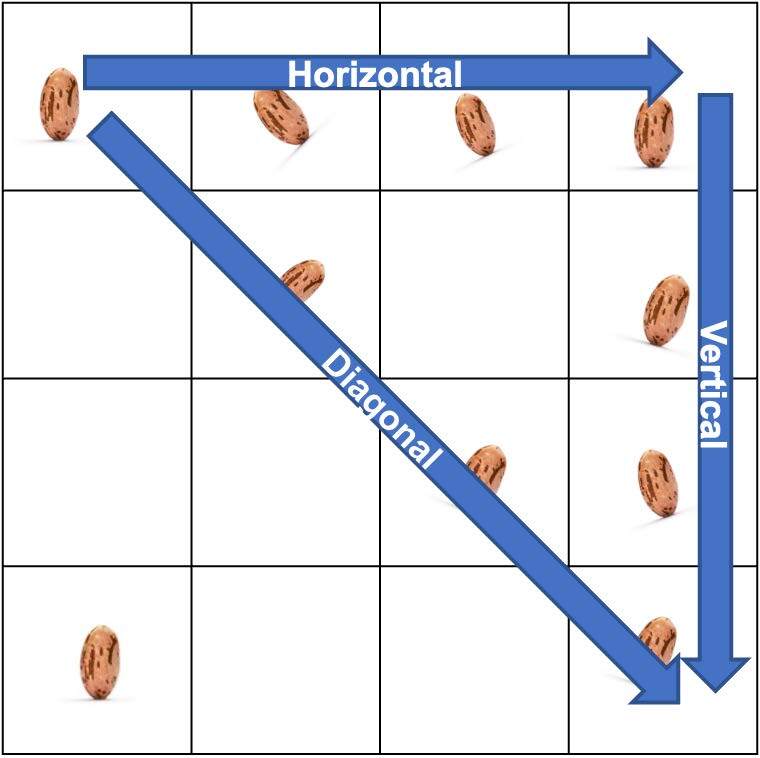
The final game contents include 20 boards, 54 cards and an instructional and informational booklet. All materials are available in English and Spanish. See Figure 1 for GLL components, Figure 2 for sample cards, Table 1 for game instructions and Figure 3 for a depiction of what a winning board looks like.
_components.jpeg)
Implementation of the Game
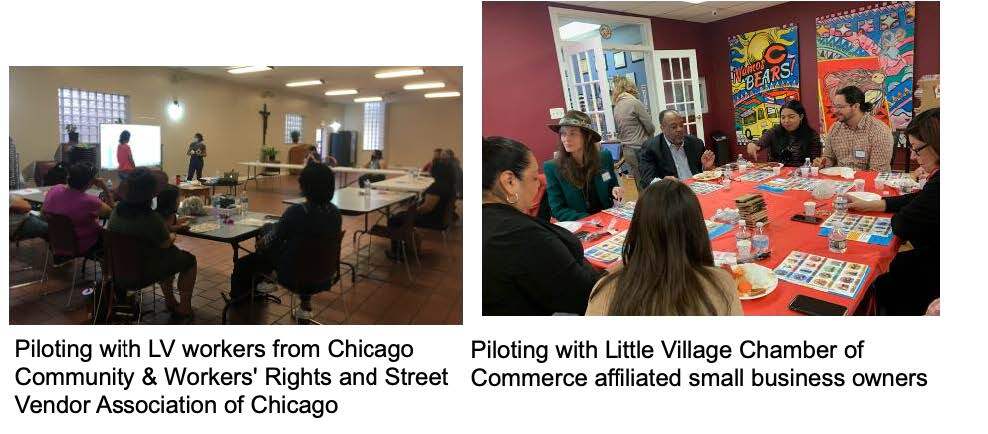
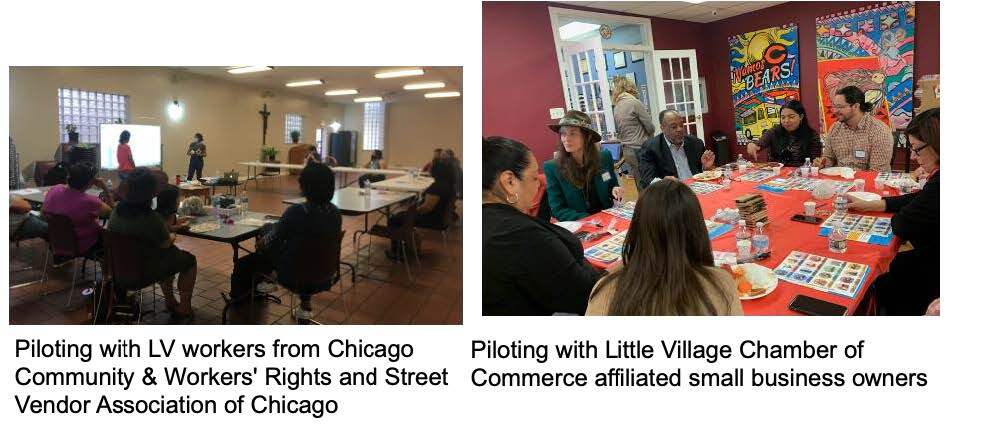
Two primary methods were employed to implement the GLL in Greater Lawndale, piloting and projections, both serving purposes of evaluation and broader dissemination. The game was piloted with 5 groups of interest, including community members, two high school student groups, small business owners and members from a worker rights center (See Figure 4). After each game was played, participants were asked to complete a survey to measure shifts in knowledge, attitudes and beliefs, and engage in the Head, Heart and Feet reflection. Participants were encouraged to reflect on what they learned, felt, and what praxis was inspired from playing the game.
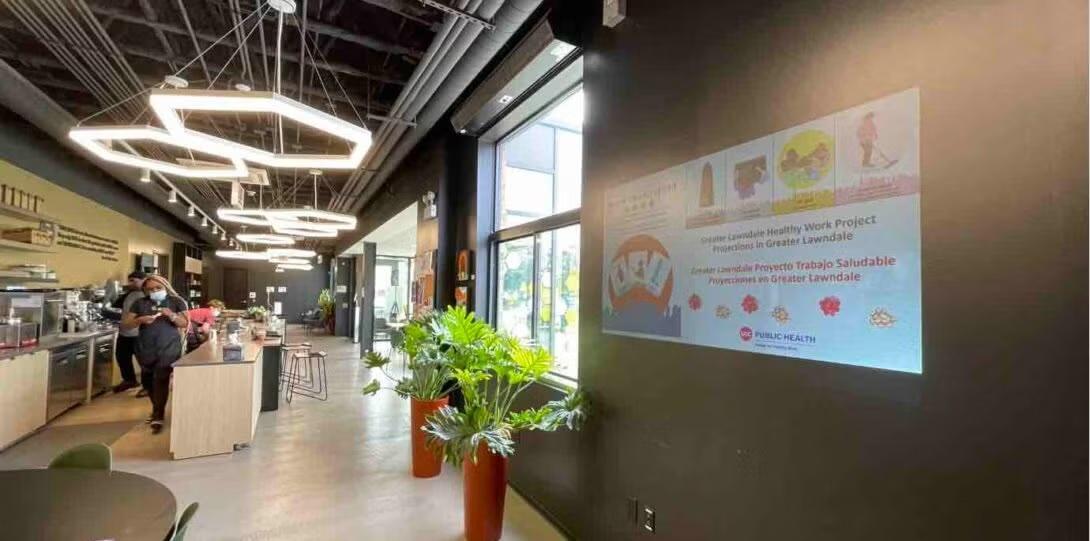
A curated sample of the GLL cards, including the illustrations and narratives, were projected in GL using a portable projector and white screen, at local businesses, churches, food pantries, cafes, community events and federally qualified health centers (see Figure 5). Individuals passing the projections were invited to respond to the Head, Heart and Feet qualitative reflection questions.
_projections_in_greater_lawndale.jpeg)
A celebration was organized to disseminate the GLL and recognize the collective contributions of community-academic partners. The event also served to share research findings, strengthen community-academic partnerships, enhance engagement with the materials, and increase the visibility of the GLHW Project with GL residents and organizations. Approximately 20 large posters were distributed to community and academic partners to increase awareness and engagement of the GLL. GLL posters remain in central places in GL including community-based organizations and local businesses. Other promotional material, such as postcards and flyers were also developed to support outreach efforts.
A request form was created to distribute physical copies of the GLL to community partners for educational purposes, accompanied by an optional evaluation to recipients. The evaluation was designed to hear their experiences, measure shifts in knowledge, attitudes and actions, and enhance future use and engagement with the GLL.
GLL has been shared across various community-academic spaces, including classrooms, conferences and workshops. The game was featured at the David J. Sencer CDC Museum in Atlanta, Georgia in the major exhibition Health Is a Human Right: Achieving Health Equity.
We finalized the process guide with specific detail of each participatory process and posted it to our website so other CBPR place-based, community-academic groups could replicate our evidence-informed product.
Results
Findings from Evaluation Pilot Testing
A total of 47 groups of interest pilot tested the GLL. (See Table 2). Of this group, 21% described their work in the past two years as having precarity characteristics, such as being on call, being a day laborer or working in temporary work with no contract. A total of 21% reported being engaged in temporary, short term contractional work (< 1 year) and another 1% reported that they do permanent but part-time work (< 35 hours/week). Just under half, 47%, reported permanent full-time work over 35 hours per week. We also measured domains of knowledge, attitudes and beliefs about work after playing the game.
Knowledge. The majority, 93%, of participants reported that they strongly agreed or agreed to learning something new about healthy work in GL. The vast majority, 88%, reported that they strongly agreed or agreed to knowing about workers’ rights in the workplace. Nearly all, 95%, reported that they strongly agreed or agreed to learning about different jobs in GL.
Attitudes. Of the 47 participants who responded to the questions about attitudes, 77% reported that they strongly agreed or agreed to knowing how to get involved in community efforts; 84% reported that they strongly agreed or agreed to knowing how historical events impact work situations in GL; and nearly all, 98%, reported that they strongly agreed or agreed to people having the power to mobilize for change in the workplace and community.
Beliefs. Of the 23 respondents who were asked questions about beliefs, 100% of GL resident respondents strongly agreed or agreed to the GLL accurately representing jobs they are familiar with in their neighborhoods. Beliefs were also ascertained via the Head, Heart and Feet reflective exercise (see below).
Participants were largely satisfied and positive about the game: 95% strongly agreed or agreed that they enjoyed the experience; 90% strongly agreed or agreed that they saw the GLL as an effective educational tool; 93% strongly agreed or agreed that the GLL could have a positive impact on the community; and, 98% strongly agreed or agreed that they would like to partner with the GLHW Project in the future.
Head, Heart and Feet Themes
Three themes emerged from analysis of the Head, Heart and Feet reflective activity among the participants who played the game or viewed the projections.
Theme 1 - Head: Labor Rights Movement Continues to Inform Efforts to Address Exploitation and Health Concerns. This theme reflects two seemingly different yet interconnected tensions that emerged in the data as participants reflected on what they were thinking. First, participants reflected on experiences with inequities at the workplace, and neighborhood such as high levels of precarious work, job insecurity, low pay, lack of benefits, exploitation, systemic inequities, exposure to chemical hazards and workplace accidents, gentrification and lack of access to basic services. Participants also emphasized the need for improved safety measures and health protections for workers at the community and systems level. Second, Greater Lawndale has a long history in labor rights organizing and community activism, laying the groundwork for ongoing efforts to address workplace challenges and champion labor rights. This rich legacy informs current advocacy efforts and underscores the community’s commitment create social change and address exploitation at the workplace. For example, in response to “what did you learn in playing the game” participants responded: “I learned that we are a strong community and supportive”. “…most jobs don’t treat or give good benefits to their employees when it comes to pay or treatment”. “I learned that our people do the hardest jobs and get paid the least.”
Theme 2 – Heart: Advocacy, Awareness, Empathy and Hope. Participants expressed mixed feelings of empathy and frustration, often stemming from personal or family experiences. The shared empathy may turn pain and frustration into hope and collective action to advocate for workers’ rights. For example, in response to “what did you feel after playing the game” participants responded: “I feel hopeful!”. “I hope this helps many others to learn about workers and their rights”. “I felt optimistic about policy change; anger because change is slow; frustrated about the complexity of the challenges.”
Theme 3 – Feet: Community-based Efforts, Education and Engagement. Greater Lawndale residents who played the game or engaged with the projections were invited to engage in praxis, reflecting on what action are needed to address labor rights issues in their neighborhoods. When asked what participants felt called to do after playing the game, participants named attending workers’ rights and workplace safety trainings, taking collective action with labor unions and getting involved with community organizations. Residents also recognized the power of buying locally to strengthen the local economy as another method to drive change. For example, in response to “what did you feel called to do after playing the game” one participant responded: "…share with others how multi-faceted precarious work can be, how precarity can be in so many work arrangements, how so many people can be affected multi-generationally". “I want to educate laborers about their rights”. “…challenge my own family’s perspective or how they treat others in these jobs.”
Discussion and Conclusion
We sought to create a community-developed, popular education-based game to influence community norms about work by shifting knowledge, attitudes and beliefs about work at the neighborhood level. We also wanted to use the game to disseminate what our CBPR team learned through our exploratory action research about work characteristics in Greater Lawndale and perceptions of residents about how work impacts their health. In particular, we wanted to share our mixed methods findings (surveys, interviews, focus groups and concept mapping) on how residents experience and conceive of work at the neighborhood level. In sharing these findings while contextualizing them with historical labor wins, work precarity, community assets, and workers’ rights information, we also wanted to use the game to raise critical consciousness about work as a SDOH and shift knowledge, attitudes, and beliefs about work among residents. We wanted people to be able to connect their work situation and that of their neighbors with larger structural forces that shape work opportunities. We used a participatory process to disseminate and evaluate our findings, resulting in the development of a Process Guide as an intentional methodological output designed to support replicability and contribute to participatory methods and praxis. We evaluated our implementation and dissemination and found that after playing the game participants were more knowledgeable about work at the neighborhood level, empathic, and eager to take action to foster healthier work. Our emphasis on raising critical consciousness of contextual forces has been used by others to improve health literacy (Dearfield et al., 2017). Like our approach, other participatory research groups have used games as a way to foster solidarity and social connection within a community (Parker et al., 2006). This was especially important to us as North Lawndale and Little Village are often pitted against each other. While other researchers have used games as interventions, (Nascimento et al., 2023) we are aware of few game-based interventions that also serve to translate research findings. Popular education, game-based interventions can be effective tools for sharing research findings to build critical consciousness. By centering SDOH rather than individual responsibility, GLL uses participatory dissemination methods to help communities identify and challenge the systemic inequities that shape precarious work and health outcomes. We believe popular education interventions and participatory dissemination methods are critical for building collective power to foster health equity at the neighborhood level and is aligned with our justice-centered, equitable partnership, serving as a key mechanism to achieve the transformative potential of CBPR.
©2022 the Board of Trustees of the University of Illinois, Ronica Hicks, Sylvia Escárcega, and Theodora Salazar. This work may be adapted, shared, reproduced or otherwise used solely for noncommercial purposes as long as it includes this attribution: ©2022 the Board of Trustees of the University of Illinois, Ronica Hicks, Sylvia Escárcega, and Theodora Salazar. For any other uses please contact the University of Illinois Chicago Office of Technology Management, 312-996-7018, otm.uic.edu. *The contributions from the Center for Healthy Work, Greater Lawndale Healthy Work Project, Chicago Community and Workers’ Rights, Equity and Transformation, Lawndale Christian Health Center, North Lawndale Community Coordinating Council, Saint Anthony Hospital, Sinai Urban Health Institute, Taller de Jose, and Telpochcalli Community Education Project made this project possible. *