
1. Introduction
1.1. Co-researchers
Co-research involves collaborative inquiry conducted "with" the population of interest rather than research conducted "on" or "about" them (Fudge et al., 2007). This inclusive approach can potentially incorporate methodologies that actively engage the target population throughout the entire research process, from conceptualisation to implementation (James & Buffel, 2022). Co-research emphasises the equal value and importance of the voices and perspectives of individuals with lived experience, recognising the unique insights gained from their firsthand knowledge (Durose et al., 2016). By challenging traditional power dynamics between researchers and participants, co-research fosters an environment of equality, facilitating high-quality research design based on mutual respect and collaboration (Ray, 2007).
The involvement of co-researchers, especially those with direct experience of a health condition, presents advantages to the research process. Their lived experiences offer a critical perspective through which researchers can better understand and contextualise the complexities of the health issue under investigation, thereby enhancing the validity and applicability of research findings that may be overlooked when academics researchers work in isolation (Boaz et al., 2016). Furthermore, incorporating co-researchers into the research process cultivates a collaborative environment where diverse perspectives are appreciated, leading to more comprehensive and robust analyses and interpretations of research findings.
The active involvement of sex workers as co-researchers facilitates the transmission of their experiential knowledge, leading to a comprehensive and nuanced understanding of their needs and experiences. In our project (the case study example), co-researchers played an active role in shaping many aspects of the research process, including developing interview questions, drawing on their lived experiences to ensure relevance, sensitivity, and appropriateness. Moreover, co-researchers provided invaluable feedback on data analysis, offering unique insights and interpretations that enriched the research findings. This collaborative approach not only strengthens the validity and reliability of the research but also fosters greater transparency and inclusivity throughout the research process.
1.2. Sex workers as co-researchers
Prior research within the sex worker community has focused on traditional methodologies, such as qualitative interviews, often conducted by researchers ‘on’ sex workers. Participatory Action Research (PAR) has become a way of integrating more inclusive research practices (O’Neill, 2001, 2007). Such inclusive research methodologies are rooted in a desire for societal transformation and social justice, acknowledges research endeavours’ subjective nature and political context. It prioritises fostering positive societal change and democratic participation, with a specific emphasis on strengthening the self-esteem of marginalised groups (Lewin, 1946; Borda, 1988 in O’Neill, 2010). PAR fundamentally transforms the research landscape by engaging marginalised voices as co-creators of knowledge, thereby disrupting traditional power dynamics between researchers and participants. This approach values experiential knowledge on equal footing with scholarly expertise, especially the insights drawn from lived experiences within marginalised communities (Houh & Kalsem, 2015). PAR principles rely on reflection of participants as actors within the research; data collection which aligns with research need and is participant led, and action which seeks to reduce inequalities in health (Baum & Smith, 2006).
Previous research involving sex workers has faced criticism from within the sex worker community for its limited engagement of sex workers themselves, often restricted to participant roles or basic forms of collaboration, rather than leadership positions (Jeffreys, 2010). Participatory research has gained significant attention in sex industry research, as scholars increasingly recognise its potential to amplify the voices of marginalised groups (Graça et al., 2018; Oliveira, 2019; O’Neill, 2010; Wahab, 2003). PAR shifts the focus from conducting research ‘on’ sex workers to conducting research ‘with’ sex workers, acknowledging them as experts in their own lives.
An example of sex worker involvement in research was a fundamental aspect of the research framework for the second Law and Sex Worker Health Study (LASH 2). The LASH 2 study employed a unique approach by integrating nine peer researchers into the team, highlighting the importance of peer involvement in the research process. After the study, interviews were conducted with seven of these peer researchers to facilitate critical reflection and identify lessons learned, following established debriefing strategies in research (Wray et al., 2007). The involvement of sex workers significantly enriched the team’s understanding of sex work dynamics, providing insights drawn from shared experiences, including cultural identity, language, and demographic and socio-economic backgrounds (Lobo et al., 2021).
Moving forward, ensuring fair compensation and ongoing opportunities for involvement is essential to promote sustainability and empowerment within marginalised communities engaged in research. This could include continued participation in data analysis, co-authorship opportunities, and involvement in advocacy initiatives based on research findings. These efforts would not only enhance sex work research but also serve as a model for inclusive and empowering research practices across various fields. The involvement of peer researchers was meaningful throughout the research process, with no reported feelings of tokenism. However, challenges in accessing specific populations, such as Asian sex workers, persisted despite the involvement of peer researchers from these communities and the translation of survey instruments, highlighting ongoing barriers in research (Roche et al., 2010).
Maintaining the trust and credibility of peer researchers within the sex worker community was crucial, requiring careful management of role duality and the preservation of existing relationships (Heslop et al., 2018; Kaida et al., 2019). Pragmatic considerations, such as clear role expectations, equitable opportunities, and adequate support, were also essential to ensuring a positive experience for peer researchers, consistent with findings from previous studies (Greer et al., 2019). Despite these efforts, language barriers and survey design issues still impacted data quality, underscoring the need for thorough pre-testing and attention to participants’ diverse needs (Ruel et al., 2016). Finally, understanding the motivations of peer researchers such as political engagement and community connection was key to the effective implementation of the peer research model.
1.3. Outline of the study
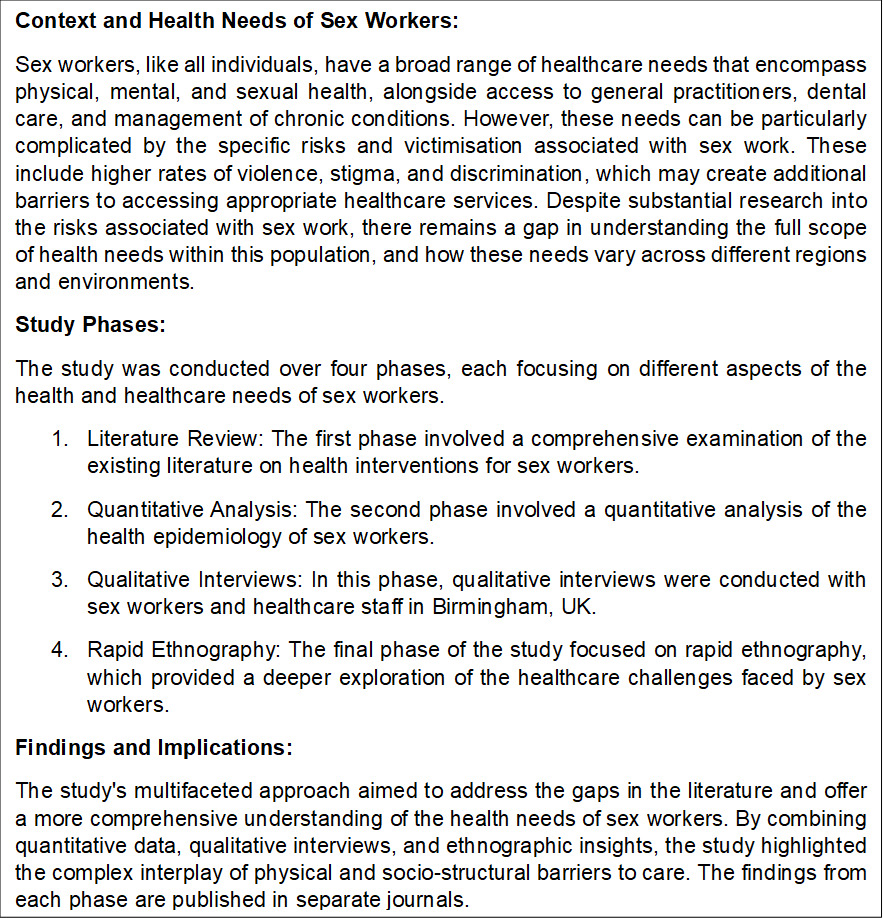
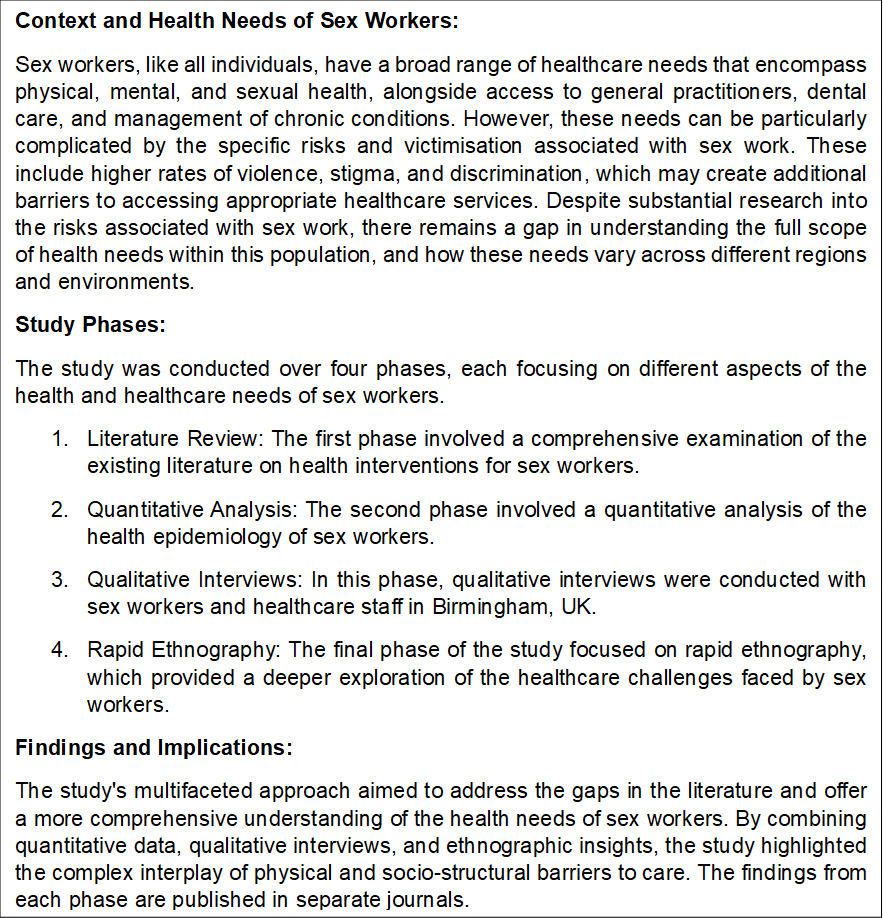
In 2023, we undertook a multi-phase study in the UK (see link to report: Sex Worker Analysis of Health Needs (SWAN) | Inclusion health | Birmingham City Council), aimed to investigate the health needs of sex workers and assess the effectiveness of services in meeting these needs. The study was structured in four phases: a literature review on evidence-based health interventions for sex workers, a quantitative analysis of sex work epidemiology, qualitative interviews with sex workers and healthcare providers, and a rapid ethnography exploring the lived experiences of three sex workers and their experiences of access to healthcare (see Box 1). The findings from these phases are disseminated in other publications. This paper specifically examines the embedded co-research design, which incorporated two co-researchers with lived experience of sex work who collaborated closely with the academic team. This approach ensured that the research was grounded in the lived realities of sex workers, providing a more nuanced understanding of their health needs and the effectiveness of existing support services.
1.4. Role and Objectives of Co-researchers within the Research Team
After providing the context of the project and the role of peer researchers, we offer a detailed critique of the co-researchers’ participation, highlighting both the positive and negative reflections that emerged throughout the research process. By examining the co-researchers’ experiences, the aim is to uncover the complexities and nuances of their involvement, highlighting the benefits and challenges of collaborative research. Co-researchers played a central role in shaping various aspects of the study, from study design, participant recruitment, and data collection to the analysis and interpretation of findings. In the context of the SWAN Stydy, the qualitative work package research strategy aligned with the principles of PAR by reflecting on and approaching data collection and analysis from an embodied reflective lived experience of the co-researchers. Their first-hand knowledge and experiences as sex workers provided invaluable insights that might otherwise have been overlooked. This collaborative approach fostered a dynamic exchange of ideas between the co-researchers and the academic team, leading to a deeper understanding of sex workers’ health needs and the effectiveness of support services.
We also examine the challenges co-researchers face in navigating the pervasive stigma unique to sex work (Connelly & Sanders, 2020; Lobo et al., 2021). In doing so, we hope to enhance understanding of the barriers sex workers encounter within the context of peer research. Ultimately, we draw lessons from the co-researchers’ experiences, highlight best practices, and offer recommendations for future collaborative research projects. Reflecting on both the successes and challenges of co-researcher involvement contributes to ongoing discussions about the meaningful engagement of community members in research, particularly among marginalised populations such as sex workers. Furthermore, these reflections can be used in a wider context and should be utilised to reflect on research with all stigmatised groups, not exclusively the sex work community.
2. Reflections on joining the project
Initial encounters with the research team helped clarify expected roles and responsibilities, with training and preparatory resources provided to support co-researcher involvement. Throughout the research process, co-researchers faced challenges, including navigating complex dynamics and balancing protecting their identity with research objectives. However, they were supported by strong systems of collaboration, which fostered a sense of community and solidarity.
2.1. Concerns specific to sex work research
Both researchers experienced uncertainty when joining the project. We were concerned about the potential for harmful research practices that could detrimentally affect sex workers’ wellbeing, rights and working conditions. Research regarding sex work can often be complex and driven by ideological positions rather than robust research methods (Bowen & O’Doherty, 2014; Vanwesenbeeck, 2017; Weitzer, 2005, 2017). Research which derives from an anti-sex work perspective, based either on radical feminist or conservative and religious values, has been shown to conflate consensual sex work with trafficking. Research has shown that this has been harmful to sex workers as it creates the foundation for the criminalisation of sex work (Jeffreys, 2009; Levy & Jakobsson, 2014; Weitzer, 2005). Criminalisation plays a significant role in creating dangerous working conditions, which leads to the violation of sex workers’ rights (Anderson, 2021). Additionally, such research perpetuates harmful stereotypes, which preserves the societal marginalisation and omnipresent stigmatisation of sex workers (Benoit et al., 2018). These methodologies are not inclusive of sex workers’ voices, instead using ideological positions of conservativism, radical feminism, and religion to underpin their research (Ellison, 2018; Weitzer, 2005).
The sex work community advocates for a human rights and harm reduction approach to sex work research, which includes the voices of sex workers. In doing so, sex workers advocate the 'nothing about us without us’ approach to research and place emphasis on expertise by experience. Consequently, data produced with the inclusion of sex workers, have shown the need for decriminalisation of the sex industry and the removal of negative stereotypes to ensure sex workers have equal access to their human rights. However, despite the abundance of evidence for decriminalisation, complete or partial criminalisation is still the leading legal model for sex work in over 39 countries. Scholars have argued that this is due to law and policy being influenced by anti-sex work ideological positions that conflate sex work with trafficking. Thus, it is common for law and policy to discount the evidence provided by sex worker academics and those with lived experience (Anderson, 2021; Ellison, 2018; Jeffreys, 2009; Weitzer, 2005).
Another concern vocalised by the sex work community is the practice of ‘outsiders’ researching the sex work community, without care or consideration for the sex work community (Raven & O’Doherty, 2017). As a marginalised group, sex workers are likely to have relatively little power when engaging in research, which can be taken advantage of by researchers. Adding to the marginalisation is the topic of sex, which, for some, can elicit interest or ‘fascination’ with sex workers. Sex workers have noted that they can feel like ‘animals being studied in a zoo’ rather than people with their own agency (Raven & O’Doherty, 2017). A subject to be studied rather than an active participant in the process of creating knowledge.
Consequently, sex workers are acutely aware that any research project that is underpinned by anti-sex work beliefs or undertaken out of a ‘fascination’ with the industry, can cause harm to sex workers. As a result, sex workers can be reluctant to take part in research projects. As a movement, sex workers ask that the research should have rigorous methodology based on evidence rather than ideology, including sex workers’ voices and, at a minimum, cause no harm (Raven & O’Doherty, 2017). With all this in mind, the co-researchers in our study, used the information available to assess whether the project aims aligned with a progressive approach to sex work research. This assessment was critical as the team leading the project were not sex work researchers. When engaging with projects that are led academics with a specific expertise in sex work research, it is easier to establish their approach to research by studying their previous research methods in the context of sex work research. In our case however, the team were health academics who had not previously had experience researching sex work. Although they had extensive experience working with experts by experience and vulnerable individuals and had previously conducted research on sensitive or challenging topics, either due to the nature of the subject or the vulnerability of the population, these were often groups that are traditionally under-represented in, and underserved by, research. This added a level of uncertainty for the co-researchers and a need to derive the project’s approach from different means. Thus, the co-researchers instead evaluated how language was used during recruitment and in draft materials. They also observed how the team responded to feedback on stigma, using these as indicators as to whether the project aligned with sex worker-centred, harm-reduction values.
2.2. Recruitment strategy
A critical element that fostered trust between the research team and co-researchers was the recruitment process. The research team sought a relationship with sex worker-led organisations to advertise the co-research positions and ultimately, to recruit participants. Both co-researchers felt assured that the project had positive intentions by engaging in this way with sex work organisations for recruitment. Subsequently, during the interviews, both co-researchers used the opportunity to determine the project’s intentions, values and ideologies, by evaluating three key elements: terminology used, education on the subject matter, and the project’s methodology.
The terminology surrounding sex work has developed extensively over time, with the term ‘sex work’ proposed initially by Carol Leigh in 1978 to draw attention to the labour inherent in sex work. By using this term, it gives a level of autonomy to sex workers that has not been afforded to them historically. It also removes the negative connotations associated with the term ‘prostitution’, which is often used by anti-sex work movements to conflate consensual sex work with sex trafficking (Leigh, 1998). Given that the research team were ‘outsiders’ to the sex workers’ movement, it was crucial for the co-researchers that the team received foundational education on the terminology, history, and priorities of the sex workers’ rights movement. Throughout the study, the team remained attuned to the needs of the research field and the community, demonstrating a commitment to the community’s well-being. For example, the research team used language such as ‘full-service sex work’ demonstrating knowledge of the progress of the sex workers rights movement in pushing back against using language with negative connotations. Additionally, the inclusion of two co-researchers with lived experience exemplified an inclusive methodology that valued situated knowledge.
To the relief of the co-researchers, the recruitment process demonstrated a rights-based approach to sex work research. The research team had invested significant time in building relationships with sex worker organisations, educating themselves on the sex workers’ rights movement, and understanding the key issues facing the community. Furthermore, they were committed to employing a methodology that ensured the inclusion of sex workers’ voices. For example, by including sex workers both within the research team and through interviews and the ethnography that were conducted with sex workers.
Based on these efforts, both co-researchers felt confident that participation in the study would not harm themselves or the broader sex worker community. They also felt reassured that safety, confidentiality, and consideration of the unique needs of sex workers would be prioritised throughout the project. However, it became clear to the co-researchers, that the complexities of sex work, anonymity, and positionality within the team were more intricate than initially anticipated. The following sections will discuss how these issues were navigated through the project and how positionality held both positive and negative opportunities, due to the complexities of stigma versus value of situated knowledge.
3. Reflections on working within the team
Bowen and O’Doherty discuss ‘research with rather than research on’ sex workers, highlighting the need for sex worker-led research that includes sex workers through design, method and analysis. Their framework moves beyond PAR, emphasising ‘participatory driven’ research, which calls for sex workers to be at the forefront of research. Reflecting on this framework, we now highlight how our study, the ‘Sex Workers Heath Needs Analysis (SWAN)’ project, took a ‘participatory-driven’ approach. We discuss the limits of ‘inclusive research’ methods due to power dynamics, emphasising the need for a ‘participatory-driven’ approach.
3.1. Co-researcher Engagement and Collaborative Decision-Making
The SWAN project prioritised inclusivity by recruiting the co-researchers immediately after receiving ethical approval. From the outset, the co-researchers were invited to provide critical feedback on the research design, leveraging their lived experiences and expert knowledge in relevant areas. Their involvement extended beyond initial consultations; the co-researchers were actively engaged in all study aspects, including refining the study design, finalising interview questions, and developing recruitment strategies. Throughout the data collection phase, the co-researchers participated in weekly meetings with the qualitative research and ethnography team leads, offering valuable insights on the interview protocol, emerging themes, ethnographic findings, and participant recruitment strategies. In addition, monthly meetings with the broader project team ensured that all stakeholders were aligned and that the co-researchers’ perspectives were continuously integrated into the research process. After the study, the co-researchers were consulted on all research outputs, including the literature review and qualitative and ethnographic findings, before publication. They also contributed to conference presentations reflecting on the co-research methodology and were pivotal in co-authoring this paper. We discuss these in subsequent sections of the article.
3.2. Navigating Power Dynamics and Inclusivity in Participatory Action Research
The reflections on inclusivity and power dynamics in the SWAN project highlight the complexities of implementing participatory approaches in the context of sex work. Despite efforts to create an inclusive and collaborative environment, both co-researchers felt like ‘outsiders’ within the team, which will be further explained throughout this section of the paper. This paradox underscores the inherent challenges of achieving true 'inclusivity’, primarily when power imbalances exist between academic researchers and individuals brought in for their lived experience. The co-researchers felt this gap was particularly pronounced due to the stigma surrounding sex work. Sex workers are often treated as ‘less than’ in society, facing exclusion across various aspects of their lives.
While the academic team made considerable efforts to ensure the co-researchers’ involvement in the study, the stigma associated with sex work remained a significant barrier. This stigma hindered their ability to connect with the academic team fully, for example not feeling they could engage in decision making. The imbalance became especially apparent in the co-researchers’ responses to the findings of the ethnography phase (Phase 4). After reviewing the outcomes of the interviews and ethnography, both co-researchers felt that the ethnography oversimplified sex workers’ experiences.
The ethnography focused in-depth on three sex workers, all of whom identified as sex workers but had experiences with trafficking or forced exploitation. The co-researchers believed this was problematic for generalising the health needs of sex workers. The co-researchers were concerned that reporting the findings in this way, conflated sex work with trafficking, a harmful practice repeatedly criticised by sex workers, rights organisations, non-governmental organisations, scholars, and activists (Amnesty International, 2024; Blunt & Wolf, 2020; NSWP, 2019; Weitzer, 2005). Furthermore, a sample of just three individuals was too small to represent the diversity of the sex worker community. The co-researchers believed that focusing on trafficking in the ethnography oversimplified the experiences of sex workers and failed to capture the broader spectrum of their health needs, further contributing to the problematic conflation of sex work and trafficking In contrast, the qualitative interviews (Phase 3), which included over 20 sex workers, offered a more nuanced, intersectional perspective, with participants varying in age, gender, sexual orientation, and ethnicity.
Initially, the co-researchers hesitated to voice these concerns, feeling that their position within the team did not grant them the authority to question the findings. This hesitation reflects the inherent power dynamics in PAR, where the academic team holds a level of authority that those with lived experience may feel unable to contest. When both co-researchers realised that they shared the same viewpoint, they felt able to exercise their voice and articulate their concerns to the academic team.
This gave the co-researchers a stronger sense of authority, and the response from the qualitative research lead, who created a space for open discussion, was pivotal in addressing – and mitigating -power dynamics. By valuing the co-researchers’ lived experience, their feedback was given due weight and authority, which helped to build trust and foster a more collaborative relationship with the broader team. This process underscored that overcoming power dynamics does not require creating sameness between the academic team and the co-researchers. Instead, it involves valuing and celebrating their differences. This realisation was crucial in bridging the gap and fostering a more equitable research environment.
The importance of fostering strong relationships among co-researchers also emerged as a key factor in mitigating power imbalances. Given the pervasive stigma sex workers face, it was essential for the co-researchers to have a safe space to share their experiences and concerns freely. Strengthening relationships between the co-researchers helped them navigate the project and ensured that the research remained driven by their expertise. In the next section, we will reflect on how these foundational relationships contributed to the SWAN project’s transformation into a genuinely participatory action research initiative, where the co-researchers played a leading role in shaping the direction and outcomes of the study.
3.3. Shifting Power: From Co-research to Co-driven PAR Methodology
On reflection, what made the SWAN project significant from a methodological perspective, was the shift from being a co-researched project to one driven by co-researchers. As previously mentioned, Raven and O’Doherty developed the concept of PAR in the context of sex work, which emphasises the leadership of individuals with lived experience. This approach goes beyond simply involving those with lived experience in the project; it seeks to empower them as the leading voices in research within their communities and spaces.
One of the key principles of PAR is the ability of communities to shape the research from conceptualisation and framing to data collection, analysis and dissemination (University of Reading, 2023). This study, was designed in the context of the commissioning brief from Birmingham City Council, as a needs assessment, exploring sex workers access to health services. While this limited the earlier co-design work which could be undertaken with community members, it was a starting point to begin the conversations and developing relationships with local and national charities and organisations, included RSVP (RSVP, 2026), National Ugly Mugs (NUM, 2026) and Birmingham LGBT (BLGBT, 2026). The research team at Birmingham have a history of undertaking research, which is participatory in nature, with a strong sense of community engagement, in a research space that explores Risk, Abuse and Violence within and around health, health service provision, and access to healthcare (UoB, 2026). As such some of the community organisations had been part of previous research, and ongoing discussions around research and research priorities.
Much of the work around community engagement, and working alongside community organisations is the work of developing, building and maintaining collaborative relationships with organisations, outside of collaboration in research, but as people working in similar spaces. As a research team, these long-standing relationships acted as the foundation to develop a research plan which focused on centring lived experience. These relationships also meant that the research team were a trusted partner, and that the organisations had trust that by sharing co-researcher advertisement and information with the communities and service users, they could guarantee that the team would approach the researcher/participant relationships building appropriately.
The SWAN project did not initially set out with the intention of being led by co-researchers. While it aimed to be a particiaptory study, the emphasis on the co-researchers driving the project emerged later and developed organically. The relationship between the co-researchers was foundational in building the confidence to challenge research findings, marking a turning point in the project. As we reflect on the shift from a participatory approach to one driven by co-researchers, we highlight the concept of 'value.’ When researchers’ opinions, experiences, and knowledge are not valued, PAR risks becoming a mere checkbox exercise. In contrast, giving meaningful value to these contributions and demonstrating this value in tangible ways fosters an environment where experts, by experience, hold a comparable level of authority and decision-making power as the academic team.
3.4. Empowering Co-researchers: Leading the Narrative and Shaping Dissemination
The co-researchers’ knowledge and expertise became evident throughout the project, beginning with their authorship of a statement for the final report. This statement emphasised, from their perspective, the nuanced interpretation of the research findings, particularly highlighting the conflation of sex work and sex trafficking. By leveraging their expertise in sex work and research, the co-researchers took an authoritative role in shaping the research narrative, thus leading the conversation rather than merely advising it. This allowed them to play a central role in the decision-making process and the project’s final output.
Valuing the co-researchers’ knowledge led to their presentation at the European Sex Workers Alliance (ESWA) conference (Box 2 illustrates this with a personal narrative). The opportunity arose through the co-researchers’ networks, and they proposed presenting the results of the SWAN project at the conference. Initially, it was assumed by the academic team that the presentation would focus on the project’s health findings. However, following discussions led by the co-researchers with the broader team, it was decided to present the co-research methodology of the SWAN project instead.
The co-researchers took the lead in preparing the presentation, submitting the abstract, and driving the process with support from the wider team. At the conference, the co-researchers shared their experiences and led an interactive workshop on co-research, engaging both the sex work community and researchers. This workshop facilitated knowledge exchange and sparked thought-provoking discussions. It also provided a safe space for the co-researchers to openly discuss their lived experiences. This was crucial because their positionality as sex workers had potential to present both positive and negative implications in co-research. This is, especially the case in a stigmatised environment where their identity could have serious consequences if exposed. If the conference was not a sex worker led, run and inclusive environment then being ‘out’ with lived experience can have a detrimental impact. Exposing engagement in sex work can lead to wide-reaching consequences regarding future job opportunities, family/friend relationships and access to social institutions and rights (Sanders & Campbell, 2014).
The wider team acknowledged the risks involved and supported the co-researchers in making decisions about their participation at the conference, while respecting their authority in all aspects of their engagement. Presenting at a conference of their choice, on a topic of their choosing, and with funding to do so, was a clear demonstration of the academic team valuing their voices. This approach also reduced power imbalances by embracing the unique strengths of the co-researchers. Rather than striving for ‘sameness’ by assigning tasks that mirrored the team’s strengths, the project fostered the distinct strengths of those with situated knowledge.
Presenting at the ESWA conference fostered more trust and equality between the team than any other aspect of the SWAN project. By platforming the voices of the sex workers involved in the project, the co-researchers gave value to their unique knowledge in a tangible format. This event allowed the co-researchers and the broader team to reflect on the power dynamics inherent in PAR. It was not until the co-researchers experienced the decision-making and authority of leading the presentation that they understood the power dynamics unintentionally built into PAR methodologies. Furthermore, these dynamics are particularly hard to navigate and overcome in the case of sex work due to omnipresent stigmatisation and marginalisation.
To build upon this point, the next section will reflect on sex workers’ positionality as co-researchers in the distribution of research findings. Particularly addressing how the position of being a sex worker or someone with a stigmatised identity can be both a positive and a negative when it comes to being involved in the distribution of findings.
4. Reflections on the distribution of research findings
4.1. Boundaries and positionality as both positive and negative
During the data collection phase of the SWAN project, the positionality of the co-researchers as sex workers did not play a significant role in the project. This is to say, during this time, the co-researchers worked in a team, which could be considered a ‘safe space’ where everyone was aware of their job title. The benefits of the positionality of being sex workers were apparent in that their knowledge helped guide the project as described throughout this paper.
Involving people with lived experience benefits a study in many ways. In the SWAN project, the networks that the co-researchers were part of led to most of the recruitment. Furthermore, having sex workers involved in the project fostered trust between the research participants and the research team. As noted earlier, sex workers are often hesitant to be involved in research due to problematic methodologies, bias and stigmatisation. Thus, having sex workers involved in the project played a pivotal role in recruitment. Additionally, knowledge surrounding the wording of questions ensured that all interviews were undertaken with an extra level of ethical consideration and respect. The interpretation of results was given an additional level of confirmation as both co-researchers could relate to and interpret issues that participants described with a level of knowledge derived from their lived experience.
Thus, the benefits of positionality can be observed whilst the project was contained within the research team. However, a key reflection of ours is the difference in how positionality becomes challenging to navigate once the project results are to be distributed. This is particularly imperative as Raven and O’Doherty’s framework suggests that co-researchers should be further involved in PAR by participating in academic writing and the general distribution of research findings. As the SWAN project has attempted to make this possible, we will now outline the barriers we experienced when trying to do so.
Sex workers involved in inclusive methodologies have a unique difficulty when it comes to the distribution of findings. As a marginalised group, being ‘outed’ as a sex worker can have vast consequences. Social consequences include stigmatisation from friends, family or partners, barriers to work opportunities, legal ramifications in contexts where the sex worker lives under criminalisation, barriers to other opportunities such as education and general stigmatisation from institutions and broader society (Benoit et al., 2018; Bruckert et al., 2013; Weitzer, 2017).
Based on this premise, both co-researchers felt high levels of trepidation regarding the distribution of findings. The first instance of navigating this came in the form of the final SWAN report. As noted previously, the co-researchers were given space to write about their hesitation regarding the ethnographic findings in the final project. When this was sent to the funder, both researchers felt comfortable putting their legal name on the project. However, at a later date, parts of the project were to be disseminated beyond the funder. Both researchers felt uncomfortable with this and made the academic team aware of their concerns. In response, it was agreed that co-researchers’ legal names were removed and replaced with pseudonyms.
Initially, both researchers wanted their legal names on the project to demonstrate the work and time they had put into being part of the project. Both had gained skills and knowledge that they hoped would be demonstrable in their careers in the future; this included being able to reference their involvement in the project directly. Thus, the benefits of being a part of the project were in some sense obscured because of the pseudonymisation. While ultimately the dedacting of real names was an act of protection against stigmatisation and fear of being ‘outed’, this does underscore the complexities of research – and especially co-research – in the context of sex work. In the following section, we expand on the specific challenges regarding writing and dissemination.
4.2. Academic writing
A key reflection from the ‘after’ phase of the SWAN project relates to the complexities surrounding the involvement of sex workers in academic writing. This paper has been co-authored with the involvement of the co-researchers, and it is important to acknowledge their significant contributions. However, to protect their identities, we have been required to write with a level of ambiguity to avoid directly linking specific authors to their sex work status.
At the project’s outset, when conceptualising a co-authored paper, the project lead considered it both appropriate and empowering for the co-researchers to lead the authorship, with support from the wider team. This was rooted in a commitment to centring the voices of sex workers and recognising the value of their lived experience. Unfortunately, concerns around disclosure and safety meant that this ideal could not be fully realised.
As discussed in the earlier section, publishing under their legal names would have offered tangible benefits to both co-researchers in terms of academic recognition and enabling them to speak authoritatively from their own experiences. While they remain actively engaged in writing, they were unable to directly narrate or claim ownership of their lived realities within the text. This constraint has proven emotionally burdensome, as the intellectual and emotional labour invested cannot be openly attributed. Both co-researchers view their situated knowledge and sex worker identity as central to this project’s success. The need to obscure this identity due to societal stigma has, once again, erected a barrier to full recognition of their work and contributions.
Moreover, this fosters a sense of shame and invisibility, a common experience for sex workers. In contrast to more empowering engagements, such as presenting at the ESWA conference, this process has felt disempowering. It has also limited the professional benefits the co-researchers might have gained by citing this work in future academic or professional contexts. Writing an academic paper that centres the voices of sex workers has been both emotionally and logistically challenging. This experience has underscored the broader issue: while PAR methodologies claim to be inclusive, in practice, they must move beyond tokenism to ensure empowerment at every stage, including dissemination. Sex workers should not only be involved in shaping research but also in owning and distributing its outputs. As Raven and O’Doherty argue, involving sex workers in academic writing ensures that the research remains grounded in their lived realities and priorities.
The SWAN project provided space to reflect on these tensions critically. Our experience illustrates just how complex and difficult it can be to involve sex workers meaningfully in dissemination, particularly where anonymity is necessary. Navigating this challenge has been an ongoing and collaborative process between the co-researchers and the wider team. From the first meeting on authorship, we were faced with urgent questions about how to avoid ‘outing’ the co-researchers while still foregrounding their input. One early solution involved avoiding the use of first-person language. Later, we explored the idea of including ‘Co-researcher One’ and ‘Co-researcher Two’ as authors, a compromise that helped maintain anonymity while acknowledging contribution.
The wider research team met these challenges with open communication, mutual respect, and care. It is essential that researchers without lived experience recognise both the value and the emotional toll of sex worker inclusion. Listening, being guided by those with lived experience, and fostering supportive dialogue were crucial in navigating these ethical and practical dilemmas. The co-researchers were given autonomy in deciding how their identities should be represented (or not) while being supported to remain central to the project. One of the authors of this paper has lived experience and was a co-researcher on this project. The second co-researcher was no longer engaged with or available for the project. After a team discussion which prioritised the needs of this author, it was decided that the paper would be written in third person. As this decision is made due to stigmatisation two of the authors including the co-researcher decided to include the vignette as a representation of the co-researchers being able to use their own voices in first person whilst keeping their identity anonymous.
In this sense, in this article we have reflected on the real-life challenges of centring sex workers’ and stigmatised voices in participatory research. Ideally, such barriers would not exist. However, by reflecting openly on the ethical tensions and constraints encountered during the SWAN project, we hope to contribute to broader efforts to dismantle these obstacles and push forward a more inclusive, respectful, and just model of co-produced research. Furthermore, highlighting how the wider team navigated these limitations and did the utmost to ensure the centring of co-researchers’ voices whilst respecting their position will help those who wish to push forward with inclusive methodologies driven by those with lived experience.
5. Limitations of the paper
This paper has several limitations. The reflections are based on a single case study with only two co-researchers, which limits the generalisability and transferability of the findings to other sex work settings or participatory research contexts. The small number of co-researchers also means that relational dynamics, trust-building, and power shifts may have been unique to this project. Additionally, the reflections rely on the personal experiences and perceptions of those embedded within the project, introducing potential subjectivity and confirmation bias.
While the academic leads had extensive experience working with vulnerable populations, they did not have prior expertise in sex work research, which may have influenced the project’s initial approach. Ethical considerations around anonymity constrained the co-researchers’ visibility in authorship, limiting full ownership of the narrative and the enactment of participatory-driven principles. Methodologically, the ethnographic focus on three individuals with trafficking experiences may have unintentionally reinforced conflation between consensual sex work and exploitation.
Finally, the study is situated within the UK context, shaped by specific social, policy, and legal conditions, which may limit the applicability of the findings in other jurisdictions.
6. Framework
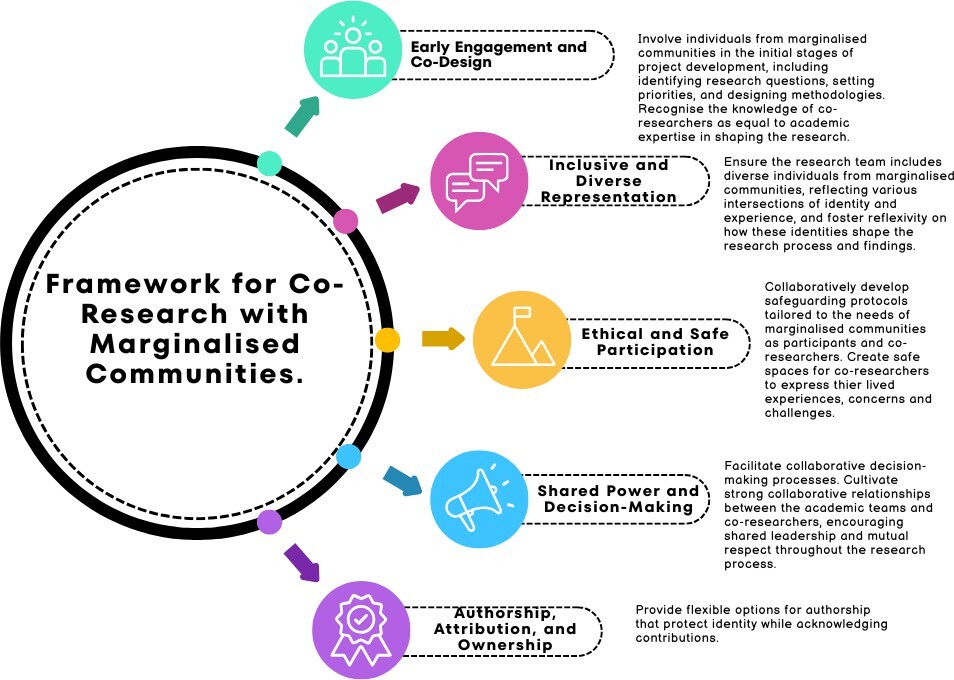
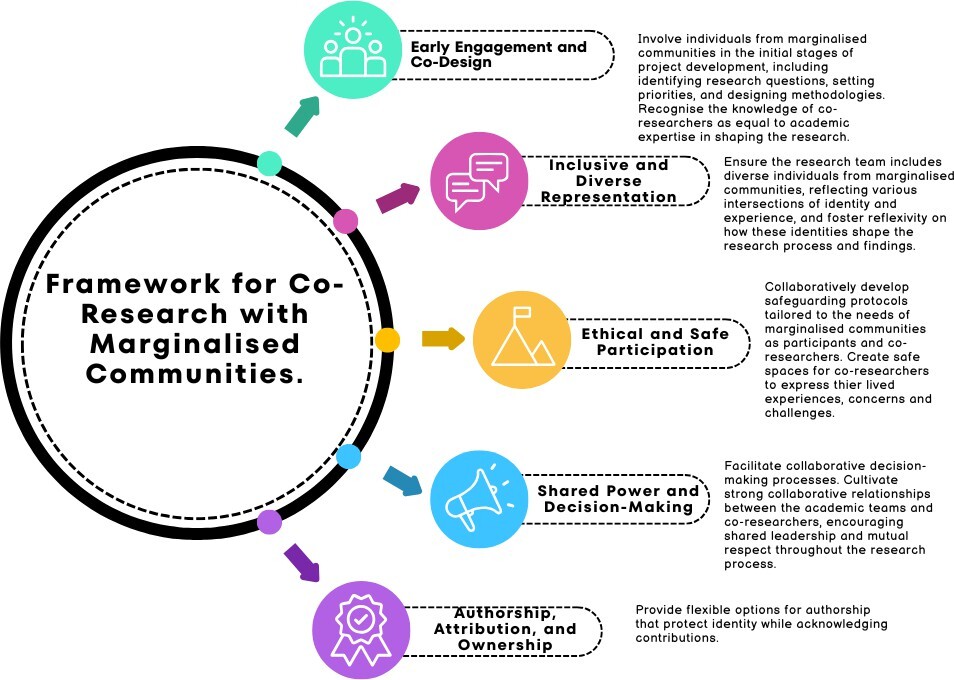
Having explored the co-research element of the SWAN study, we propose a framework for the meaningful involvement of marginalised communities, in research. This framework has been developed in response to the need for a more inclusive and equitable approach to research that goes beyond tokenistic participation. Historically, marginalised populations have often been excluded from the research process or involved in ways that do not fully recognise their expertise or lived experiences. As a result, research findings may fail to reflect the complexities and nuances of these marginalised communities.
The framework aims to establish a model of co-research that values the diverse experiences and knowledge of these groups at every stage of the research process. It outlines key principles for inclusive recruitment, ethical engagement, and shared decision-making, while prioritising the importance of addressing power imbalances and fostering equitable collaborations. This approach recognises the complexities of various marginalised communities, such as those affected by mental health challenges, racial and ethnic minorities, and people with disabilities, ensuring that their perspectives are integral to research.
By embedding this framework from the outset, researchers can ensure that research is ethically grounded, inclusive, and reflective of the multifaceted realities of these marginalised communities. The development of this framework is driven by the desire to enhance representation, promote greater accuracy in research, and ensure that the voices of those who have historically been silenced or misrepresented are heard. This model encourages not only greater representation but also deeper insights into the unique challenges faced by marginalised communities, ultimately strengthening the validity and relevance of research findings.
7. Conclusion
The SWAN project is a powerful example of how particpatory approaches can be transformed into a co-researcher-driven methodology. By valuing the knowledge and expertise of co-researchers with lived experience, the project shifted from a traditional academic-driven study to one that was shaped and led by those directly impacted by the issues under investigation. This approach enriched the research process and fostered a more nuanced and authentic understanding of the community’s needs, challenges, and strengths.
Recognising the power dynamics inherent in participatory approaches and valuing the differences between the team rather than trying to achieve ‘sameness’ is key to ensuring co-researchers lead the project. Attempting to create equality is necessary but insufficient to overcome power dynamics. The project became ’ co-researcher led ’ by placing value on the co-researcher’s distinct insight. Placing co-researchers at the forefront of the project was most successful during the data collection phase as they worked within a team which fostered and encouraged this process.
However, when it comes to disseminating research findings, there are new barriers to overcome. As inclusive methodologies develop, discussions around how to navigate this stigma whilst still pushing forward to ensure sex workers are the leading voice in research projects about them is imperative. The framework developed from the reflections of the SWAN project serves as a starting point to further develop participatory-driven methodologies within marginalised communities.
Whilst sex work research has a unique element of stigmatisation, many marginalised groups fear the stigma associated with their marginalised identity. For example, those experiencing mental health issues may be reluctant to have their name associated with research projects. Stigmatisation often goes hand in hand with a marginalised identity, and identifying oneself within the said group can be challenging due to fear of ramifications. Thus, it was crucial to reflect on how the team and co-researchers navigated these barriers and ensured the central role of the co-researchers’ voices whilst respecting their anonymity. In an ideal world, the shame and stigma associated with a marginalised identity would not exist, and we hope the SWAN project and the framework created add a step to overcoming these barriers.
Key Recommendations
Table 1 summarises the key principles we identified as crucial when conducting research with sex workers. These principles centre lived experience, acknowledge power imbalances, and prioritise safety, agency, fair recognition and representation. They are intended to act as a practical guide for researchers to ensure the process, design, analysis and outputs remain ethical, reflexive and grounded in the priorities of those with lived experience.