
Introduction
The relationship between science and society has undergone profound transformations over recent decades, particularly in a context of increasingly pressing environmental and social issues. These transformations have coincided with a growing perception of distance between professional scientists and citizens, fuelled by diverging expectations regarding the role of science in addressing contemporary issues such as climate change, biodiversity loss, public health, and urban sustainability. This distancing can be understood, at least in part, as a consequence of the progressive professionalisation of science. While this process has enabled major scientific advances, it has also contributed to sidelining citizen engagement and experiential knowledge within scientific knowledge production (Irwin, 1995). At the same time, conventional research practices have also been increasingly criticized for their extractive logics (Chossière et al., 2021), reinforcing the perception that researchers “extract” data, resources, or knowledge from territories without clear reciprocity for local actors (Gomez & Tyl, 2025). In response to these critiques, and to the growing demand for more inclusive, transparent, and socially relevant forms of knowledge production, participatory approaches to research have gained increasing prominence.
Participatory science as an alternative
Against this backdrop, participatory initiatives have emerged across a wide range of domains, including ecology, environmental monitoring, public health, urban planning, astronomy, and digital technologies. These initiatives respond simultaneously to scientific needs — such as the collection of large-scale, spatially distributed data — and to societal demands for greater involvement in research processes and decision-making. Among these approaches, participatory science has gained particular visibility and legitimacy, both within academic communities and in public policy arenas.
Participatory science is commonly defined as “forms of scientific knowledge production in which non-scientific actors — professionals, whether individuals or groups — participate actively and deliberately” (Houllier & Merilhou-Goudard, 2016). It is grounded in the recognition of “the competence of citizens or groups to be directly concerned by an issue and motivated by their desire to better understand the phenomena that affect them, or to take action on their own conditions or on their immediate or distant environments”. By opening up the scientific process, participatory science seeks to re-establish trust, reciprocity, and dialogue between experts and society. Beyond its epistemic ambitions, participatory science plays a key role in enabling the large-scale collection of data, often over long time periods and across extensive territories, thereby addressing challenges that would be difficult to meet through conventional research alone (Bonney et al., 2009). At the same time, it fosters citizen engagement, scientific literacy, and the democratisation of science (Haklay, 2013; Irwin, 1995), aligning closely with contemporary agendas related to ecological transition, digital transformation, open science, and social innovation. Participatory science mobilises a diversity of participants with heterogeneous motivations, skills, and degrees of involvement (Edwards, 2014). Clark and Illman (2001) distinguish between “citizen scientists” seeking hands-on understanding of scientific processes, “citizen volunteers” contributing primarily through data collection following researchers’ protocols, and “citizen activists” capable of engaging critically and reflexively with experts. This diversity of profiles highlights both the richness and the complexity of participatory arrangements, and underscores the importance of aligning project objectives with appropriate forms and intensities of citizen engagement.
The widespread success of participatory discourse (now a policy “buzzword”) is inherently linked to the plurality of meanings attached to participation, resulting in heterogeneous practices and interpretations (Mazeaud & Nonjon, 2016). This has contributed to the emergence of “participatory engineering”, understood as an assemblage of actors, tools, ideas, and expertise dedicated to promoting participation (Mazeaud & Nonjon, 2016). While institutionalisation may foster legitimacy, it can also entail standardisation and instrumentalisation (Vohland et al., 2021).
Limitations and obstacles: governance, timing, evaluation
Despite its growing popularity and institutional support, participatory research faces a number of practical and conceptual challenges that call into question both its effectiveness and its integrity. Beyond the recurrent issue of data quality (Crall et al., 2011; Gardiner et al., 2012), participatory science raises fundamental questions regarding the definition of scientific approaches and the articulation between expert knowledge and so-called “crowd” knowledge (Vohland et al., 2021).
Additional obstacles relate to the governance of participatory projects, including the management of multiple actors with divergent values, expectations, and frameworks for action (Stokols et al., 2008). The often-long timeframes required by research processes can also lead to participant exhaustion, disengagement, or disillusionment, particularly when initial expectations are poorly aligned with project outcomes (Bonney et al., 2009; Strasser et al., 2019). These challenges are further compounded by existing evaluation frameworks, which remain largely designed for conventional research and shape both project design and scientific publication practices, as well as funding decisions and assessment procedures (Da Silva et al., 2017; Houllier & Merilhou-Goudard, 2016). Taken together, these issues highlight the need to develop evaluation approaches specifically adapted to participatory science projects. As Sebillotte (2001) emphasised, “participatory research will require a specific evaluation system. Beyond the traditional, disciplinary model of scientific knowledge production, any other model requires its own evaluation rules”. Such evaluation must therefore account for both scientific and non-scientific perspectives.
The evaluation of participatory science research, as developed by Campilan (2000), emphasizes continuous learning and the co-construction of evaluation criteria with stakeholders, allowing both processes and outcomes to be assessed. In contrast to conventional evaluation approaches—typically conducted by external actors and focused on outputs intended for managers and funders— evaluation of participatory science explicitly addresses five key dimensions: why the evaluation is conducted, how it is carried out, who carries it out, what is evaluated, and for whom it is conducted (Campilan, 2000).
From a scientific gap to the objectives of the paper
While scientific evaluation has traditionally relied on well-established criteria such as methodological rigour, production of results, and peer recognition, participatory research calls for new evaluative frameworks capable of accounting for processes, relationships between actors, and the broader social effects of research activities (Blackstock et al., 2007; Sebillotte, 2001). Recent years have seen the development of valuable frameworks to evaluate the impacts of citizen science—such as the open framework by Kieslinger et al. (2018) or the consolidated impact assessment framework proposed by Wehn et al. (2021). The literature highlights specific shortcomings in existing methods that this new tool seeks to address. Previous approaches often present the following limitations:
-
A high level of abstraction: many existing frameworks lack ready-to-use, operational indicators for practitioners, remaining too theoretical to be easily applied by non-specialists (Passani et al., 2022).
-
Linear conceptualizations: traditional logical frameworks often evaluate outputs and impacts linearly, failing to capture the complex and non-linear nature of participatory processes (Wehn et al., 2021).
-
Ex-post focus over in itinere analysis: existing evaluations are often conducted at the end of a project to satisfy funders, or on ex-post impact assessment (e.g., scientific, social, or policy outcomes), rather than being used as an iterative, process-oriented tool to adjust governance and power-sharing as the project unfolds (Campilan, 2000; Wehn et al., 2021).
-
Proceduralization of engagement: evaluations of participatory science can sometimes become a formal exercise that fails to challenge underlying power asymmetries, acting as a ‘machinery of consensus’ rather than evaluating the quality of co-construction (Felt & Fochler, 2010; Giardullo, 2023).
Therefore, the remaining scientific gap is not a lack of robust evaluation framework, but rather a dispersion of approaches and a lack of process-oriented, reflexive tools that can be used iteratively (in itinere) to understand and adjust participatory dynamics, governance, and power-sharing as they unfold. The absence of such frameworks limits the ability to characterise the “open” nature of research practices and complicates the identification of appropriate criteria for assessing the quality, relevance, and social contribution of participatory projects. In particular, it hinders the recognition and valuation of the means, resources and processes involved, such as time, coordination and relational work, which are as important as, if not more important than, scientific results.
Against this background, the central research question guiding this study is: how is participation defined and operationalized in participatory science projects, and according to what criteria is it evaluated and valued?
Accordingly, this paper pursues two main objectives:
-
to map how funders and project leaders, within the French research context, conceptualise participation and its evaluation;
-
to develop a reflexive analytical tool capable of objectifying degrees of participation and providing a methodological bridge between conventional and participatory research.
The paper is structured as follows. The first section reviews the state of the art and situates our research within the existing literature. The second section presents the mixed methodological approach adopted, combining a literature review, interviews with funders and participatory science project leaders, and collaborative workshops. The third section presents the results, analysing how participation is perceived and operationalised within participatory science projects and introducing the participatory science analysis grid. The paper concludes with a discussion of the implications of these findings for the assessment of participatory research and outlines future research perspectives.
State of the art
In this section, we present several key elements from the literature[1] that inform our understanding of participatory science. We first clarify what participatory science encompasses by reviewing the plurality of definitions, forms of engagement, and stakeholder configurations discussed in the literature. We then discuss the main limits and challenges highlighted in the literature—such as the lack of harmonised criteria, the difficulty of reconciling scientific rigour with citizen inclusion, and the absence of shared tools for designing or evaluating projects across heterogeneous contexts. Together, these insights reveal the need for a clear and explicit analytical framework to guide participatory research and underpin the analytical grid developed in this study.
A diversity of definitions and practices in participatory science
The literature mobilises a plurality of partially overlapping labels to describe research involving non-professional actors (i.e., individuals who are not professional scientists) in the production of scientific knowledge. To make this diversity easier to navigate, Table 1 summarises the main terms used in this article, their dominant orientation, the typical place granted to non-professional actors, and a set of indicative references. The table is intended as a heuristic synthesis rather than a stabilised classification.
As Table 1 suggests, these categories should not be understood as fixed, exhaustive, or mutually exclusive. Their meanings vary across disciplinary traditions, institutional settings, and linguistic contexts. In some strands of the literature, citizen science functions as the broad umbrella term covering most forms of public participation in research, whereas in others participatory science or participatory research is preferred. Our aim here is therefore not to stabilise the terminology of the field, but to make explicit the main analytical distinctions structuring the literature reviewed in this article.
In this perspective, participatory science is mobilised in the literature as a broad expression referring to forms of scientific knowledge production in which non-scientific actors are involved in at least one stage of the research process, in a way that recognises the competence of stakeholders directly concerned by an issue and remains sufficiently broad to encompass the diversity of participatory practices (Vohland et al., 2021). This broad usage reflects an effort to capture the heterogeneity of participatory arrangements rather than to impose a unified definition.
Participatory science can also be defined by what it is not. It should not be reduced to a source of free labour nor a symbolic device to legitimise predefined research agendas or policy decision, nor does it imply that citizens must be involved at all stages of research; participation may be limited to specific phases, such as data collection. It also mobilises heterogeneous actors with diverse motivations, capacities, and roles, including, individual “citizen scientists”, organised community groups, NGOs, activist collectives, schools, local authorities, and other public institutions. As noted by Clark and Illman (2001) and Edwards (2014), participants may range from contributors following predefined protocols to activists capable of critically engaging with experts and decision-makers. Forms of participation can also be distinguished according to the degree of citizen involvement, from contributive models focused on data collection, to collaborative and co-creative approaches involving shared responsibility across multiple research stages. But literature underlines that these forms often coexist within a project and reflect underlying power asymmetries, raising questions about the distribution of decision-making, and power relations between institutional and non-institutional actors (Giardullo, 2023).
Numerous typologies and evaluation frameworks have been proposed to categorise participatory science projects (Haklay et al., 2021; Wehn et al., 2021). These typologies typically categorize initiatives into contractual, contributory, collaborative, co-created (or transformative) (Spasiano et al., 2021). These typologies rely on criteria such as project objectives (learning, support to public policy), forms of engagement (voluntary/paid, individual/collective), participant roles, target audiences, spatial scale, and protocol design (opportunistic/standardised survey, prior training requirements). Evaluation frameworks increasingly seek to capture both scientific and societal value, including data quality, participant engagement, learning outcomes, empowerment, and policy impact. At the European level, frameworks such as the ECSA 10 Principles of Citizen Science or Horizon Europe’s SwafS and mainstreamed open science programs have promoted participatory research (European Commission, 2020; Fraisl et al., 2025). However, these approaches remain heterogeneous, partially standardised, and unevenly applied across disciplines and contexts.
Therefore, despite the rapid growth in the number and visibility of participatory science projects, and the expansion of the associated academic literature, the field remains highly heterogeneous. This heterogeneity concerns conceptual definitions—marked by overlapping and sometimes ambiguous uses of terms — as well as forms and degrees of participation, stakeholder configurations, institutional settings (from small grassroots initiatives to large projects supported), and evaluation practices, which variously prioritise data quality, levels of engagement, learning outcomes, empowerment, policy influence, or broader social impacts. Participatory science thus appears less as a unified methodological framework than as a constellation of evolving practices situated at the intersection of science, society, and public action. While this diversity fosters innovation and adaptability, it also generates conceptual ambiguities and evaluative challenges, underscoring the need for clearer conceptual frameworks and context-sensitive analytical tools.
These labels should not be understood as fixed or mutually exclusive categories. As the literature shows, citizen science, participatory science, participatory research, civic science, and crowd science are used differently across disciplinary, linguistic, and institutional contexts, and often partly overlap. In some strands of the literature, citizen science functions as the umbrella term; in others, participatory science or participatory research is preferred. Our aim here is therefore not to stabilise the field’s terminology, but to make explicit the analytical conventions adopted for the purposes of this article.
For the purposes of this paper, we use participatory science as a working term to designate research projects explicitly anchored in scientific knowledge production and involving non-professional actors in at least one stage of the research process. We use participatory research in a broader and more inclusive sense to refer to the wider family of approaches that open research activities to non-professional actors, including, depending on the context, citizen science, community-based research, action research, and transformative research. These choices are analytical and pragmatic rather than normative, and do not imply that these labels are used uniformly across the field.
Limits and specific challenges with citizen-scientist frameworks
The distinctions between citizen science, participatory science, civic science, and crowd science are not merely semantic. The literature shows that these distinctions have concrete implications for how citizens’ concerns are integrated into research processes, shaping all stages of project design, from topic selection and research questions to data collection, interpretation, and collective action. While many studies document the benefits of participatory approaches, far fewer propose shared and operational criteria for designing, assessing, and comparing participatory projects. Critical perspectives have notably questioned whether participatory science sometimes operates as a new political label mobilised to attract funding rather than as a genuine transformation of research practices. Some authors interpret certain forms of participatory science as expressions of neoliberal governance, in which citizens provide unpaid labour and generate valuable data within an increasingly data-driven economy (Riley & Mason-Wilkes, 2024). More broadly, the rise of participatory science has fuelled intense debates about the scientific legitimacy of citizen contributions. These debates extend well beyond issues of data quality and touch upon the very definition of scientific practice itself (Vohland et al., 2021). Despite this rich critical literature, shared and operational evaluation criteria remain insufficiently stabilised across disciplines and institutional contexts.
Several recurrent limitations emerge from the literature on participatory science. A first major challenge lies in the lack of harmonised evaluation criteria makes it difficult to assess projects consistently across fields, scales, and institutional settings. This difficulty is compounded by the diversity of project objectives, which may range from scientific knowledge production to education, empowerment, behavioural change, or policy support. Furthermore, as noted by Spasiano et al. (2021), the field still lacks a systematized transdisciplinary theoretical framework capable of assessing the organizational and behavioural mechanisms of participation. A second structural difficulty concerns the tension between scientific rigour and citizen inclusion. The literature highlights the substantial organisational and methodological effort required to reconcile openness to participation with standards of robustness, reproducibility, and validity, particularly in long-term or analytical complex projects.
The complexity of multi-stakeholder governance also constitutes a major limitation. Participatory science projects often bring together stakeholders with divergent logics, values, competencies, and temporalities, including researchers, citizens, associations, and public authorities, requiring constant mediation and negotiation (Stokols et al., 2008). Long-term participation may also lead to fatigue or disengagement when expectations are unmet or feedback loops are insufficient (Bonney et al., 2009; Strasser et al., 2019).
Another major limitation concerns the absence of shared operational tools for project monitoring, impact assessment, and financial evaluation. Existing academic evaluation frameworks remain poorly aligned with the specificities of participatory projects, as illustrated by debates on publication of participatory research results, recognition of citizen contributions, and scientific standards within traditional systems of academic evaluation (Crall et al., 2011; Da Silva et al., 2017; Gardiner et al., 2012; Houllier & Merilhou-Goudard, 2016). Ethical issues—such as informed consent, data governance, and protection of participants’ rights—add a further layer of complexity, particularly in projects involving vulnerable populations or sensitive data.
Taken together, these limitations generate significant difficulties for the comparison of participatory science projects. The lack of shared benchmarks and harmonised indicators complicates the assessment of scientific quality and societal impact, which remain fragmented and context-dependent. These gaps also undermine efforts to ensure the overall quality of participatory science, as methodological robustness, levels of engagement, learning outcomes, and social transformation are rarely evaluated within a unified framework. These shortcomings also affect the sustainability and funding of participatory science, as funding bodies increasingly require robust indicators of excellence and impact. In the absence of stabilised evaluation tools, project leaders may struggle to demonstrate added value, creating structural obstacles to long-term institutional recognition despite the growing visibility of participatory science.
Towards the need for an adapted and shared evaluation framework for participatory science
Participatory research cannot be adequately assessed through conventional scientific evaluation frameworks alone. As Sebillotte (2001) already argued, “beyond the classical and disciplinary model of scientific knowledge production, any alternative model must establish its own evaluation criteria”. Traditional evaluation systems are primarily designed for mainstream academic outputs—such as peer-reviewed publications, data quality, and methodological rigour within disciplinary boundaries. However, participatory science introduces additional and decisive dimensions that these frameworks fail to capture, including collaborative dynamics, mutual learning, empowerment, trust-building, and processes of social transformation. For this reason, the evaluation of participatory science research must articulate two complementary perspectives. On the one hand, conventional evaluation—usually conducted by external stakeholders—focuses on outcomes intended for project managers, funding bodies, and institutional reporting. On the other hand, the evaluation of participatory science research emphasises process-oriented learning through the co-construction of evaluation criteria with stakeholders. This second approach makes it possible to assess not only results but also the quality of the collaborative processes themselves (Campilan, 2000). These two logics are not mutually exclusive but must be articulated within a coherent evaluation architecture.
In this perspective, several methodological frameworks have been developed to operationalise the evaluation of participatory science research beyond static or purely quantitative indicators. These range from open frameworks designed to assess citizen science activities across scientific, participant, and socio-ecological dimensions (Kieslinger et al., 2018), to more consolidated approaches like the Citizen Science Impact Assessment Framework (CSIAF), which provides guiding principles to evaluate impacts across five interconnected domains: society, economy, environment, science and technology, and governance (Wehn et al., 2021). Additionally, recent studies have proposed multidimensional and modular methodologies that are specifically designed to be flexible, allowing for personalization while remaining fully operational for non-specialists to assess both the socio-environmental impacts and the transformative potential of the projects (Passani et al., 2022). These approaches aim to support iterative, reflexive, and adaptive forms of evaluation across the project life cycle. For example, Blackstock et al. (2007) advocate evaluation methods that not only measure outcomes but also actively facilitate collective learning, strategic decision-making, and continuous improvement of participatory processes. Across this literature, a converging argument emerges: the development of a shared and adapted evaluation framework to guide the design of participatory projects for several reasons. First, it is necessary to guide the design of participatory projects, by supporting project leaders in clarifying objectives, levels of participation, roles of stakeholders, and expected scientific and societal outcomes from the outset. Second, it is a key condition for reproducibility and comparability, allowing results, impacts, and organisational choices to be analysed across different projects, fields, and institutional contexts. Third, such a framework is necessary to ensure scientific and societal evaluation, by articulating criteria of methodological robustness with indicators of engagement, learning, empowerment, and policy or social impact. Fourth, it contributes to reinforcing trust between researchers and citizens, by making expectations, responsibilities, and evaluation principles transparent and collectively negotiated. This framework must be based on different criteria that may be epistemological (relating to the validity and integration of different types of knowledge), organizational (concerning the management of collaborative work and the distribution of roles), strategic (linked to project objectives, partnerships, and institutional positioning), or political (reflecting power relations, conflicts, and governance arrangements).
Beyond methodological considerations, the need for shared frameworks is now strongly expressed at both scientific and institutional levels. Researchers call for clearer standards to secure academic recognition of participatory work, while funding agencies increasingly require robust, standardised indicators to assess societal impact, stakeholder engagement, and long-term sustainability. In the absence of such stabilised tools, participatory science risks remaining marginal within evaluation and funding systems, despite its growing political visibility. At a more fundamental level, the evaluation of participatory research requires understanding the rationale behind the choice to adopt participatory approaches and how these choices shape knowledge production. Evaluation must therefore focus not only on outputs but also on the way research unfolds within participatory project teams. It is in this dynamic process that epistemological, organisational, strategic, and political dimensions intersect.
To analyse this diversity without reifying the terminology, the article adopts a set of explicit analytical conventions. These conventions do not aim to settle the definitional debate surrounding participatory science, but to provide a coherent basis for the framework developed below. The corresponding working definitions are presented in the methodology section.
Methodology
Definition of key concepts
To ensure analytical consistency, this study adopts a set of working definitions. These definitions are pragmatic rather than normative: they are used to clarify the scope of the framework developed in this paper and do not imply that the terminology is stabilised across the field.
The term participant refers to any non-professional actor involved in a research process, regardless of their degree of engagement, role, or expertise, and whether they contribute to data collection, problem framing, analysis, dissemination, or decision-making. A participatory science research project is defined here as a specific subset of research initiatives in which non-professional actors are deliberately involved in at least one stage of the scientific process, within a framework that remains explicitly anchored in scientific inquiry and knowledge production. We deliberately use the term participatory science to refer to these projects, rather than the broader notion of “participatory projects”, in order to delimit our analytical scope and to emphasise the explicit scientific aims of the initiatives under consideration.
More broadly, the term participatory research is used here in an inclusive sense, encompassing a wide range of research approaches that associate non-professional actors with scientific activities at different stages of the research process. This includes, depending on the context, citizen science and participatory science projects, as well as community-based research, action research, and transformative research, insofar as they seek to produce shared knowledge and/or to contribute to changes in practices, organisations, or socio-environmental settings. While these approaches differ in their epistemological orientations, institutional settings, and intended outcomes, they are considered here as part of a broader family of research practices sharing a common concern with opening up research processes and redefining relationships between science and society
Description of the methodology
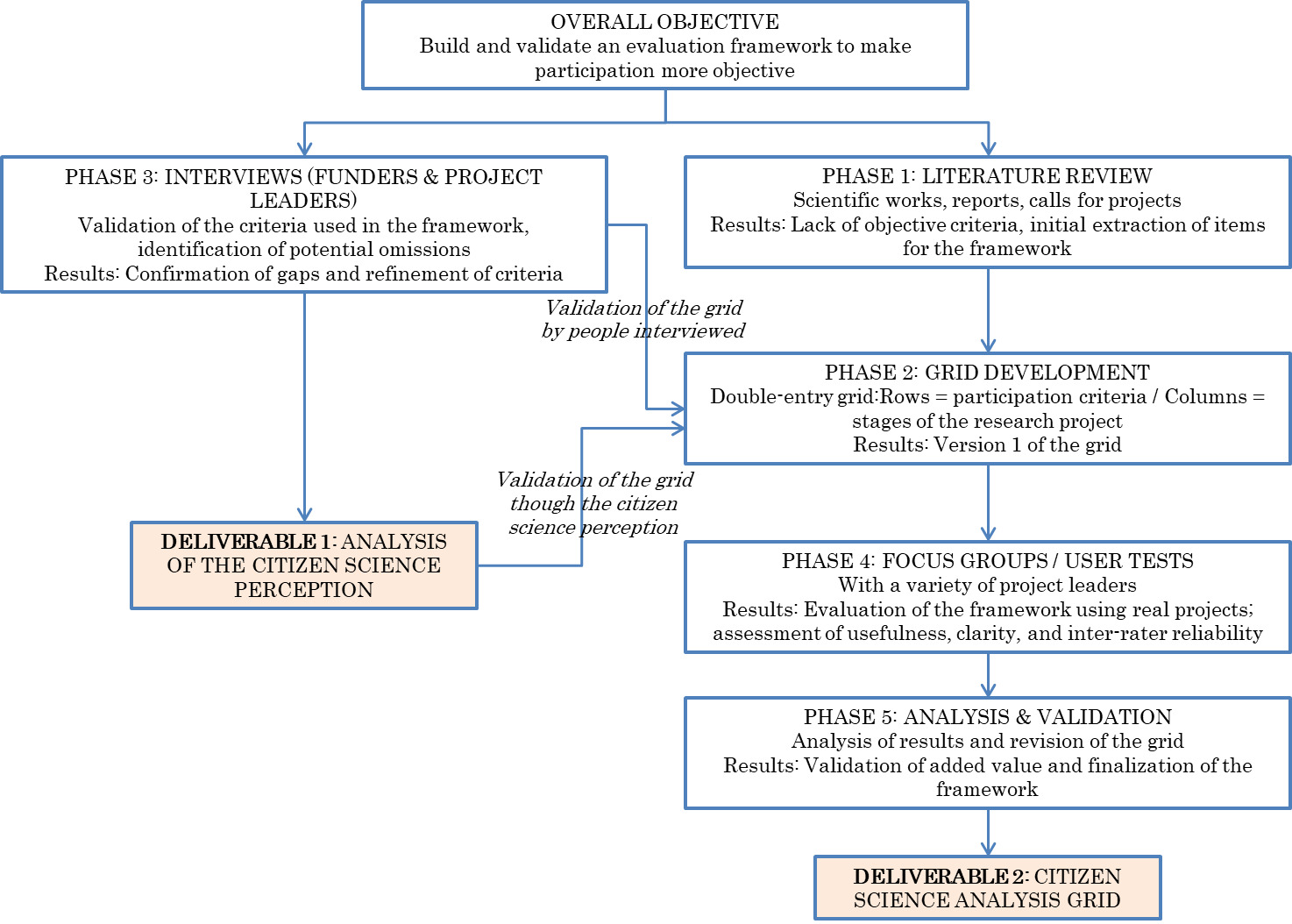
The methodology consisted of five main phases, from a literature review to the final validation of the analysis grid. Figure 1 provides a synthetic overview of this process.
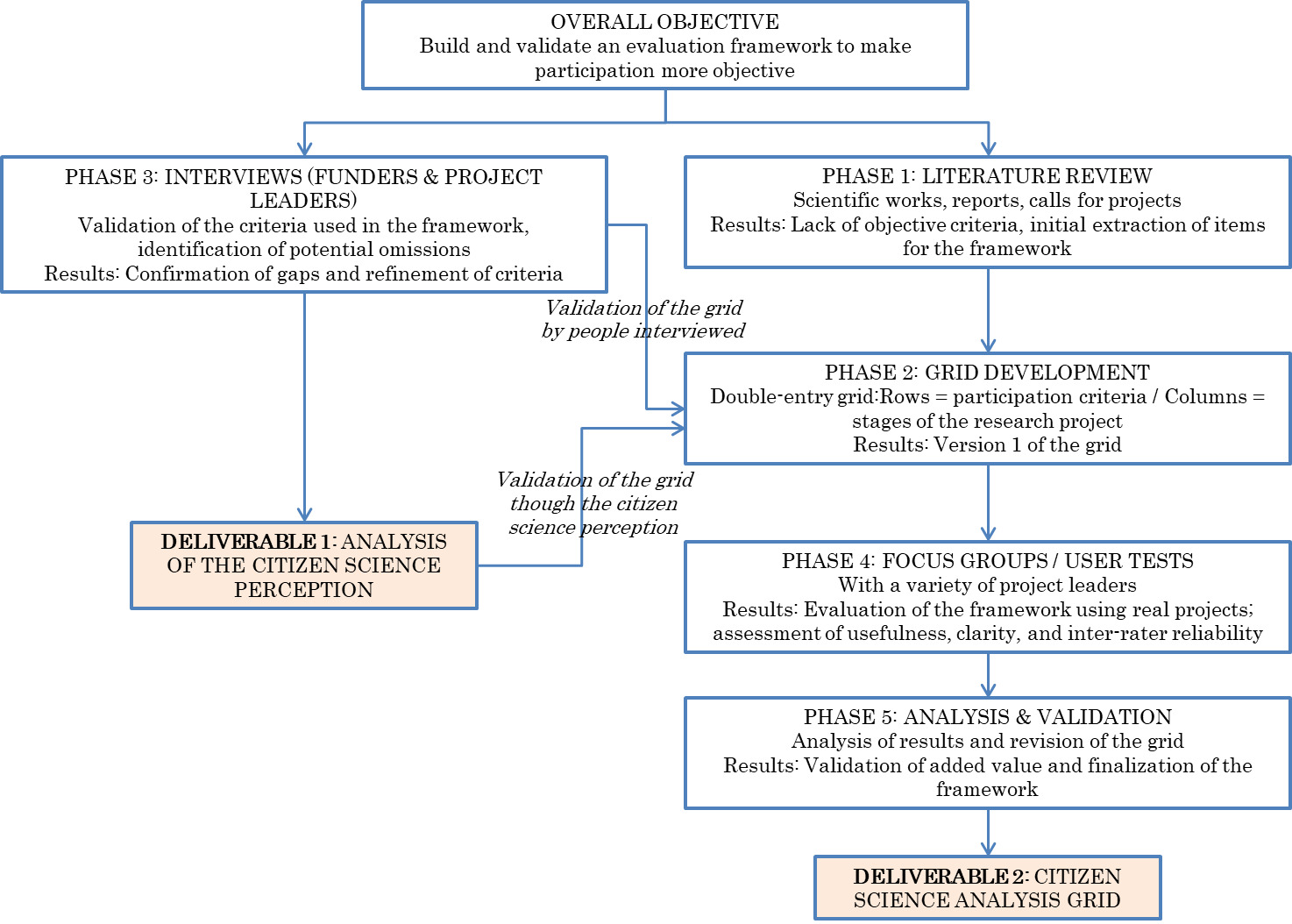
First, a literature review was conducted to identify the key criteria for characterizing participatory research projects, ensuring their effectiveness and alignment with research objectives, and the actions that can be implemented to minimize the risk of deviating from the initial aims of the participatory research process (phase 1).
This review drew on calls for proposals specifically dedicated to participatory science as well as academic literature that provided descriptions, classifications, or typologies of participatory research (cf. Section 2). The empirical basis for this study was focused on the French research ecosystem. Consequently, the interviews with funders and project leaders reflect the specificities, constraints, and institutional cultures of the French academic and associative sectors.
Concerning the calls of projects, four of them were identified in France in 2023:
-
“Participatory Science and Research” (SAPS) from the French National Research Agency (ANR)
-
“Co-Construction of Knowledge” (CO3) from the French Agency for Ecological Transition (ADEME)
-
Call for projects “What contribution do associations make to local areas?” from the French Institute for the Associative World (IFMA)
-
Call for projects “Participatory science action in interdisciplinary situations” from the French National Centre for Scientific Research (CNRS)
Based on their analysis, an operational gap emerged. While several national programs promote participatory science, none of them provide explicit, operational criteria for evaluating participation within research projects. This finding highlighted the need for a structured analytical framework capable of both characterizing participatory dynamics and supporting project design and evaluation
It also confirmed the lack of practical tools to support the design and implementation of participatory science projects, as well as the scarcity of detailed analytical frameworks for comprehensively evaluating and characterising them. This gap limits the ability to justify the “open” nature of research and complicates the selection of appropriate criteria for assessing project quality and relevance. Based on this review, we identified a set of participation criteria organized in an initial proposal for an analysis grid for participatory research.
This corresponds to phase 2 during which the first version of the grid was built as a double-entry matrix, where the rows represent participation criteria and the columns correspond to the successive phases of a research project.
The objective of this grid is not to ensure that all participatory aspects are addressed or that participation occurs at every stage of the project. Instead, it is designed as a decision-support tool to guide informed choices throughout the research process — whether during the project design phase (upstream), at key milestones (during implementation), or at the project’s conclusion (evaluation and self-assessment). To enrich this initial proposal with diverse perspectives, we conducted exploratory interviews and collaborative workshops with stakeholders involved in participatory science projects (phases 3 and 4). More specifically, phases 3 and 4 did not constitute final validation stages, but rather empirical phases used to discuss, test, and progressively refine the initial version of the grid developed in phase 2.
We first carried out exploratory interviews with both funders and leaders of participatory science projects (phase 3). To identify relevant contacts, we reviewed the participatory science project calls mentioned earlier. Among the four existing calls, we obtained the lists of 20 awardees from the 2022 edition of the ANR call for projects “Science with and for Society – Participatory Research 1” (SAPS-RA-RP1), and 10 awardees from ADEME’s CO3 call. From each of these two programs, five projects were randomly selected, and their leaders—representing both academic and civil society organizations—were contacted. We received responses from four of the five ANR projects (including two complementary interviews for the same project, one with the academic lead and one with the civil society lead) and from two of the five ADEME projects. Additionally, we interviewed one action research collective and contacted the coordinators of both calls for projects, receiving a response from one of them.
In total, nine one-hour videoconference interviews were conducted and fully transcribed, covering a wide range of disciplines across the social and natural sciences. The interviewees were not novices; they possessed significant expertise in the field of participatory science, having previously carried out or participated in multiple projects. The primary objective was to explore participants’ understanding and perceived added value of participatory research, their motivations for undertaking such projects, the challenges encountered during implementation, the criteria they associate with project success, and their approaches to evaluation and dissemination of results. A secondary objective was to collect feedback on the proposed analysis grid (following its presentations)—its perceived usefulness, limitations, and possible areas for improvement. The interview guide is provided in the Appendix A. These interviews were used not to validate the grid in a definitive sense, but to identify missing dimensions, discuss its relevance, and collect feedback for its revision.
Phase 4 consisted of two exploratory collaborative workshops aimed at practically testing and refining the grid. The grid was subsequently tested and refined during two exploratory collaborative workshops. These workshops aimed to apply the grid to participatory science projects at various stages of development—emerging, ongoing, or completed. Both sessions were held online (due to an insufficient number of participants for in-person meetings) and involved three associations active in science communication and the social and solidarity economy. Similar to the interviewees, the participants from these three structures were experts in participatory science with prior experience in similar projects.
The first workshop focused on defining and discussing practices related to participatory science, using a set of questions similar to those in the interview guide used with funders and project leaders (see Appendix A). After presenting the grid, participants engaged in a group discussion about its structure and relevance. The second workshop focused more on practical testing: participants were asked to complete the grid based on their own projects. The diversity of the three structures allowed us to test the grid on projects with different levels of maturity (all three stages of progress being represented). Data during these workshops were collected through detailed researcher notes.
Finally, phase 5 involved the analysis and validation of the grid. The interview transcripts and the workshop notes were analysed. The use of complete transcripts for the interviews allowed us to accurately capture the participants’ perceptions of participatory science and their practical applications (as detailed in the Results section), while the workshop notes provided direct feedback on the grid’s practical applicability. The feedback collected during interviews and workshops was analysed to identify the criteria that were most consistently validated and those requiring refinement. This phase resulted in the final adjustments of the grid and the production of the validated grid associated with its user manual. The final version of the grid is presented in the “Results” section. This phase was intended as a practical test of the grid on projects at different stages of development, in order to assess its usability and to identify points requiring clarification or revision before final validation.
Therefore, the involvement of non-scientific partners and project leaders during the collaborative phase 3 and 4 (interviews and workshops) went beyond mere validation. While Phase 2 produced an initial draft of the grid, this draft served primarily as a starting point to stimulate joint inquiry and co-design.
Results
The following section examines how participation is understood and mobilised by research project holders and funders throughout participatory science projects, based on interviews and collaborative workshops. It then presents the analytical grid developed in this research and discusses its perceived added value.
Analysing how participation is perceived and operationalised
The results of the semi-structured interviews and collaborative workshop provide insights into how participation is understood and implemented by project managers from academia and civil society, as well as the expectations of funders.
Overall, respondents describe a growing interest in participatory approaches, but one that is driven by different motivations. Researchers see it as a means of disseminating science, accessing otherwise inaccessible data, or addressing issues that are insufficiently covered by traditional research formats. Some are attracted to science communication, while others are simply curious about these approaches, without seeing them as a profound paradigm shift. Above all, they are looking for participatory expertise, tools, and a local anchoring to renew their research topics (Pandya, 2012; Vohland et al., 2021). Civil society organisations, for their part, are seeking methodological support, academic recognition, and a framework for addressing concrete local issues through participatory science.
The stakeholders interviewed generally distinguish between citizen science, participatory research and action research, although the boundaries between them remain blurred. These approaches are based on the co-production of academic and experiential knowledge to inform, transform and/or solve problems. However, the interviews highlight a frequent disconnect between the ambition to “involve citizens” and the concrete modalities of participation: while co-production is valued in funding, its practical modalities are rarely specified. The objectives and purposes differ significantly from those of academic research, making comparisons difficult. This also leads to different expectations and deliverables that must be discussed at the project design stage. For some, the approach can be perceived as utilitarian when participation primarily serves scientific needs. Several also mention a problem of legitimacy or fragmentation, as participatory research sometimes produces its own subjects (agriculture, education, health, environment) and social or technological innovations that do not easily fit into traditional academic frameworks.
Consortia are often formed on the basis of pre-existing collaborations, which facilitates the implementation of projects but limits the diversity of the stakeholders involved and sometimes the identification of the most relevant partners. Tasks are frequently divided according to a siloed logic, by discipline or type of stakeholders, which limits regular interaction and the construction of a genuine research collective. The role of a third-party facilitator (tiers-veilleur[2]) introduced by the ANR is seen as a step forward, although its use varies from project to project. Furthermore, the restrictive definition of “civil society” by some funders, excluding local authorities and education authorities, for example, reduces the possibilities for partnership.
Within projects, participatory mechanisms mainly take the form of confidentiality agreements, awareness-raising tools, data visualisation and sharing platforms, and support modelling. However, participation is often occasional and limited to specific stages of the project rather than being ongoing, relying mainly on surveys or feedback. The involvement of local representatives or political actors is considered essential to trigger a dynamic for action, but it is rarely anticipated in projects.
The issue of participant representativeness and data reliability is largely absent from initial considerations. When it is raised, respondents stated that few measures were planned to assess or ensure it. Data reliability is often relegated to the background due to a lack of specific criteria shared by project leaders and funders.
The obstacles identified include a lack of knowledge or mistrust of participatory approaches, inadequate academic structures, administrative red tape and organisational overload, which distracts project leaders from their scientific work. Added to this are difficulties in data management within the framework of consortium agreements and structural constraints such as the impossibility for an association to officially lead or co-lead a project. There is also a significant asymmetry in resources between academic institutions and civil society stakeholders, accentuated by a “threshold effect” that favours the best-resourced organisations. Collaboration can thus appear unbalanced, especially since funding arrangements often favour academic research. Funders want to strengthen the legitimacy of civil society stakeholders, but without really providing them with the means (time, budget, tools) to play a central role. In addition, co-construction requires additional resources – for communication, coordination, facilitation – that are often underestimated when setting up a project.
The definition of criteria for success also differs. For project leaders, the sustainability of the project, scientific recognition and regional impact are essential criteria, which call into question the persistent role of publication as the primary measure of academic success. For funders, the criteria are based mainly on quantitative indicators (number of responses, diversity of topics). The quality of co-construction is rarely explicitly evaluated, while interest in scientific publications remains strong.
Finally, although participatory science is perceived as a more holistic approach capable of transforming scientific and social practices, its evaluation remains difficult due to the lack of a standardised framework. This situation illustrates the gap between the formal promotion of participation and the limited consideration given to its methodological specificities. Overall, these projects struggle to be recognised as a mature approach due to a lack of consensus on their objectives, protocols and evaluation criteria. Greater institutional support therefore appears essential to enable these collaborative approaches to reach their full potential.
Development of the participatory science analysis grid
Presentation of the grid
The analytical grid presented in this section constitutes one of the main outcomes of this research (available in Tyl et al., 2026). It was developed to provide a structured framework for the qualitative analysis of participatory science projects and to address a recurrent challenge in this field, i.e., how to characterise and reflect upon the participatory dimensions of research practices. Rather than functioning as a formal evaluation tool, the grid is conceived as a process-oriented and operational instrument that makes it possible to assess degrees of participation and to identify areas for adjustment or improvement over the course of a project.
The grid is designed as a reflexive support tool for structuring participatory approaches and fostering ongoing critical reflection. It aims to support project stakeholders—researchers, coordinators, and non-academic participants alike—in planning, implementing, and analysing participatory research in a collaborative and inclusive manner. Inspired by Jones’ (2003) concept of “micro-tools,” the grid is intentionally simple, autonomous, and adaptable, allowing for quick appropriation and iterative use throughout the life cycle of a project. It can be mobilised at different stages—during project design, implementation, monitoring, or final assessment—and can be completed collectively in order to stimulate dialogue, clarify expectations, and support shared decision-making.
The grid begins with a series of open-ended questions intended to situate and describe the project. These questions aim to clarify project objectives and expectations, identify the composition of the consortium (including key partners and their roles in decision-making processes), and explore the relevance of adopting a participatory approach. This initial step encourages project teams to explicitly articulate the motivations, values, and needs underpinning participation, as well as the anticipated contributions of non-academic actors, particularly in terms of governance.
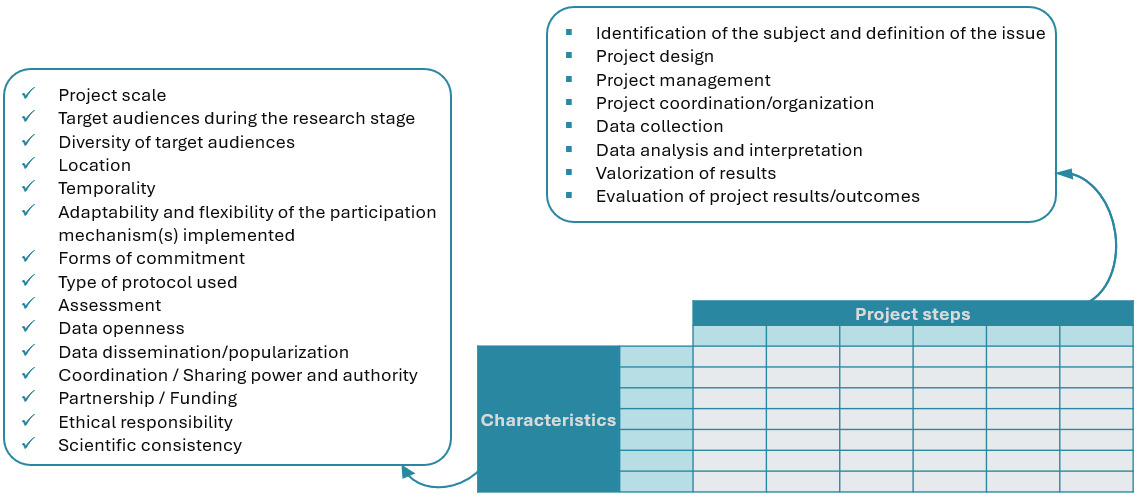
The core of the tool consists of a double-entry matrix that crosses the main stages of a research project with a set of analytical dimensions related to participation as illustrated in Figure 2. The columns represent successive stages of the research process: identification of the topic and problem definition; project design and planning; project management and coordination; data collection; data analysis and interpretation; dissemination and valorisation (uptake) of results; and evaluation and project follow-up.
The rows correspond to key dimensions of participation, identified through the literature and refined through empirical discussions conducted during interviews and collaborative workshops. These dimensions include:
-
Target audiences and diversity of participants, examining who is involved and how representativeness is addressed;
-
Locality and territorial anchoring, assessing how the project relates to its social and territorial context;
-
Temporality and duration of engagement, identifying when and for how long participants are involved;
-
Participation mechanisms and forms of engagement, analysing how participation is organised (e.g. consultation, collaboration, co-decision-making);
-
Type of research protocols and data management, distinguishing between standardised and co-designed approaches;
-
Resource management, governance, and funding transparency, addressing coordination, accountability, and sustainability;
-
Communication and accessibility of results, including data openness, feedback mechanisms, and knowledge sharing;
-
Ethical responsibility and power relations, considering consent, fairness, and the protection of participants;
-
Scientific coherence and credibility, ensuring alignment between participatory practices and methodological rigour.
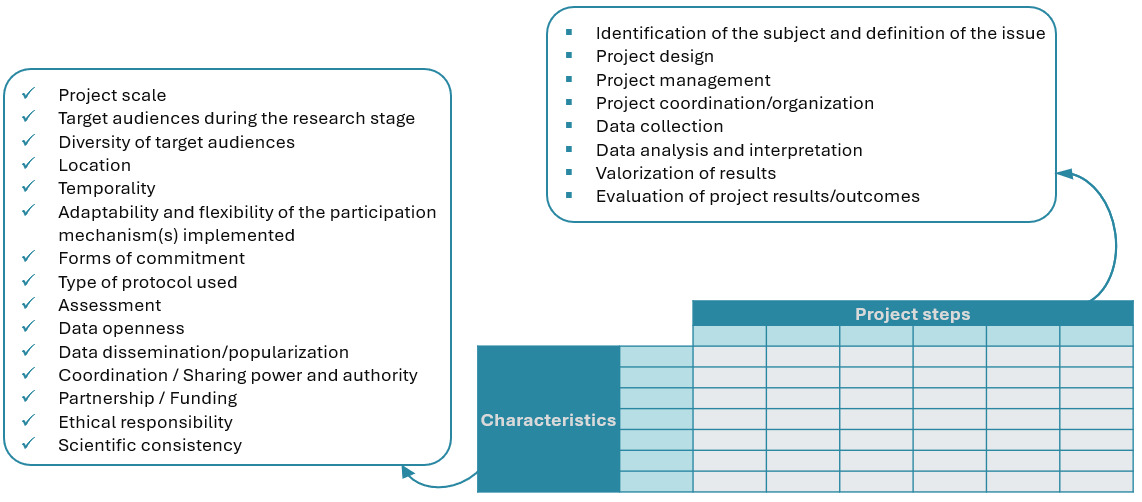
Each cell of the matrix invites users to describe or document how participation is articulated at the intersection of a given project stage and a given analytical dimension. This structure enables a cross-sectional reading of projects, making it possible to identify where participation is strong, partial, or absent, and to observe how participatory and conventional research logics coexist, overlap, or remain compartmentalised.
To support this analysis, the grid explicitly distinguishes between “conventional research” and “participatory research” practices. This dual perspective allows users not only to identify participatory elements, but also to examine how—and to what extent—they are integrated into the overall research process. In doing so, the grid helps reveal potential discrepancies between stated participatory intentions and actual practices.
The grid is accompanied by a user guide that details its underlying logic, clarifies key concepts, and provides examples of use. Users are explicitly encouraged to approach the grid not as a checklist, but as a reflexive framework for examining how participation is conceived, implemented, and valued. In this sense, the grid can operate both as a monitoring tool and as a self-assessment device, contributing to transparency and to the overall quality of participatory science projects.
Beyond its formal structure, the grid offers several concrete contributions to the analysis and steering of participatory science projects. It provides a systematic framework for examining citizen involvement across all stages of the research process, rather than treating participation as a single, undifferentiated project characteristic. In doing so, it functions as a decision-support tool, enabling project leaders to adjust participatory arrangements over time rather than relying solely on ex-post evaluation. It also explicitly foregrounds issues of governance and power-sharing, drawing attention to the allocation of roles, responsibilities, and decision-making authority between researchers and non-academic participants.
At a more analytical level, the grid supports a differentiated reading of participatory practices. It makes it possible to distinguish varying degrees of citizen involvement, ranging from simple data contribution to full co-construction of research processes, while simultaneously encouraging reflection on the diversity and representativeness of target audiences. By doing so, it highlights the risk of restricting participation to already-engaged or socially advantaged groups. Finally, the grid opens up a space for considering broader societal and policy implications, by prompting users to reflect on how research outputs are mobilised, appropriated, and translated into decision-making or social and environmental change.
It is important to underline that this grid is designed to be fully modular and flexible, meaning it can—and often should—be only partially filled out. As highlighted in literature, evaluation methodologies for participatory science must be modular to adapt to the specificities, limited resources, and varied capacities of different projects, allowing for a high degree of personalization (Passani et al., 2022). Therefore, it is not intended to serve as a normative checklist, but rather as a reflexive framework that opens up the field of possibilities, prompting project leaders to ask critical questions across the different stages of the research process.
The grid does not treat knowledge as an isolated output detached from the research process. Rather, it documents the conditions under which knowledge is produced, discussed, and validated by making explicit the roles of participants, the types of protocols used, the forms of engagement, the moments of deliberation, and the guarantees of scientific coherence. In this sense, the grid helps relate participatory research to more conventional forms of research, not by opposing them, but by making visible, in both cases, how evidence is generated and under what methodological and organisational conditions.
To illustrate how this non-linear and iterative process is managed by actors, typical use-case scenarios are provided in Appendix B.
Perceived added value of the grid
Insights from the interviews
The presentation of the participatory science analysis grid elicited a wide range of reactions from project leaders. Overall, the tool generated both interest and constructive debate, showing the diversity of expectations and practices within the participatory research community. Most interviewees expressed a clear willingness to test the grid, perceiving it as a useful means of structuring their approach and drawing inspiration from existing frameworks, such as those used by the French National Research Agency (ANR) or other typologies described in the literature (see Section 2).
Several respondents noted similarities between the proposed grid and tools used in participatory biodiversity programmes or association-based project design processes, suggesting that the grid could be transferable across a variety of participatory research contexts. At the same time, some reservations were expressed. A number of participants perceived the grid as potentially rigid, raising concerns that it might constrain the flexibility and creativity often associated with participatory projects. Others expressed discomfort with critically examining their own practices, particularly when participation remained informal or was still under development.
Questions were also raised regarding the scalability of the grid and its applicability to small-scale or experimental initiatives. These concerns reflect a broader tension between the need for methodological structuring and the desire to preserve the open-ended and adaptive character of participatory inquiry.
Importantly, interviewees generally acknowledged that the individual items included in the grid were not, in themselves, innovative. Rather, its added value lay in the systematic organisation of these elements and in its capacity to support continuous reflection throughout the project life cycle. The two-dimensional structure was particularly appreciated for providing a clear and comprehensive overview of the research process, enabling users to identify underdeveloped or overlooked dimensions of participation.
In a funding context where calls for participatory projects do not always require explicit justification of governance arrangements or participatory methods, the grid was also perceived as a potential transparency-enhancing tool. Several participants suggested that it could be used by project coordinators, evaluators, or third-party facilitators (tiers-veilleur) to ensure that key aspects of participation are explicitly addressed and documented. Some even proposed that the grid could be included as an appendix to calls for projects, functioning both as a planning aid and as a formal commitment to participatory quality.
Insights from the collaborative workshops
The collaborative workshops further confirmed the grid’s added value as both a reflexive and an evaluative support tool. Participants highlighted its usefulness in encouraging systematic discussion of the participatory dimensions associated with each stage of a research project. In particular, the grid was effective in revealing “blind spots,” such as limited participant involvement in decision-making and in defining results, insufficient attention to representativeness, or a lack of explicit ethical safeguards.
The formulation of the analytical dimensions as questions rather than prescriptive criteria was widely perceived as a strength, as it invites discussion and interpretation rather than mere compliance. The possibility of using the grid iteratively—during project design, implementation, progress reporting, and final evaluation—was also seen as a major advantage, fostering learning and reflexivity over time.
Participants proposed several concrete improvements, many of which were incorporated into the final version of the grid. These included the refinement or subdivision of certain project stages, the clarification and enrichment of several analytical dimensions, the addition of dimensions that were initially insufficiently visible, and improvements to overall clarity and readability for its practical use.
Indeed, on the latter, workshop participants noted that the grid may appear complex without appropriate facilitation or guidance, given the number of dimensions and stages involved. As a result, it was viewed less as a stand-alone self-assessment tool than as a resource for facilitation and collective steering. Discussions also raised methodological questions regarding modes of use: whether the grid should be completed individually by different stakeholders, collectively in a participatory setting, or used as a discussion support to surface divergent perceptions (e.g., about power, legitimacy, or expected results).
From a practical perspective, the spreadsheet format of the grid was considered accessible and adaptable. Participants suggested simple usability improvements—such as freezing the first row and column corresponding to project stages and analytical dimensions—to improve navigation and readability.
Discussion and conclusion
Through a combination of literature review and empirical insights drawn from interviews and collaborative workshops, this research has examined how participatory and citizen-based approaches are increasingly mobilised within research and policy contexts characterised by socio-environmental transitions. While these approaches have contributed to widening the range of actors involved and diversifying participatory practices, our findings highlight persistent tensions between participatory ambitions and their concrete operationalisation. In response, this study proposes an analytical grid designed not as a normative evaluation instrument, but as a reflexive support tool for the design, governance, and in itinere assessment of participatory science projects.
Contributions of this research: participation as a design space
This study makes two main contributions to the understanding and operationalisation of participatory science in territorially anchored and transformative research.
First, it helps clarify participation as a design space for research projects, rather than as a generic label attached to research projects. The literature consistently shows that participation generates scientific and civic value when it is “deliberately” designed, resourced, and staged over time as a research regime, and not as a one-off method (Adler et al., 2020; Vohland et al., 2021). This implies clarifying objectives across multiple registers — scientific, civic, territorial, and policy-related — and aligning participatory modalities with these objectives throughout the research process (Adler et al., 2020; Shirk et al., 2012; Vohland et al., 2021).
However, our empirical findings show that these principles remain difficult to translate into operational research architectures. In practice, participation is often weakly formalised, particularly with regard to representativeness, data-quality procedures, and the temporal organisation of collaboration. This gap reflects a broader structural mismatch between the rapid growth of participatory ambitions and the slower development of the institutional, financial, and methodological infrastructures required to sustain participation as a cumulative and accountable research regime.
This mismatch manifests in two recurrent tendencies. First, participation is frequently reduced to any form of interaction beyond the laboratory, blurring distinctions between information, consultation, collaboration, and co-decision. Second, funding and evaluation frameworks remain largely centred on conventional academic outputs, while collaboration with non-academic actors — often grouped under the broad and weakly defined category of “third actors” — is insufficiently recognised or resourced (Houllier & Merilhou-Goudard, 2016; Serret et al., 2019; Shirk et al., 2012; Vohland et al., 2021). As a result, participatory projects tend to internalise coordination and facilitation costs while externalising scientific and organisational risks, reinforcing asymmetries between well-resourced institutions and smaller, field-based organisations. Without explicit outreach strategies and dedicated facilitation capacity, representativeness remains aspirational and participation remains episodic rather than cumulative. These findings point to the need for tools capable of stabilising, documenting, and justifying participatory choices throughout the research process.
Second, this study contributes an analytical grid that operationalises these insights by formalising the process conditions under which participation is organised. The grid explicitly integrates intermediary actors — such as local research–society hubs, associative networks, and inter-municipal structures — not as peripheral partners but as resourced components of participatory research architectures. By doing so, it provides a structured way to account for how these intermediaries widen publics and connect research activities to decision-making arenas (Houllier & Merilhou-Goudard, 2016; Vohland et al., 2021).
Combining a process-based perspective (i.e. successive stages of the research process) with a set of qualitative analytical dimensions, the grid is not conceived as a post hoc scorecard. Rather, it is a means-oriented framework that clarifies how participation is integrated into research design and governance. In this sense, it shifts attention from outcomes — necessarily uncertain in participatory science — to the integrity, transparency, and inclusiveness of research processes.
The grid does not replace scientific results. Instead, it contributes to making participatory research traceable and auditable by documenting how roles, protocols, and decision points evolve over time and how participation shapes the production of evidence (Pandya, 2012; Serret et al., 2019). In applied terms, it invites project teams to make explicit their participatory theory of change, to stabilise a minimal set of process indicators that can be followed over time, and to associate data-quality criteria adapted to each participatory device. These indicators — such as recruitment pathways, participant retention, deliberation moments, or verification procedures — do not substitute for scientific results, but rather render them intelligible and comparable across projects by documenting the conditions under which knowledge was produced (Pandya, 2012; Serret et al., 2019).
Limits of this research and perspectives
This research and the analytical grid have some limitations that open avenues for future work.
At an empirical level, a primary limitation of this research is its geographical and institutional scope. The analytical grid and the empirical insights (interviews, workshops) were developed specifically within a French research context. While this allowed for a deep analysis of specific institutional mechanisms, it may not fully capture the dynamics present at the broader EU level or in other international regions with different participatory processes.
Moreover, the study is based on a limited number of interviews and workshops, primarily involving actors engaged in participatory research programmes led by academic institutions. Intermediary organizations and community-based structures remain underrepresented in the interview sample (Phase 3). This imbalance is primarily due to the sampling strategy, which relied on the official lists of funded projects from national agencies (ANR and ADEME). Furthermore, despite targeted efforts to involve them, community-based structures often face significant constraints regarding time, funding, and human resources, making them less available for research interviews. Future research should therefore broaden the range of actors involved and systematically include intermediary organisations to fully capture how they experience constraints, negotiate roles, and manage tensions within participatory research.
Regarding the grid itself, while it provides a structured framework, several methodological and practical limitations must be acknowledged. First, regarding the ease of use, filling the squares of the matrix is not necessarily a straightforward task. The grid cannot be considered entirely self-explanatory. Because participatory science involves complex, context-dependent dynamics, translating these realities into the specific cells of a matrix requires a certain level of conceptual familiarization. This is precisely why the grid is accompanied by a user manual and why, as illustrated in the use-case scenarios, the involvement of a facilitator (such as an intermediary actor) is highly recommended to guide the process.
Second, deciding what to write in a specific square can be challenging because stakeholders often have differing perceptions of what constitutes “participation” or “governance.” However, this difficulty is inherent to the tool’s design: the friction experienced when trying to agree on how to fill a cell is exactly what triggers the necessary reflexive dialogue. The grid is not designed to produce objective, standardized metrics, but rather to capture the intersubjectivity of the project team.
Finally, a significant practical limitation is the risk of the grid becoming an administrative burden. Project leaders and civil society partners often operate under strict time and resource constraints. If the tool is perceived merely as another bureaucratic requirement or a rigid “tick-box” exercise rather than a flexible boundary object, it will fail to foster genuine critical reflection. Therefore, its successful application relies heavily on the willingness and availability of the actors to engage sincerely with the reflexive process it demands.
To overcome these limits, further work is needed to move beyond collaborative workshops towards extended testing across disciplines, project temporalities, and institutional configurations. The grid should be applied to projects at different stages—design, implementation, completion—and by different users, including project leaders, participants, evaluators, and funders. It should also be tested across disciplinary contexts with varying participatory traditions, from fields with long-standing experience (e.g. ecology, medicine, astronomy) to those where participation is less established (e.g. engineering, economics, informatics), in order to assess its adaptability to different epistemic cultures.
Another limitation relates to the primary users of the proposed grid. This grid is an evaluation of participation, but it is not, in its current form, a participatory evaluation tool. As noted by Wehn et al. (2021), a fully participatory evaluation requires involving citizen scientists not only in data collection but also in devising the relevant impact assessment indicators themselves. Therefore, the current tool is not inherently participatory, but it is a promising perspective for future research to check if it is appropriate for such evaluation.
Finally, while the grid encourages justification of means rather than results, this orientation currently lacks full recognition within funding and evaluation systems. Advancing participatory science therefore also requires institutional changes that explicitly value process-oriented work — such as facilitation, coordination, and long-term engagement — within project assessment and funding mechanisms.
Toward a critical and politically reflexive analysis grid
A strong justification for developing an analytical grid lies in its capacity to support serious and structured reflection on citizen participation in research. However, such a tool also carries risks. As long emphasised in critical participation studies, participation should not be assumed to be inherently virtuous or self-correcting (i.e. the critique of the “participation tyranny” (Cooke & Kothari, 2001)). Without a reflexive stance, evaluation tools may inadvertently reproduce the very depoliticising tendencies they seek to counter, translating complex power relations into procedural checklists.
A first challenge concerns the risk of depoliticization (Williams, 2004). Participatory practices may serve either to redistribute power and open decision-making, or to stabilise institutional legitimacy without altering underlying asymmetries. An analysis grid must therefore allow users to interrogate whether participation functions as a space for emancipation or as a mechanism of control. In this sense, the grid should not merely assess how participation is organised, but also why it is mobilised and whose interests it ultimately serves (Stilgoe et al., 2014).
Furthermore, participatory discourse does not necessarily signal a commitment to democratic transformation. Actors may engage in participatory projects for diverse reasons, including access to funding, professional positioning, or territorial branding. A reflexive grid should therefore help make visible the plurality of motivations underpinning participatory evaluation itself and examine how these motivations shape research practices.
Even though these aspects are embedded in the grid, they remain only partially explored and call for further research, as each criterion could constitute a research object in its own right, enabling deeper analysis of participatory dynamics and the construction of robust indicators or scales.
Finally, the grid should not aim to stabilise meanings or impose a singular model of “good participation”. Its value lies instead in its capacity to make tensions visible and to open spaces for critical dialogue about the conditions, limits, and political implications of participation. In this perspective, hybridising the grid with approaches such as Illich’s notion of conviviality — emphasising tools that enhance autonomy rather than bureaucratic control (Illich, 1973) — could offer promising avenues for future research. Used critically, the grid can thus contribute not to the standardisation of participatory science, but to its continued pluralisation and politicisation.
Funding
This work was co-funded by the Nouvelle-Aquitaine region and by the European Regional Development Fund (FEDER).
Acknowledgment
The authors would like to sincerely thank all the individuals who agreed to be interviewed for this research, as well as the participants of the workshops for their valuable time and insights for the analysis grid.
Contribution
The three authors contributed equally to the conceptualisation, methodology, experiment, validation, writing, review and editing, as well as to the funding acquisition.
Ethic statements
All procedures performed in this study involving human participants were conducted in accordance with standard ethical guidelines for qualitative research. Prior to participation, all individuals involved in the interviews and workshops were informed about the purpose of the research, the nature of their participation, and how their data would be used. Informed verbal consent was obtained from all participants before any data collection or recording commenced. Participation was entirely voluntary, and participants were informed of their right to withdraw from the study at any time without providing a reason. To ensure confidentiality, all interview transcripts and workshop notes were anonymized, and any identifying information regarding the participants or their specific projects was removed or generalized in the final reporting.