
Participatory Drawing as a Method to Explore Youth Sense of Place
Reductive conceptions of young people often position them as “passive recipients” of institutional and material conditions (H. Cahill & Dadvand, 2018, p. 249), as opposed to civic actors who can advocate for and enact social change. Relatedly, the assumption that youth are not equipped to reflect deeply on social and structural challenges that affect them (Sinclair et al., 2023) can influence how youth are engaged in research designed and led by adults (Literat, 2013; Tuck & Habtom, 2019). These dynamics can shape what is studied and how young people’s insights are presented to adult audiences (C. Cahill, 2007; Hart, 1992; Spyrou, 2018).
These dynamics represent adultism: a series of beliefs reflected in social structures and everyday practices that are rooted in the idea that adults are superior to youth (Bañales, 2024; Corney et al., 2022). Researchers can use participatory methods in youth-oriented research to challenge adultism and better understand young peoples’ knowledges, perceptions, and ideas about their worlds. Creative visual methods are one such approach, broadening the ways young people can share their insights and build spaces for creation and reflection within the research encounter. Visual methods offer the opportunity to think with young people as they reflect on their social and physical environments, including their relationships to the places they inhabit amidst everyday social relations and dynamics of power–a series of relationships sometimes referred to as sense of place (Manzo et al., 2023). Participatory drawing in particular has been incorporated in research alongside young people to build rapport, offer space for creative and in-process reflection, allow for multiple forms of expression (Literat, 2013; Yuen, 2004), and to better understand their sense of place (Gillespie, 2010; Trell & van Hoven, 2010).
In this paper, we discuss a participatory drawing approach we have used in focus groups as a part of a larger longitudinal evaluation of a place-based action civics curriculum, Design Your Neighborhood (DYN). We discuss how the approach has changed over time, adapted to meet project and contextual needs, account for facilitator strengths, and better link visual and verbal data. We offer early findings and insights, highlighting possibilities and limitations of the approach as both a tool for engagement and a method for data collection. Through this work, we have found that exploring place-based experiences through participatory drawing can enrich youth-oriented focus groups, as the method enables opportunities to build comfort and rapport with and among youth participants, strengthen overall engagement, and serve as an additional artifact within the study.
Exploring Youth Sense of Place in Research
Research across disciplines has explored young people’s relationships with the places they occupy and move within (Valentine, 2019). One theory used to better understand these relationships is sense of place. Manzo et al. (2023) describe sense of place as “the constellations of place interpretations, meanings, and values continually formulated and negotiated among collectives of people in an uneven landscape of power” (p. 37). For young people, these uneven power landscapes include surveillance in public spaces, experienced disproportionately by Black and Brown youth (Fine et al., 2003; White, 1996), adult-controlled schedules in school and home spaces (Holloway & Valentine, 2000), and adult-managed or restricted engagement with public places (Skår & Krogh, 2009; Valentine, 2004). Conceptually, sense of place reflects how individuals and groups make meaning of their physical environments, as well as feelings of bonding or attachment to important places (Erfani, 2022; Hay, 1998).
Neighborhood features in particular can support a strong sense of place for youth. In a study with youth in Milwaukee, Wisconsin, participants who knew of a nearby natural area to play reported a stronger sense of place, defined by feelings of safety, social cohesion, place identity (or how much the neighborhood represents personal identity), and symbolic meanings of neighborhood ecological features (Kroencke et al., 2015). Prior research has found that young people’s perspectives on their neighborhoods are distinct from adults; for example, youth perceptions of dynamics like social cohesion, safety, and crime differ from those of their parents (Colburn et al., 2020). As a result, it is vital to engage young people in research on their neighborhood environments and consider their ideas and insights when generating plans for place-based community development and change (Mansfield et al., 2021).
Researchers have explored young people’s sense of place and neighborhood perceptions using a variety of methodological approaches, including walking interviews (Alicea, 2023) and go-alongs (Kusenbach, 2003). These mobile methods (Kusenbach, 2012), in which a participant brings the researcher on a route that is personally meaningful to them (Carpiano, 2009; Kusenbach, 2003), can embed the researcher in a participant’s environment, where the participant serves as guide and place expert. Below we describe additional ways scholars have collaborated with young people to conduct research on topics that are central to their lives. Specifically, we explore creative visual methodologies as an approach in research with young people that seeks to prioritize their insights rather than adult perceptions or interpretations of these insights.
Research With Youth: Visual Methodologies
Young people are often considered the subjects of research, as opposed to valuable collaborators. As a result, much research on youth fails to adequately represent their ideas and perspectives. Creative visual methods have the potential to center youth perspectives and support youth meaning-making. Methods such as photo-elicitation, photo mapping, drawing, and collage allow adult researchers to learn alongside young people, prioritizing youth participants’ meaning-making over pre-determined research agendas (Ergler, 2017; Pinter & Zandian, 2015). Creative activities with participants in focus groups can also push the bounds of power-sharing in adult-led research (Walters, 2020; Yuen, 2004). For example, these activities can support facilitators in relinquishing control in the focus group environment, centering what is authentically generated and subsequently discussed by participants. The use of participatory methods like drawing, particularly when the adult is drawing with participants, can also distinguish adult researchers and/or evaluators from other adult roles (e.g., teacher) in formal or hierarchical settings. For research taking place in schools, activities at the beginning of a focus group can “diffuse the formality of the school setting” (Walters, 2020, p. 237), supporting researchers in building rapport with the youth participants.
In this paper we use “participatory” in our description of the method to denote that drawing was employed to support deeper engagement and increased participation of students in our evaluation study, similar to other researchers who have used drawing in their evaluation research design (Literat, 2013). The participatory drawing method used in our focus groups was one aspect of an evaluation study conducted through a research-practice partnership, and we do not see this drawing approach alone as a community-engaged methodology like participatory action research (C. Cahill, 2007). However, we do believe that the approach supported engagement more than a words-alone method of data collection and offered an avenue to explore students’ place-based experiences (Literat, 2013; Power et al., 2014).
Although visual methods in research with young people can help subvert adult researchers’ influence in the research process (Yuen, 2004), they are more likely to do so when integrated into action research approaches that prioritize youth leadership and knowledge generation throughout the entire process of inquiry (Cammarota & Fine, 2008; Fine et al., 2003; Ozer, 2017). For example, participatory visual methods were effectively incorporated in the Making Sense of Movements (MSOM) project led by Black and indigenous youth researchers detailed in Tuck & Habtom’s (2019) work. The approach incorporated annotations and redactions of photographs taken using photovoice methodologies, emphasizing additional practices of choice and refusal by youth researchers not always included in photovoice projects. MSOM also incorporated place-based methods like community mapping, where researchers drew maps of their own communities and connected their maps to other researchers’ to discuss alignment and divergences in their community representations (Tuck & Habtom, 2019). In addition, Yonas et al. (2009) highlight the Visual Voices method designed to position young people as co-researchers and knowledge producers in creative inquiry. The Visual Voices method was used to explore perceptions of youth safety and wellbeing in community-based participatory research in both Baltimore and Pittsburgh, including places that felt safe and unsafe (Yonas et al., 2009). Photovoice has also been employed by youth organizers in a project that advocated for mobility justice (Romano et al., 2022) and used to highlight the impacts of property vacancy on youth residents (Teixeira, 2015). Together, these studies reflect the potential for youth leadership in creative research exploring place and place-based experiences. Youth-led participatory research projects can effectively incorporate visual methods to highlight social injustice and inequity in the built environment, and to advocate for place-based action and change (Aldana et al., 2021; Topmiller et al., 2015; Tuck & Habtom, 2019).
Participatory Drawing in Focus Groups
Previous research with youth has pointed to benefits of incorporating participatory drawing into focus groups. Drawing is a co-constructive approach (Literat, 2013) that can create a relaxed atmosphere and enable researchers to learn from young people through their own imaginings (Yonas et al., 2009; Yuen, 2004). Drawings have been used, for instance, to explore youth perceptions of the “ideal” school (Loureiro et al., 2020), the meanings of third places (Arlinkasari, 2023), young women’s visions of their future selves (Nungsari et al., 2024), children’s experiences during the COVID-19 lockdowns (Idoiaga Mondragon et al., 2022), and Black young people’s perceptions of the multiple pandemics of police violence and COVID-19 (Barton & Cappello, 2023). Collectively, findings from these studies show that visual activities can elicit concrete representations of abstract ideas like play, belonging, safety, and inclusion, and reflect young people’s gendered and racialized experiences. The embodied process of drawing can also support participants as they make meaning of these ideas (Yuen, 2004). Using the physical body can move the artist past simple recollection into an engagement with the world they are depicting (Literat, 2013). Drawing also has the potential to be more generative than digital photos or videos in research, because “one has to actually draw the world into existence,” and not just capture elements of an already-existing environment (Literat, 2013, p. 88). Drawings can be used both as a tool for engagement in focus groups or as data in and of itself (Gillespie, 2010; Loureiro et al., 2020; Yuen, 2004).
Researchers have approached the analysis of drawings generated in research with young people in various ways. Some researchers have used rubrics to quantify or compare particular features or elements of drawings (Gillespie, 2010; Idoiaga Mondragon et al., 2022; Nungsari et al., 2024). Researchers like Walters (2020) have used drawings primarily as stimuli to enrich the discussion between participants during focus group conversations. Others have used drawing to contextualize or add to what is shared by participants in studies using multiple methods (Colburn et al., 2020; Trell & van Hoven, 2010). We discuss both the possibilities and limitations in the analysis of drawings generated by youth participants more below.
Sketch Maps, Mental Maps, and Qualitative GIS
In our study, we asked participants to draw their neighborhood as they see it. They were asked to recall, from memory, a familiar physical environment to explore their feelings and experiences in that environment, as well as add additional features to improve their neighborhood. This participatory drawing approach, which generated neighborhood sketches, is a visual place-based method (Carlson, 2025; Tuck & Habtom, 2019). Maps created from memory have been referred to as sketch maps (Moran et al., 2017), mental maps (Ehrkamp, 2013; Trell & van Hoven, 2010), and cognitive maps (Gillespie, 2010). Some authors argue that sketch maps require sketches on top of maps (Boschmann & Cubbon, 2014; Pearsall et al., 2015), while other researchers use the term sketch map to denote from-memory drawings of places (Moran et al., 2017). This choice often depends on the orientation to the research–if researchers are hoping to understand the relationship to particular physical locations (i.e. intersections, blocks, or small subdivisions), then sketch maps on existing geographic maps may be the best fit. However, sketch maps drawn from memory can still elicit meaningful reflections on place-based experiences (Blades, 1990; Moran et al., 2017; Rissotto & Tonucci, 2002).
Related methods for exploring youth-place relations include deep mapping (Webber et al., 2024) and thick mapping (Nelischer, 2025). These approaches layer qualitative representations of place-based relationships and experiences on top of a cartographic representation of a space (Nelischer, 2025; Webber et al., 2024). For example, Webber et al. (2024) used deep mapping to explore the sense of place of 6-11 year olds in Bristol, United Kingdom, particularly focusing on most-often-visited places at two points during the Covid-19 lockdown. Participants were asked to map their world at this time, and then reflect on their drawings, adding notations or additional elements. Drawings reflected how youths’ relationships with their environments changed during the pandemic, representing limits on movement and their inability to visit places they typically enjoyed, such as parks or pools (Webber et al., 2024). These mapping approaches are both forms of qualitative GIS, which connects qualitative and spatial methods “to imbue spatial data with qualitative meaning” (Teixeira, 2018, p. 11).
Qualitative geographic methods can be a natural fit for participatory research. Topmiller et al. (2015) connect community-based participatory research with participatory approaches to GIS, showing how young people in public participatory GIS projects represent “their perceptions of neighborhood environments and to then use those maps as tools for advocacy” (p. 3). Although our participatory drawing approach is not a qualitative GIS approach since it does not layer spatial or GIS data and visual neighborhood representations, it shares an orientation with the various place-based and mapping approaches that have been used to explore young people’s feelings, experiences, and perspectives on their physical environments.
Project and Study Context
This article draws on a longitudinal evaluation of Design Your Neighborhood (DYN), a place-based action civics curriculum implemented in middle schools in Nashville, Tennessee, USA. At the end of a two-week curriculum, students were invited to participate in a focus group to reflect on their experiences and perceptions of their neighborhoods.
Design Your Neighborhood (DYN)
Design Your Neighborhood (DYN) was developed in 2017 by the Civic Design Center, a Nashville nonprofit that advocates for equitable urban design through education, community engagement, and policy influence. One of the Civic Design Center’s landmark projects was the Plan of Nashville, a 50-year vision for the city developed through a participatory design process that engaged hundreds of residents (Kreyling, 2005). Building on this legacy, the Civic Design Center sought to integrate similar principles into public education by equipping young people with the knowledge and tools to help shape their city through a district-wide curriculum embedded in Metro Nashville Public Schools (MNPS) with the goal of reaching every student before graduation.
DYN builds on the model of action civics, in which students move through cycles of analysis, issue selection, research, planning, action, and reflection (Morgan & Ballard, 2024). By rooting this process in Nashville’s urgent challenges, including rapid growth, uneven development, and underinvestment in public transportation and neighborhood schools, DYN is a place-based intervention. The local context is central, serving as both backdrop and catalyst for students’ inquiry. Through their projects, youth practice connecting curricular concepts to their lived experiences.
The multi-week DYN curriculum was originally designed for middle school students and co-written by MNPS teachers and Civic Design Center staff to align with state standards across English, social studies, science, math, and art. Seventh graders focused on transportation by exploring the question, “How can young people reconnect Nashville’s growing neighborhoods?” while eighth graders examined affordable housing through the question, “How can young people disrupt displacement in Nashville’s growing neighborhoods?” Across subject areas, students worked on projects that connected local urban challenges to systemic inequities. For example, students in DYN designed sustainable housing prototypes, created podcasts to amplify neighborhood voices, painted crosswalks and other safety installations, and partnered with Nashville’s transit authority to build bus stops featuring student artwork.
Since its launch, DYN has shifted considerably in scope and format. Today, the model often takes the form of modular project-based workshops—such as bus stop murals, advocacy podcasts, artistic crosswalks, and affordable housing design builds—that can be facilitated flexibly with the support of Civic Design Center staff. This evolution reflects both the challenges of sustaining interdisciplinary units at the school district scale and the opportunities to reach more schools and students through shorter, high-impact projects. Looking forward, the Civic Design Center is refining the curriculum to meet rising demand and expanding professional development and volunteer facilitation to ensure sustainability. DYN now serves as the entry point to another youth civic engagement and design pathway: middle school students can continue into the Nashville Youth Design Team, a paid high school internship where youth conduct participatory action research and lead tactical urbanism projects that influence city planning (see Anderson et al., 2024).
The DYN program encourages youth to see themselves as civic actors who can critically assess inequities, generate solutions, and engage decision-makers. Students are expected to develop not only conceptual knowledge but also civic identity, a sense of belonging, and confidence in their ability to influence change. Evaluations of DYN have examined how the curriculum fosters place attachment, or the emotional bonds young people form with their communities, and sociopolitical control, or students’ perceptions of their efficacy to influence civic decisions (Morgan & Christens, 2023). DYN also supports critical consciousness development, giving students opportunities to analyze inequities and imagine more just futures (Morgan & Christens, 2023). In the following sections, we outline our use of participatory drawing in DYN focus groups, discussing the study design and how the method has shifted over time to support student engagement, explore neighborhood experiences with participants, and link visual and verbal data.
Process & Approach
As part of the ongoing evaluation of the Design Your Neighborhood curriculum, students were invited to participate in focus groups at the end of each DYN project. Aligning with the DYN curriculum, focus group questions prompted students to share their perceptions of their neighborhood and city, and their takeaways from the curriculum (see Appendix A). To open each focus group, the facilitator introduced the participatory drawing activity, asking students to “Draw your neighborhood as you see it,” giving students 10 minutes to create their drawings. While students were drawing, the facilitator invited them to add features that would make their neighborhoods healthier, safer, and more affordable. For example, to prompt students to add an element that would increase safety, the facilitator would say: “Now add something that you think would make your neighborhood even safer.” The facilitator drew alongside participants to “model” participation. Besides answering clarifying questions from students, the facilitator remained silent while participants drew. If a student stopped early, she would prompt them to think more about their experiences in their neighborhood, asking questions such as: What do you usually see in your neighborhood? What colors do you think of when you imagine your neighborhood? Is there anything about the road or streets nearby your house you want to represent in your drawing? Once students completed their drawings, the facilitator asked each participant to share what they drew with the group and to highlight what they added to make their neighborhoods healthier, safer, and more affordable. Sharing out typically took around 10 minutes, depending on the number of follow-up questions from the facilitator about the features participants added. In total, the participatory drawing activity took around 20 minutes.
By integrating participatory drawing into focus groups, we aimed to achieve three goals: (1) support rapport building among participants and with the facilitator to enable active engagement; (2) address power differentials between adults and young people often embedded within school settings; and (3) provide contextual information to support students’ verbal responses to focus group questions. We describe each of these objectives below.
Participatory drawing within DYN focus groups has supported rapport-building among participants and with the facilitator to increase engagement throughout the session. Participatory drawing is a free-flowing and playful method (Blaisdell et al., 2019; Literat, 2013) which can help youth participants feel more comfortable with one another, the facilitator, and the research process. Having a drawing activity at the beginning allowed participants to get settled and focus on a common purpose, with drawing serving as “a tool to foster interaction and establish a common starting point” (Yuen, 2004, p. 470). For participants who felt less comfortable sharing their ideas out loud, drawing also offered an avenue to make meaning of their neighborhood perceptions and experiences through another medium. We found that participants often referred to themes that first emerged in their drawings later in the focus group, suggesting that the drawing prompted ideas and reflections that may have not otherwise emerged.
Starting the focus groups with participatory drawing also helped address power differentials prevalent in school settings. Within a school environment, young people’s movements, social interactions, and schedules are often dictated by adults, creating norms around adult-led hierarchies and ultimately replicating youth-adult power inequities (Holloway & Valentine, 2000). As Pinter & Zandian (2015) note, participatory approaches can be difficult to incorporate in school settings, as “the social order of adult control makes genuine participation difficult to achieve” (p. 237). Therefore, incorporating efforts that support power-sharing in schools-based evaluation research, such as participatory drawing, can help address these challenges and subvert adult-youth hierarchies that may feel inherent in a school context.
Finally, from a research design perspective, even if a researcher chooses not to analyze the drawings created in focus groups, drawings can be helpful artifacts for researchers to refer to during the analysis of focus group transcripts. The drawings can help contextualize student experiences, providing additional insights that students may have struggled to articulate verbally. For example, a student may share in one of the focus groups that she feels her neighborhood is “boring,” but does not share what about her neighborhood makes her feel that way. The researcher could return to this student’s drawing to understand if any additional details might reflect some of the reasons she feels the neighborhood is boring. If she added a playground and children playing when asked to add something to make her neighborhood better, for example, the researcher may get the sense that she would want more children or places to play to make her neighborhood less boring. Essentially, the researcher can refer back to drawings during qualitative analysis to see how particular emotional or social experiences were represented, and to continue to engage with the multiple forms of expression offered in focus groups using drawing methods.
The benefits of integrating participatory drawing into focus groups have emerged over six years of engaging in this process, as we’ve continually adapted the approach to support student participation. In the following section, we describe key considerations for incorporating participatory drawing in focus groups with young people informed by our team’s experience.
Key Considerations for Integrating Participatory Drawing into Focus Groups with Youth
While we have noticed numerous benefits to using participatory drawing in focus groups, our primary goal in using the method is to position youth as experts of their neighborhood environments (Teixeira & Gardner, 2017). In this section, we discuss key considerations in our implementation of participatory drawing to achieve this goal.
Approaches to Facilitation
Over six years of facilitating focus groups, certain practices have emerged that have been helpful in promoting student engagement. First, near the end of the initial drawing period, the facilitator prompted students to imagine future possibilities in their neighborhood, inviting participants to add elements to their drawings that would improve health, safety, and affordability. These prompts are designed to further reflection, as well as assess learning from the DYN curriculum, as they push students to apply their learning directly to their neighborhood context. Second, students are often encouraged to continue drawing throughout the focus group. We have found that providing students with a creative activity while they are asked questions about their personal experiences removes some of the pressure they may feel when asked to reflect and share in a group setting. When students were reminded that they could draw throughout, we witnessed them becoming more relaxed and less self-conscious in front of recording devices, as they had something additional to focus on during discussion. Finally, we have paid close attention to the setting in which the focus group occurs. Often, focus groups were held in spaces like an empty office in the school library, a naturally quiet environment. The lack of ambient noise could make participants feel added pressure or seriousness. To address this, during the drawing portion of the focus group, the facilitator offered to play lo-fi music or background noise and/or encouraged students to use headphones to play their own music. Though a small act, this choice contributed to a more relaxed atmosphere, and responded to past students’ feedback that they felt “put on the spot” in particularly quiet or under-stimulating environments.
Accounting for Interruptions
Due to limited flex time in school schedules, we aimed to use our time with participants thoughtfully and effectively. However, even with intentional planning and staff collaboration, some focus groups were shorter than scheduled due to unforeseen conflicts, a common aspect of schools-based research. For example, some focus groups were abbreviated due to interruptions like fire drills, shortened school days, and unexpected location changes. Over time, we adapted the protocol to account for these scheduling challenges, adjusting the length of the drawing and discussion portions to keep the activity meaningful in shorter sessions. We originally selected the method to prompt rich discussion during and after the drawing portion, so when faced with shortened focus groups we still incorporated drawing but abbreviated the time spent on drawings to 5-7 minutes. Instead of asking participants to add something safer, healthier, and more affordable to their drawing, we asked them to simply add something to their sketch “to make their neighborhood better.” We still asked participants to share out, but asked fewer follow-up questions about what was included in favor of beginning the broader discussion about what youth hoped for in their neighborhoods.
Conceptualizing “Neighborhood”
Facilitators noticed over time that the word “neighborhood” sometimes prompted follow-up questions from participants. For example, in a focus group conducted in November 2024, one participant responded to the prompt by saying '‘I don’t think…I’m trying to think if I have a neighborhood." Another participant clarified, asking “like the whole street?” In another focus group, a participant shared that he had drawn his cousins’ neighborhood in Chicago, because he felt that that most reminded him of a neighborhood as he sees it.
The idea of “neighborhood” is subjective and dependent on social relations and environmental conditions, and how young people conceptualize their neighborhood is unique to them (Colburn et al., 2020; Nicotera, 2007). Based on our observations of the sometimes-disparate meanings participants associated with “neighborhood,” we ultimately adjusted the prompt from “draw your neighborhood” to “draw the place where you live” to account for students’ varied understandings of what a neighborhood is and how it could be defined. In this way, young people’s feedback shaped how questions were asked by researchers in future focus groups. This change could also impact what is included in participants’ drawings, and future analyses could explore potential differences in what is represented in drawings when asked to draw where you live vs. draw your neighborhood, contributing to the literature on youth neighborhood perceptions and spatial processing and cognition (Colburn et al., 2020; Gillespie, 2010; Lehman-Frisch et al., 2012).
Encouraging Expression Without Evaluating Skill
Participatory drawing broadens expression beyond the verbal responses that are most commonly elicited in research in the social sciences. Drawing allows time for students to reflect individually before speaking and creates a comfortable entry point for participants who may feel less inclined to share their ideas aloud. Overall, it offers the possibility of engaging young people who may feel less comfortable speaking in a focus group setting (Pinter & Zandian, 2015). We noticed that although some students did not feel comfortable participating in the focus group discussion, most, when given the choice, did present their drawings.
However, for young people who have different preferred forms of expression, drawing can feel particularly difficult or restrictive and may limit some participants’ engagement. We found that some students were particularly hard on themselves about their drawing skills, for example, opting to only draw one or two houses before stopping, or asking to restart on a new piece of paper if they were not satisfied with their first sketch. This self-consciousness at times led participants to begin the focus group feeling frustrated or disappointed in their work. If a student seemingly exhibited heightened stress or concern about their drawing, the facilitator would remind them that the activity is not about the “skill” of the artist or how “good” they imagine their work to be, but that the activity is about giving us a chance to learn from them and their neighborhood experiences and see their neighborhood how they see it. This concern about art-related skill has occurred in other studies employing activities with an art element, where youth participants chose not to participate in arts-based methods because they didn’t see themselves as creative or artistic (Lyon & Carabelli, 2016).
Another way we have mitigated the stress that drawing sometimes induces is by having the facilitator draw their own neighborhood alongside the participants. By doing this, the facilitator models that the activity is less about artistic ability and more about generating and sharing knowledge about one’s neighborhood. For example, if a student chose to talk negatively about their own drawing, as participants over the years have asserted that they are not “good at drawing” or “don’t like to draw,” the facilitator can respond that they also do not feel that they are personally artistically talented but the activity is “just to get us thinking about our neighborhoods.” On the very rare occasion that a participant critiqued the drawing of another participant, the facilitator would shift the conversation to her own drawing, to divert attention away from any teasing.
Linking Visual and Verbal Data
In a preliminary analysis of transcripts from earlier focus groups (McCormick et al., 2026), we realized that while drawing helped facilitate rich dialogue between participants and generated useful insights on how participants conceptualized their neighborhoods, individual drawings could often not be linked to individual speakers in the focus group transcript. We also noticed that features that participants added to their neighborhoods were not always distinguishable as the features generated when participants were asked to include something to make their neighborhood safer, healthier, or more affordable.
To more effectively use drawings to aid in the analysis of focus group data, we began asking students to use a different color for each subsequent feature they added in response to these prompts to better distinguish these features from what youth already saw as present in their neighborhood. Second, we began asking students to label their images with a number, as shown below in Figure 3 and 4. This approach maintained participant anonymity, in alignment with our IRB, while still allowing the facilitator to refer to drawings in later focus group analyses. Associating each individual drawing with a participant’s voice and reflections shared in the group supported recognizing which themes they referred to from their drawings and linked any features they added to their drawings to what they verbalized during the focus group discussion. In one focus group, students were instructed at the beginning of the focus group to label their drawings as follows: “Okay, so first, I’m going to have everyone just write a number that I tell you at the top of your page, so that when I ask you about your picture, it’s not associated with your name…it’ll be totally anonymous.” Later, before a student would share out, the facilitator would ask them to say their number or clarify the number on their image so that it was referenced in the audio recording. For example, in this same focus group, the facilitator asked one student “yours is drawing number two, right?” before the student began sharing about their sketch. If they added anything additional, the facilitator would ask them to state their number again or add: “and that was for drawing number 2.” Participants’ voices and corresponding additions to their neighborhood were then able to be linked to their drawings, both for the facilitator to reference and to better understand how they discussed their initial drawing and responses to each prompt (i.e., safer, healthier, more affordable).
We have incorporated adaptations in our approach such as playing music to counteract potentially under-stimulating environments, clarifying the concept of neighborhood, drawing alongside students to model that the activity is less about artistic ability and more about neighborhood knowledge, and creating a system to link participants’ drawings with their verbal insights. By making small, intentional decisions with the focus group, we were able to increase youth participation and engagement in the focus groups, leading to more fruitful discussions and eliciting rich reflections on youth participants’ relationships to and perceptions of their neighborhoods. In the next section, we argue for the use of participatory drawing in place-based inquiry, identifying it as a strategy that fosters engagement and contextualizes research findings.
Benefits of Participatory Drawing for Place-Based Inquiry with Youth
As discussed throughout this paper, participatory drawing offers a promising approach for exploring youth sense of place. Using drawings generated in DYN focus groups, we highlight key affordances of the drawing approach to both generate discussion and support or contextualize insights shared verbally by participants.
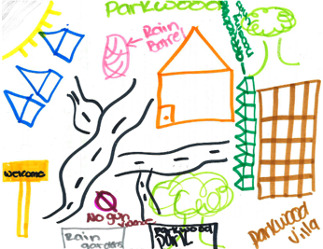
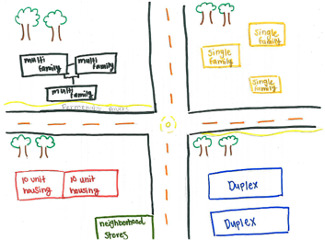
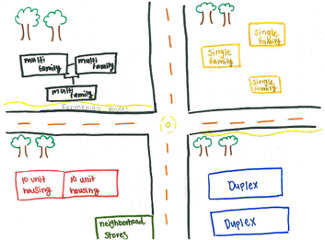
One promising aspect of the use of drawings in focus groups is that the approach can elicit information from participants on particular aspects of the curriculum that resonated with them. For example, we could explore what topics or themes from the curriculum were added to their drawings to improve their neighborhoods or how participants engaged with what they learned when generating solutions to what they identified as needs in their neighborhoods. The drawings in Figures 1 and 2 are from data collection during the 2018-2019 school year, and represent different features and themes explored in the curriculum as shown in the students’ maps. For example, in Figures 1 and 2, students who were involved in the affordable housing unit added affordable houses and multi-unit homes to their drawings. In Figure 2 the student included permeable pavers along the road, a subject discussed specifically in the DYN science curriculum. These maps can enhance an evaluation project, helping researchers better understand participants’ key takeaways from a curriculum or program.
Figure 1 also represents a drawing created during a focus group for the DYN art curriculum, where students were prompted to include additions that would make their neighborhood safer, more welcoming, healthier, and more affordable. In response, this participant incorporated both elements drawn directly from the curriculum and ideas that extended beyond it. The rain barrels and rain garden featured in the image reflect a specific concept students learned about and were building in class, while the “welcome” sign and “no gun violence” symbol illustrate how students brought their own values and community concerns to the exercise. It is less clear which additional elements were intended to address affordability, which is a limitation of our early approach to participatory drawing. In later focus groups, we addressed this by asking participants to use different colors for each prompt, making it easier to see what features were added in response to each dimension of the question, as is represented in Figure 3 and 4.
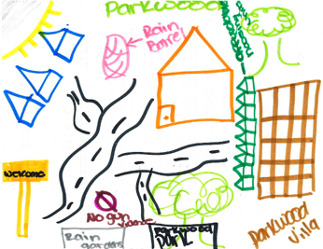
Figure 2, created in a science class, also reflects how the participatory drawing activity surfaced students’ application of civic design and environmental planning concepts. Here, the student represented a range of housing types, including single family homes, duplexes, multi-family units, and ten-unit housing. This depiction illustrates how students took up questions of affordability via representing housing density. This participant also addressed sustainability through the addition of features like permeable pavers, an example of environmentally resilient neighborhood design introduced in the curriculum.
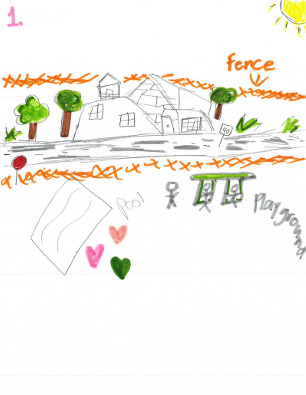
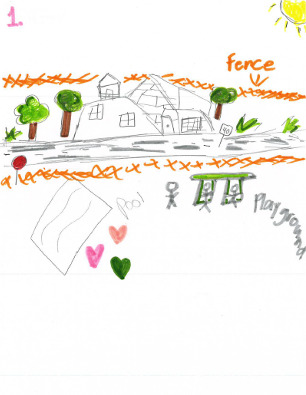
Insights from drawings from Figure 3 and 4 reflect adaptations to the drawing approach after the analysis of drawings completed in earlier focus groups. In drawings from these groups, students did not denote what was added for each prompt (safety, health, affordability, etc.), so referring back to drawings to contextualize student insights when listening to focus group transcripts was difficult. However, students had begun to add a number to their drawings to link verbal and visual data more effectively and to use different colors to denote features that they added. This is reflected in Figure 3, where additions to the drawing were denoted with both written labels and the use of different colors from the rest of the drawing. The student who drew the map in Figure 3 shared that they added the playground and pool to make their neighborhood more connected. She also added a fence to make her neighborhood feel even safer, explaining that she added the fence “because…I’m pretty new to my neighborhood, so I don’t know if it’s pretty safe.” While these additions were clearly denoted with labels, prompting from the facilitator about the fence nuanced what may seem, without the accompanying transcript, as simply the addition of a fence to indicate safety. Instead, the participant shared that she was still discerning how safe she felt in her new neighborhood, and the fence was added because she felt it could potentially contribute to improved neighborhood safety. Thus, while the drawing provides a valuable additional artifact during the analysis phase, the drawing is contextualized by the reflections shared verbally by the participant during the focus group discussion.
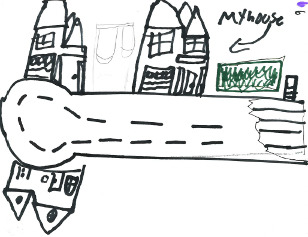
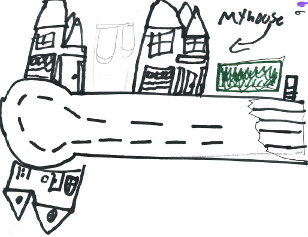
Relatedly, as Figure 4 represents, it is sometimes more difficult to discern from the drawing alone what was added in response to prompts, even with the addition of asking participants to add prompted elements in different colors. With this image in particular, the park, playground, and gate on the drawing all could have been perceived by a researcher as additional elements since the writing utensil used was different than the one used to draw the rest of the sketch. The number at the top of the photo helped us to return to the focus group transcript to hear more about what the student intended to add to their neighborhood space in response to the prompts. When asked what they added, the participant who drew the map in Figure 4 shared that they added a park to make their neighborhood safer. When asked “What did you think that would help with in your neighborhood?”, they responded that they hoped for a park so “more kids would come outside.” While the field next to the participant’s house was drawn in green, which could represent an addition when looking at the drawing alone as the rest of the cul de sac is drawn in black marker, or opposed to the playset, which was added in pencil, the student shared in their description of the drawing that the field was already present in the neighborhood. These examples not only illustrate the added richness of the drawings, but the potential of using drawings to further understand and contextualize participant insights shared in focus group discussions.
Possibilities and Limitations of Drawings for Place-Based Inquiry
In this section, we discuss potential drawbacks and benefits to analyzing participants’ drawings as data, extending our discussion above on the benefit of drawings as artifacts for contextualizing focus groups discussions. We discuss some of the limitations to analyzing the drawings generated in our focus groups, including the limitation of focusing on features or elements alone, the constraints of a place-based approach to analysis, and the potential misalignment of an adult-led analysis of drawings with more community-engaged approaches to research. However, we also see the potential for analyzing drawings as a part of curriculum evaluation, discussing how an analysis of participant-generated images can support researchers in better understanding youth-generated solutions for improving their neighborhoods.
Possibilities for Analysis
While we primarily discuss possibilities for analysis of the drawings generated as a part of the DYN focus groups, we see these approaches to analysis as relevant across diverse research contexts. Participatory drawing holds potential for evaluating the effectiveness of a place-based curriculum, understanding youth participants’ ideas for neighborhood improvement, and for conceptualizing how young people might relate to and interact with their neighborhood and city space, or their sense of place.
Evaluating Curriculum Effectiveness and Resonance
One particularly promising aspect of analyzing drawings is that the approach can elicit information from participants on particular aspects of the curriculum that resonated most with them, so much so that they add these elements to their drawings to improve their neighborhood. When we began utilizing drawing, we hoped to hear students use terms from the curriculum authentically and concretely in connection to their own communities, partially as a way to see what new ideas from urban design and planning they learned but mostly as a way of assessing the development of critical consciousness (Morgan & Christens, 2023).
We found that the language and ideas introduced in the curriculum emerged in drawings in authentic and concrete ways. For example, some students drew bus stops without sidewalks and then added “safer crossings” or “better lighting,” explicitly using terms from the unit on transportation equity. Others shaded in “affordable apartments” next to schools, echoing discussions of displacement and accessibility. These responses showed not only what students noticed in their neighborhood communities but also how civic and design concepts from DYN shaped their reflections.
Understanding Youth-Generated Solutions
Although there is analytic potential in the drawings themselves, such as tracking what features students add and why, we found that much of the richness in this approach actually emerges when students explain their images. In these moments, students often connect curriculum concepts to their localized neighborhood experiences, articulating both the inequities they see and the futures they imagine. In this sense, participatory drawing mirrors the aims of DYN itself: to create conditions for young people to critically examine their environments, envisioning alternatives that would otherwise be missing in research and in civic and planning processes.
For example, in reflecting on their maps, students in focus groups referenced spatial and racialized dynamics like gentrification and displacement when discussing the additions they made to their maps, reflecting linkages between discussions on housing inequity in the curriculum and their own generated solutions for their neighborhood. Their learnings regarding density, green space, and walkability were reflected in the solutions they generated to address neighborhood challenges they identified. For example, participants in a 7th grade Design Your Neighborhood science class discussed how adding permeable pavers along their streets would support in making their neighborhood safer, an actionable solution for addressing pedestrian safety needs. Places to play or engage with neighbors (represented in Figure 3 and 4) were also often added, which participants saw as a potential feature to address an identified need to connect more with the people that live in their neighborhood.
Through an analysis of both what students added to their maps and what they shared when they were asked to explain what could make their neighborhood better, we could learn about how students imagine a more ideal neighborhood and what elements in the built environment could potentially contribute to this ideal, as well as how these ideas were informed or clarified by their participation in the Design Your Neighborhood curriculum. Similarly, drawings have been used to explore young people’s “ideal” school. Loureiro et al. (2020) employed a visual grounded theory methodology (Mey & Dietrich, 2017) to analyze drawings generated in response to the prompt: “draw your dream school.” Researchers working with children in a Luxembourg primary school used drawings to identify students’ ideas for school infrastructure improvements, activities to increase child-friendliness, and conceptions of subjective well-being.
Finally, we offer that it may be important to incorporate drawings in some form in any analysis of focus group transcripts because they are sometimes the sole offering from participants who didn’t feel as comfortable expressing themselves verbally. Youth who don’t participate verbally can still share their drawing to represent potential improvements to their neighborhood, fostering the inclusion of their ideas that would perhaps otherwise be missed.
Exploring Youth Sense of Place
To explore sense of place alongside young people, adult researchers can engage youth researchers in exploring their dialogic relationships with their neighborhoods and reflecting on the social and political dynamics that animate those relationships. In our study, we ask focus group participants to draw the place they live and share their ideas for making their neighborhoods better. A potential qualitative analysis focused on youth sense of place could include listening to transcripts and reviewing participant drawings with analytic attention to the varied meanings and experiences of neighborhood spaces. We could identify meaningful or important neighborhood features for young people from neighborhoods across Nashville, highlighting some of the most resonant aspects of neighborhood spaces for young people in the city. Findings from this analysis could then inform the place-based advocacy work of the Nashville Youth Design Team, who engage in place-based research and design to address youth wellbeing and advocate for more youth-supportive spaces in Nashville (Anderson et al., 2024).
Limitations in Visual Analysis
As noted throughout the paper, participatory drawing can be a helpful approach to support increased participant engagement, and potentially provide an opportunity to understand youth-generated solutions to neighborhood improvement. However, including the drawings in the analysis process presents some limitations, such as challenges contextualizing place-based data, over-reliance on feature-specific analysis, and misalignment with community-engaged research approaches and values.
Challenges Contextualizing Place-Based Data
Due to IRB requirements for focus group participant anonymity, we were unable to ask participants where they lived in the city, and many participants chose not to label their drawing with their street name, neighborhood, or other identifying geographic features. Because of this constraint, we were unable to relate the images from individual focus groups to particular areas of the city, or to compare narratives from different students about the same neighborhood. Further complicating contextualization is the reality that students in Metro Nashville Public Schools are not required to attend their zoned school. This means that the sketch maps youth participants drew were not necessarily representative of the neighborhoods near the schools where the focus groups were held. As a result, it is difficult and often impossible to contextually analyze the drawing, limiting the ability to gather insights into how youth see and represent their neighborhood environment in their drawings alongside the actual physical characteristics within the neighborhood’s built environment. However, analyzing drawings alongside built environment features could elicit exciting insights into what young people see as the most resonant features of their neighborhoods. For example, Anderson et al. (2025) spatially explored youth preferences for neighborhood built environment features and the presence or absence of those features in their neighborhood, examining how young people’s lived experiences align or misalign with their ideal neighborhoods.
Feature-Specific Approach to Analysis
Within the drawings, many students did not clearly identify, by color or label, what features already existed in their neighborhood versus what they hoped to add or change. Without the context of specific neighborhoods or schools, a researcher or coder may miss items that students want to highlight that exist in their neighborhood or elements that students specifically added to improve their neighborhood, resulting in important features–either those present or added–potentially being misattributed or excluded from analysis.
Since we had students represent their neighborhoods and the environmental features within them, and asked students to add elements to improve their neighborhoods, we could perhaps conduct an element-specific analysis. In Gillespie’s (2010) study, participants drew their representations of “home,” and the researcher used rubrics in analysis to quantify particular feelings and features reflected in youth participants’ drawings. However, in our case, perceived improvements like the permeable pavers in Figure 1 or the community center in Figure 2 would be quantified through a rubric approach, but would be de-contextualized from the particular area within the neighborhood where a participant saw them as adding the most value. Put simply, analyzing or quantifying by feature (instead of looking at maps as whole artifacts or as supplemental to verbal data) could mean that important context around the physical locations of the participants’ suggested neighborhood improvements would be missed. Instead, it is important that the maps are holistically analyzed alongside the focus group transcripts. While drawings sometimes have easy-to-understand elements added (i.e. they are labeled or differentiated in color) as represented in drawings like Figure 1 and Figure 2, drawings like Figure 3 and Figure 4 where the participants did not label or reference which additional elements were added are more difficult to analyze, and could possibly lead to intended meanings being further obscured.
Misalignment with Community-Engaged Research Approaches
Perhaps most importantly, there is potential dissonance between conducting an analysis of drawings from focus groups and the ethos of community-engaged research approaches. While an analysis of drawings can be a valuable complement to the analysis of focus group transcripts, with the potential to represent compelling additional themes and envisioned changes to youth participants’ neighborhoods, adult researchers analyzing the drawings themselves as a part of the broader qualitative analysis may be discordant with the goals of community-engaged research approaches (Wallerstein, 2021). In the current study, ongoing collaboration with students past the focus group wasn’t part of the research design, as focus groups were conducted as a part of an evaluation study after students complete the Design Your Neighborhood curriculum.
However, in future research, there is potential for analyzing drawings alongside the young people who generated them. For example, in research designs informed by critical participatory visual methods (Tuck & Habtom, 2019) or qualitative GIS approaches such as participatory photo mapping (Dennis et al., 2009; Teixeira, 2015), conducting a thematic analysis may be more aligned if youth participants are engaged in both generating drawings and collectively analyzing the themes that emerge from them.
Moreover, even when youth are engaged in the analysis of visual data, adultist biases and assumptions may color adult researchers’ interpretations (Teixeira et al., 2021). Research approaches such as youth participatory action research (YPAR), however, offer an alternative orientation, positioning youth as knowers and leaders in processes of inquiry rather than research subjects (Cammarota & Fine, 2008; Fine et al., 2003). YPAR and other action research approaches often use multiple methods (Ozer, 2017) to explore complex questions and generate strategies to challenge injustice in young people’s lives. These can include traditional research methods such as interviews, focus groups, and surveys, as well as creative visual methodologies, such as photo-elicitation (Briggs et al., 2022), photo mapping (Dennis et al., 2009), and the participatory drawing approach (Literat, 2013).
Drawing as a Place-Based Research Method
The participatory drawing approach prompted our participants to visualize their home neighborhood before discussing the impact of a place-based curriculum on their sense of place in their neighborhood and city. Beginning focus groups by asking participants to visualize and draw their neighborhood as they see it allowed for the opportunity to “bring the neighborhood” into the physical location of the focus group. In school-based research, data collection occurs in the time confines of a school day and within the school building. Although methods like walking interviews allow for exploration alongside participants of the physical environment of focus in research, and are ideal in many ways for place-based research (Alicea, 2023; Kusenbach, 2003), these approaches may not always be possible in evaluation studies or in school-based research. Drawing provided a prompt for participants to visualize the place that was being discussed in the group while remaining in the school space. The approach also allowed for collective meaning-making of neighborhood experiences, which can be a rare opportunity for students.
As its use in the evaluation of the DYN curriculum demonstrates, drawing can be utilized to better understand how young people perceive their home neighborhood and how they’d hope to improve it. This method supports contextual and environment-focused conversations, particularly in settings where mobile methods or other place-based approaches aren’t possible. We have found in this project that the use of drawing to explore the neighborhood can be a generative way to supplement neighborhood-focused discussions in a focus group setting. The conversations were rich and remained place-based throughout, and we argue ultimately (aligned with scholars like Power et al., 2014) that focus groups using words-alone methods would not have brought students’ experiences of their places into the discussion as vividly.
Implications for Participatory and Community-Engaged Research Practice with Youth
Adult researchers need to critically consider how they go about participatory drawing with youth. The application of visual methods alone does not necessarily lead to deeper engagement and partnership with young people. Nor does it mean that researchers are subverting adultism in their practice by utilizing creative visual methods. Instead, we urge adult researchers to be intentional when using this method to facilitate and support youth participation. In particular, adult researchers should pay careful attention to the power dynamics between adult researchers and youth and attention to contexts in which researchers are engaging youth in participatory drawing (H. Cahill & Dadvand, 2018). As Mitchell (2006) writes in her discussion of the methodological tensions of using drawing in anthropological research, “enabling child and youth perspectives through drawings requires more than crayons and paper; it also requires an awareness of the conditions under which those visual images are produced and viewed” (p. 65). This includes attention to what Cahill & Dadvand (2018) define as “positioning.” Young people participating in drawing activities should be positioned as active agents and experts who are discerning of their social, material, and political worlds. The positioning of youth researchers during drawing and within a larger study may involve shifts in the mindsets of adult researcher(s) away from perceiving youth participants as passive subjects (H. Cahill & Dadvand, 2018, p. 249). Positioning youth as only subject to and not acting on and within neighborhood contexts and conditions, as discussed above, may lead adults to perpetuate youth exclusion from meaningful engagement in local knowledge production and decision-making. This is particularly important in school settings and other institutional contexts where young people are positioned with particularly limited decision-making power. Ultimately, our use of participatory drawing in focus groups surfaces important considerations for place-based research with and alongside young people.
Conclusion
Utilizing arts-based approaches, particularly in focus group contexts, can help groups of young people to build comfort and rapport, reflect individually before sharing out, and communicate their impressions and feedback in non-verbal ways. Participatory drawing of the neighborhood allows for participants to be “brought to their place” while remaining in a single location and positions youth participants as experts in their spatial contexts. Researchers can explore sense of place with participants by asking what participants might want or need from their neighborhood that they are not already getting. As our uses and adaptations of participatory drawing demonstrate, researchers employing the approach will need to determine as a part of study design whether participatory drawing will be used solely to facilitate engagement and build a comfortable space with participants, or whether an analysis of the resulting drawings is aligned with both the methodological orientation and desired outcomes of the research.
Overall, this study adds to emerging evidence e.g., Literat, 2013; Yuen, 2004) that participatory drawing in focus groups can support building comfort and safety with youth participants. We have also found that participatory drawing can be an effective place-based methodological approach to use with young people, and a promising step toward greater incorporation of youth perspectives into decision-making processes about neighborhoods and cities. Person-centered visual methods can play a vital role within place-based research because they are dialogic, allow for individual reflection, and can support in the exploration of young people’s distinct meanings and associations in their neighborhood environments. Future research should continue to explore these possibilities and assess the effectiveness of variations in participatory drawing approaches.