As we entered the Weatherspoon Art Museum in the fall of 2024, carrying in a load of costumes and supplies for our performance including hula hoops, minions hats and vests, and a huge parachute, we found ourselves pausing to breathe and take in the moment. This moment that we had been working towards for an entire semester- it was here. Students were showing up in their blacks, excited and nervous, ready for one last rehearsal, trying to remember their blocking and generally settle themselves. These students were not actors- not in the traditional sense. They were everyday college students who showed up on the first day of class, and were invited to engage in a creative research process that would require them to be on stage and improvise with community members at the end of the semester. Over the course of 4 months, they called on their bodies as sites of knowledge as they critically analyzed ableist systems and ideology. As they moved through the discomfort of unfamiliar embodied, theatre exercises and co-created data in response, they cared for each other in our classroom community, and they advocated for the larger community. It was a powerful semester.
This article describes the ways in which the authors have used applied theatre—specifically Theatre of the Oppressed (TO)—as a method for teaching, critical participatory action research and creative practice in the university and larger community. Over the course of one semester, through a course-based undergraduate experience (CURE) we used theatre to explore issues around access and disability justice by engaging with the embodied, lived experiences of community members as well as our own. This engagement led us to an exploration of collective care, both as a recommended practice for access by members of our community, and to move as a class throughout the semester.
Who We Are in This Work
As educators and scholars, we are committed to humanizing, holistic pedagogies and research practices that honor the multiplicity of wisdoms present in community and believe that arts-based approaches—specifically embodied, participatory, action-oriented practices—have the potential to create radically democratic learning spaces in higher education and in the communities with whom we partner. Our practices are reflective of what Nicole Rangel (2016) describes as a decolonizing holistic pedagogy that “centers healing and love and decolonial priorities and pedagogical imperatives,” and that speaks to the “mindbodyspirit labor, restoration and creativity involved in decolonizing education” (p. 536).
As a part of our critical orientation, we feel that it is important to speak to the ways in which our lived experiences and identities influence our research engagement and interpretive lenses. Lalenja identifies as a black, southern artist/educator invested in queering what it means to “know” and value a multiplicity of body/minds in community. Performance has been a keystone throughout her life, in multiple forms, and she is a TO/Playback Theatre practitioner who has studied for many years with Boal protegee, Marc Weinblatt. She has been inspired by her work in these traditions to bring embodied/dramatic processes into her teaching and research practice. It is this intersection, she believes, that has transformative potential to disrupt institutional practices that center/value the experiences of a few and expand the ways in which we learn/move/care/support a broad spectrum of humanity both in the classroom and beyond.
As a woman of color and an international graduate student navigating learning across borders, Sabrina understands how our positional experiences shaped by linguistic, cultural, social, and political crossings, can make expression feel limited or misunderstood. These experiences guide her toward creative and participatory ways of knowing that allow meaning to move beyond words. To her, art is something universal, a language that transcends boundaries and embraces difference by facilitating collective meaning-making and helps ideas take shape through color, movement, and story. This perspective deeply influences her learning and pedagogy and guides her to create spaces that uplift voices that are often unheard. Through arts-based and participatory research she sees knowledge as something co-created with care, connection and humanity at its heart.
We believe that our collective epistemological perspectives align closely with Critical Participatory Action Research (CPAR) and connect our work to its “commitment to bring together broad social analysis, the self-reflective collective self-study of practice, and transformational action to improve things as method” (Kemmis et al., 2014, p. 12). In the next sections, we describe our process as one 1) where that self-reflective, collective self-study of practice was not limited to us as the instructors, 2) where all members of the classroom community were invited to engage in such reflexivity, and 3) where we examined our community practices, responded and took action as needed, and connected such transformation to the larger social analysis that we were making together through a critical disability lens.
HSS 148: Theoretical Connections and Course Content
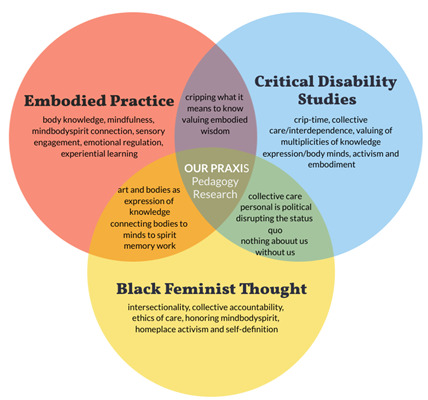
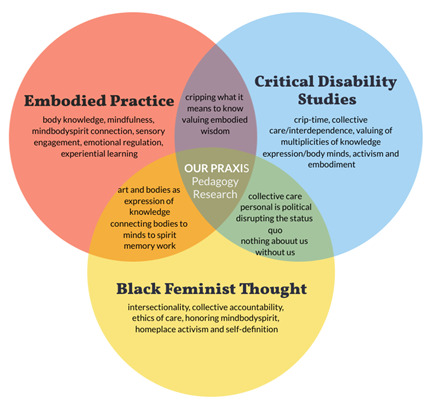
Our pedagogical, research and creative work/methods as instructors/facilitators of undergraduate and graduate learning communities are anchored in Critical Disability Studies, Black Feminist Thought and Embodied Practice. The interplay of these three perspectives aligns well with applied theatre as teaching and research method, as we illustrate below (figure 1). Given the intertwining of pedagogy and research in our classroom, we offer the following section to provide a broad overview of the foundational frameworks that were explored through class content and enacted through our research process. From an Educational Studies and Cultural Foundations lens, we connect these theoretical frameworks to CPAR as they invite us to interrogate “social realities in order to discover whether social or educational practices” recreate or perpetuate unjust conditions in the classroom and community (Kemmis et al., 2014, p. 16). Each framework described here represents a curricular thread that we explored in HSS 148.
Critical Disability Studies (CDS)
As a microcosm of inclusive/accessible community, we have found that theatre offers a generative space for real-time engagement with critical disability theory and accessible research practice. Our practice is aligned with crip theory, which encouraged us to challenge compulsory able-bodiedness as we celebrated disabled bodyminds, knowledge and being (Campbell, 2009; McRuer, 2006). Our class and creative process were informed by the work of disabled scholars/activists/artists including concepts like crip-time (Kafer, 2013, 2021), collective care/interdependence (Kafai, 2021; Piepzna-Samarasinha, 2018), valuing of bodyminds and multiple ways of knowing (Schalk, 2018; Wong, 2020), activism and embodiment (Sins Invalid, 2016). These concepts encouraged us to engage in practices that 1) disrupt rigid/eurocentric understandings of time and productivity, 2) provide support to the collective as defined by the collective, 3) are holistic and acknowledge that wisdom comes in many ways, 4) name the inequities that impact lived experience and 5) celebrate what the body knows. In relationship to CDS, research is framed not as a problem-solving tool to be wielded by the experts FOR people, but as a relational, reciprocal engagement WITH community, co-designed to respond to what is most important to them.
Black Feminist Thought (BFT)
Like Critical Disability Studies, we have found that Black Feminist wisdoms are foundational in the shaping of our praxis and also align well with theatre as a creative and research method. Elements of BFT like intersectionality (Annamma et al., 2018; Collins, 2002; Crenshaw, 1991; Erevelles & Minear, 2010), collective accountability (Combahee River Collective, 1977), ethics of care (hooks, 2014; Lorde, 1984), honoring mindbodyspirit (Dillard, 2012; Lorde, 1984), homeplace (hooks, 1992), activism (Davis, 1983) and self-definition (Collins, 2002) inform our practice in many ways. In classroom and community this looks like 1) honoring and naming the impact of living at the intersection of multiple identities, 2) holding our community accountable to agreements that we have made to hold our container, 3) centering self and collective care even when that means adjusting our trajectory, 4) engaging with ALL of the parts of us that show up, mind, body and spirit, 5) emphasizing practices that create a sense of belonging, of home, a place to breathe freely, 6) responding to calls to action as an essential part of our practice and 7) naming ourselves as we want to be/know we should be called. Naming as a practice is important in our space, and also in our research practice. As students and co-researchers, we take time to name ourselves, our processes, our ancestors and lineage holders, issues/injustices that impact us as humans/community, and anything else that we feel needs to be named and made visible. We value the sense of home/belonging that naming helps us create as a part of our research method, as well as the ways in which it helps us to identify action steps that we need/want to take both in the classroom and in the world.
Embodied Practice
For us, embodiment resonates with both CDS and BFT. Concepts like embodied knowledge (Garland-Thomson, 1997; Hemphill, 2025; Wilcox, 2009), mindfulness (Hersey, 2022; Owens, 2020), mindbodyspirit connection (Gumbs, 2017; Walker, 1983), emotional regulation (Mullan, 2023), experiential learning/meaning making (Boal, 2000; Conquergood, 2002) are like connective tissue between frameworks. Embodied practices include: 1) having students express their understanding beyond the text, encouraging them to trust the knowing that their bodies hold, 2) taking time in class to slow down and breathe together, give ourselves permission to bring our attention to self in the moment, 3) inviting students to express themselves holistically and challenge Cartesian binaries that separate mind and body, 4) making space for folks to metabolize emotion through embodied activities and meditation, 5) and centering learning that happens through doing. In our class and in our research, theatre and movement become both method and medium. Students create meaning through tableaux, improvisation, and metaphor. Through these embodied practices, students realize that learning and research isn’t something done to them; they are part of it.
Research frameworks that anchor our work
Methods that carry out our work are grounded in our identities and relationships we hold within the community. Our intention leans towards the methodological traditions that listen to embodied knowledge, honor creativity, and practice collective care. In our process, Arts-Based Research (ABR) provides us with the lens to see knowledge in movement and story. Critical Participatory Action Research (CPAR) invites analysis of larger social issues through collaboration and co-creation with people, not on them. And applied theatre transforms performance into civic action. Taken together, these approaches turn research into something lived, an act of community, care and shared change. In the following sections, we will touch on the research approaches that inform our use of applied theatre, specifically TO, as a method of CPAR, knowledge production and community care, which is where we feel our work with HSS 148 is most accurately captured.
Arts-Based Research (ABR)
We begin with Arts-Based Research (ABR), a way of knowing that breathes. Instead of focusing on rigid steps, it invites curiosity, breath, and movement. Patricia Leavy (2015) reminds us that “arts-based researchers see and build in different shapes,” (p. 3). Shapes that might appear as a poem, a painting, a performance or a piece of music. Each shape carries its own way of telling the truth. For us, ABR is the practice of invitation; welcoming people into research through images, stories, and performances so they can feel knowledge as much as they think it. ABR values the body as a site of knowing and believes that wisdom lives in gesture, silence, and breath. As Tuisku (2015) explains, embodied pedagogy “entails the whole body/mind,” challenging the belief that learning is purely intellectual (p. 16).
Critical Participatory Action Research (CPAR)
As we outline the ways in which our research practice is guided by a critical lens reflective of CPAR, we offer a brief description of the broader umbrella of Action Research (AR) to help us clarify this claim. Carr & Kemmis (1986) describe AR as a process that aims at the “transformation of individual and collective practices” and understandings from which a “programme of reform emerges” that “embodies particular practices of collaborative self-reflection” (p. 185). In the classroom, AR invites teachers to reflect on and transform their own practices through an action-oriented research process. In their work linking Legislative Theatre to CPAR, we find Bodziński-Guzik, B., & Stożek, R. (2025)’s synthesis of the three types of AR identified by Carr and Kemmis (1986) to be instructive:
-
Technical AR- a practitioner-researcher centered research process of reflection and improvement that is framed by the practitioner, even when other participants are involved.
-
Practical AR- a research process that seeks to “give voice” to other participants reciprocally engaged in the reflection and improvement cycle but is still framed by the practitioner/researcher.
-
Critical AR- a research process that demands “strict reciprocity between the researcher-practitioner and the others” and is framed collectively through a critical lens
The common links amongst the different types of AR consist of 1) a recognition that people with shared experiences have the capacity to actively participate in all aspects of research and that 2) said research in which those same people engage is “oriented to making improvements in practices and their settings by the participants themselves” (Kemmis et al., 2014, p. 4).
Although we formally held the practitioner-researcher roles in our classroom, our process aligns with a critical one as outlined by Kemmis, McTaggart, & Nixon (2014), where reciprocity was “amplified” in that responsibility, and where the research was “taken collectively, by people who act and research together in the first person (plural) as ‘we’ or ‘us’” (p. 16). We agree with the assertion that the collective responsibility called for in critical AR/CPAR insists that co-creation should be tied to a critical examination of unjust structures and to transformative actions that make practices more “rational, sustainable and socially just” (p. 82). We interpret this framing of CPAR as one that acknowledges that those who carry the weight of injustice, also have the wisdom to name the wound and imagine the healing (Benjamin-Thomas et al., 2018; Kidd & Kral, 2005), and connect it to Freire’s (2014) insistence that “the oppressed must be their own example in the struggle for their redemption” (p. 54). This orientation is central to our work with TO as a critical research method.
We also acknowledge Kemmis, McTaggart, & Nixon (2014)’s claim that
Critical participatory action research is strongly represented in the literatures of educational action research and emerges from dissatisfactions with classroom action research which does typically not take a broad view of the role of the relationship between education and social change (p. 12).
In our project, CPAR frames theatre as a critical public space rather than merely a classroom exercise. Through embodied inquiry and collective reflection, we, as a community, examined institutional ableism, norms of productivity, stigma and exclusion; CPAR in alignment with a critical disability lens that frames collective care as a political rather than merely emotional practice.
Applied Theatre: Performing Research, Enacting Justice
As a teaching and research method, applied theatre with its emphasis on embodiment, invites students and community members to offer “what they know” through sound, movement, visual tableaux and metaphor, challenging the idea that the written word is the most valid way of expressing knowledge. Augusto Boal (2000) imagined theatre as a space where democracy could come alive, where audiences become “spect-actors” and where they no longer sit quietly but step in to act, question and think for themselves. Boal’s Theatre of the Oppressed (TO) is an applied theatre tradition that we believe like Bodziński-Guzik and Stożek (2025), stands at the intersection of ABR and CPAR, bringing together embodied knowing and collective action. TO specifically invites processing experiences of oppression through the body, including an exploration of strategies/action steps to address said experiences. This is an important process that aligns with the work of disabled scholars/activists/artists in the naming of power inequities and calls for action/activism.
Over the course of the semester, we used different TO forms (described below) from Boal’s “arsenal” to interrogate individual and collective understandings of oppression in relationship to disability, culminating with a participatory theatre community event informed by Legislative theatre.
Games. Intentionally scaffolded embodied exercises/activities that are designed to bring body and mind into conversation with each other, with aims to develop and awaken the senses and their memories by bridging the gap between feeling, touching, listening and hearing (Boal, 2002).
Image Theatre. A system of techniques/activities using the body to create images and movement as tools for meaning making and interpretation, operating with the premise that “images are a language in themselves” (Boal, 2002, p. 175). Images may be expressed individually, or in collective sculptures or tableaux, and through a facilitated process of “dynamizing” are deepened and connected to a larger social analysis (Boal, 2002).
Rainbow of Desire. A collection of techniques/exercises anchored in Image theatre designed to examine individual, internalized oppressions and link them to a larger societal context. Our work focused on what Boal calls Cops in the Head, which is a process whereby individual protagonists identify internalized voices of oppression and move through a scaffolded series of embodied invitations for reflection and analysis (Boal, 1995). Analysis stems from their own engagement, but also from those witnessing their story, differentiating this process from an individual therapeutic exercise and Boal’s vision for collective political intervention.
Forum Theatre. This TO branch has been described as an interactive form of theatre where the public (as “spect-actors”) is invited to join actors on stage to offer tactics/strategies/interventions that “promote changes in social or political conflicts or a problem” shown during the play (Wrentschur, 2021, p. 637). This engagement provides the community with opportunities to “practice” responses to oppression, to “rehearse for the revolution” (Boal, 2000).
Legislative Theatre. Legislative Theatre was developed by Boal as a way to extend Forum theatre’s potential as a political change agent beyond the show itself (Kelly-Goffman, 2017). It is an in-depth process that involves multiple points of engagement, including Forum’s creation of problem plays that identify shared concerns by community members, the embodiment of tactics/strategies to address concerns by community “spect-actors”, robust community discussion/debriefing/debate with relevant decision makers about strategies and possibilities for policy recommendations, voting on desired recommendations, and follow up on action steps/changes to law/policy as a result of the process (Boal, 2002; Bodziński-Guzik & Stożek, 2025; Kelly-Goffman, 2017; Pratt & Johnston, 2007).
We intentionally describe our event as one “informed by” Legislative Theatre, because we see it as one step in a longer process of change that should ideally occur over multiple events and engagements with communities, decision makers/law makers; a process that is beyond the scope of one course. For a more in-depth discussion of Legislative Theatre as CPAR we point to Bodziński-Guzik and Stożek (2025) and their article Exploring the relationship between legislative theatre and critical participatory action research, where they assert that intersecting CPAR and Legislative Theatre expands the ability of both to meet their goals with greater depth and accuracy.
CURE: Intersection of Research and Course Engagement
As a Course-based Undergraduate Research Experience (CURE), HSS 148 engaged students in research practices that emphasized collaboration; explored broadly relevant topics; invited students into a formal process of inquiry, and integrated iteration into the course so students could see how learning from research builds on itself (Bangera & Brownell, 2014). Participant selection within the CURE format aligns with purposive sampling, where participants are recruited “who share specific qualities that are relevant and have the potential to answer the inquiry” and who “can provide rich information and, accordingly, yield an in-depth understanding” of the phenomenon of interest (Ahmad & Wilkins, 2025, p. 1462). In our case, the phenomenon of interest was the use of applied theatre as a method for exploring experiences of disability, access and inclusion. 14 students enrolled in HSS 148 with that shared interest and were recruited to participate in a study that explored access through experiences of disability.
We worked closely with our IRB office to ensure that our study followed ethical research guidelines with students, ensuring that there was an understanding that participation in the study itself was voluntary, and that engagement in the course as an academic offering was not determined by their consent or non-consent; to decrease possibilities of coercion, the primary instructor was not given access to consent forms until grades were submitted after the semester. Ultimately, all 14 students enrolled in HSS 148 gave consent to have their “data” included in the study. Data for the study included class artifacts/assignments (journals, image scripts, collective scripts, artist elicitations), class discussions, the final problem play script, practice recommendations from the community and resulting report.
Research Questions. Although our research focus was broadly determined by the topic of the class, after discussion with our students, we collectively decided that the following specific questions would guide our initial work together over the semester:
-
What are the lived experiences of disability in our classroom and our community, and how is access/lack of access impacted by said experiences?
-
How do students describe their experience of learning through the intersection of embodied pedagogy, art and research?
The following question also emerged from our forum theatre process:
- What are possible strategies for countering ableist notions of productivity, normalcy and independence?
Our Method(s)
In the fall of 2024, Lalenja took on a role as Faculty Fellow with the Weatherspoon Art Museum (WAM) in relationship to their *Crip exhibit (focus on disability justice and access). WAM became a partner that helped us to “produce” our legislative theatre event with the community. They offered class access to the exhibit, teaching and performance space, funding, technical (and emotional) support throughout the course and for the final event. Our course HSS 148: Devising Inclusion in a Global World was a perfect fit for the partnership as it was designed to explore the concept of inclusion through embodied practice (TO) as a teaching/learning method and as community centered, participatory research method. Our community consultants were connected to our class in different ways. One consultant was a former student with lived experience with a disability, 4 consultants were family members of our classroom community with lived experiences of disability, and 1 consultant was a director of a statewide Arc, with years of experience advocating and making policy alongside members of the disability community. Our classroom community also contained students and instructors with lived experiences of disability.
We also intentionally built relationships with each other through the ways in which we built our classroom container together. By building a container we mean an intentional set of practices that create an inclusive, “engaging atmosphere where participants are encouraged to experiment with new behaviours, consider new possibilities or explore different ways of seeing things” (Stuart, 2012, para 1). For us, this also meant centering collective care and well-being through humanizing pedagogical practice, ongoing and intentional identification of collective needs and ways to meet them, as well as collective accountability practices as we moved through the methodological “waystations” that we describe in the following section.
Waystations in Our Process
In this section we outline our method through a series of waystations, with the understanding that although there was a temporal order for some elements, as with any research process, there was a significant amount of iterative “back and forth” throughout that make linear representations difficult. We visited and revisited waystations as the CPAR process called us to do throughout the semester.
Waystation 1- Pre-semester Planning. Before the semester started, we met with museum representatives to lay out a schedule for classroom usage (the museum let us hold some of our classes there), and for the final event. We planned for marketing, exhibit engagement, rehearsal space, and day-of logistics. We also invited a colleague and acting instructor from UNC School of the Arts to co-teach with us for this course, to support students in the dramatic process. We set our co-teaching plan for the semester.
Waystation 2- Setting up our container. We spent the first week of class setting up our container for the semester together- inviting students into the process by creating community agreements, outlining our learning and research plans, answering questions about expectations, reassuring anxieties, and engaging in embodied activities designed to build community. This was an essential process to start immediately, as we knew how important it would be for the class to feel like a community once we moved into the TO activities, which can feel vulnerable. We consistently evaluated our container throughout the semester, inviting students to actively provide feedback.
Waystation 3- Content instruction (Theory). Students spent the first third of the semester engaging with content and with each other around crip theory, disability justice, and access and inclusion (see theoretical connections).
Waystation 4- Content Instruction (Research frameworks). Students explored qualitative research design, including community-engaged, participatory, arts-based, and liberatory research methods (see methodological approaches).
Waystation 5- Data Creation-In class. Students spent the next third of the semester creating data through dramatic responses to the content. The two main TO structures used to generate data were Image Theatre (IT) and Rainbow of Desire (described in Applied theatre section). One IT example included Image of the Word, where students were asked to create static images with their bodies to communicate their understandings of access and exclusion. They documented their images through photos, creating an “image script” of titled images. Then students engaged with each other’s scripts and analyzed them interpretively. Through the Cops in the Head (Rainbow) structure, students were asked to collectively construct a list of oppressive voices people have internalized related to disability. Those voices were discussed in depth, with invitations to directly engage/transform through embodiment. A final list of voices that resonated most to the collective were then integrated into the script for the problem play. Both exercises were a form of analysis in and of themselves. The collective themes from both structures were documented.
Waystation 6- Data creation: *Crip exhibit. Students visited the *Crip exhibit at the museum and analyzed art works and descriptions by disabled artists. The themes from this and earlier work in class were then collectively reviewed and discussed, resulting in a “final” list of themes that resonated most with the class.
Waystation 7- Community consultation-themes. Students “member checked” themes with community consultants with lived experience of disability, to identify the most resonant themes, and finalize those as topics for the “problem play.” Final themes were triangulated between community consultants, exhibit artists, and student co-researchers.
Waystation 8- Data creation and analysis: Writing of Problem Play. In the last third of the semester, students collectively wrote a play illustrating the final themes with inspiration from the artists exhibiting in Crip and feedback from community consultants. Two points of feedback that greatly impacted the construction of the play, were a piece of artwork in the exhibit that used a parachute as a metaphor for access, and a description from a community consultant likening service providers to “minions.” The students collectively resonated with the multi-colored parachute in an embodied way, sharing memories of parachute games in school. Metaphorically, the parachute became a symbol for access and collective care. The description of providers as minions sparked a collective connection/resonance with the movie Despicable Me, and they became foundational characters in the play, representing different aspects of ableism (normalcy, isolation. The character of Grut came to represent the “systems” that gatekeep and oppress disabled folks, who had to “jump through hoops” just to get what they needed to be able to live their desired lives.
Waystation 9- Community Consultation- Problem Play. Students “member check” the play with feedback again from local community consultants through a shared document and conversation.
Waystation 10- Legislative Theatre Event. Students presented the play during a Legislative Theatre event and invited community involvement through forum theatre and collective discussion. Elements of the event included:
-
Presentation of problem play
-
Invitation to community spectators to enter scene with strategies/tactics
-
Discussion/naming of tactics
-
Brainstorming about possible policies/practices connected to tactics
-
Review of recommendations by panel of consultants in relationship to/with lived experience of disability
-
Community vote on final list of recommendations
-
Documentation of the event through a Legislative Theatre (LT) Report
Waystation 11- LT Report Follow-up. After the event, graduate students from Lalenja’s class, ELC 745: Critical Disability Studies were asked to identify individuals and organizations to share the report with, track action steps, and offer resources and support to community partners. Their efforts were documented in the final draft of the report.
How We Came to our Learnings
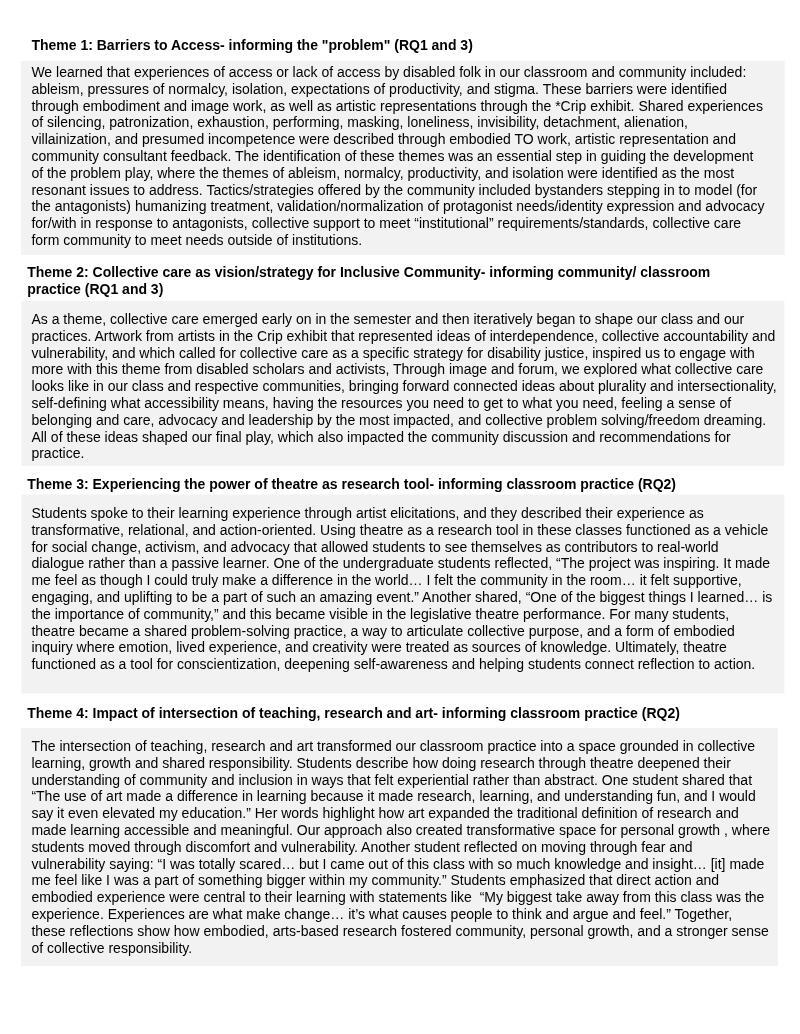
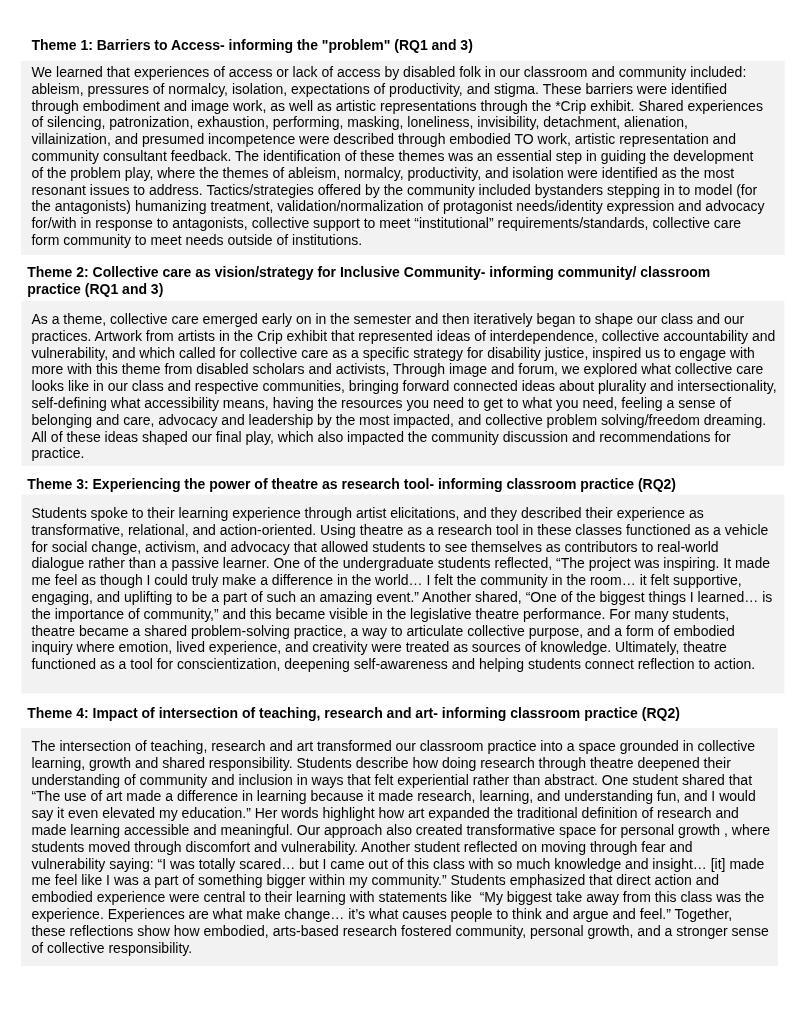
To arrive at our play and final list of learnings, we engaged in an ongoing, iterative, complex process of collective analysis throughout the semester that included individual and collective thematic analytics like concept coding, emotion coding, and values coding (Saldana, 2015). The legislative theatre process itself was best understood through a process of dramaturgical analysis (Saldana, 2015). Our final learnings/themes (see figure 2) represent the results from a triangulation of our different forms of analysis.
Thematic Analysis. Throughout the semester, class discussions/activity debriefs became spaces for collective thematic analysis, often resulting in whiteboards filled with lists of codes. Codes included feelings/emotions in response to barriers (such as frustration, loneliness, anger, resignation, etc.) values/beliefs about inclusion (equity, love, access, etc), and concepts related to disability theorizing (ableism, productivity, normalcy, etc.) This included analysis of the artworks in the *Crip exhibit, where students made notes about their interpretations in relationship to our research question. Our final play was ultimately shaped by and representative of such analysis. At the end of the semester, we reviewed all student-generated artifacts, including scripts and the LT report and completed a first pass of concept coding-identifying “bigger picture” ideas like accessibility, inclusion, belonging, etc. As we worked together on our second round of coding, we sharpened our focus and “felt” into our noticings about the connections that we were seeing between emotions and values and our first round of codes. We then zoomed back out to identify larger categories, which in some cases were similar to our initial concept codes, but were now more nuanced in our understanding after the second round.
Dramaturgical Analysis. Our final script as well as our LT performance and report was developed through a process of dramatic analysis. Theatre activities in the classroom provided embodied data shedding light on what motivates us as humans. Image work and Cops in the Head led to collective analysis/discussions about lived experiences of ableism, which led to the identification of possible points of conflict/themes for the problem plays. Themes were member checked by community consultants with lived experiences of disability and were then analyzed dramatically through our script writing process, identifying “objectives, conflicts, tactics, attitudes, emotions and subtexts” (Saldana, 2015, p. 147). When the problem play was presented to the community, collective dramatic analysis continued as community members offered strategies in response to the themes that were identified through the play. Those strategies were then connected to community generated recommendations for policies/practices– a dramatic analytic process with the potential to “introduce alternative perspectives and ways of thinking, which is necessary to inspire changes in people’s everyday lives” (Wrentschur, 2021, p. 639).
Our Learnings
We identified 4 major themes over the course of our work together. Our problem play was informed by the emergence of barriers to access expressed by classroom and community members (see theme 1). Barriers that resonated most across artists, students and community consultants included ableism, normalcy, productivity, and isolation along with a critical view of the ways in which dominant systems and ideologies actively uphold such barriers. Tactics offered by spect-actors in the community (see theme 1) were resonant with collective care practices that we identified through classroom engagement during the semester and through the practice recommendations made during the public event (see theme 2). The emphasis on collective care as essential for inclusion, the belief that mutual support is a joyful and integral part of community, the demand for more human-centered practices in schools and in the workplace, and a critical troubling of “rehabilitative” approaches to access became what felt like a clarion call for HSS 148 students and community attendees alike to challenge institutions and systems that are anchored in capitalist, ableist frames that devalue the intersectional, lived experiences of those who are most impacted by said frames.
We believe that the co-created work presented during the event offered the community a dedicated space for generative, critical dialogue and opportunities for dreaming into action through their engagement and practice recommendations, which is an important finding/result in and of itself from the research.
Engaging in theatre as a vehicle for coming to these new understandings through embodiment, was identified as a powerful research process by students in the class (see theme 3). They described their time in HSS 148 as one of conscientization, where they were able to expand their self-awareness in ways that encouraged them to make social change (Freire, 2014). They experienced research in unexpected ways that helped them see their bodies as sources of knowledge, as important sites of data. They also expressed an appreciation for the practical problem-solving experiences that TO as method brings to the research process. As a mode of meaning making that sits at the intersection of teaching, art and research practice, students were appreciative of the invitation to bring all of their identities to the learning process in a way that reflects the complexity of inclusion (see theme 4). Ultimately, they connected their learning experience through this intersection to their own expanded understanding of what community, collective care and accountability looks like and feels like, including ways that they can take action and advocate for such practices in other parts of their lives and their communities. This was also a key finding for us.
In summary, we found that the blurring of lines between research, learning, art and activism created the conditions for performance to transform into a critical, shared practice of justice, care and political action, and that this process aligned with a critical disability lens. Alongside this learning, and what we have shared here from our analysis of “data”, we use the next section to outline experiential learning and practice considerations that we have also documented from our work together.
Points of Consideration/Adaptation
There are any number of insights that we have gained from our work with HSS 148 as a course-based undergraduate research experience (CURE). We would like to offer some of them here as points of consideration/adaptation in relationship to teaching and research practice.
Adapting TO as CURE method. As we engaged with TO as a research method, we found that we needed to make some adjustments to the form to align with our work as a class. In Forum theatre, problem plays should ideally be generated from the lived experiences of the creators. In our case, although some students identified as having a disability, this was not the case for all involved. To ensure that perspectives of disabled folks were at the center of our writing, we used a system of creative triangulation to collectively devise the problem play. We drew inspiration from the artists in the *Crip exhibit, feedback from community consultants and students with disabilities in the class. We member checked our scene creation by sharing our documents with our community consultants and inviting feedback, which was documented and integrated into our writing process.
We also adjusted our use of Cops in the Head as a part of our research process. We did not feel that the duration of a class period was supportive of the deep, individualized work required for this form, particularly if we were going to make sure that students had access to care if needed. We chose to create a “constructed” person/identity to explore, so that students had some distance from what can be a painful process of identifying oppressive, internalized voices. Instead of asking students to do a deep dive into their own personal experiences of oppression, we asked them to think about all that they had learned from folks with lived experiences of disability over the course of the semester, and to share possible “cop” voices that they may have heard through the readings/art/media. That distance made it less likely for our embodied work to trigger a depth of response that we would not be able to hold with care during our class time.
Regarding our use of Legislative theatre as an inspiration for process, like Bodziński-Guzik & Stożek (2025) we found ourselves thinking about “law” with a more expansive lens that acknowledges its potential “far beyond solely a change of bills”. The “possible influence of Legislative Theatre processes,” they assert, “can be seen in individual transformation, raising social awareness, and strengthening dialogue between engaged parties –including lawmakers” (p. 351). We found this to be true for our engagement as well, with an anchoring in collective care as practice in the classroom and in the community, inspired by the disabled artists and consultants with whom we were in community. The event itself encouraged meaningful community dialogue and brainstorming around the idea that revisioning laws/policies is not the only goal, especially given the ableist systems in which they are anchored. Collective care was explored as an alternate route that involved community members partnering together to fulfill each other’s needs, a “for us, by us” approach to accessibility. This vision for community practice that emerged from our TO/Legislative Theatre engagement was significant in a “felt” way and in its own right- for us, our students and our community.
During the event, we also had an in-the-moment aha about our own collective care practice as we asked the audience to use thumbs up/thumbs down paddles so that we could count votes. In an ironic twist, given our topic of accessibility, we neglected to think through what this would mean for audience members who were blind. We adjusted quickly, inviting folks to use their own thumbs or raised hands to communicate their vote to us, but the omission impacted us greatly. We also realized that our materials needed to be more accessible to blind folks, and that we needed to make more time for the panel discussion so that our panel member who was blind could follow and engage fully. Again, learnings that demonstrated to us that we have more work to do to put our findings into practice and to be a truly welcoming space for all bodyminds in our community.
Pedagogical Considerations for CURE. HSS-148’s smaller class size supported deep relational work and collective reflection in ways that might not be as easily replicated in larger classes. However, CPAR and TO should not be limited to small classes. In larger courses (40-70) this model can be adapted through small working groups, rotation of cohorts and structured breakout sessions. With intentional facilitation, large classes can still preserve collective reflection while remaining manageable. The core elements—critical dialogue, embodiment, and participatory intervention—are scalable when thoughtfully designed. When implemented with first year and high school students, additional scaffolding may be needed to introduce foundational concepts such as power, positionality and critical reflection. However, we believe that the embodied and dialogic nature of TO may support early-stage students in understanding complex ideas through their experiential and relational learning. So, the feasibility of this approach depends less on enrollment size and more on facilitation design, time allocation and institutional support
In our experience, the use of embodied practices that connect students to experiences of oppression requires a very intentional pedagogical engagement that is informed by trauma responsive practice. Considerations that we make as a part of that practice include:
-
An intentional construction of the course schedule that makes time for trust and relationship building activities that best support engagement with embodied practices
-
A trauma-informed awareness of the amount of time certain TO activities/structures require to be done with care (this may mean NOT making invitations if we know that a short class period will not allow us to “hold” students
-
A commitment to ensuring that mechanisms of care are in place when students are invited to engage in TO practices (time and space for debrief, room to step away, resources for accessing counseling, etc)
-
Culturally responsive teaching that affirms multiple identities that are likely to be expressed through TO work
-
An invitation to normalize discomfort and its transformative potential, which also includes honoring student resistance and agency as they engage with the work
Final Thoughts
Our work in HSS 148 using TO as teaching and research method, affirmed our beliefs that knowledge is not confined to textbooks or data, but is also produced and lived through movement, breath, and relationships. Every rehearsal, reflection, and conversation that unfolded in our classroom became a site of collective meaning-making for students. Those who began the course and were uncertain about their positionality found confidence in their voices and bodies. Community members shared their lived truths and experiences through feedback and intervention, reminding us that research reaches its fullest form when it listens with openness and care. We experienced collective care as a living practice, sustained through trust, reciprocity, and vulnerability. We discovered that slowing down and holding space for one another can itself be a radical act of resistance against systems that demand speed and productivity.
We also see TO as a process that creates possibilities for other radical acts that we hope will connect to other disciplinary traditions engaged in decolonizing and abolitionist work. We believe that TO, with its historical anchoring in “the political” and its processes of conscientization that move people to action, has great potential as a classroom and research practice that aligns with frameworks like freedom dreaming as abolitionist educational practice (Kelley & Monet, 2022; Love, 2019), abolitionist critiques of the prison industrial complex (Davis, 2003), and the abolition of child welfare systems/social work practice as settler colonialism projects from the indigenous perspective (Fortier & Wong, 2019; upEND Movement, 2026). “Through the use of complex and polyphonic performance texts… [that] can express social problems and their complexity through the connection between everyday actions and socio-political structures” we believe that the aims of such abolitionist projects can be supported by TO through the embodied visioning of alternate futures, in a way that can “reach and involve many people far beyond academic contexts” (Wrentschur, 2021, p. 651). In this way, TO becomes more than a pedagogical tool; it becomes a site for imagining and enacting transformation.
Lastly, we would like to share one artifact from the semester. In addition to our work with WAM, we were also in partnership with a media studies student with a vision for creating a short documentary to chronicle our class’s journey. She was greatly impacted by our research story, and made this the focus of her film work, Justice Theatre, which is linked to the QR code above. We share her film because it provides an embodied experience of our process, and is also a beautiful example of one of many meaningful partnerships that enriched our work and helped us see its impact.