
Youth participatory action research (YPAR) is a systematic approach to research that centers youth voices and experiences in ways that typically result in action, activism, and/or other creative responses by youth to make positive social change (Caraballo et al., 2017). Participatory action research, like YPAR, is characterized by including voices that are typically excluded from the research process (Cahill et al., 2008). What distinguishes YPAR from other types of participatory research is its focus on being not only about youth experiences but also often including youth in the research process (Bautista et al., 2013; Bettencourt, 2020). However, there are different levels of involvement of youth in YPAR research. Rather than merely being participants in adult-planned research, youth-centered YPAR provides some space for youth to give input on study procedures conducted by adults and may also involve member checking with youth (Bertrand, 2016; Bettencourt, 2020) whereas youth-led YPAR is research that is planned and conducted predominantly by youth with adults providing support (Anselma et al., 2020; Branquinho & De Matos, 2019; London et al., 2003; Ozer, 2017). Youth-led YPAR is not about “giving voice” to youth (Liebenberg et al., 2020). Youth-led YPAR not only positions youth as experts in their own lives (Bautista et al., 2013; Rodríguez & Brown, 2009; Thorius et al., 2020), but it also creates space for them to enact their agency to investigate and make change on what impacts their lives (Bautista et al., 2013; Cahill et al., 2008; Rodríguez & Brown, 2009).
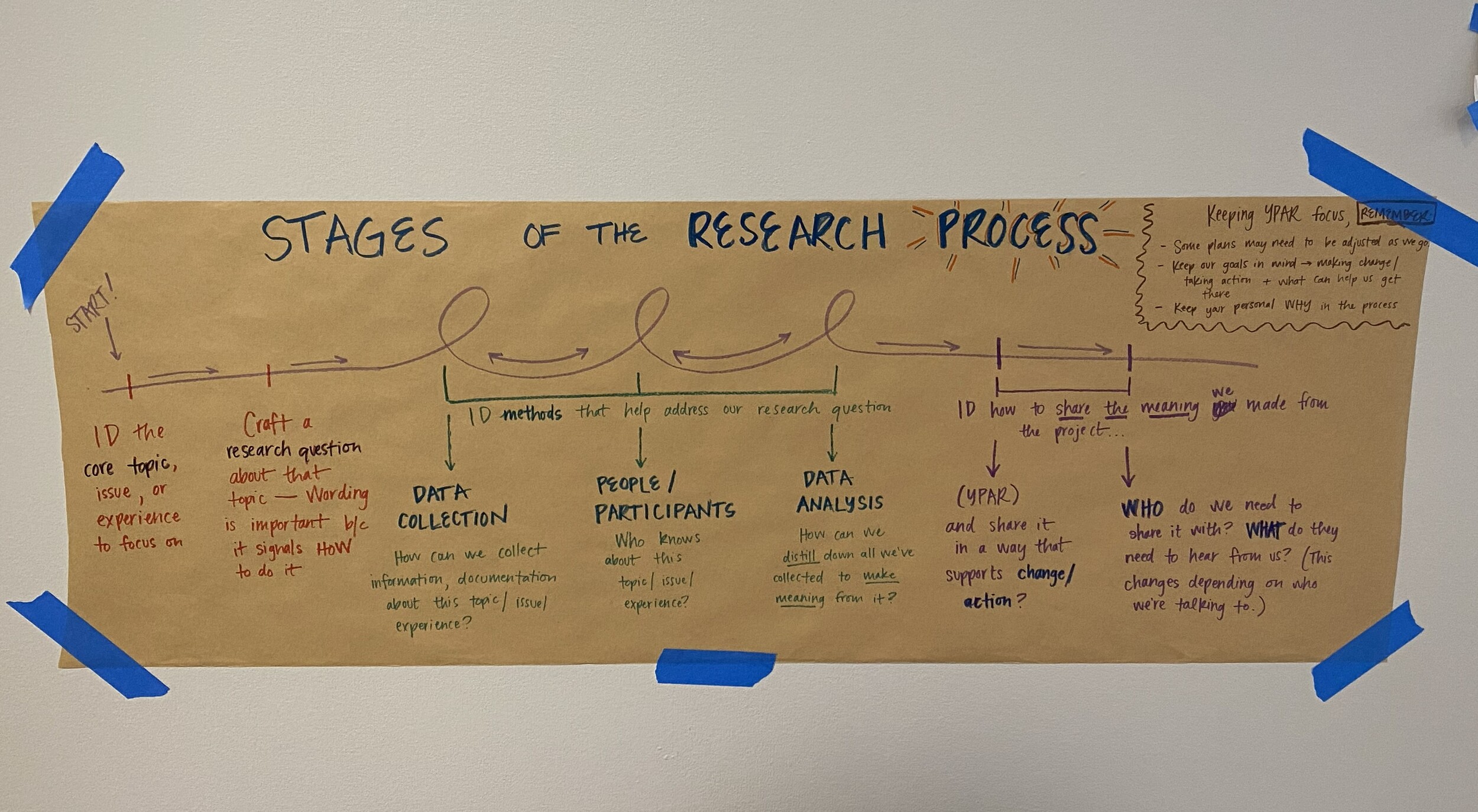
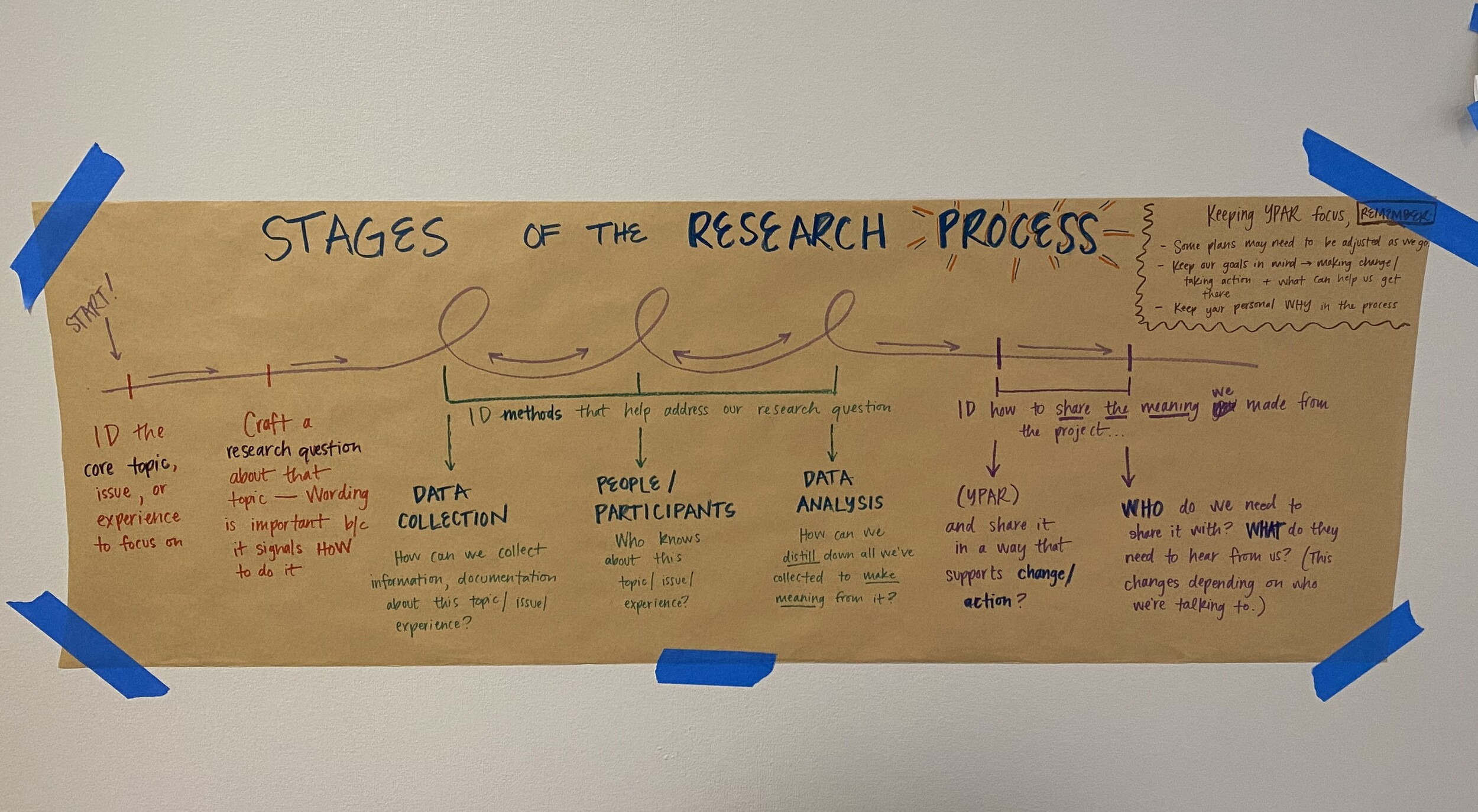
Youth-led YPAR entails a research process that is similar to other types of research (see Figure 1). Youth identify research topics that are important to them and the data that are relevant to study those topics (Bautista et al., 2013; Rodríguez & Brown, 2009; Thorius et al., 2020). Rather than aiming to generalize to all youth, YPAR focuses on topics of interest to youth in specific cultural and community contexts (Gallagher et al., 2024). Youth then plan for and implement systematic data collection methods. Because most YPAR projects entail investigating a complex social experience in the community or school, these projects often entail collecting multiple data sets (Anyon et al., 2018; Shamrova & Cummings, 2017). Youth also conduct the analyses on the data they collected ensuring the findings are relevant to their experiences (Liebenberg et al., 2020) using a variety of approaches (Bautista et al., 2013; Liebenberg et al., 2020). Youth-led YPAR then often entails transforming their data and findings into various products depending on their intended audiences and the change they want to inspire. The YPAR process entails adult facilitators guiding youth throughout this process, teaching them about research methods and supporting their decision making along the way (Bautista et al., 2013).
The purpose of this article is to provide experience-based recommendations to adult research partners in support of youth integrating art and artistic practices throughout the youth-led YPAR process. It is important to note that our thinking of what is “art” and therefore what constitutes arts-based research is more expansive and inclusive of all forms, formats, genre, and media that can be made by anyone, not just those with fine arts training or specific forms of art. Art can be integrated in multiple stages of the YPAR process including collecting art-based data in the forms of creative writing (Gallagher et al., 2024; Thorius et al., 2020), drawing or taking pictures of experiences or places (Thorius et al., 2020), filming videos (Liebenberg et al., 2020), doing body and community mapping (Kelley, 2022; Liebenberg et al., 2020; Thorius et al., 2020), and more. Youth can also transform their data and findings into creative expressions such as using theatre to share experiences and innovatively identify solutions to social issues (Gallagher et al., 2024; Lee et al., 2020), creating sticker and poster campaigns and websites (Cahill et al., 2008; Liebenberg et al., 2020), filming documentaries (Bautista et al., 2013), painting community murals (Lee et al., 2020; Liebenberg et al., 2020), and writing and performing songs and dance routines (Lee et al., 2020).
To contextualize our discussion of integrating art in YPAR work, we first describe the context of our work with a local YPAR group and our positionalities related to that group and our work and identities relevant to this article. Then we detail several, though not all, stages of the YPAR process. In discussing these stages, we provide one or more vignettes from the authors reflecting on how we navigated supporting youth-led YPAR that integrated the arts at various stages. Our stories and debriefing discussions detail the messy work navigating tensions related to power, privilege, incorporating art (or not), and facilitating youth in enacting change from their research. We end with several recommendations for other adult facilitators in supporting the use of art in youth-led YPAR work.
Contextualizing Our Work: Action Research Team (ART)
This paper features Deep Center’s Youth Participatory Action Research Team (ART), a leadership program for young people ages 13-18. Deep Center, a community-based nonprofit in Savannah, Georgia, began as a creative writing program for underserved middle schoolers, using literacy and art as tools for self-expression. Over time, the organization recognized that while youth voices could be elevated, systemic narratives and policies continued to hold them back. In response, Deep expanded its programming to incorporate more direct services, advocacy, and programs for young people, educators, and community members including ART. Rooted in principles of cultural organizing, ART centers youth in community building and root-cause analysis to ignite transformative change.
Our ART program is also designed intentionally around principles of critical hope, including imagination, community, criticality, self-efficacy and action. Our definition of critical hope was informed by a review of literature on the concept as it has been defined and applied in work with young people and around systems change (Duncan-Andrade, 2009; West, 2004), conducted in partnership with Georgia Southern University researchers. “Critical hope is authentic, courageous, critical, and community-centered. It creates roadmaps and action plans, not false dreams” (Deep Center, 2023, para. 2).
Each year, ART members select a topic of interest and relevance to them to study using YPAR. ART is an example of youth-led YPAR based on the high level of leadership that youth have in the conceptualization, design, and implementation of their research project (Anselma et al., 2020; Gallagher et al., 2024; Lee et al., 2020; London et al., 2003; Ozer, 2017; Ozer et al., 2013). ART was first piloted in 2019, with a focus on general political education. It was re-launched in 2021, with a more targeted focus on educational systems broadly because all young people, regardless of their background, have lived expertise with the education system.
Reflecting Deep Center values, ART is designed as a youth-adult partnership program. The young people work in partnership with adults on programming decisions and to address the educational issues affecting youth. In order for YPAR to “be instrumental in fostering youth civic engagement and/as critical literacy” (Burke & Hadley, 2018, p. 221), youth researchers need to be empowered to lead the work. Therefore, Deep Center staff function as adult allies, sharing decision-making power with young people on programmatic decisions like attendance participation policies, as well as the curriculum that supports their annual YPAR project.
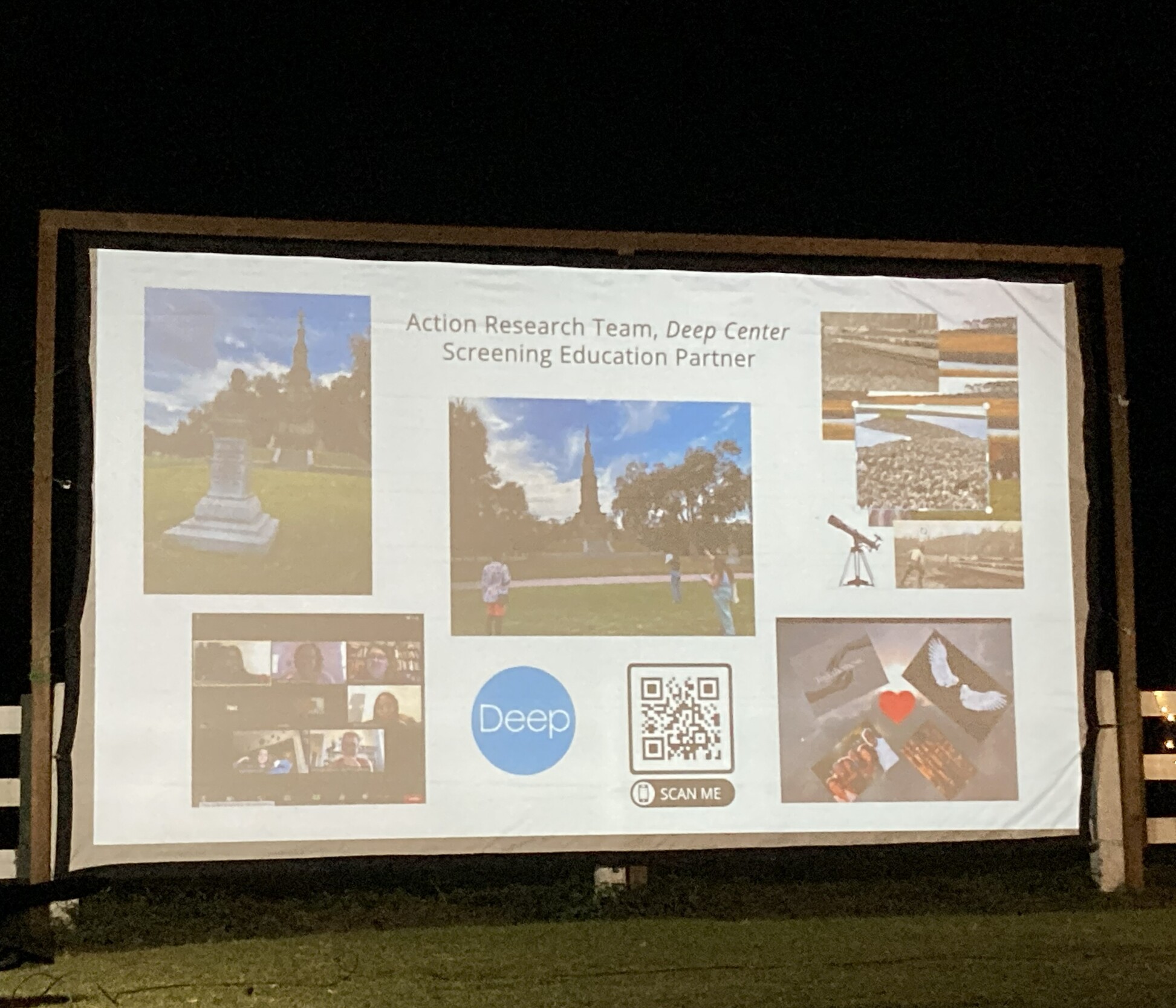
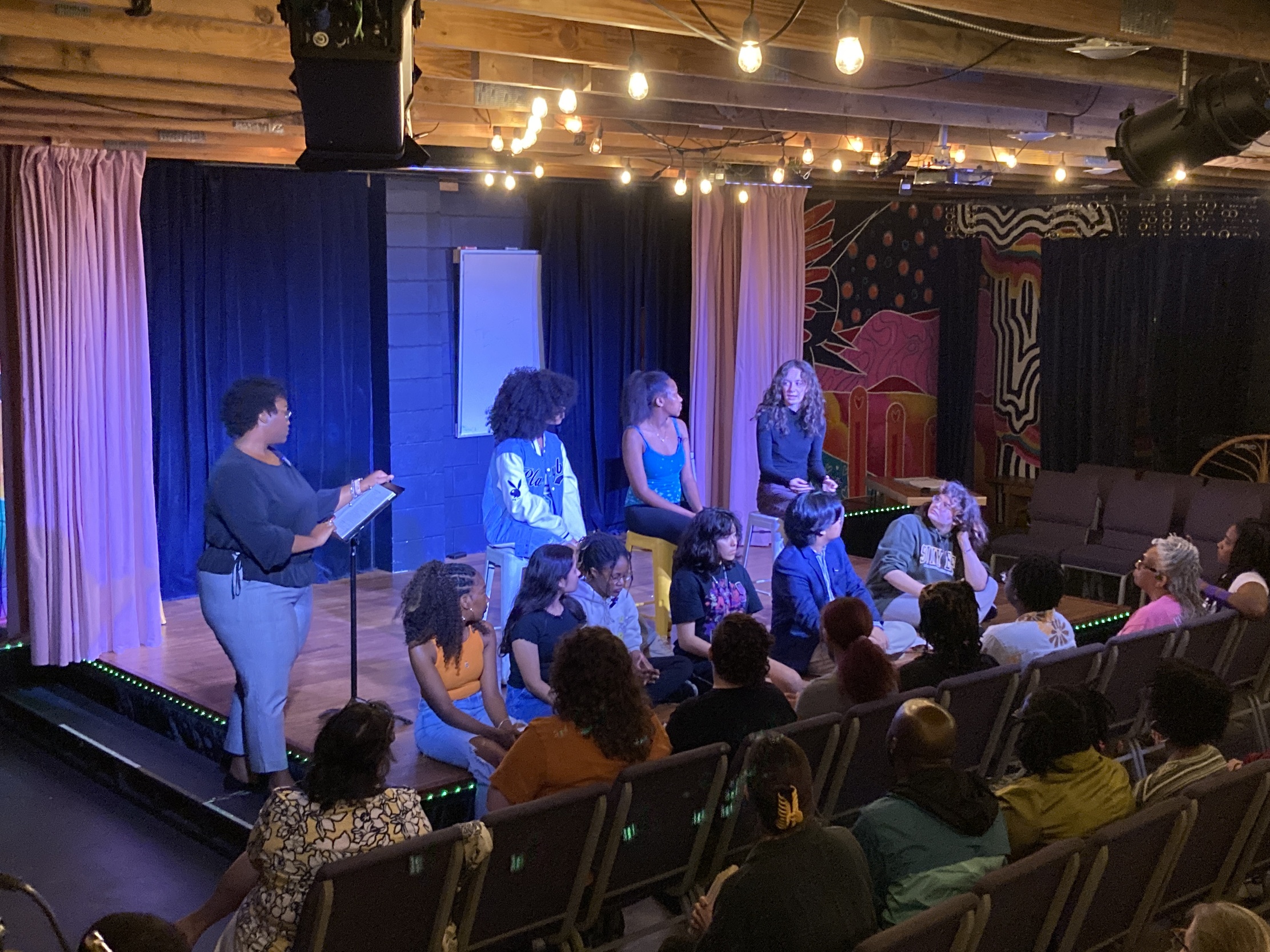
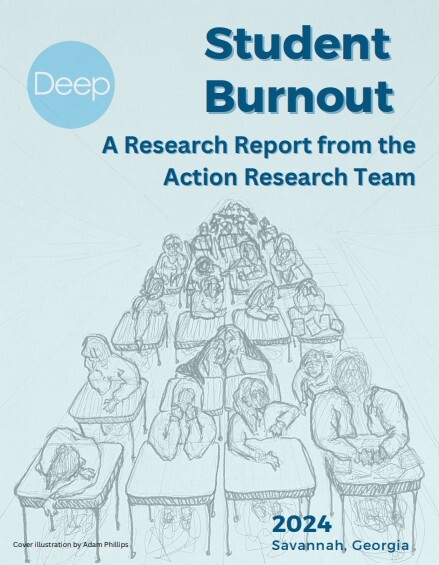
Past projects have included creations and presentations of artistic re-imagining of what could replace local confederate monuments (see Figure 2; Deep Center, 2022); a zine of written and visual art that expressed critique of state legislation to ban so-called “divisive topics” in Georgia schools (Action Research Team, 2022); the writing and performance of dramatic scenes about gender-based microaggressions, written and performed by ART members (see Figure 3); and a report on student burnout that features ART member’s visual interpretation of data (see Figure 4; Action Research Team, 2024);
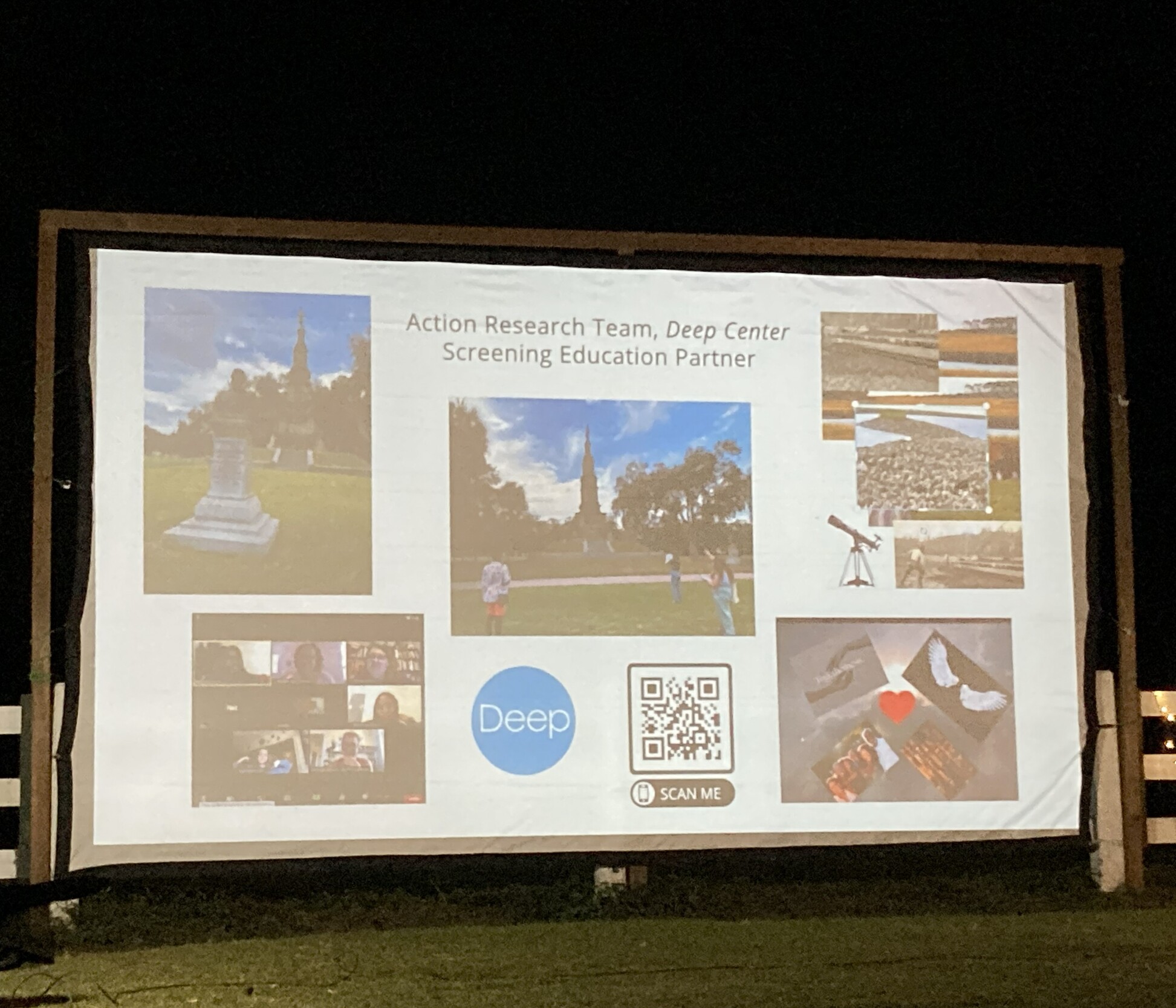
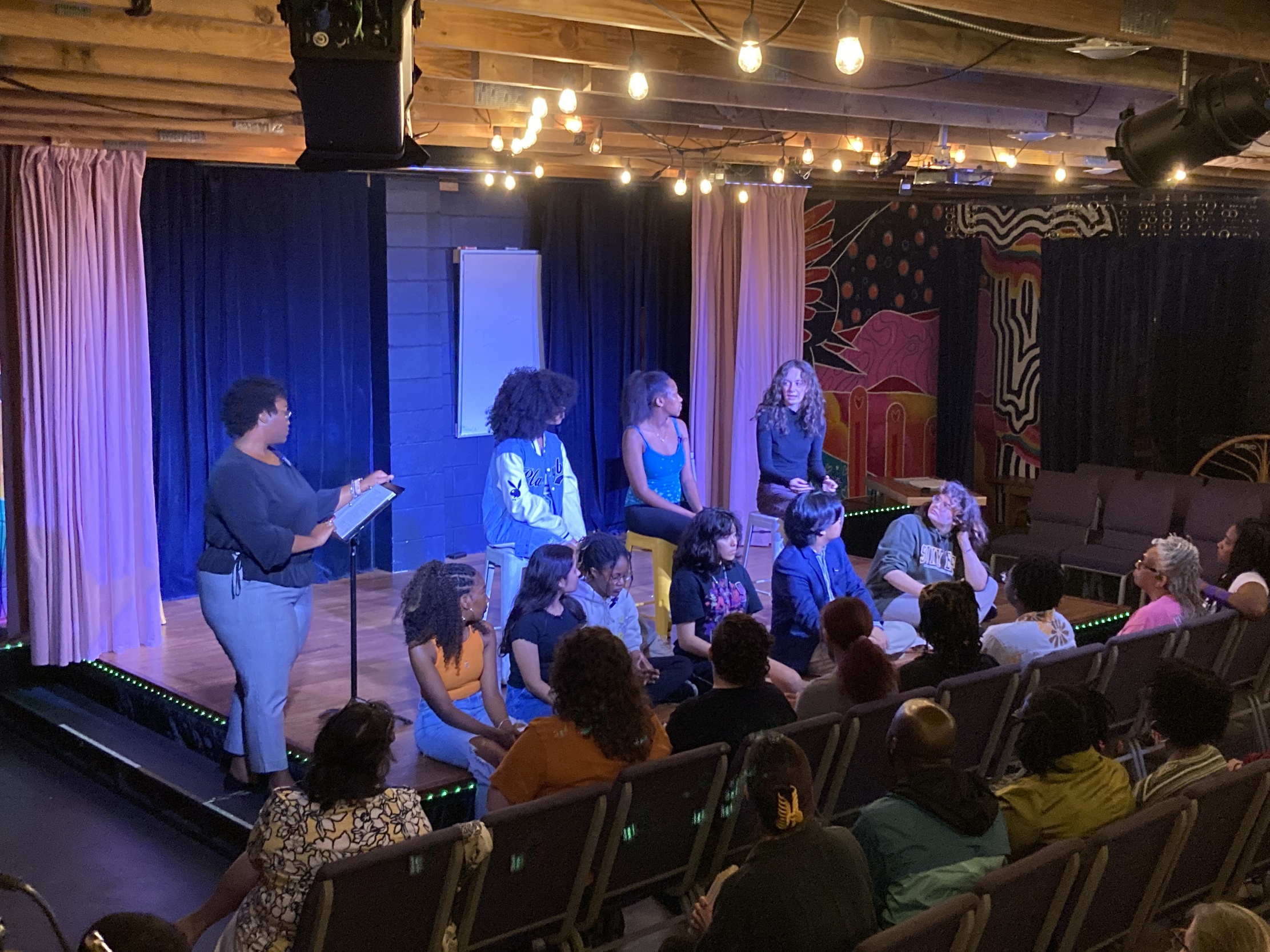
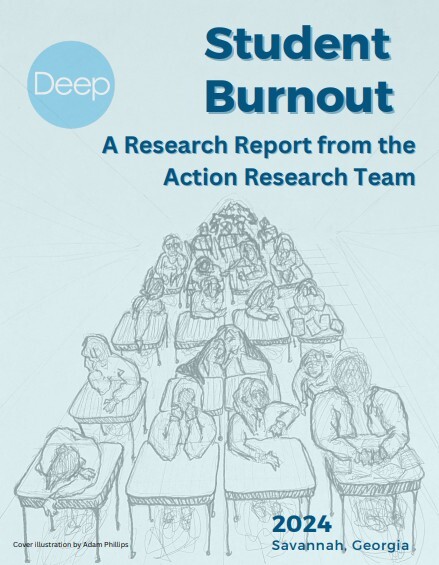
ART members join the program through an application process, after being nominated by themselves, a peer, teacher or community member. There are no academic requirements to join ART, and we actively seek out members who may not be considered “good students,” instead valuing those that are curious, critical, collaborative, and reflective. We welcome those that are interested in research and have basic understanding of systemic issues, even if they don’t have the academic language to describe them yet. Most of our members have identified as Black or Brown, and often over a third as queer. The ART meets 2.5 hours weekly during the school year (August-May), during which they plan and execute their YPAR project, as well as plan special events like Youth Summits and civic education and advocacy trips. Often data collection activities happen outside of these hours.
In its initial years, Deep Center staff received guidance and support from university-based researchers and publicly available resources about designing and conducting YPAR studies. While we sometimes still turn to academic experts, like the lead author of this study, ART’s YPAR projects are designed and conducted by Deep Center’s staff and ART members.
Our Positionalities in the Work
Engaging in critical self-reflexivity about one’s identities, experiences, and ways of knowing and the impact of these on the research process is an important hallmark of critical research approaches (see for example Berger, 2015; Cayir et al., 2022; Chapman et al., 2018; Milner, 2007; Olukiun et al., 2021). Such reflection is especially important for adults working with youth in YPAR work (Ali & McCarty, 2020; Thorius et al., 2020) because it can help adults recognize and disrupt adultist assumptions that position youth as incapable or unknowledgeable about their lives or doing research (Bertrand et al., 2020; Bettencourt, 2020). We engaged in this critical self-reflexivity throughout our work with ART, but provide a snapshot of our positionalities here to also contextualize the stories we capture in the vignettes below and how we navigated key moments in integrating the arts in youth-led YPAR.
Peggy is a teacher, researcher, writer, and activist. Their work across these areas focuses on increasing accessibility, creating space and strategies to use multimodal ways of thinking, and advocating for social justice change. They have been partnering with Deep Center restorative practices work since 2019, including working as an adult research partner with the Action Research Team. They also teach research methods courses at Georgia Southern University including mixed methods, action research, and qualitative research and mentor doctoral students’ research especially those using creative approaches to critique and disrupt various forms of oppression in educational contexts.
Mel is Director of Restorative Practices and Culture at Deep Center, where they Direct the ART program as well as Deep Center’s work to incorporate equity-centered and restorative principles in educational spaces. They joined Deep Center at the re-launch of ART in 2021, while in the process of completing their PhD exploring philosophy of education and post-qualitative inquiry, which has influenced how our adult-allies embrace critical, arts-based and experimental approaches with the ART team.
Megan Ave’Lallemant is a writer, facilitator, and designer who has worked at Deep Center for over a decade, including piloting the very first Action Research Team in 2018. They also work to build educators’ capacity to write, lead, and advocate through leading Deep Writing Project, a site of the National Writing Project. Their involvement with both youth and teachers alike informs the perspective she brings to each space.
Socks is the Youth Action Coordinator at Deep Center and has served as the lead adult ally for the Action Research Team in 2023. They are a passionate advocate for youth-led and community-driven cultural organizing as well as the transformative power of art, play, and creation, which informs how they facilitate the Action Research Team.
Exploring Arts Integration in the Youth-Led YPAR Process
To describe how we supported the youth researchers in using arts-based approaches in their YPAR work, we organized the following sections based on major stages of the YPAR process: identifying what YPAR and “research” is, choosing the topic and scope of a YPAR project, selecting and creating the methods for collecting data, working through data analysis and interpretation strategies, and deciding how to represent and share the YPAR project. With each of these stages, we present one or more vignettes from the article authors. These vignettes are meant to jump into a scene from our work with ART members to introduce one of the process issues that we as adults have navigated during this stage of a youth-led YPAR process. It is important to note that we did not depict all stages of the YPAR process in these vignettes. For example, we discuss planning for data collection but not actually collecting data. Rather than represent all stages, we chose to instead focus on those with poignant stories we could tell about our work with young people doing arts-based YPAR work. Following the vignette(s), we discuss how we made adjustments to present information and provide meaningful choices to the young people in a way that maintains a focus on the components of YPAR, such as being youth-led, having an action orientation, conducting research, and often using arts-based methods.
Defining What is YPAR, What is Research
It’s midnight and I am sitting at a kitchen table in a large VRBO, next to a 15 yr old whose heart is breaking over again about talking points and education legislation that demonizes and harms him and his peers. Tomorrow he will eviscerate the logic of lawmakers, but despite his testimony, the law will pass anyway. Elsewhere we have the YPAR research briefs and talking points tucked away to hand out.
There is a version of myself that would want to go and pull out those documents and cross-list our arguments with the emotion that I see in front of me.
But in this late night moment everything feels far away and inadequate. I know that it probably wouldn’t make a difference - we learned that the hard way last year.
So I just listen and affirm.
—Mel
The research project we designed for that year’s YPAR project was about student burnout and well-being. It was a topic that was intensely and physically, viscerally connected to our student-researchers, and often served as a source of validation. However, there are relational and methodological/ethical challenges to figuring out where and how to balance the individual, personal dimension of ART’s members’ engagements in YPAR while developing their understanding of the political power and responsibility as researchers.
Over multiple years, we have experimented with how to nurture this researcher identity. One of the very first stages of our YPAR process is introducing new ART members to the concept of research itself. For many, the word “research” evokes standardized tests, science fair posters, or authoritative reports that rarely reflect their own realities. We begin instead with a participatory action research lens: research as something youth do with and for their communities, grounded in lived experience and oriented toward justice. This re-framing helps young people imagine research as a tool not only for critique but also for transformation, a practice that can hold their testimonies, their analyses, and their hopes for a different future (Cammarota & Fine, 2008; Paris & Winn, 2014).
A key element has been the presence of returning ART members who act as mentors for newer participants. Four years into the program, youth—not adults—for the first time led the introductory session on what YPAR is. This marked a turning point: YPAR was no longer simply explained to them, but enacted by them, in their own voices and frames of reference (Rodríguez & Brown, 2009). While our adult team is spending much of our days planning for the YPAR projects, our team members spend most of their time at school, with friends, or at work. Over the years we have learned to fill our meeting spaces with images, co-created charts and art created by team members about the research process and their topic, to reinforce concepts we introduce and their emerging identity as researchers.
We also refuse to gloss over the messy histories of “Research” itself. From the beginning, youth are invited into critical conversations about ethics, epistemology, and power. They grapple with questions such as: What counts as evidence? Who counts as a knower? What types of information have power and who wields it? These conversations draw on feminist, decolonial, and critical traditions that expose how research has historically been used to pathologize youth and communities of color, while also pointing to alternative traditions of community-based inquiry (Fine, 1994; Tuck & Yang, 2014). It is a lot to try to fit into a weekly after-school program. We are having some conversations that some of us adults did not have until graduate school. But the young people can hang. We have found that youth already have a high-level critical analysis when they are engaging with news media, social media, and the interactions they have with both peers and the adults in their lives. As they gather an understanding of why we do research, they are more fully able to participate in the creative and arts-based processes folded into our research processes.
Our YPAR project is developed while ART members are also going through a curriculum about research. So we are constantly learning by-doing, and use experiential role-plays and art-making processes throughout that learning. To make these concepts tangible, we lean on concrete and often arts-based practices. For example, we invite youth to consider everyday decisions—who to trust, whether to attend a social event—as complex forms of data collection and analysis. We paired an identity mapping and discussion about visual art, asking participants to interpret images and then reflect on how their perspectives are shaped by position and identity. These activities help youth connect their daily interpretive practices to larger debates about observation, subjectivity, and objectivity (Garcia et al., 2015).
Ultimately, these early engagements with the concept of research are not merely preparatory exercises. They are foundational to YPAR itself: cultivating identities as researchers, problematizing dominant narratives of objectivity, and linking critique with imagination. Therefore, the young researchers as change-makers become part of the impact of the YPAR program, alongside any time-bound projects the team engages in each year. The midnight vignette reminds us that research alone may not overturn oppressive laws. But it also underscores why participatory, justice-oriented research matters: it equips youth to see their own knowledge as valid, to challenge systemic erasures, and to build alternative ways of knowing and being together.
Choosing a Topic and Scope
I watched the minutes tick by—twenty minutes, forty—until our team of high schoolers had spent nearly an hour and a half attempting to sway each other into consensus. It was a messy process. I could see they were as frustrated by the team’s indecision as they were passionate about their potential topics: championing mental health support in school, getting cops out of schools, building an out-of-school-space for teens to (un)learn about systems of oppression together.
“What if we combine all three?” someone asked.
“Yeah, can we do a little bit of all of them?” The group brightened at this solution and looked to me, the adult in the room.
While all the issues were worthy of our attention and indeed were interrelated, we had to pick just one, I told them. We had to be mindful so that our efforts could be strategic and concentrated on pulling in the same direction, knowing that the team’s capacity would likely diminish as the school year wore on and stressed their emotional and physical bandwidth.
I offered these observations but no guidance on which direction to go. It’s your choice, I told them. But ultimately we left that meeting with no decision.
The next time we were together, I started the meeting by asking how they felt about last week’s session.
“I feel like we just went around in circles,” someone said. Everyone murmured in agreement.
—Megan
Adult allies have complicated roles in guiding topic selection and setting the overall scope of a project. As Megan’s vignette shows, we wanted to step back and let youth lead, but sometimes we had to point out limits. For example, we reminded team members that their projects needed to connect back to the education system. In the early years, our projects were directed toward policymakers. We hoped that the voices of young people would enter conversations about laws directly affecting them. We talked often about how the purpose of action research is to speak to problems that are bigger than any one person or group, and to advocate for change that can improve the lives of others. The reality, however, was that those in power were rarely swayed. We were starting to see that ART members were getting frustrated and disheartened. They joined ART because they wanted to make change, to make a difference, and they did not always see that happening. Some became burnt out along the way. At the same time, the legislative, social, and political environment was forcing our adult facilitators to confront a difficult question: how do we hold truths that we believe young people do and should have power, and that, no matter how well-researched or well-articulated their projects are, their work may still be dismissed?
Over time, we have expanded that understanding to include the act of conducting the research itself as a meaningful form of action. When the team’s efforts did not produce change, we talked about the importance of creating and doing regardless of outcome. Through this, arts-based processes offered both a reprieve and a reorientation. Using art to conduct research, analyze data, and present findings allowed youth to see their work as a form of cultural organizing. We were able to think about art not only as a way of representing information but as an alternative way of thinking, reflecting, and building collective agency. It expanded what “action” could mean and what change could look like, and that sometimes the transformation begins in the creative process itself. Yet, when Deep Center staff facilitated decision-making processes with ART, these were moments of power that, even when offered gently, narrowed the possibilities of what youth could investigate. Yet they also kept the work from collapsing under its own ambition. This tension is well documented in the YPAR literature, where adult scaffolding is described as both necessary and fraught (London et al., 2003; Ozer, 2017).
The early stage of our research—settling on a topic and shaping a question—is never straightforward. It often looks like long circles of talk, youth leaning in and out of the process, adults trying to figure out how much to intervene. In Megan’s vignette, the group argued for nearly ninety minutes about whether to focus on mental health, policing in schools, or creating out-of-school “third spaces” for learning and connection. The impasse ended only when someone suggested combining them all, a proposal that lit the room for a moment. This was not just indecision; it was evidence of how deeply interwoven the issues felt to the young people, and how hard it was to treat them as separate. It is in times like these that we sometimes use consciousness-raising discussion to distinguish between the problems youth experience and the problems they might be able to influence. These discussions can sometimes reframe an overwhelming issue into a smaller one; sometimes it meant naming a dominant narrative they could disrupt even if they could not dismantle the whole system. Art helped here, making abstract power dynamics visible and turning them into objects the group could wrestle with together similar to how photovoice, performance, and other arts methods surface these structural questions in ways conventional analysis cannot (Cahill, 2007; Rodríguez & Brown, 2009).
For example, the most recent cohort of ART chose a research topic about Meaningful Learning. The topic came about after multiple members expressed intense interest in the concept of “third spaces,” or physical spaces outside of work and school where people can gather for free and be in or build community (Butler & Diaz, 2016), and much less enthusiasm for a research project. Through conversation, the youth connected their desire to create a third space back to the problems in education; that school schedules left no time for connection, and that taboo subjects like sex education or racism were shut down and that the knowledge young people most needed was often precisely what school refused to provide. These realizations came not from using a formulaic, interactive or multi-modal activity to “plug in” the components of a research question, but from layered, art-infused activities that let youth move between symptom and structure, an approach that resonates with arts-based participatory research traditions (Bagley & Castro-Salazar, 2012; Barone & Eisner, 2006).
Additionally, we learned over time that consensus itself was part of what we had to train the ART youth in. The quick-consent process was not only a tool for efficiency but small democratic experiments in how to be with one another, creating space for each youth voice to matter without foreclosing disagreement, echoing what others have noted about participatory processes as rehearsals for democracy (Cammarota & Fine, 2008; Foster-Fishman et al., 2010). At the same time, even here at the stage of topic selection, we have used art to reinvigorate an imagination towards possibility. A sketch, a diagram, or an offhand metaphor could reframe the problem and invite the group to picture what might be possible otherwise, echoing Freire’s (1970) claim that imagination is essential to critical consciousness and our programmatic framework of critical hope (Deep Center, 2023).
Planning for Creative (and Traditional) Data Collection
The data collection was a whole other labyrinth to navigate. Deciding and defining what questions we’d ask and how we’d ask them and why we were asking them led to much back and forth. The team debated on the type of language we were using and what data we really wanted to collect from their peers. For their project, ART hosted a series of workshops on topics that were meaningful to them, and at the same time exploring the experiences of their peers. What they came up with was Deep Space. The Deep Space pilot was an event but truly it was the other world the young people on ART built to experience the meaningful learning they and their peers were craving, and it was a container for our data collection. This is where we learned many lessons.
During our Deep Space Pilot we had used an exit ticket survey to gather participant experience. It was made up of 2 pages front and back printed on electric blue paper that the team said would make it less schooly. The first page was about gathering data on what students thought a school should be and how they felt about learning directly from their peers, with the back side offering a short response opportunity to expand on what they saw during our pilot. The other page was what we on the internal adult team referred to as our Matrix chart. The hope was that it would be an easy visual way for the young people to indicate their experience on how specific ‘taboo’ topics were treated in the classroom and had even included the use of stickers to indicate that -a suggestion from the team during one of our first feedback sessions.*
We were in a planning session for our second Deep Space deliberating about how to alter the data collection methods we had made for the pilot. I had spent the two days prior working with another adult ally to make new charts that encompassed questions we had yet to consider for our project and that had taken into account some of the feedback we had initially received from the team after the Deep Space Pilot. As I handed the charts out, [they looked back at me] in disbelief. Then one of the young people on the team righteously demanded “STOP giving us charts. They are BORING!”*
I had to laugh because it was true: charts were disengaging when given out like worksheets from school, and the whole point of the space culture we wanted to cultivate was to make it not like school. I went back with this student and asked them if we couldn’t get rid of charts altogether, how could we make the charts less school-y?
They gave some great insight and when I came back the following week with the same charts but created into something the entire group would do after each activity using stickers to indicate values, they felt like it was a good middle ground solution.
—Socks
“Okay, okay, I think we can make this work.”
I tell it to myself and the main adult-allies/facilitators of ART. The young people had been loud and clear about what they wanted: to host peer-led workshops, outside of school time, where they could have meaningful discussions about topics that were important to them, but often ignored or censored in school like navigating white supremacy and healthy relationships. They wanted to have real conversations and knowledge sharing about both physical and emotional intimacy.
That sounded amazing. But my mind was spinning at the same time. I am responsible to the young people and our programmatic values, but also for our program, organizationally. The ART program - its coherence and funding - are around educational equity and systems change, through youth participatory action research. Plus, there are swirling political winds to navigate.
But being youth-led is part of the programmatic integrity as well, and I believe that I can chart the connections between the young people’s intention, and what our programmatic needs are. I try to lead the group - firmly, but with multiple concrete options - to lean into arts-based data collection for a YPAR project that is distinctly not school, but can comment on school.
If the project is like the ship, and I am the captain, then gripping the wheel tightly in anxiety will only do so much, I have to trust the team to catch the wind.
—Mel
Both vignettes highlight a tension we often faced during the YPAR process of choosing data collection methods that both aligned with the research questions youth picked while also not feeling like schoolwork. The vignette from Socks describes a scenario during a recent ART cohort where Socks and another adult ally made some handouts for students to use to collect data in a project about ART creating an alternative space for youth. When Socks passed out the tools, the students “righteously,” as they wrote, pointed out how the handouts were too much like the kinds of handouts they would have to do for classes at school. This was an important moment because, as Socks explained, the adult facilitators want the ART space to not feel like school. Yet, many of the types of data collection that involve making a protocol (see the tools in Billups, 2020) look like the kinds of graphic organizers students have to do at school (Gallavan & Kottler, 2007). Both teachers and researchers use handouts as a way to organize information and attempt to collect information in a clearly defined way (e.g., Barton-Arwood & Little, 2013; Dexter & Hughes, 2011; Lambe et al., 2023). However, as Socks’s vignette highlights, youth may not be interested in collecting data in this formulaic way in their YPAR studies. Instead, having unique, creative, and engaging ways to collect data is more engaging and can help them feel like the research project is less like school.
This sense of the data collection process feeling like schoolwork is also represented in Mel’s vignette about how ART members wanted to create peer-led workshop events (“Deep Space”). We envisioned the events including art-making activities for participants that could double as art-based data. However, we ran into roadblocks with the processes that would need to be put in place to use them as data. In one instance, there was a collage activity where participants were invited to respond to a general prompt (“what are your general hopes, concerns about the future”) as well as one that was about the research question (“what does meaningful learning mean to you, compared to what you’ve been shown”). Collages can be an engaging form of data collection for participants that allow them to visualize themselves and their experiences and elicit more conversations (Butler-Kisber, 2008; Dutton et al., 2019; Lahman et al., 2020). This second prompt functioned to spark conversation about the topic of the workshop (white supremacy), but was not usable to answer the research question. During our discussion with ART members though, they were more interested in talking about their topic than answering the research question they originally identified. This might have also been compounded by the fact that the prompts was given to them by the adult facilitators. In another instance, we considered having sculptures and other physical art-making stations open during the workshop. In order to use what was made at the stations for data collection though, the adult facilitators felt that we needed to set a specific prompt for participants and/or ask for an artist’s statement to explain the art piece. However, the young people balked at how such directives would make the workshop and art making feel like school. Instead, they wanted the art-making stations to serve as an outlet for self-expression or self-care.
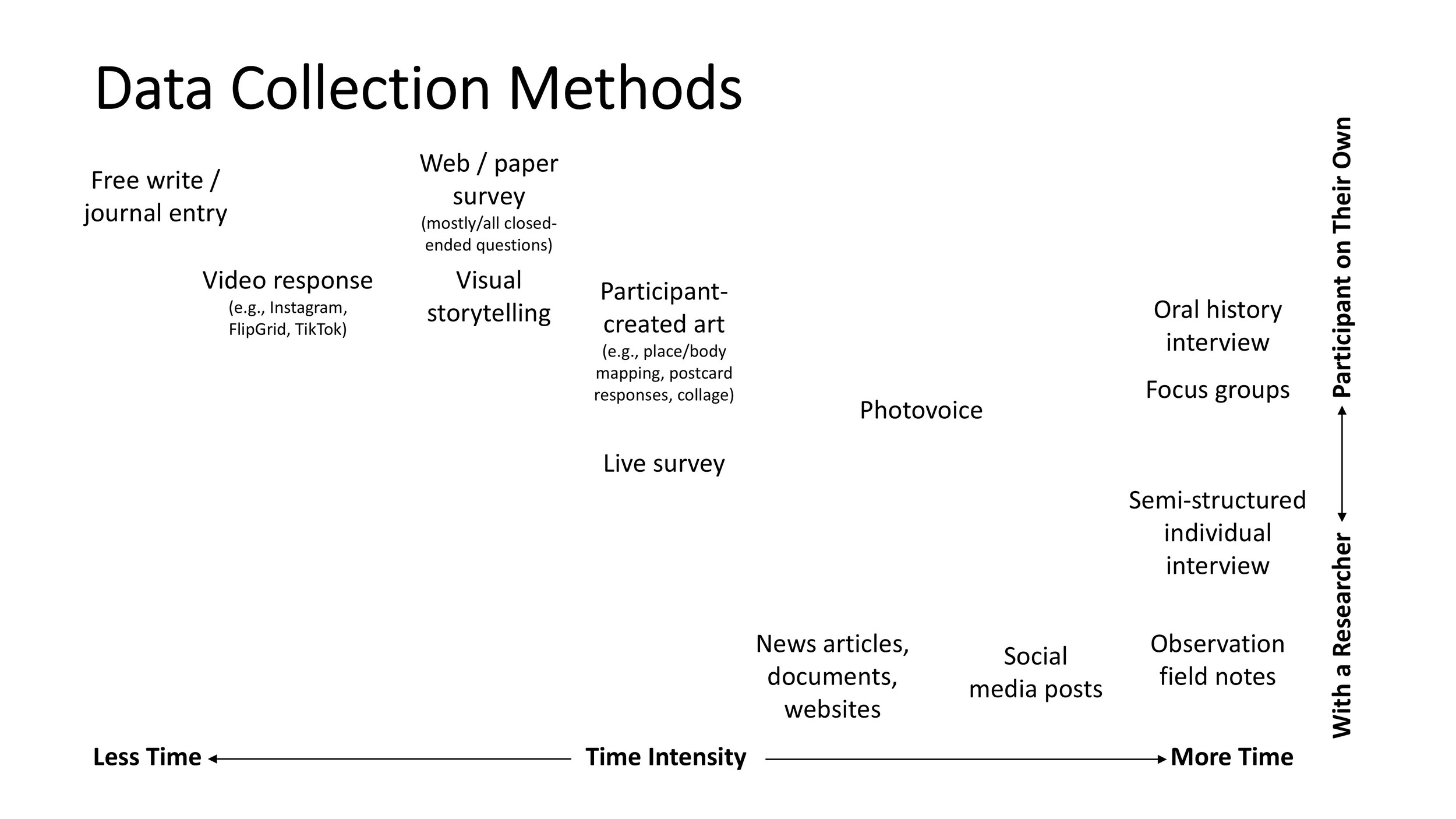
Another key point related to data collection methods in the youth-led, YPAR process from the adult facilitators’ perspectives has been how to present the various types of data to the youth to choose which they want to use in their research project. In the initial years of ART, the main types of data adult facilitators shared with individual interviews and surveys. These are the most common types of data collection and the ones that the facilitators were most familiar with. These types then expanded to include others such as journaling (e.g., Benninger et al., 2023), participant-created art (e.g., Kelley, 2022), observational field notes (e.g., Benninger et al., 2023), etc. When Deep Center facilitators asked for suggestions on data types when Peggy joined as a research partner, they made a visual to introduce these and other types of data that have been used in YPAR studies (see Figure 5). This visual approximates how much time might be needed from the researchers to prepare and implement (left to right) compared to who is more involved in doing that work from the researcher to the participant (bottom to top, respectively). Peggy shared this along with a list of example studies to see how these data have been used.
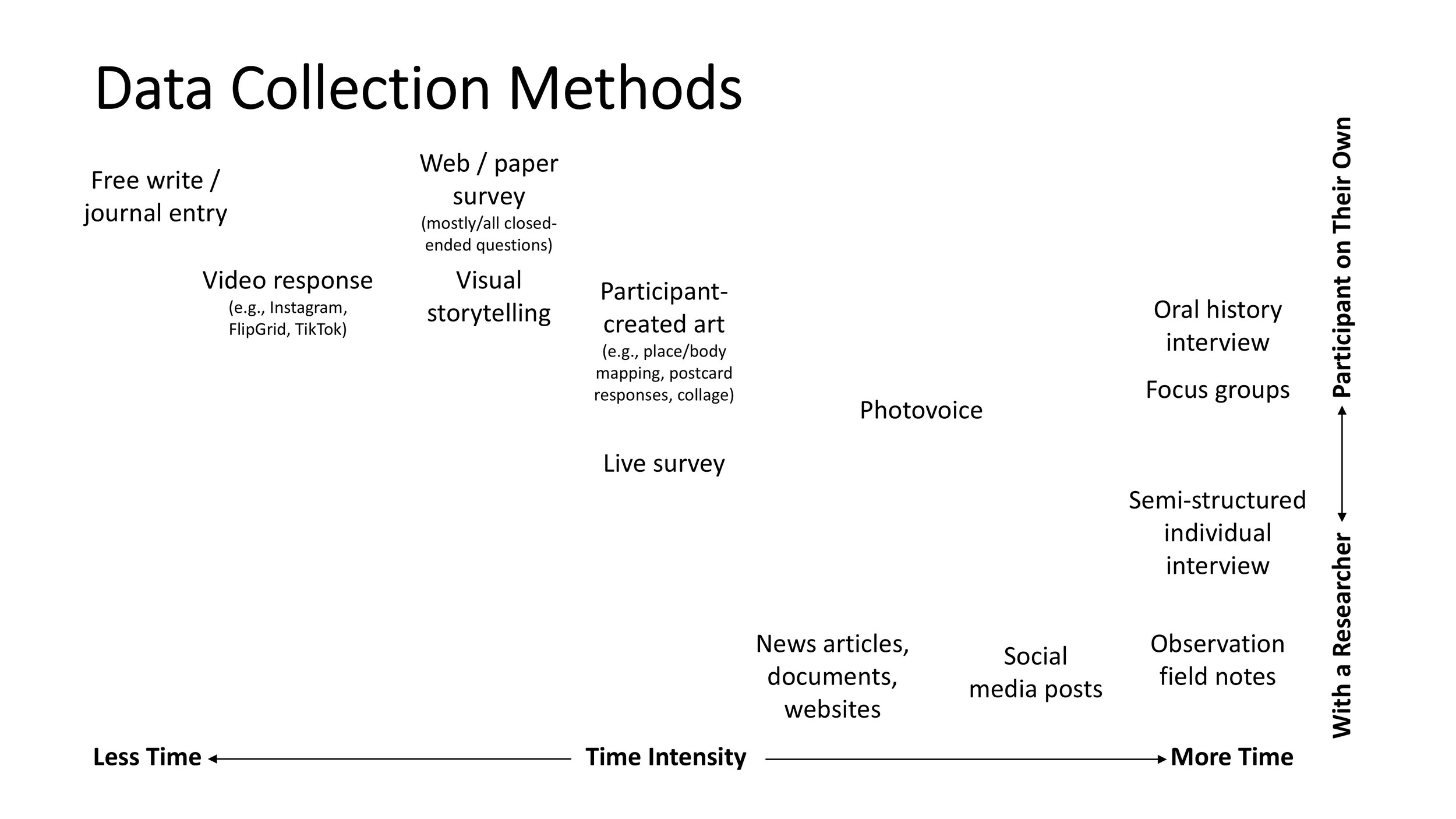
A tension in the selection of data collection types was the concern that the adult facilitators had with how research based on non-traditional forms of data (e.g., postcard responses, place mapping, video responses) would be received by the intended audience. Although many types of data collection suggested are more adjacent to how youth interact (e.g., social media posts, video responses), there was a concern that some adult groups such as legislators or school or district administrators might not take those forms of data seriously. This was compounded by the concern about adultism (Bertrand et al., 2020; Bettencourt, 2020; Hall, 2020), i.e., that the YPAR work might not be seen as “real” research because it was conducted and led by youth (Bautista et al., 2013; Branquinho & De Matos, 2019; Liebenberg et al., 2020). Additionally, although the visual was helpful in seeing the variety of data types possible beyond surveys and interviews, the facilitators decided that sharing so many options with the youth during an ART meeting might be too overwhelming. There were concerns about how to manage if the youth chose many types of data for one project. We instead opted in that year’s group (2023-2024) to share a selected list of data types to have them choose which to work on either individually or in small groups. That year, the youth chose to do individual and focus group interviews, live surveys, and observational field note journaling.
Analyzing and Interpreting Their Own and Others’ Data
“It’s on [my/their/someone’s] phone.”
This phrase was a death knell for our rich data. Nearly all of the team’s interviews and focus groups existed purely in audio recordings, meaning tedious hours of listening back and transcribing. That is, if the team was ever able to collectively access the files. For weeks, we adult allies implored that data be uploaded into a shared folder in the cloud. We asked that each be labeled, and we showed file formats and naming conventions. We spent precious hours in-session troubleshooting compatibility issues between Androids and iPhones, mp4s too large to be uploaded via our feeble WiFi, attempting to attach files to text messages, emails, Airdrop—anything to liberate the data off a single person’s phone and into a space where the collective group could help analyze it. Much of our data was trapped inside individuals’ phones, and worse, our team was bored and beginning to check out. It had been fun to interview and record, but judging from the body language in the room, it was decidedly not fun to organize this type of data.
—Megan
The vignette above is from one of our more ambitious projects: to conduct an ethnodrama that would result in a theatrical performance of a play written and acted by ART. We aimed to do this all in under 9 months, including developing our research question, identifying a methodology, and developing young people’s ability to conduct interviews and then analyze the data and create a product. Much of this was supposed to, and did, happen squeezed into weekly 2.5 hour evening meetings in addition to planning a Youth Summit, a trip to a state capitol to learn about educational policy as well as proms and college applications and standardized testing, and the looming excitement of summer vacation and heart-soaring and heart-wrenching social relationships. Participatory research can be messy, time-consuming, and unpredictable (Baum et al., 2006; Podar, 2024) so across the years, we looked for ways to streamline and scale back data analysis plans. However, even in years where we tried to scale back on what our ambitions were, the team hit a spring slump.
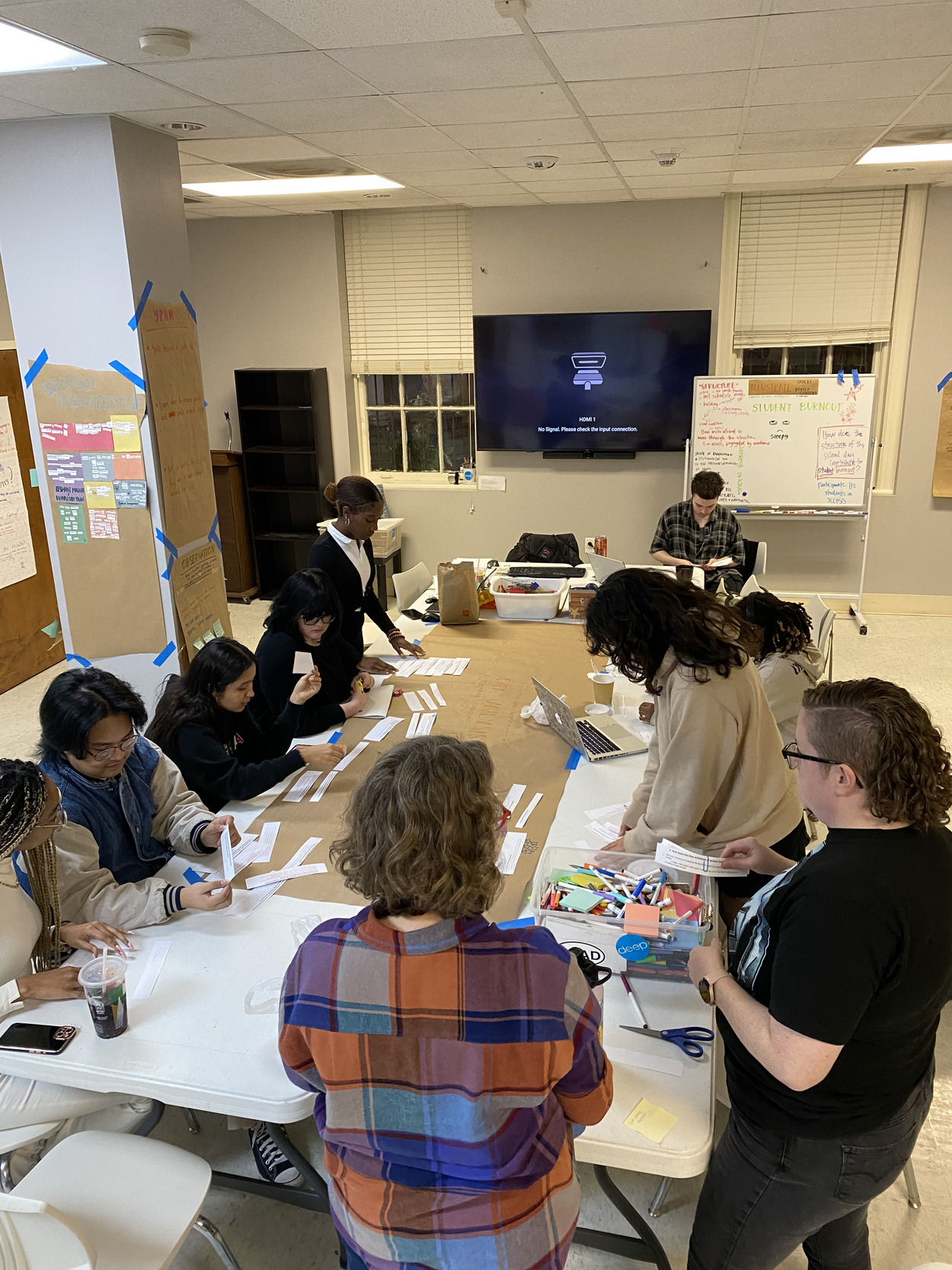
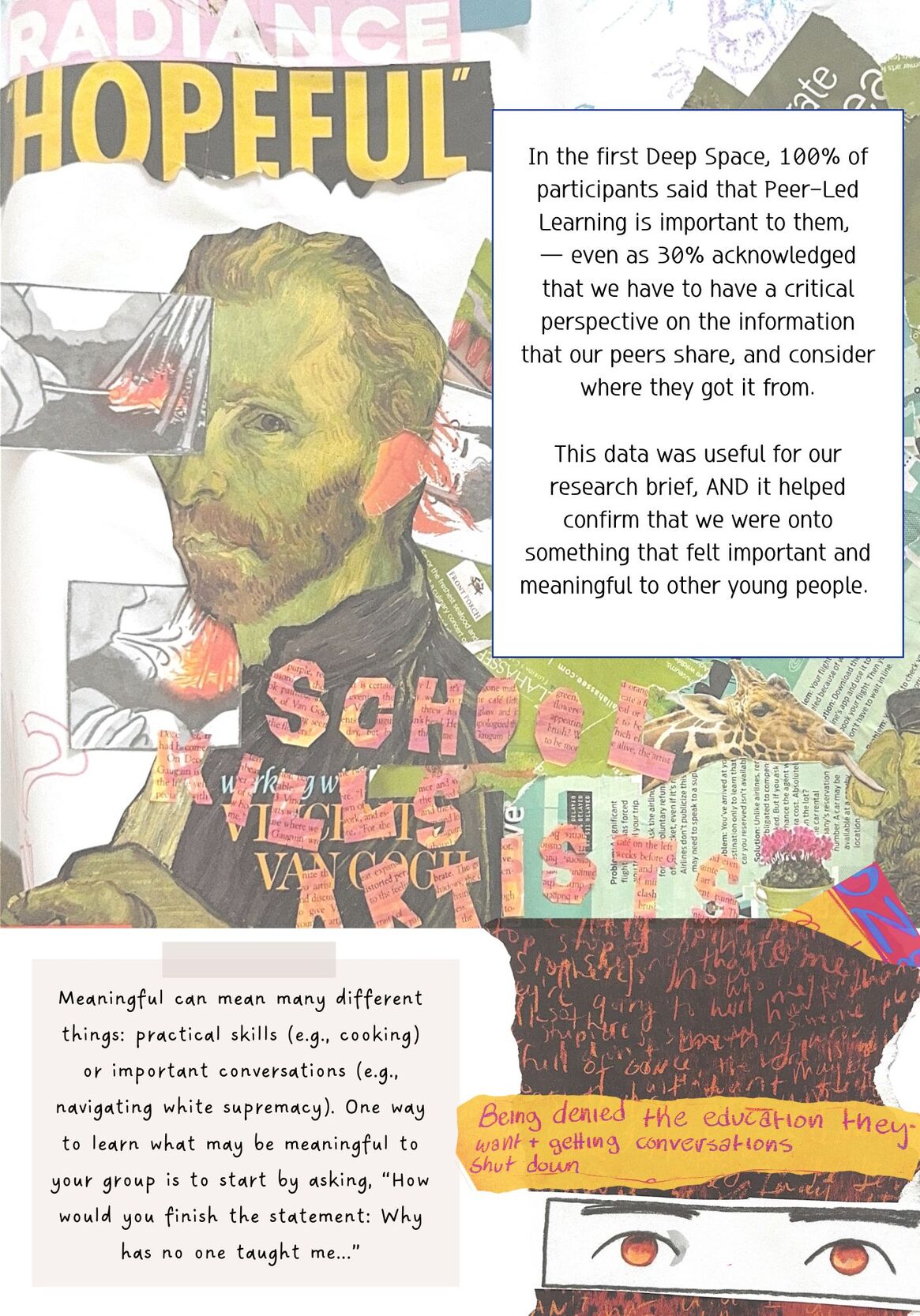
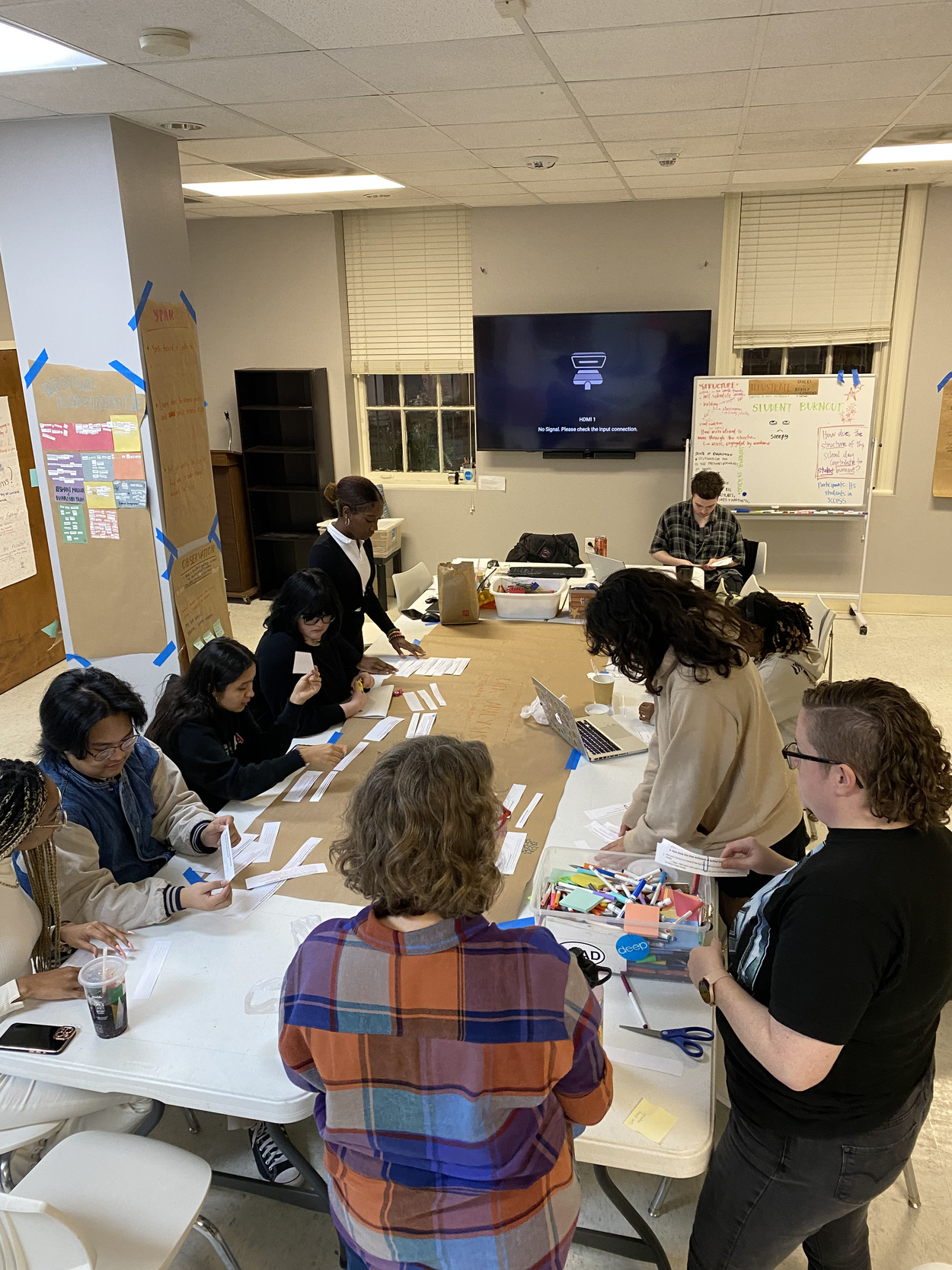
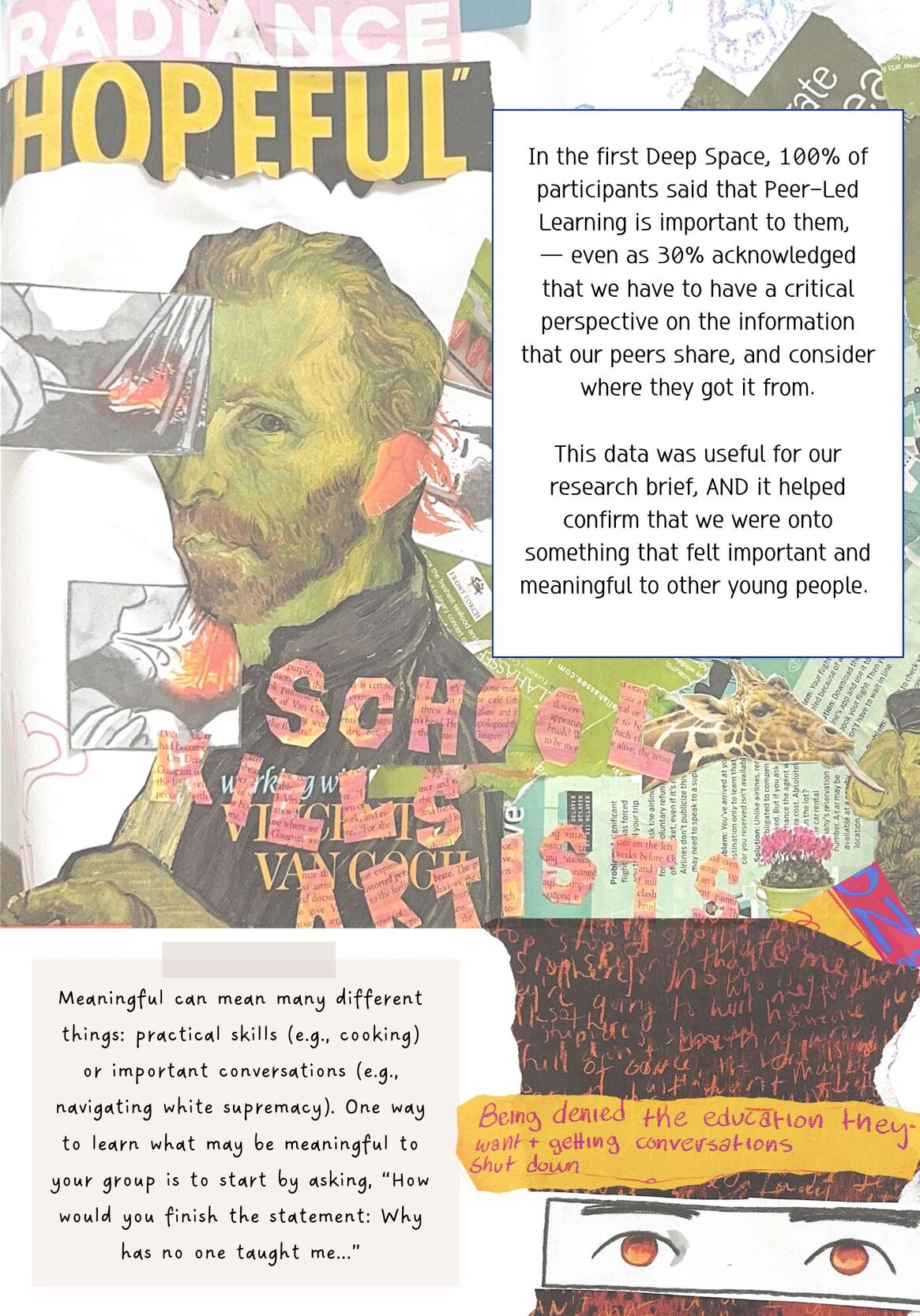
It was ART’s choice to use ethnodrama methods, albeit one that they choose after the adult adult facilitators presented it. The initial intention was to lean into the arts-based values, providing the ART members with an education about what is possible with research outside of what they may be familiar with. However, structuring meaningful learning experiences about research methods and ethics from a critical perspective is time consuming. We had to learn to make critical decisions about what should be a skill they learn, how to present direct instruction (if needed), and how to provide feasible options. In some cases, adult facilitators had to do some of the prep work leading up to analyzing. For example, we had to take on the process of transcribing and doing draft thematic coding of the data to keep ART in a timeline that allowed the group to finish the project. However, we noticed that when it came to creating the script from the data, they often fell back on their own experiences rather than the stories we collected in interviews and focus groups perhaps because they did not go through the transcripts themselves. In more recent years, adult facilitators shifted gears to make the data physically tangible (paper notes) so that ART members could interact more directly with the data and analyze it themselves (see Figure 6). In addition, our adult team created more specific instructions for how ART could engage in data analysis and through different artistic mediums including poetry, collage, comic books, and visual art. We also started using the format of artist statements to help bridge the youth-researchers-artists identities and engage with the data (see Figure 7).
Representing and Sharing Youth-Led YPAR Work
A row of our student-researchers stood under the lights on the stage of a local black-box style theater. They were buzzing.
The audience was made up of invited guests; about 30 local educators and young people. Many of the VIPs that the team had originally wanted to invite like local school administrators never made the cut.
“I learned so much, and after watching this play, I’m replaying the things that I’ve said to my own students and - mmhhm, yeah, you’ve given me something to think about. But also, what do you want us to do about it?” This was said by an educator in the audience after the show.
—Mel
The team was in the midst of planning out our data collection and took a moment to forecast what potential products could look like. We had talked about definitely making a brief of sorts about our project for those in more official positions of power, but we had also mentioned making a guide for students/youth-centered groups, but hadn’t gotten into the details. I asked the team what they were imagining when talking about this guide.
“It could be like a manual,” said one of the ART members.
“Like, a how-to guide?” another teammate responded.
“Yes exactly, that way other students could hear from us about how we made our spaces and how to make the vibes relaxed and fun.”
I looked around and watched as a wave of excitement rumbled through the team. They were bouncing back and forth about different ideas of what could be included.
I asked them “So how would someone use this manual, what advice would it give?” They paused in thoughtful silence, and someone eventually answered.
“I think it would have to talk about how we reserved the space and different recommendations. We’d want to make sure whatever student or other groups that use this can actually follow along with our process.”
“It would have to document some of our choices about the space and schedule too” another team member pipped in.
“It’ll be like a how-to zine. We’ll give people all the steps and choices we made and some advice we think will be helpful, especially if whoever is going to use this is an adult with young people. We want to make sure they are uplifting the teen voices.”
“Yeah, people can interpret vague instructions in a way that can ruin the intention if we’re not clear.”
“But we don’t wanna be too over-explained and boring then no one will actually read it. We should keep it clear, simple, and easy to follow.”
—Socks
Both of the vignettes here showcase how the youth researchers in ART are excited to share their work, where Mel’s vignette documents this excitement while sharing their research during a theater production they made and Socks’s vignette documents this excitement while planning how to represent and share their work later. They have knowledge and experiences they want to share not only with their peers but also adults. Youth-led YPAR projects can be spaces where youth enact their agency and share their voices on the topics that directly impact them that they want to make change on (Bautista et al., 2013; Cahill et al., 2008; Rodríguez & Brown, 2009). In the first vignette, the researchers transformed their study findings into an engaging and evocative set of theatrical scenes depicting how youth experience gender-based discrimination in school spaces, such as in disciplinary actions against dress code violations, teachers not respecting students’ chosen names or pronouns, etc. Theatrical productions have been used to share youth’s experiences and innovate in making change on issues impacting youth (e.g., Gallagher et al., 2024; Lee et al., 2020). The back-and-forth dialogue in the second vignette shows this peppering of ideas among the researchers, displaying how their excitement in sharing their YPAR project builds on each other’s responses and new ideas.
Although the quote from an adult educator in the audience shows that the scenes portrayed clearly made her reconsider her own past actions and interactions, she seems to have wanted more direct guidance from the researchers on what to do next. This reaction, along with the fact that several key persons the youth intended to have present being absent from the performance, highlights a tension in the YPAR process: where does responsibility transfer from the youth researchers in portraying their findings and recommendations to the adults using their positions of power to enact changes on what they have learned from YPAR projects? YPAR projects can have a transformative impact on youth and their communities (Bautista et al., 2013; Gallagher et al., 2024; Lee et al., 2020). With this in mind, how can youth researchers get their YPAR work into the hands of people with access to power to make social justice change?
Both vignettes indicate that the youth researchers clearly planned for different audience groups to interact with their work. The theatrical production in Mel’s vignette shows that time to debrief the scenes portrayed with the audience members was a planned component of the production. Socks’s vignette documents a detailed conversation between the researchers and Socks as an adult facilitator on how to ensure what they create not only speaks to their intended audience in content but also in an engaging and usable format. Arts-based representations of YPAR projects can both evoke emotions and drive change (Gallagher et al., 2024). Even while planning their data collection early on in the YPAR process, the ART members were additionally planning the final products of their research. This conversation showcases how the youth researchers wanted to ensure their how-to guide in the format of a zine provides clear recommendations about how other groups can create a space culture like they did, following their same process.
An additional challenge related to the representation and sharing of findings that has come up previously but is not part of a vignette is the importance of directly using data in the final products. For example, in a previous year, ART members talked about making dioramas comparing the current state of school spaces that contribute to student burnout versus their imagined new spaces that mitigate this burnout. As they planned the elements of each of the two dioramas, such as the type of seating, colors used, and lighting, Peggy asked the group how they could use some of their data to inform their decisions about what to include. Did any of their participants mention specific elements of a classroom, such as harsh lighting, blandly colored walls, or uncomfortable seating? Using participants’ stories to help make artistic choices about what to represent in each diorama was positioned as a responsibility that researchers have to represent what participants have shared with them. Drawing directly from the data collected can be used alongside youth researchers’ own experiences when transforming their work into art.
Conclusions and Recommendations
The purpose of this article was to provide experience-based recommendations to adult research partners in their support of youth transforming their work on YPAR projects into various art forms. Based on our experiences working with youth in youth-led YPAR projects with ART members that we explored in this article, we offer several recommendations for other adult facilitators aiming to use arts-based approaches throughout the YPAR process. These recommendations are based on our work with cohorts of high school aged youth once per week over the course of a school year. Although we work with some new youth each year, many stay as long as they can and bring along the knowledge from previous years into the iterative research process.
-
Defining What is YPAR, What is Research
-
Provide direct instruction in research methodology and arts-based research to youth in the YPAR team.
-
Connect research activities to youth’s lived experiences and expertise, while providing clear models of how “the personal” (which is always already “political” on its own) can be transformed into both art and research that may be used to represent or speak for other individuals or groups.
-
Build and recognize youth leaders within the group.
-
Used arts-based activities that cement learning and can serve as visual artifacts for participants throughout the research process and between the next YPAR group meetings.
-
-
Choosing a Topic and Scope
-
Find a framework for adult allyship and power sharing in decision-making with young people.
-
Ensure that the decision-making processes include intentional reflection, time for young people to provide feedback to adults, and opportunities to incorporate arts-based methods.
-
Use art-based activities to engage participants in root-cause analysis activities, such as a tree diagram that names the symptoms (leaves), problems (branches/trunk), and causes (roots) of an issue.
-
-
Planning for Creative (and Traditional) Data Collection
-
Identify ways to collect data that engage with youth’s creativity and address their research questions.
-
Share a range of data collection methods, including traditional and arts-based options, with youth to empower their decision-making in the project.
-
Use data collection methods that are engaging and multimodal to avoid having the research project feel like schoolwork.
-
-
Analyzing and Interpreting Their Own and Others’ Data
-
Have a data management plan.
-
Collect artist statements, and provide a model and/or template for what information these should contain.
-
Use physical and conversational ways to analyze data, and have a way to capture those analyses (e.g., printing transcripts to move around by hand, creating collages or sculptures).
-
-
Representing and Sharing Youth-Led YPAR Work
-
Keep the audience(s) in mind when making project representations as some audiences may respond differently to traditional representations (e.g., pamphlet) versus artistic representations (e.g., theatrical production).
-
Ensure both traditional and artistic representations of the study bring in examples from the data youth collected in addition to their own experiences and knowledge on the topic.
-
Have adults build bridges between youth and power brokers to support using youth’s research in support of systems change.
-
Intervene as adults, when working with other adults, to reframe and recenter young people’s expertise.
-