
Introduction
In this brief report, I describe how I used poetic transcription of interview data to create personal and group data poems in a participatory action research (PAR) study. My PAR study investigated how 10 self-identified urban youth, ages 18 to 24, who formerly served in an arts-based peer education program reflected on their identities as urban youth and peer educators. For context, one of the study aims was to interrogate the use and meanings of these identities. A major finding was how youth reclaimed an urban youth identity as they re-narrated its meaning for their intersectional lives. A PAR stance informed the qualitative study design to engage these college-aged youth as participants with research roles. The youth shared their stories and also helped interpret and distill its meanings for the study’s public arts-based research exhibit. The visual narratives displayed in the study exhibit were derived from the “poetic transcription” (Furman, 2006, p. 560) of their semi-structured interviews. This report will focus on the analytic utility, or usefulness, of poetic transcription and the use of data poems in PAR studies. The terms ‘poetic transcription’, ‘found poems’ and ‘data poems’ are used interchangeably.
Analytic Tool: Poetic Transcription of Interview Data
To help identify and represent salient data themes, I translated the youth’s interview data, or verbal narratives, into a visual re-presentation of data. More specifically, I co-authored up to five “found poems” (Butler-Kisber, 2002, p. 232) for each youth by slowly omitting their words. This omission is called “poetic transcription” (Furman, 2006, p. 560) because selected excerpts from the transcript were arranged in such a way that the prose resembled the look and shape of a poem. The careful repositioning of words into a poetic form also allowed the data to reveal more nuanced and full meanings (Furman, 2006; Furman et al., 2007). As Furman suggests, I kept the words, sentences, and phrases close to the original sequence to preserve its original meaning. Langer and Furman (2004) credit the arranging of poems as analytic work. In the study, I referred to these poems as data poems.
The data poems served a couple of analytic purposes. First, the poems reduced the copious amount of interview data. My initial poetic transcription of the interview transcripts into data poems was an interpretive act based on several rounds of hand coding. The hand coding process began after I conducted, recorded, transcribed, and annotated the 10 interviews. I initially read through the audio-recorded interview transcripts (that included the narrations of the identity maps) using a line-by-line form of open coding:
One of the advantages of line-by-line coding is that it forces you to pay close attention to what the respondent is actually saying and to construct codes that reflect their experience of the world, not yours or that of any theoretical presupposition you might have (Gibbs, 2007, p. 52).
I read and re-read all 10 interview transcripts to organize fragments of coded data into broader categories. The first round of open-coding (Boeije, 2010) allowed me to organize chunks of interview data into comprehensive fragments. I selected verbatim words from the youth’s transcript to serve as 156 preliminary open codes. I used the youth’s choice of words and phrases to vividly reflect phenomena, or what Saldaña (2013) refers to as in-vivo coding. After the line-by-line analysis within the first round of open coding, I moved into a second round of axial coding. According to Saldaña (2013, p. 222), “One of the ultimate goals during axial coding is to achieve saturation.” The primary way poetic transcription is useful is by reducing data into a manageable form.
The second purpose of the data poems was to analyze, and visually re-present, the study themes. I asked the youth to assist me with translating their coded interview data into study themes to display as visual exhibit data. Before the youth could assist in this regard, I had to reduce the data to make it more accessible. I relied on an open coding process known as dramaturgical coding, which allowed me to approach the interview transcripts as a monologue or dialogue with “improvised scenarios” (Saldaña, 2013, p. 123). This coding strategy was well-suited for the study’s performance lens. Therefore, I reviewed the initial list of 156 open codes and began to condense the codes into one of five axial codes, or dramaturgical categories: objective, conflict, strategy, attitudes, and emotion (Table 1. In-vivo Codes and Dramaturgical Categories). These pre-determined categories reflect Saldaña’s (2013) recommendation to string dramaturgical codes together to discern a storyline of interactions. Each of these five dramaturgical categories later translated into the five study themes, or five data poems. In essence, poetic transcription is useful by helping to create data themes in visual ways.
Using these five dramaturgical categories, I reduced and organized by hand the master list of 156 in-vivo codes into 54 in-vivo codes in a Microsoft Excel spreadsheet. I distinguished the remaining 54 codes into primary and secondary in-vivo codes to demonstrate its super and subordinate characteristics—with the primary codes encompassing the secondary codes. Table 1 lists the 54 in-vivo codes that represented each of the five data poem categories. Once I had these five dramaturgical categories, I was able to co-author, title, and share up to five data poems with each of the youth.
To co-author these data poems, I copied and pasted verbatim lines representing each code from the electronic interview transcript into each dramaturgical category within the Microsoft Excel spreadsheet. Then, I copied and pasted chunks of verbatim data from each dramaturgical category in a Microsoft Excel spreadsheet’s interview matrix into a Microsoft Word document. I read and organized each excerpt through constant comparison to the original interview transcript. I wanted to ensure that the context of their stories remained unchanged as I omitted words to take on the format of a poem (Table 2. Example of Poetic Transcription).
I often opted to keep fillers such as “like” and “you know?” as well as specific expressions such as “Yo,” colloquial phrases such as “clap-backs,” and their references to concepts such as “code switching” and “acting light skinned” to preserve their voice. I mainly omitted superfluous conjunctions and details about a story concept that they had already summarized in key lines. There was one case where I decided to repeat the line “people have this stigma” in a poem to emphasize the varied types of stigma a youth addressed in their story. Each youth received an email from me with a copy of their full interview transcript and the four to five personal data poems I distilled from it. In return, all 10 youth reviewed and, in some cases edited, their data poems to confirm that it adequately embodied the identities they lived, authored, and experienced. The analytic processes I underwent in co-authoring each data poem prevented me from misinterpreting their narratives (see Table 3. Data Analysis Processes). With a PAR stance, the aim of poetic transcription is not relying on a consensus or sorting through dissention in the analytical process. Instead, it is focused on using the poems to showcase the multiple meanings that can co-exist.
Analytic Tool: Using Data Poems in PAR
In this section, I describe how the youth assumed research roles by responding to the youth identity literature with group poems, confirming all of the data codes, brainstorming study themes to re-present each of the five categories of data poems, and deeply analyzing their own stories.
To ensure that the data poems reflected the voices of the youth, I invited them to participate in two PAR team meetings. At the time of the first meeting, all of the youth had completed their individual interviews with me. I had already emailed each of them a copy of their full interview transcript along with the five personal data poems I distilled from it. All 10 youth responded by email to approve each of the co-authored data poems. Once I heard from everyone, I invited the full group to a PAR team meeting to assist with analyzing the data.
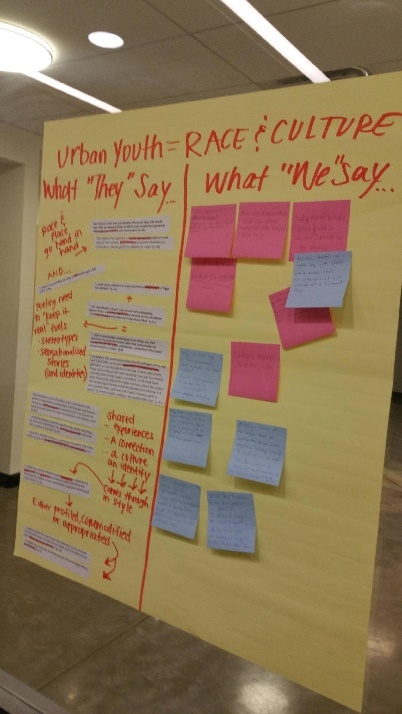
During the first PAR team meeting, I presented what “they,” or the literature, had to say about urban youth and peer educator identities to the youth during the first PAR team meeting. This PAR team meeting also allowed the youth to confirm the reduced list of in-vivo codes that I developed so that they could collectively determine study themes. After theming the data , I invited the youth to author group poems that “talked back” to the youth identity literature. To prepare for the first PAR team meeting, I re-read and pre-coded excerpts of the youth identity literature from using the organizing method of Auerbach and Silverstein (2003). This included color-coding key words and developing a list of in vivo codes in the margins related to the study constructs. As such, I hand coded selected excerpts of the literature—20 articles and four books—on an urban youth and peer educator identity. I added the six codes, which encompassed 19 sub-codes as a new tab, to the codebook I developed in a Microsoft Excel spreadsheet. I cut out passages that represented each of these six codes and glued them to flipchart papers as seen in Figure 1. Creating Group Poems.
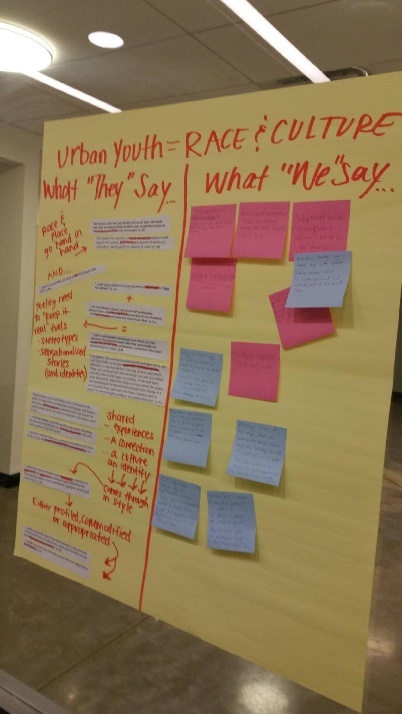
In response, the youth responded to the passages on post-it notes. After each youth had a chance to respond to each coded passage, one youth volunteered to coalesce their comments into a collective response for each code. The collective response they authored became three group poems starkly juxtaposed with excerpts from the literature in the study’s PAR exhibit.
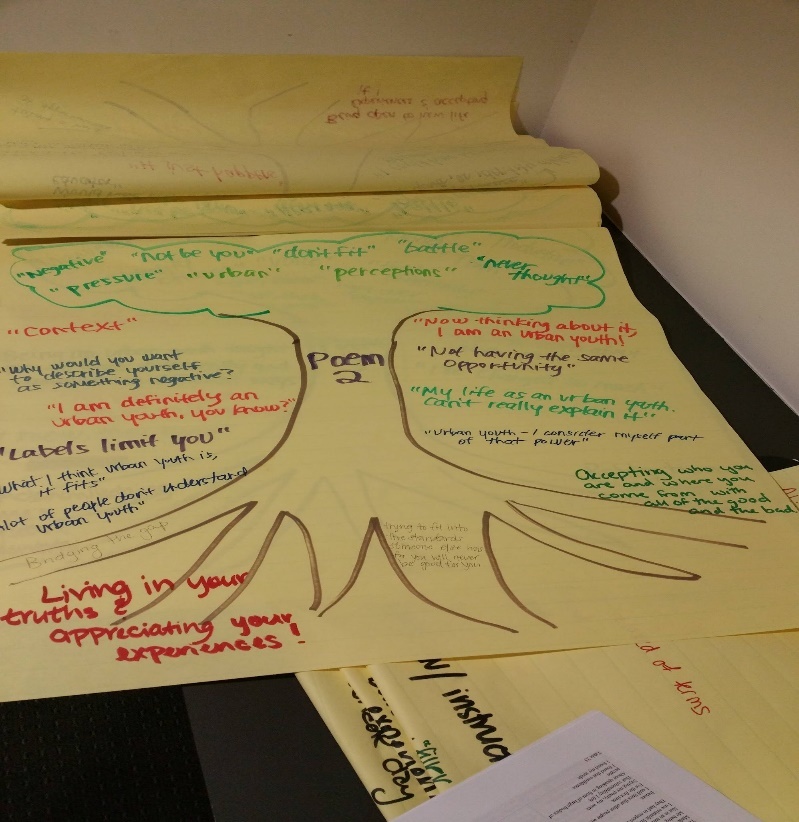
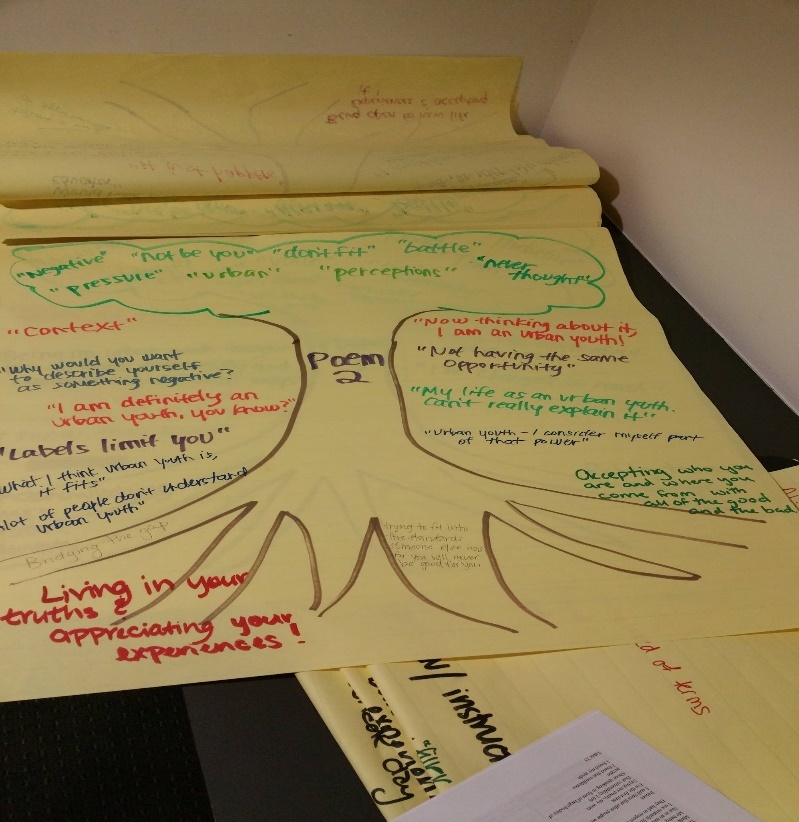
After the youth produced the three group poems, I shared the interview codes with them. I drew five trees on separate flipchart papers. On the trunk of each tree, I wrote the poem number. For instance, the dramaturgical category of codes called “objective” served as poem one. In the leaves of the trees, I wrote the name of each code for that category. I distinguished between primary and secondary codes by using two shades of a green marker (Figure 2. Using Codes to Theme Personal Poems). On the empty sides of the trees, I wrote the names of all of their poems for that category. I drew roots and left them blank for their interpretations. I invited them to review and approve all of the codes as well as offer suggestions for a theme that tied together all of these codes. I presumed that adding the titles would facilitate their ability to draw parallels for the through line across each poem.
The group poem process was inspired by Dill’s (2014) youth PAR study where the researcher reviewed the pejorative demographic data of the youth’s neighborhood and in response the youth authored interpretive poems that reclaimed their neighborhoods. This PAR team meeting allowed for me to elicit what the youth had to say about how the literature conceptualized their identities. And, in turn, compare their own conceptualizations of their urban youth and peer educator identities to the literature-based conceptualizations.
After our initial PAR team meeting, I sat with the data and developed a list of supplemental inquiries that we addressed in our second PAR team meeting to guide us in more critically exploring the assorted meanings imbued within their personal data poems. I shared the five tentative themes with the youth during our second PAR team meeting. The aim of this meeting was to elicit their feedback and approval on the study themes.
Representation or “Reliability” of Data Poems
To enhance the representation, or “reliability,” of the data poems, I trained the youth participants in coding; relied on piloted study protocols; and included thick descriptions and poetic excerpts within the study narrative. I also attended to representing the data in democratic, reflective, and accurate ways by reporting the youth’s commonplace experiences alongside more peculiar ones.
Democratically, I ensured that their data poems and study themes reflected the commonalities across their stories but also the distinctiveness of their realities. I did not search their stories to simply report what appeared interesting or important to me. Instead, I chronicled the mundane amongst the peculiar such as traveling to and from school, missing rehearsal, writing and sharing poems, being nervous, and passing out condoms on the street, to cite a few examples. I also included stories that reinforced stereotypes. Rather than erase or subdue their wide-ranging perspectives, we used the research space to talk through their narrations. Regardless of the extent of their participation, all of the youth engaged in the iterative use of poetic transcription and group analysis within the PAR team meetings. Engaging the youth in the data analysis process was just as participatory as it was democratic.
Reflectively, I situated their stories in larger social and historical conditions. I wrote about the educational, geographical, and race and class-based stigmas projected onto their identities. Considering such conditions provided some context to explore how the youth recognize, perpetuate, fight, and survive oppression. This contextual understanding was important for exploring the complexity of how youth perform their identities in relation to the world around them. Understanding the social and historical contexts of identity performance also allowed me to make sense of their negotiations from the personal interviews to the PAR team meetings. In particular, Fine, Weiss, Wessen, & Wong (2000) write that “the cacophony of voices filled with spirit, possibility, and sense of vitality absent in individual data” (pp. 267-268) is what helped me understand why the reclaiming of an urban youth identity happened for the youth only when among their peers.
When it comes to “accurately” representing their identities, I reported what the youth shared with me, regardless to whether I agreed. For instance, when I asked Dana why she edited her poem, she candidly shared that she didn’t want to be perceived as unintelligent. I reported that. However, Fine et. al. (2000) suggests that researchers not simply document the stories that participants share but use the data to recast what these stories could be and could mean. As such, the data re-presents negotiated interpretations based on questions I posed to the youth in our PAR team meetings that invited them to consider additional perspectives on the stories they shared.
Trustworthiness or “Validity” of Data Poems
Traditional verification procedures used in postpositivist research were a misfit for the aims of my qualitative study. However, there were specific safeguards in place so that the data of this study reflected the realities experienced by the youth.
As opposed to triangulating methods for the positivistic aims of validity, the concurrent use of multiple analytic tools strengthened the trustworthiness of the data. The participatory design also inherently offered an ongoing check of interpretations before I drew conclusions. I selected this design in anticipation that all youth would benefit from sharing and retelling their narrative identities. As such, this study inherently offered what Merriam (2009) describes as member checking. The youth led the meaning-making process as they identified themes and offered checks and balances to ensure my interpretations of their narrations were preserved. The audio recorded interview transcripts also allowed cross-referencing of the handwritten notes, data poems, and resulting codes and themes.
Another advantage of the PAR stance in building trustworthiness of the data was that the youth confirmed the master list of codes. This analysis process loosely resembles an intercoder agreement, or what Creswell (2007) describes as conceptualizations of what codes mean when categorizing transcript passages into chunks of data. I initially developed codes based on the words and terms that the youth shared in their interviews. Our PAR team meetings allowed the youth to weigh in on and suggest themes in addition to the opportunity to review and compare visual data to improve the likelihood that the codes re-presented collective interpretations while still making room for dissent.
Limitations
An inherent limitation to using arts-based research (ABR) methods is the variability in interpreting data sources. For example, poetically transcribing the youth’s interviews was dependent on my subjective selection of some words and phrases over others. Additionally, though I did not decidedly select data not to report, the data reduction process inherently minimized some data over others. Though the youth reviewed and approved the co-authored data poems, my initial interpretations may have limited the range of meanings available for our group analysis. As such, the interpretations offered by myself and the PAR study team could not capture all of the varied meanings of the data.
In response to this limitation, the strengths of the PAR stance lies in its ability to privilege multiple meanings and voices in the process. I did not excavate my voice or analytic role from this process. In fact, because this was a dissertation study, there was an inherent limitation to inviting the youth to serve as co-researchers and co-authors. Instead, they were invited to engage in this study as ‘participants with research roles’ with analytic responsibilities such as reviewing, editing, and approving the data poems I took the lead on developing based on how they narrated their personal identities in the interview transcripts. But this also meant that they took the lead on writing the second set of data poems that represented their group identities where I needed to collaborate with them for sense making. Therefore, a discussion on the roles and rights of group representations with the youth on the PAR team pre-empts any attempts at consensus-building at the expense of autonomy (Kamberelis & Dimitriadis, 2013; Silverman, 2010).
Conclusion
For researchers studying complex phenomenon such as identity, relationships, trauma- among others- poetry allows for a deep and meaningful expression of otherwise unexplored feelings and experiences. As an ABR method, poetry is known for readily and evocatively contributing to a counter narrative (Fine, personal communication, June 5, 2013). In my PAR study, the use of data poems allowed for youth to choose how their identities get characterized in non-confining ways. Researchers may elect to use this method when interested in engaging and disseminating their work in equitable ways that include plain language and non-scholarly audiences. There is much utility for how other PAR studies can rely on the use of data poems given how they double as a way to interpret and disseminate the rich meanings of qualitative interview data.