
Introduction
Around 20% of children and young people aged 8 to 16 years old have a probable mental health disorder in the UK (Newlove-Delgado et al., 2023). The transition from childhood into young adulthood represents a key period for the development of mental health disorders, with 50% of mental health disorders developing by the age of 14 (Kessler et al., 2005). Despite this, children and young people’s needs remain largely unmet (Colizzi et al., 2020). Long wait times prevent children and young people from accessing help and support, with over 40,000 young people waiting over 2 years for NHS mental health treatment in the year 2022/23 (Children’s Commissioner, 2024). Furthermore, out-of-date treatment models have been reported, which do not meet the cultural and developmental needs of young people (McGorry & Mei, 2020). As a result, many young people are reluctant to seek help (McGorry & Mei, 2020) and are instead turning to schools for support, with teachers being the most likely source of support for children and young people’s mental health and wellbeing (Lowry et al., 2022).
Support from schools can come in a variety of different formats. The main research focus so far has been on the provision of direct mental health and wellbeing support for pupils within secondary schools. Findings have identified mental health and wellbeing support to be primarily focused on those at risk of developing or with existing mental health difficulties (Patalay et al., 2017; Vostanis et al., 2013).
Other areas of school provision, such as sporting and physical activities, and arts/creative activities are often not categorised as mental health and wellbeing provision but have also been found to be beneficial to young people’s wellbeing (Bungay & Vella-Burrows, 2013; Ennis & Tonkin, 2018; Morse et al., 2021; Rodríguez-Bravo et al., 2020). A recent systematic review explored school provision of physical activities and their impact on adolescent mental health and wellbeing and found a range of best practice examples which utilised minor modifications to usual provision to have a positive impact on young people’s mental health and wellbeing. The authors highlighted the need for physical activity in secondary schools to go beyond routine physical education to have a positive impact on wellbeing (Rocliffe, Adamakis, et al., 2023). However, an audit of physical activity provision across secondary schools in Ireland found a lack of prioritization for both physical education and any extra-curricular physical activities (Rocliffe, O’ Keeffe, et al., 2023). This highlights the need to monitor differences between access of physical activity provision amongst schools, given the impact lack of access to it could be having on children and young people’s mental health and wellbeing.
The literature on the provision of arts/creative activities within schools is less expansive. Whilst the importance of and link between arts/creative activities and children and young people’s mental health and wellbeing has been highlighted (Bungay & Vella-Burrows, 2013; Davies et al., 2013; Ennis & Tonkin, 2018; Hugh-Jones et al., 2025; Morse et al., 2021), little is currently known about the provision of arts and other creative activities within schools. This means that overall, there has been a considerable focus on schools as a site for deploying mental health support with much less focus on the variety of provision which, whilst not labelled as mental health support, may nevertheless support children and young people’s mental health and wellbeing. This provision from schools could either act as supplementary to existing services, or by helping to prevent the development of long-term difficulties which require more intensive support (Fledderjohann et al., 2021).
Therefore, these gaps in the literature suggest that our current understanding of what schools can offer is limited and as such, an updated school provision survey which encompasses the above would be valuable to increase understanding and knowledge. This is particularly important now, given the negative impact of the Covid-19 pandemic on children and young people’s mental health (Creswell et al., 2021; Montero-Marin et al., 2023) and following the introduction of Mental Health Support Teams in schools (Ellins et al., 2023) whose impact providing support for mental health and wellbeing provision has not yet been fully explored.
#BeeWell is a programme delivered within secondary schools to explore what affects children and young people’s wellbeing, via pupil surveys (#BeeWell Research Team, 2023). The #BeeWell programme to date has been completed by over 85,000 young people across multiple regions, working with schools to feedback and provide targeted local action. This includes schools in Greater Manchester and Hampshire, Isle of Wight, Portsmouth, and Southampton (#BeeWell, 2023). The annual #BeeWell survey covers different aspects and influences of wellbeing, including psychological wellbeing, self-esteem, autonomy, school, health and routines, relationships, and hobbies (#BeeWell Research Team, 2023). A gap was identified within the #BeeWell programme in which data on the provision available within schools to support pupil wellbeing was not being collected. Further, most school surveys have not linked results to young people’s reported wellbeing. Surveys that can link school mental health and wellbeing provision, alongside the provision of other physical and arts/creative activities, to children and young people’s reported wellbeing outcomes would not only provide an understanding of availability within and between schools, but it may also provide information on the direct impact of such provision. This information could subsequently be fed back to schools to help identify and resolve issues with gaps in their provision. Therefore, an additional survey could be delivered within #BeeWell schools to collect data on the provision available to pupils, as well as linking this provision to their pupil-reported outcomes.
Patient and Public Involvement
The inclusion of school staff, young people, and other stakeholders (e.g. researchers, individuals working with local councils or charities etc.) via Patient and Public Involvement (PPI), defined here as “research being carried out ‘with’ or ‘by’ members of the public rather than ‘to’, ‘about’, or ‘for’ them” (Biggane et al., 2019, p. 126), may help to improve our ability to capture school provision data. The inclusion of PPI has been associated with increased research quality and integrity (Biggane et al., 2019), with reported benefits including PPI participants helping to identify relevant research questions, create participant facing materials, increase recruitment of research participants, improve trial delivery, and disseminate the results of research to relevant audiences (Aries et al., 2021; Arumugam et al., 2023; Blackburn et al., 2018; South et al., 2016; Wilson et al., 2020). Research suggests that PPI leads to individuals feeling more confident and empowered, as well as benefitting from skills development (Brett et al., 2014; Lepage et al., 2025; Stocks et al., 2015; Wilson et al., 2020).
Children and young people have traditionally been involved in PPI less than their adult counterparts (Preston et al., 2023; Rouncefield-Swales et al., 2021). Contributing to this could be fears that participation might adversely affect a child or young person (Clarke, 2015) or beliefs that children and young people are not competent enough or lack the necessary skills to engage with and improve the quality of research (Campbell, 2008; Moules & O’Brien, 2012; Powell & Smith, 2009). This can lead to children and young people being left out of the research process or being involved in a tokenistic or superficial way, to provide a false sense of partnered working, when in reality their involvement has no real impact on the research (Larsson et al., 2018). However, the inclusion of children and young people as active PPI participants should be seen as a priority, with article 12 of the United Nations Convention of the Rights of the Child (UNCRC) stating that every child has the “right to express their views, feelings and wishes in all matters affecting them, and to have their views considered and taken seriously” (MacKenzie et al., 2020, p. 12). Therefore, the meaningful involvement of children and young people within PPI is essential to ensure their voices are heard. Involving children and young people within PPI has also been associated with benefits which cannot be achieved by adults alone, such as helping to ensure that research topics encompass their experiences and having better access to young person groups for data collection and dissemination (Wilson et al., 2020).
But whilst the inclusion of PPI within research becomes more routine, reporting on involvement remains inconsistent (Jones et al., 2015; Preston et al., 2023; Rouncefield-Swales et al., 2021). In particular, reporting on the impact PPI had on the research or the individuals involved is low, despite the number of tools available which have been designed to evaluate the impact of PPI within research (Lammons et al., 2025). There is a need for researchers to routinely report both PPI processes and impact. Research suggests that studies that report PPI impact are more likely to adhere to good practice (Blackburn et al., 2018), with fears that a lack of reporting might result in PPI activities which are tokenistic in nature or included as merely a tick-box exercise (Mann et al., 2018). For PPI involving children and young people in particular, reporting on PPI impact also helps to ensure the UNCRC are being adhered to, and that their views are being listened to and taken seriously. The Lundy Model was designed to conceptualise children and young people’s right to involvement in research and the development of services, to ensure they have “the space to express their views; their voice is enabled; they have an audience for their views; and their views will have influence” (Lundy, 2007, p. 3). Consisting of four elements (space, voice, audience, and influence), this model could be a relevant tool to provide a way for those working with children and young people to ensure that their involvement is meaningful.
Being able to effectively work alongside school staff, young people, and other stakeholders in the development of a #BeeWell school provision survey may also help to ensure the survey captures information important to schools, with an approach that is feasible and able to accurately reflect school provision.
Aims
This study aimed to consult with various school staff, young person, and other stakeholder groups to design and launch a #BeeWell school provision survey exploring how schools within the #BeeWell programme support children and young people’s mental health and wellbeing. This paper outlines the process of PPI inclusion as part of survey design and plans for implementation with a focus on the impact this had on the research, the lead researcher, and the individuals involved. This demonstrates how feasible PPI methods can be when used within a short timeframe, to create a user-friendly survey which is able to capture key information about school provision.
Methods
This study included the conceptualisation, design, and implementation of a school provision survey to 255 UK secondary schools, looking at provision in three key areas: mental health and wellbeing, physical education and sport, and arts and culture. Elements of the GRIPP2 reporting checklist were used to report findings, which is the first international guidance for reporting PPI in health and social care research (Staniszewska et al., 2017). However, some sections of the GRIPP2 checklist were not relevant to this study, such as sections on theory development and economic assessment (Staniszewska et al., 2017). See Additional File 1 for the completed GRIPP2 Checklist.
PPI Groups
There were three main PPI groups involved in this study: stakeholders (e.g. researchers, individuals working for local councils or charities etc.), secondary school staff, and young people. Data on the mental health and wellbeing provision within schools is currently lacking, which could be due to the difficulty of capturing this information accurately within schools, or the burden placed upon schools to provide this information. Involving these groups in the conceptualisation, design, and implementation of the survey is valuable to help mitigate these difficulties associated with survey completion. See Table 1 for details of the PPI groups involved in the development of the #BeeWell School Provision Survey.
Stakeholder groups were involved either due to their links with the #BeeWell programme, an interest in, or work in an area being covered by the survey, or both. The secondary school staff PPI group consisted of school staff from #BeeWell schools. #BeeWell school staff were recruited via the #BeeWell school teams, who lead on school engagement and liaison. Adverts were circulated to all #BeeWell schools who were considered likely to be interested and had the capacity to be included in a consultation session. Staff interested in taking part emailed the lead researcher directly to receive further information and arrange a suitable time to take part. A total of 13 school staff expressed an interest to take part, however due to scheduling conflicts, eight school staff attended one of the three separate consultation sessions. Each session lasted approximately 90 minutes each and took place in July 2024. Limited demographic details were collected from the school staff (see Table 2), with three school staff unable to provide demographic details because they left the session early. There was also involvement in survey conceptualisation on a smaller scale from a larger group of secondary school staff during the #BeeWell Headline Findings Event in March 2024, which is a yearly event held by the #BeeWell programme to highlight key findings from the most recent pupil surveys to school staff and stakeholders. At this event, #BeeWell staff were asked for views on the need for the survey and at what point during the school year they would prefer to complete it.
Young people associated with Anna Freud (a children and young people’s mental health charity) as Young Champions were involved as the final PPI group. Young Champions are young people aged 14 to 25 years old who work to help shape the work Anna Freud does to ensure their lived experiences are represented (Anna Freud, 2024). An advert for involvement was sent to all Young Champions at Anna Freud, who were given the opportunity to express an interest. Those who did were put in direct contact with the lead researcher, who provided further information about the session including the session aims and what would happen on the day. Following confirmation of interest, a suitable time and date was set for an online session to take place. A total of four young people were interested, with three young people actually taking part in the consultation session which took place in June 2024 and lasted approximately 90 minutes.
Survey Conceptualisation and Design
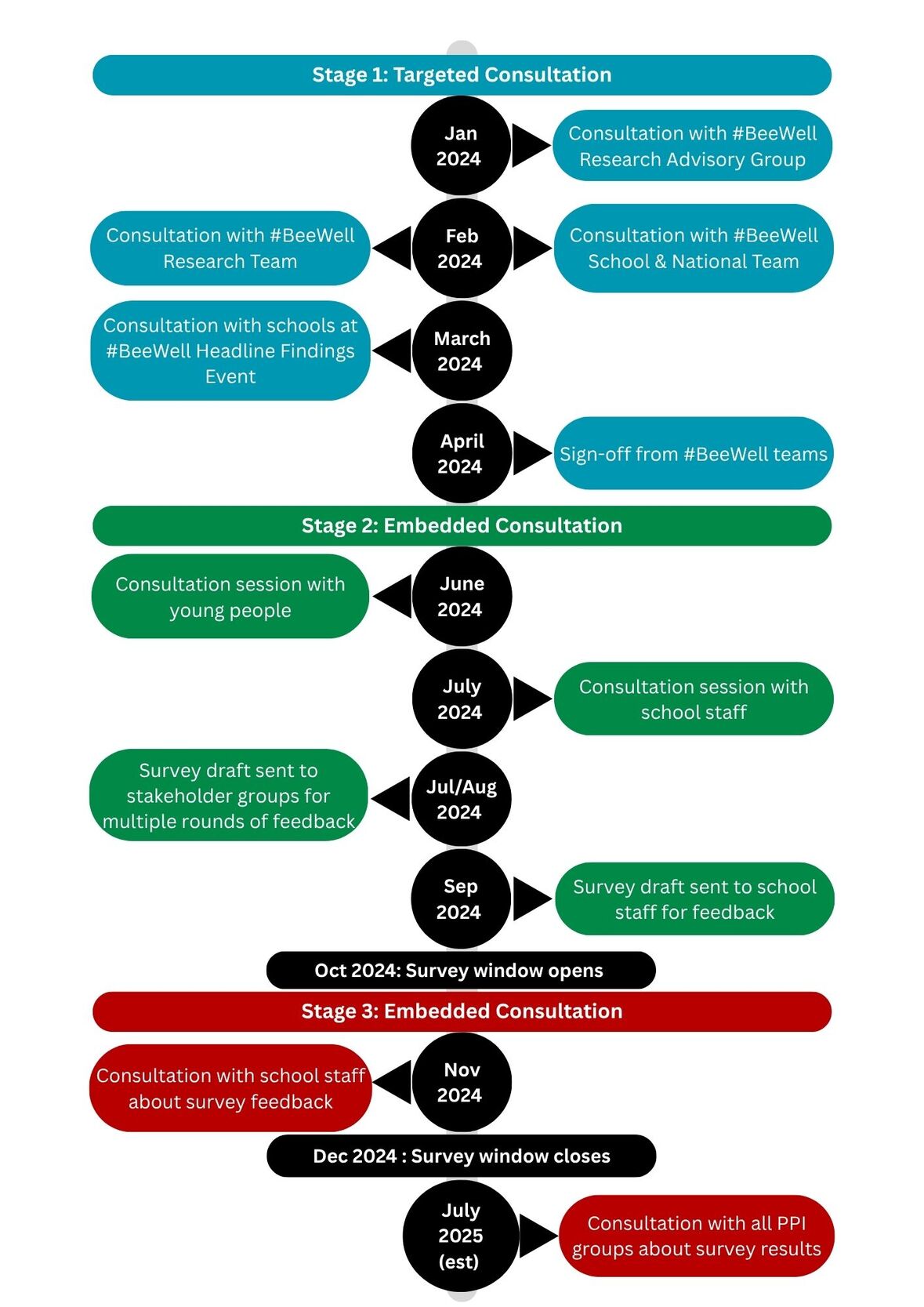
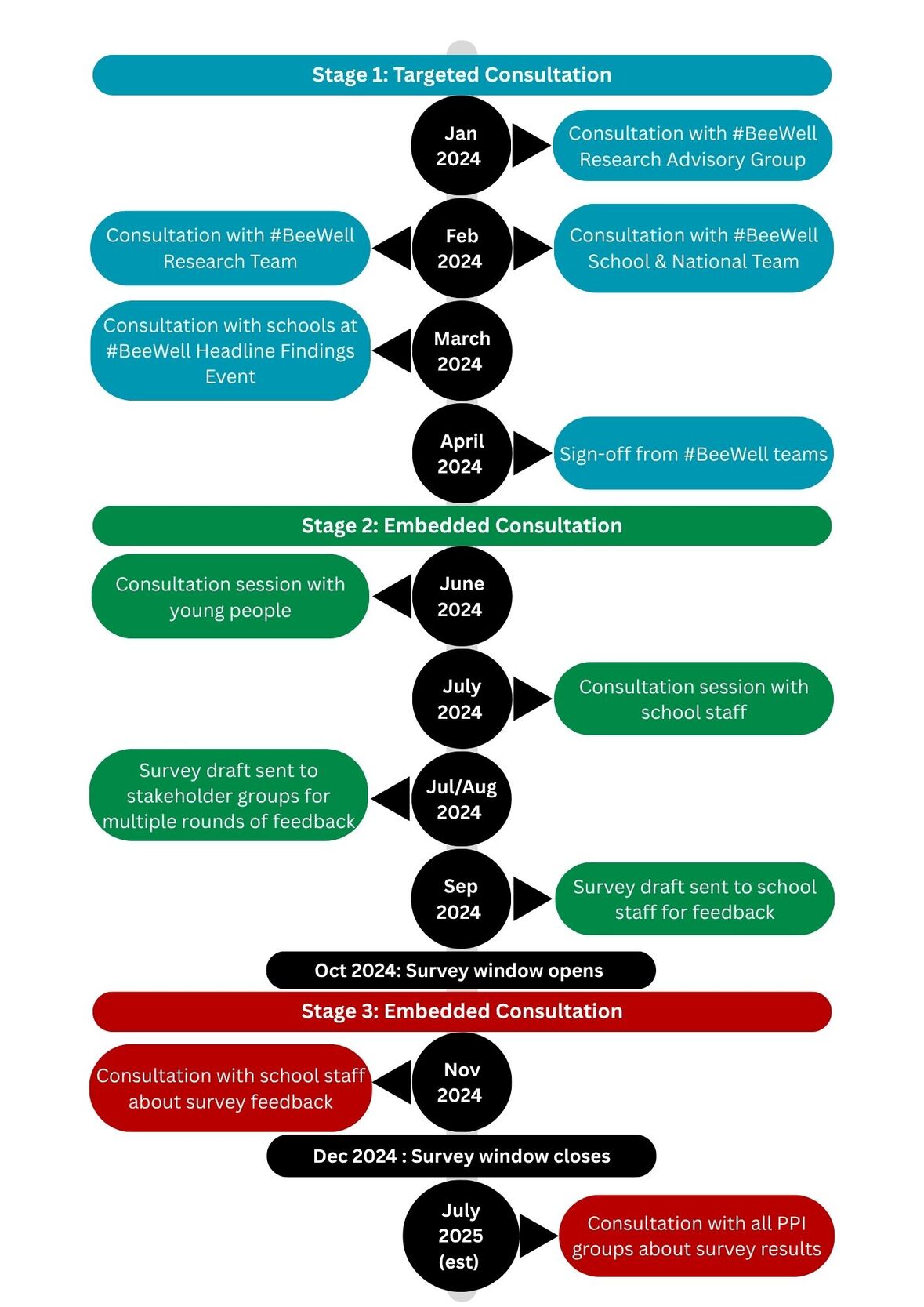
The below outlines the stages of conceptualisation and design of the #BeeWell School Provision Survey (see Figure 1 for a full flow chart of PPI involvement). This includes details about the stage and level of PPI involvement, as outlined by Hughes and Duffy (2018).
Stage One: Targeted Consultation
Initial survey conceptualisation took place between January and April 2024. The first stage included a review of the literature, where the lead researcher searched for similar surveys which had been conducted within schools to measure their provision in one of the three areas of interest. Since there was a limited timeframe for survey development, a systematic search was not possible and instead searches were conducted online using Google scholar, with additional papers also being identified through scanning the reference lists of relevant studies. This was supplemented by conversations with experts within the field (e.g. #BeeWell and Anna Freud colleagues, other academics) who had experience conducting similar surveys to determine whether anything important had been omitted. Identified surveys which covered similar areas to those of interest were drawn upon for ideas and early drafts of questions, most notably surveys from the Education for Wellbeing trial (Hayes et al., 2019) and Rocliffe, O’ Keeffe et al. (2023) were used, resulting in a first draft of the survey.
During this first survey drafting stage, various PPI groups were consulted to gather opinions on whether there was a need for a #BeeWell school provision survey, and if so, their advice on what the content of the survey should be. The #BeeWell Research Advisory Group, as well as the #BeeWell Research, National, and School teams were initially separately presented with a proposal for the survey which contained a rationale detailing the need for the survey, a plan for survey launch, and the draft survey topics and questions. These groups provided feedback on these aspects, along with other possible modules which could be included within the survey. The survey draft was subsequently updated. Further consultation with school staff took place at the #BeeWell Headline Findings Event in March 2024. Official sign-off from the #BeeWell teams was provided thereafter.
Stage Two: Embedded Consultation
Following a stage of initial targeted consultation, a stage of embedded consultation took place. Consultation sessions with young people and school staff were conducted by the lead researcher. Online consultation sessions for young people and school staff had the same format, lasting about 90 minutes, taking place via Zoom (version 6.0.0). Each session began with a brief icebreaker, followed by a ten-minute introduction to the topic by the lead researcher using a PowerPoint presentation on a shared screen. This introduction detailed the idea and rationale for the #BeeWell School Provision Survey, as well as the topics which the survey would cover.
The remainder of the session was dedicated to an open discussion to gather perspectives on whether attendees considered the proposed survey topics (mental health and wellbeing, physical activities, and arts/creative activities) important to include in the survey. This discussion also explored whether there were any other topics missing which should be included as part of the survey, based on what secondary school provision was deemed important for young people’s mental health and wellbeing. This open discussion was centred on a shared screen, which had a series of Google Jamboard pages with titled prompts related to each proposed topic and a final page for anything additional (e.g. additional topics to cover in the survey). Google Jamboard was offered as an inclusive way to ensure all attendees could access the shared screen on their own device and add their own notes and ideas directly. Despite the link to the Google Jamboard being shared at the start of the session, no attendees chose to do this. Instead, the lead researcher made anonymous live notes directly onto the Google Jamboard, which was viewed by everyone in the session via a shared screen. To validate the content of the notes, attendees were frequently encouraged to comment on the notes as they were added.
Time towards the end of the consultation session was allocated to collect feedback, which was shared as a link to an anonymous Microsoft Form. Each session was supported by another researcher, who monitored the online chat and provided further assistance as needed. As a thank you for their time, all young people and school staff who participated in a consultation session were each sent a £25 shopping voucher soon after the session ended.
Further survey drafting and subsequent revisions were led by the lead researcher and began in July 2024, following the completion of consultation sessions with young people and school staff. Survey drafts were sent via email to the various stakeholder groups for comment. Feedback was received either by email or in meetings where much more detailed feedback was received by question. This was an iterative process whereby updated drafts of the survey were circulated for further edits and comments as needed. As part of this process, meetings with key colleagues in the #BeeWell collaboration took place at multiple time points to go through feedback which had been received, and revise survey questions. The final draft of the survey was then circulated to school staff again for any final feedback, comments, or suggested edits, before being signed off within the #BeeWell team. As a thank you for their input and expertise, school staff who provided any further comments were each offered a £10 shopping voucher, however no further feedback was received from school staff.
Measurement of PPI Impact
Impact of PPI on the research was monitored by the multiple rounds of survey drafts produced prior to it being implemented in schools. The impact on young people and school staff was measured via The Lundy Model of Child Participation, which was chosen due to its ability to quantitatively capture impact across four elements: space, voice, audience, and influence (Lundy, 2007). A bespoke Microsoft Forms online feedback form was created, which included questions about the experience of participating in the session according to the elements of the model and as such consisted of statements which could be rated between 1 and 5 stars, for example “I was listened to from the start” and “I felt comfortable giving my opinions”. Additional qualitative, open-ended questions were added onto the end of this form, to capture any further insights or thoughts. Feedback on impact was collected anonymously before the end of each consultation session. See Additional File 2 for all questions included in the feedback form.
Impact of the PPI on the lead researcher was also captured throughout with the use of a personal reflexive diary. Commonly used in qualitative research, reflexivity in research involves the researcher considering the context in which the research is taking place, including their own influence on the research practice and results (von Unger, 2021). To do this, the lead researcher documented her experience throughout the survey development process, making notes in an online document after each consultation session and each meeting with the #BeeWell research team or stakeholder group. The diary was also used to report any key reflections throughout the process. Topics of reflection included general observations, feelings of triumph, challenges experienced, the impact of PPI on methodological decisions, and the experience of taking part in PPI activities as a PhD researcher.
Results
Impact of PPI on the Survey
Survey Conceptualisation and Design
The conceptualisation and design of the survey involved stakeholders and #BeeWell school staff. In the first instance, as part of a stage of targeted consultation, the concept of the survey was proposed to the #BeeWell Research and National Team’s for feedback. The focus of these conversations was on the burden of the survey on the #BeeWell schools. The original proposal therefore evolved to include more consideration for the impact of the survey on the staff members involved, and to build on the rationale for the survey to ensure its aims were worthwhile to avoid wasting school time. After this consultation, the following considerations were made:
-
The time burden on schools and individual staff members, who would also be arranging and delivering the usual #BeeWell pupil survey. This was a key consideration given the capacity of school staff who were already providing their time to deliver the #BeeWell programme. Decisions about the survey design were made with these groups to try to minimise the burden on staff completing the survey. This included:
-
Having a modular approach to the survey, whereby each topic (e.g. mental health and wellbeing, physical education and sport, arts and culture) was split into different sections, to be completed by a different and the most suitable member of staff. This would help to reduce the amount of time spent completing the survey for any one individual.
-
Reducing the number of questions in each survey module. It was decided that a maximum of 15 minutes was acceptable for any one individual to spend completing the survey and so each module was designed to take about this amount of time.
-
Advertising the survey as optional from the beginning, and whilst schools could complete the survey as soon as it was implemented, individual schools would not be prompted to complete until they had submitted the usual #BeeWell pupil surveys to help to ensure that they did not feel over-burdened.
-
-
The benefit for schools who participated in the survey. Given the commitment of schools to already arrange and deliver the usual #BeeWell pupil survey, there were concerns around whether the benefit for schools to undertake this extra commitment would exceed the extra work. As a result, time was spent thinking through the benefits to schools who take part, with the following ideas proposed and agreed upon:
-
Each school who took part would receive a summary displaying the results of the survey. This would not be shared within anyone else to protect the anonymity of the school, however, this could be used and shared by the school as needed (e.g. with Ofsted, local authorities, parents etc.) to show the level of provision available within the school.
-
The results collected from each school could be used to better identify gaps in provision. This information could then be used as part of the usual #BeeWell feedback sessions, led by the Child Outcomes Research Consortium (CORC), which take place with schools following the analysis of survey data. These sessions would be able to support the school in developing plans to address these gaps.
-
The modules originally proposed were mental health and wellbeing, physical activities, and arts/creative activities, which were all endorsed as being important to measure. During consultation with the #BeeWell Research Advisory Group, two other modules were proposed: special educational needs and disability (SEND) provision and behavioural management (e.g. management of poor pupil behaviour including isolation or exclusion policies and practices). However, due to capacity and considerations about the length of the survey, these topics were dismissed following a discussion with the Research Advisory group. It was also deemed better to instead include questions about behavioural management policies within the school in the pupil-reported surveys, because the variability of reporting from schools was likely to be low.
Embedded consultation via sessions with Young Champions and school staff then took place. These sessions provided a much richer insight into the priorities of both school staff and young people, alongside the structure of the school day, the various roles of staff (including insight into training, and how roles often overlap), what provision is offered, and the barriers to providing certain provision. Examples of changes and additions to the survey content following these discussions included:
-
The expansion of the arts/creative provision module. Young people discussed in depth the importance of provision which expanded their cultural and social awareness (e.g. through ‘cultural awareness days’, school trips, and volunteering opportunities). Opportunities for pupils to engage in activities like this were echoed by the school staff as important, leading to the expansion of the arts/creative provision module to include further questions about cultural and social provision.
-
The inclusion of pupil voice questions. A key idea from the young person session was the importance of pupils having the power to make decisions about what provision is offered in schools. This included having opportunities for them to give their opinions (e.g. on what physical activity clubs were offered, or on ideas for school fundraising activities) and there be evidence of having their voices heard by the school with changes in provision. Questions related to this were added to each module of the survey.
-
Expansion of barriers in all modules. Consultation sessions with school staff repeatedly highlighted a range of barriers to the provision of activities which had not been considered. For example, insight into how the set-up of the school day could limit the availability of provision (e.g. schools implementing split lunches limited what activities can be offered during this time given some teachers and pupils were still in lessons) was not considered. The wording of questions and answers was adjusted to better represent the context of what is available in many schools.
However, not all topics suggested within the consultation sessions could be added to the survey. For example, many school staff highlighted the importance of provision available to support staff mental health and wellbeing. Given the aim of the survey was to understand the provision available to pupils and the impact of it on their mental health and wellbeing, such questions were considered out of scope.
Following the consultation sessions, continued feedback from stakeholders throughout July and August 2024 meant that the survey was further refined. Most notably, changes to the wording of survey questions were suggested to include first-person language. Second, the grouping of curriculum and extracurricular activities were refined to better represent the variety of activities delivered within schools. Decisions to make changes to the survey were discussed at each stage with the individual who suggested it, with the final decision for a change determined within the #BeeWell Research Team. This meant that there were no strict inclusion or exclusion criteria being applied to decide whether a question should be included, with decisions based on achieving balance between including questions to cover the breadth of provision in each area whilst maintaining brevity and also prioritising what was deemed most important by young people, school staff, and stakeholders.
As a result of the multiple comments and feedback received, there were some instances where proposed changes could not be agreed. Most commonly, this resulted from additional questions being proposed which could not be accommodated due to restrictions on survey length. When this happened, the reasoning behind a decision not to change or add a question or to remove a question was fed back to the individual who suggested it. To see the full version of the #BeeWell School Provision Survey, see here.
Plans for Survey Launch and Implementation
Plans for survey launch and implementation were largely informed by schools. Those from the #BeeWell School Engagement and Research Teams who attended the #BeeWell Headline Findings Event asked the #BeeWell schools who attended for their opinion on whether there was a need for a survey and when the launch of the survey should take place. This happened during conversations with specific staff members and as a larger poll as part of the Headline Findings presentation. The consensus was for the survey to be available for schools to complete in the Autumn term at the same time as the usual #BeeWell pupil survey. This meant that the survey needed to be ready by early October 2024, to give schools enough time to complete the survey before the survey window closed in December 2024. A formal evaluation of survey implementation, including rates of engagement from schools, will be reported separately.
Impact and Experience of PPI on Participating Individuals
Impact of the consultation sessions with young people and school staff was structured according to The Lundy Model (Lundy, 2007). All young people provided feedback, scoring the session highly. Each element of The Lundy Model was scored based on several questions, which were each scored out of five. For each element the young people scored the session over four out of five on average (the lowest score was 4.2 for the influence element, and the highest score was 4.8 for the space element). Only five out of eight school staff provided feedback, as three staff members had to leave the consultation session early and were not present to provide feedback at the end. For each element of The Lundy Model, the school staff scored the session five out of five on average. Qualitative feedback was positive overall. Both school staff and young people reported finding the sessions engaging and inclusive, commenting on how it was enjoyable to share and hear other attendees’ views and opinions. Where negative feedback was provided, attendees commented on sessions being too short or that they would have preferred a larger group. Therefore, involvement in the consultation sessions for young people and school staff appeared to be a positive experience overall. All questions included in the feedback form can be found in Additional File 2.
Impact and Experience of PPI on the Researcher
Impact of the experience on the lead researcher was positive overall. As part of keeping a reflexive diary, she reported feeling more confident after having led the consultation sessions, and engaging with young people and school staff as part of the survey development process felt meaningful. She reflected on having no prior experience working with schools or young people before this and so these sessions complimented the survey drafting stage nicely, as this was largely an independent process. The lead researcher also felt that these sessions made drafting the survey feel less ‘abstract’, as leading the sessions helped her to keep a focus on the survey users themselves. One triumph centred on the use of Zoom to engage with PPI participations as part of consultation sessions. The lead researcher reflected on being apprehensive beforehand, worried that engaging with those online may be more difficult than if the sessions had been conducted face-to-face within a group. However, lively discussion took place within each consultation session over Zoom, and being able to share and write notes which everyone could view clearly on a shared screen coincided with the discussion well. The lead researcher reflected on how it would have likely been more difficult for her to both write these notes and engage with the group at the same time in-person, which felt easier within an online space.
Challenges largely centred on the short timeframe to develop the survey for dissemination to schools, which meant that PPI in some areas was reduced compared to what was originally planned. For example, fewer young people and school staff attended consultation groups than planned but time limitations meant further sessions could not be run. Similarly, the time given to school staff to feed back on the final version of the survey was shorter than planned. This was due to the need to ensure the survey would be ready to be rolled out to schools concurrently with the ongoing pupil survey – a decision based on feedback around the best timeframe for the provision survey to be completed.
Discussion
This study aimed to design and implement a #BeeWell school provision survey, alongside groups of stakeholders (e.g. researchers, individuals working for local councils or charities etc.), school staff, and young people. These groups of individuals had a large impact on the overall development of the survey, providing input in all key areas of conceptualisation, design, and implementation, resulting in the final survey being rolled out to 255 schools in October 2024. The inclusion of PPI in this study resulted in changes to the survey, such as the length which was reduced to minimise staff burden, and the expansion of topics and questions included within survey modules. PPI provided a better understanding of UK school provision, and the barriers faced by schools to provide certain activities, which was better reflected in the survey as a result. The decision of when to launch the survey to schools was also based on feedback from school staff. Other programmes which have engaged stakeholders including young people and school staff, such as HeadStart, have reported benefits including being able to prioritise what these groups want and need from the programme (National Children’s Bureau, 2022). The input of PPI in this study led to concrete changes which will also likely result in a more user-friendly survey for school staff, which captures the provision within UK secondary schools, to further understand how provision impacts children and young people’s mental health and wellbeing.
PPI in this study consisted of consultation rather than co-production. A concept analysis by Hughes and Duffy (2018) identified five operational definitions of PPI, with more increased and meaningful involvement resulting in more positive outcomes for all involved. These definitions of involvement range from undefined involvement, which involves having no consultation or involvement with members of the public at any stage of the research, to user-led involvement, which involves academics, practitioners, and members of the public with relevant lived experience working together systematically (Hughes & Duffy, 2018). The PPI in this study was found to be meaningful despite it not being fully user-led. We could have potentially incorporated user-led PPI, such as by involving a lived experience researcher (e.g. a teacher) at all stages of survey drafting, and in co-running consultation sessions. Multiple rounds of embedded consultation with school staff could have also taken place similar to stakeholder involvement. However, given that most work was done during the summer and the busy schedule of the school staff involved, it’s unlikely that full user-led PPI in this way would have been possible, making a consultation model a better fit.
Taking part in consultation PPI activities was rated positively by the lead researcher, school staff, and young people, with individuals scoring the sessions above four out of five on average in each element, with qualitative feedback also overwhelmingly positive. Whilst the decision to use The Lundy Model (Lundy, 2007) was based on practices already incorporated within Anna Freud, where the young people who participated were recruited from, for consistency the decision was made to use this method with young people and school staff who took part in the consultation sessions. Given the call for increased reporting and evaluation of PPI impact (Lammons et al., 2025), this study provides evidence for the use of a bespoke quantitative measure underpinned by The Lundy Model (Lundy, 2007) that could form the basis of further PPI tools.
Limitations
Despite the large, positive impact of PPI on the development of this survey, there were some limiting factors. Most importantly, the short timeframe to develop and launch the survey restricted PPI involvement in various ways. Most survey drafting took place during the summer months, when many stakeholders were away from work on annual leave and schools were closed for the summer break, which reduced the length of time available to involve them in consultation activities. Despite this, involvement was still able to take place, with three school staff consultation sessions happening before the end of the school term alongside multiple stakeholder groups providing feedback during this time. Similarly, school staff who took part in consultation sessions were asked if they would provide feedback on the final version of the survey once they had returned to school in September for the new Autumn term. No feedback was received from staff, which was likely due to the short turnaround time given for feedback to be returned (about two weeks) and the fact that September is a notoriously busy time in schools.
The short timeframe for survey development also potentially limited the number and diversity of both young people and school staff who were involved in consultation sessions. Based on the school staff demographic details collected, all individuals described themselves as a woman, with a limited age and job role range, although three responses were also not collected. Whilst the UK school workforce is predominantly made up of females of the ages represented in this study, males make up just under one quarter of the workforce, with more male teachers being represented in secondary schools (Department of Education, 2024). Therefore, some variation in age and gender within the sample of school staff would have been preferable, to capture the opinions of individuals who are more comparable to those within the schools who may complete the survey. The geographical variation of the groups was also limited, with representation only from #BeeWell school staff in Hampshire, Isle of Wight, Portsmouth, and Southampton, despite Greater Manchester containing a larger number of #BeeWell schools. Advertisements to take part in PPI activities were shared with school staff in both areas and it is unknown why no staff members from Greater Manchester were interested in taking part. However, due to the short timeframe and the fact that consultation sessions took place in the final few weeks of the school term, further work to identify a greater number and more diverse group of school staff could not take place.
Furthermore, only three young people were able to take part in a consultation session, which is a limitation of this study. Adverts were sent to all Young Champions in Anna Freud, and initially four young people signed up to attend the session, however one young people did not show up on the day. The three young people who took part in the consultation session shared their experiences and provided incredibly useful feedback, and as above, concerns for the timeframe to fit in the school staff sessions before the end of term meant that no further work was done to identify other groups of young people. Also, the fact that no demographic details were captured from the young people who took part also limits the generalisability of this study. Based on the learning from this study, future work should include a larger and more varied group of school staff and young people, who are more representative of those within the #BeeWell schools, as well as further PPI coproduction methods. This could be done by planning for more time for PPI activities and purposely advertising to and sampling from specific groups (e.g. males, newly qualified teachers, young people from #BeeWell schools) to ensure a range of experiences and opinions are represented.
Conclusions
Targeted and embedded PPI consultation methods had a large impact on the design and implementation of a #BeeWell school provision survey. This included additional survey topics and questions being added (e.g. social and cultural provision, questions related to staff barriers and pupil voice) because of consultation sessions with school staff and young people, as well as feedback on survey drafts and changes to the wording of survey questions from stakeholder involvement. This resulted in the final version of the #BeeWell School Provision Survey being rolled out to schools in October 2024.
Data on school provision which supports children and young people’s wellbeing is currently lacking. As such, this study demonstrates the practical inclusion of PPI methodology in the development of this survey to help ensure topics and questions are relevant, feasible to complete, and important to school staff, young people, and stakeholders. Being able to accurately capture data on provision should help to enhance knowledge about schools supporting children and young people’s mental health and wellbeing.
List of abbreviations
PPI: Patient and Public Involvement
CORC: Child Outcomes Research Consortium
Acknowledgements
We would like to thank everyone who provided input on the conceptualisation, design, and implementation of this survey. This includes Young Champions from Anna Freud and school staff from schools across Hampshire, Isle of Wight, Portsmouth, and Southampton, who provided their time and expertise during consultation sessions. A further thank you to the #BeeWell team and colleagues from CORC and other stakeholder groups from across Greater Manchester and Hampshire, Isle of Wight, Portsmouth, and Southampton for their guidance and insight.