Introduction and Background
In the face of climate change, technological innovations offer new opportunities to mitigate impacts and diminish harm. However, the health and safety of urban communities depend not just on technological innovations, but on the active participation of residents in shaping the solutions that affect their lives. The FloodNet sensor network project in New York City embodies this principle by integrating community-driven research with cutting-edge technology to address urban flooding and climate adaptation in New York City. FloodNet records street-level flooding in real time at flood-prone locations across the city, using solar-powered ultrasonic sensors that continuously monitor the distance to the surface beneath them (Mydlarz et al., 2024; Silverman et al., 2022). At the same time, FloodNet has implemented an approach to co-production and dissemination that makes flood data and resources accessible and actionable for residents, community organizations, government agencies, and researchers at every phase of the project. In this paper, we highlight three participatory pathways toward addressing urban flood adaptation: community outreach, education, and action. Each of these pathways ensures that data products and educational materials produced by FloodNet are created and disseminated collaboratively with community members in flood-prone neighborhoods. This approach yields both successes and challenges, demonstrating how co-produced and iterative dissemination deepens integration of scientific, experiential, and civic knowledge.
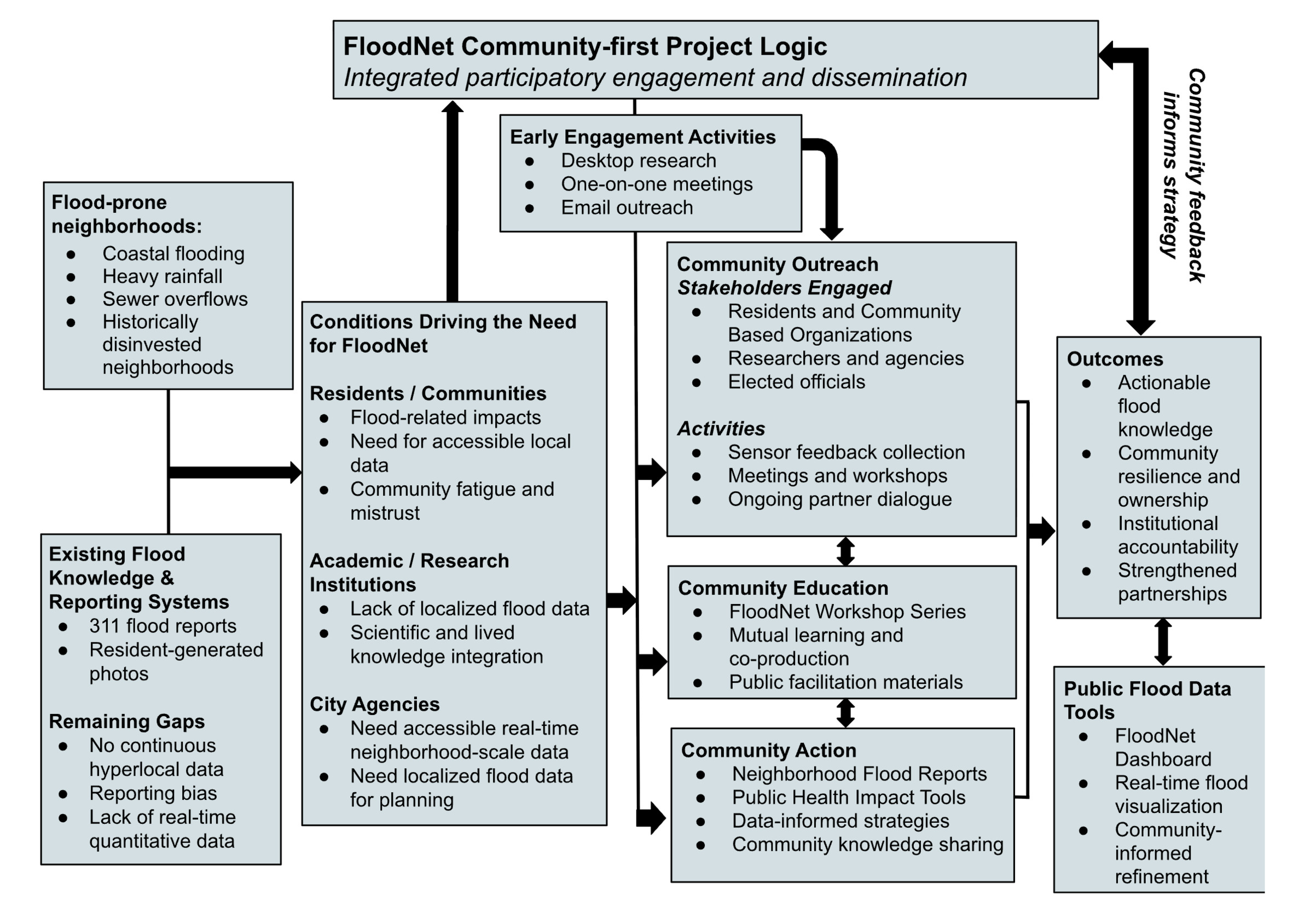
What we describe in this paper is not the technical development of a public flood-monitoring system, but instead the development of what we call a “community-first project logic.” This logic calls for the co-production and co-generation of public-facing processes, resources, and recurring points of engagement with communities, an approach that can meaningfully support climate adaptation efforts through sustained and accessible touchpoints between researchers, residents, city agencies, and community organizations. We, therefore, outline an iterative process for participatory dissemination that informs how relationships are built, maintained, and integrated into project decision-making, and how this process, in turn, shapes the evolution of the project itself. For example, although the project is funded to deliver a specific public service for New York City — a reliable and operational flood sensor network — it is led by an interdisciplinary team of academic researchers spanning technical, environmental, and community-engaged disciplines. This structure informs decision-making at every level of the project, including the rhythms and workflows of collaboration. Team members meet consistently three times per week for cross-disciplinary coordination, alongside weekly and biweekly meetings organized around technical priorities, dataset validation needs, and community engagement activities. Monthly public meetings create open forums for community participation and feedback, while quarterly meetings with city agencies and monthly meetings with funders provide opportunities to report findings, reflect on lessons learned, and collaboratively shape future directions.
By embedding dissemination within every stage of the project, our community-first project logic demonstrates how participatory research can intervene in traditionally extractive practices. Dissemination is not merely a final stage; it is a tool for fostering sustained engagement, redistributing power, and promoting actionable knowledge. We illustrate the process and outputs of embedding co-production and iterative feedback throughout the project life cycle, and consider, in the end, the potential for this model to transform both the process and outcomes of scientific inquiry, advancing practices that are ethically accountable, socially responsive, and grounded in community resilience.
Urban Flooding in NYC
As flood events become more common, given sea level rise and greater intensity storms caused by climate change, residents across New York City’s five boroughs experience disparate combinations of tidal inundation, heavy rainfall, and sewer overflows in patterns that reveal deep structural inequities, reified spatially through outdated infrastructure and historic disinvestment. In many neighborhoods, chronic street flooding has become an expected part of life, disrupting mobility, damaging property, and undermining public health and safety. For example, we partner with a resident association in the waterfront community of Hamilton Beach, Queens, a community that sees streets flood with seawater upwards of twenty times per year just from high tide, often blocking access to the single road in and out of the neighborhood. Meanwhile, our community advocate partners in Coney Island, Brooklyn, carry memories of flooding and disinvestment hand in hand, recalling that working class families of color were able to afford home ownership in the neighborhood but were left out of post-Sandy recovery efforts, despite their continued risk of flooding from both storm surge and heavy rain. These are distinct experiences of flooding with different histories and geographies; these neighborhoods are also examples of communities with whom we have worked to leverage FloodNet’s resources and data toward community action, as we will describe below.
FloodNet’s mandate to collect, visualize, and communicate hyperlocal flood data positions the project to recognize and respond to these interconnected challenges. Major events such as storm surge during Hurricane Sandy (2012); flash flooding from the remnants of Hurricane Ida (2021) and severe, chronic tidal floods underline the urgent need for real-time, neighborhood-scale data that is accessible to both residents and decision-makers. FloodNet was developed in response to this need; at the time of writing, the team has installed more than 300 flood sensors across all New York City neighborhoods, supported by collaborations with over 80 community partners and almost 20 city agencies.
Origins of FloodNet
At the time of writing, FloodNet is collaboratively led by researchers from the City University of New York (CUNY) and New York University (NYU), working alongside New York City agencies, including the Mayor’s Office of Climate & Environmental Justice (MOCEJ), Department of Environmental Protection (NYC DEP), and Office of Technology & Innovation (NYC OTI). The project emerged from two distinct but complementary initiatives, at two separate academic institutions and in two areas of the city with distinct flood-related challenges. The integration of these distinct initiatives has contributed to the novelty of the project, increased its capacity to experiment, and solidified its commitment to participatory methods for community inclusion.
One of these initiatives was a community-based, participatory project to document flooding in NYC neighborhoods surrounding Jamaica Bay that still continues to this day. This work, emphasizing public engagement and participatory science, has been carried out in partnership with CUNY, New York Sea Grant, and MOCEJ since 2018 (Campbell et al., 2021). The development and inclusion of flood sensors in this project aimed to complement residents’ qualitative reports of flooding with quantitative data about flood depth and duration. At the same time that this project was underway, our colleagues at NYU were working in two Brooklyn neighborhoods susceptible to stormwater-related flooding. NYU researchers became aware of the general lack of real-time, quantitative data on hyperlocal urban floods while attempting to study the microorganisms introduced into urban environments by floodwaters. In response, this team brought together engineers and research-based artists to design innovative technologies capable of remote flood sensing. While each effort had its own focus and approach, they shared a central goal: to help New Yorkers understand, respond to, and mitigate the risks of flooding in their communities by offering access to hyperlocal flood sensor data. The two teams were brought together by MOCEJ and NYC OTI in 2020, and FloodNet became a multi-institutional project working to develop tools for real-time urban flood monitoring and make flood data available, accessible, and useful to project stakeholders, including residents, community-based organizations, government agencies, and researchers.
Over time, FloodNet became a larger, more interdisciplinary consortium, reflecting a core project tenet that sustainable and effective solutions to climate challenges come from working with, not just for, the people most affected. As the FloodNet project expanded across the city, through a growing sensor network primarily funded by NYC DEP, the priorities, interests, and expertise from both the CUNY and NYU teams were integrated into the project’s design.
Foundations of FloodNet Community Engagement: A Community-First Project Logic
From the outset, we prioritized holistic community engagement over outreach alone, ensuring that interactions with community partners were not just about gathering feedback but about establishing genuine partnerships with local communities. Although FloodNet was developed around flood sensor technology, we recognize that flood data are only valuable to the extent that they are usable by and useful to the people and groups who may benefit most from accessing them.
Our team also understands that New York City’s flooding challenges extend far beyond isolated citywide storm events, instead comprising converging coastal, stormwater, and infrastructure-driven risks that have intensified with climate change. For example, rising sea levels are increasing the number of people and amount of infrastructure exposed to flooding during coastal storms. Compound flooding that occurs when stormwater converges with groundwater, stormwater or high tides increases the depth and duration of flooding while potentially exposing residents to raw sewage and harmful contaminants in the floodwaters due to antiquated wastewater systems. To address this complexity and intersectionality, the project seeks to build strong relationships, respect local knowledge, and ensure equitable access to tools and information that empower residents to actively shape the future of their own communities, while acknowledging the extractive histories of academic institutions. In order to carry out these commitments, FloodNet hired a Community Engagement Manager, who is the lead author on this paper. As part of this commitment, we conceptualized engagement not just as a way to share final project findings and outputs, but as a key part of the organizational structure from the project’s earliest stages.
Building on a well-established conceptualization of community-based work in public health, we then adopted a strategy that sees community as, not simply a geographical site for flood data collection and extraction but, as keepers of community resources and inherent change-making capacities essential for sustained success (McLeroy et al., 2003).
Additionally, envisioning community engagement as an intervention — where contemporary public health interventions have two broad goals: strengthening our communities’ health and building their capacity to address health-related issues — FloodNet sought to balance technical growth with meaningful public involvement. Toward this end, we maintain continuous connections with communities affected by flooding as the project scales. This ensures that FloodNet’s engagement process is not just a form of outreach but an ongoing, two-way dialogue where communities have both a voice in shaping flood research and the agency to take action using flood sensor data. Accordingly, FloodNet’s approach to community engagement is defined as a strategic, collaborative process that fosters change across environmental, social, and political domains. This process often involves partnerships, coalitions, and working groups that mobilize resources to influence programs, policies, and practices. Key principles underlying this work include trust, shared power, reciprocity, cyclicality, and respect for community expertise.
Community Engagement and Participatory Dissemination
Community engagement, here, aligns with the philosophy of co-production, which views community engagement not as one-directional outreach, but as the foundation for effective and sustainable research dissemination (Messiha et al., 2023; Vargas et al., 2022). Co-production understands communities as essential agents of change, capable of shaping both the knowledge produced by research and the actions resulting from it. Understanding that traditional research dissemination often privileges academic voices, leaving little room for the insights and experiences of the communities that research seeks to serve, we instead view dissemination as a co-produced, iterative process, grounded in reciprocity and partnership. By seeking not only to document the environmental conditions that result from flood vulnerability, but also to build community ownership of resilience tools and strengthen residents’ own adaptive and decision-making capacities, the community-first project model presented here emphasizes that the most meaningful outcomes of research are not just scientific findings but the relationships of trust, transparency, and collaboration developed between researchers and community members.
Within the context of FloodNet’s broader community engagement strategy, participatory dissemination is action-based and ensures research outputs — products, findings, and knowledge — are shared throughout the duration of a project rather than at the end of its life cycle. Dissemination serves as both a mechanism for collaboration - i.e., community engagement efforts - and an intervention in traditional research models - i.e., community stakeholders are co-creators and co-designers of a knowledge-base and resource hub for flood resilience.
By embedding community members in every phase of the research, from problem definition and data collection to interpretation and action, we create opportunities for communities to not only learn but to lead. Through three community engagement and dissemination pathways — outreach, education, and action — we ensure that the data collection process reflects the lived experiences and priorities of the communities involved. Outreach builds relationships, fostering trust and collaboration. Education empowers residents by providing the tools and resources they need to understand and interpret flood data and sensor technology in ways that are meaningful for their own lives. Action takes the form of community advocacy, as local organizations and residents use the data to demand better infrastructure, improved policy, and a more resilient urban environment. Together, these pathways foster community resilience by empowering residents to apply their knowledge to advocate for better infrastructure, policy reform, and broader societal change. Participatory engagement and resource dissemination are particularly effective and important in the context of urban climate adaptation, where both technical and local knowledge are necessary to create interventions that are responsive, just, and lasting.
In the following sections, we examine how participatory dissemination not only enhances the relevance and impact of FloodNet’s research but also strengthens potential policy interventions and builds community resilience. We argue that by treating dissemination as a co-produced and iterative process, FloodNet creates deeper integration between scientific, experiential, and civic knowledge. Finally, we propose that FloodNet’s approach offers a framework for other climate and urban research projects looking to integrate community-driven knowledge into their work.
Situating the Scholar-Practitioners
Our work is driven by a commitment to community flood resilience. Here, we understand community as a dynamic category with messy edges; as representatives of academic and municipal institutions, FloodNet’s team co-produces community resilience, engendering what Barrios (2014) has called “resilience-cultivating relationships” (330). Like community, resilience is also a capacious term. In the social sciences, resilience has been critiqued for describing a system’s capacity to return to a prior state or to reorganize in order to adapt, even when the system itself is unjust (Tierney, 2015; Walker & Cooper, 2011). In the case of urban coastal flooding, the concept of resilience may put the burden of recovery — and knowledge of how to do so — on the very same community affected by disaster (Paganini, 2019).
The relationships created and extended through FloodNet’s work become part of the fabric of communities, even as communities hold FloodNet accountable for flood preparedness and recovery. In the growing literature on equitable flood adaptation, scholars recognize that these relationships can be contentious and difficult, but that working through differing perspectives on the problem of urban flooding is necessary for a justice-oriented approach to adaptation (Eakin et al., 2021). As Barrios notes, “resilience-cultivating relationships” may look like communities making demands or refusals in order to express their needs and desires through a collaborative process of community self-determination (Barrios, 2014, p. 347). FloodNet views community-engaged and participatory research as key to equitable resilience adaptation, particularly in coastal cities, where flooding ranges from the rare but catastrophic floods caused by extreme precipitation events and high storm surge to the more common inconvenience of chronic, low-level floods caused by high tides (Campbell et al., 2021).
The FloodNet team itself is collectively made up of researchers, practitioners, and municipal employees who are positioned differently in relation to each other and to residents of New York City. Each academic and municipal institution involved in the project carries its own history of trust and mistrust in community spaces, and each has access to different resources and systems of accountability for community partnerships. The team has worked collaboratively to build on the strength of the community partnerships each institution brings, with the understanding that these relationships will endure long past the project’s endpoint.
As scholar-practitioners and implementers of the FloodNet project, working within and against institutional systems, the authors of this paper position themselves as “community-accountable scholars” who must continually negotiate their roles as both practitioners and representatives of the academy (Dill et al., 2022). Here, being both scholars and implementers means inhabiting a space of constant negotiation — between institutional expectations and community accountability. Their commitment to research that is “rooted in and answerable to the communities we love” challenges traditional notions of objectivity and power, reframing communities as collaborators and conspirators in collective action (2022, p. 48). In this sense, their work becomes a call to action for researchers like the authors of this text who seek to engage in a similar theoretical, philosophical, and practical process. Like Dill et al. (2022), we reimagine research and the project’s outputs as sites of accountability and transformation, requiring a project implementation and dissemination process that is grounded in justice, relationality, and internal transformation.
In practice, we continue to grapple with how to align institutional procedures and research goals with the lived realities and needs of community partners. Through difficult conversations about data collection, data use, sustainability, and policy influence, the team practices what Dill et al. (2022) describes as “building accountability as communication” and actively learns to tell each other “what is really going on” while reimagining how research outputs and project offerings can be co-produced, co-owned, and co-operated (p. 51). This process centers on moving away from what Eve Tuck has called “damage-centered research”, conceptualizing communities as damaged and seeking solely to address harm, and instead toward “researching for desire” through scholarship and partnerships that instead center communities’ visions for a thriving future (2009, p. 416).
Defining Pathways for Participatory Engagement and Dissemination
Bridging this theoretical positioning of the FloodNet team with practice that operationalizes community engagement and participatory dissemination, FloodNet’s community engagement strategy necessarily builds on a foundational understanding of the histories, needs, and desires of neighborhood partners across the city through the co-creation and reciprocal dissemination of the project itself and its outputs. Recognizing that flooding is an intersectional issue, FloodNet partners with organizations and leaders addressing issues that — on the surface — appear unrelated to flooding. Many of these partners focus on immediate community needs such as housing, healthcare, education, and food access. Through the city’s recent emphasis on environmental justice, New York City has recognized that these issues are deeply interconnected (New York City Mayor’s Office of Climate and Environmental Justice, 2024). For example, partnering with the Center for New York City Neighborhoods has strengthened our capacity to engage residents around climate issues, while collaborations with Math for America support schools and civic groups expanding climate education and rapid-response efforts. Overall, FloodNet’s network of community partners and project collaborators extends beyond those working directly in climate or environmental health and justice to include individual residents, resident-led nonprofit organizations and coalitions, local and regional nonprofits, locally owned small businesses, and elected officials who actively demonstrate a commitment to addressing community concerns, issues, and priorities across diverse sectors. By working with organizations that provide direct services or address social determinants of health ranging from social service organizations, health groups, community boards, and urban farms to Parent-Teacher Association groups, faith-based organizations, academic researchers, block associations, community-engaged artists, and cultural programmers, FloodNet’s engagement team has built capacity among a diverse network of residents and community organizations — reaching populations that traditional flood-focused projects often overlook. The broad continuum of partner types contributes unique expertise and local insight to advancing flood resilience and community well-being.
To move from theory to practice, FloodNet defines and organizes engagement and dissemination around three interrelated participatory pathways: community outreach, community education, and community action. Together, these pathways inform how FloodNet’s data products and community-driven educational resources are co-developed and disseminated with, through, and by community members.
To date, the FloodNet community engagement team has produced several participatory outputs including: three educational modules (i.e., FloodNet Community Workshop Series), nine Neighborhood Profiles, one Public Health Impact Tool/Information Sheet, and seven printable Neighborhood Flood Reports, all in response to expressed community partner needs (Table 2). These resources are regularly shared at community-facing events and are available on the FloodNet website for anyone to download and use. Through partnership with the NYC Mayor’s Office, informational materials have been translated into the ten most spoken languages in New York City.
Across outreach, education, and action at FloodNet, we develop and implement efforts that increase reciprocity and shared governance, modifying research-initiated engagement with critical elements of community-initiated approaches. We follow El-Bassel (2021)’s insights that researcher-initiated engagement efforts are typically structured, time-bound, and oriented toward predefined project outcomes, while community-initiated approaches emerge from within communities themselves, tend to span longer time horizons, and often reflect broader social or environmental priorities (El-Bassel et al., 2021). The most impactful and enduring collaborations often integrate these models — when researchers shift from directing engagement to supporting it, providing technical assistance, evaluation, and institutional resources that allow community-led work to thrive (El-Bassel et al., 2021). Community Engagement at FloodNet operates within this hybrid space, reflecting a broader spectrum of engagement approaches that balance researcher-led and community-driven efforts both in process and in outcomes of collaboration. FloodNet’s evolution has been defined by an increasing commitment to participatory dissemination, both as a pathway for collaboration with community stakeholders and as an intervention in traditional research models that often see community stakeholder needs as tangential to research aims.
The following examples detail how FloodNet’s participatory dissemination approach operates as a continuous process of communication and collaboration, ensuring that knowledge moves iteratively between stakeholders — communities, researchers, educators, and policymakers — to create dynamic feedback loops that inform both community action and institutional decision-making.

Community Outreach
Community outreach connects New York City residents, community boards, and community-based organizations across climate, arts, and social service sectors, as well as elected officials, academic researchers, and municipal agencies. Through meetings, workshops, and feedback sessions, FloodNet outreach activities help inform sensor placement, surface local knowledge, and build the trust necessary for sustained collaboration.
Example - Community Suggested Locations for Sensor Installation
The process of collecting flood sensor locations from community members and incorporating them into the flood sensor placement process is one example of FloodNet’s participatory community outreach. Almost every time we meet new people through our work with FloodNet, the first thing that comes up in conversation about the project is a suggestion for where we should install a sensor. These suggestions are often followed by a detailed description of how often it floods at that location, who lives nearby, and how it impacts the neighborhood. Perhaps there is a school on the corner, and flooding makes it dangerous for students to cross the street. Maybe an elderly resident lives nearby who needs reliable access to medical services. When we make it part of our project design not only to receive this information, but to incorporate it into how FloodNet is carried out, outreach turns into an opportunity for our partners to establish their own stakes for FloodNet and to imagine how our work fits into existing advocacy and community-based efforts.
Soliciting suggestions for flood sensor locations as an integrated and systematic part of outreach builds on the early phases of FloodNet, when the first flood sensor locations were selected in close consultation with residents. This approach served to ensure that sensors would be installed in places where persistent flooding was confirmed and that flood sensors would be useful to the residents who had requested them in the first place. When the project received funding from NYC Department of Environmental Protection to scale up the installation of sensors citywide, we were tasked with developing a new strategy for locating a much larger network of 500 sensors across the five boroughs of NYC.
As we built out our community engagement strategy in concert with our sensor location strategy, we realized that sensor placement could be operationalized as a collaborative process, enabling community participation to directly determine where sensors should go. We created an online form to collect sensor location suggestions and began sharing it through presentations, conversations, and electronic communications with project stakeholders including NYC residents, city agency partners, and research collaborators. The form link was also incorporated into FloodNet flyers and featured prominently on the project website. It became one important avenue through which stakeholders could interact with, impact, and weigh in on the FloodNet project.
By disseminating the sensor suggestion form widely across the city, with an emphasis on flood-prone and historically disinvested neighborhoods, we collaboratively generated a new qualitative spatial dataset with hundreds of locations reflecting broad desire to have access to data on hyperlocal flooding conditions and a voice in how this data is produced and shared. This dataset demonstrates to government agencies and potential funders how wide and diverse the potential stakeholder group for FloodNet data is. At the same time, FloodNet’s community engagement team attended events and facilitated workshops, where they were able to speak directly with residents about the presence or absence of sensors across various neighborhoods of NYC. In these conversations, team members observed that for many residents, the siting of a sensor at a given location is not only about enabling data collection at that location. These residents understood sensor placement itself as a form of co-production, wherein the presence of a sensor at a community requested location comes to represent institutional validation of community knowledge about hyperlocal flooding (Burnett et al., forthcoming).
Deciding how to convert this community-sourced dataset of flood sensor suggestions into installed sensor locations involved difficult conversations across disciplinary and professional norms on a highly interdisciplinary team. In our interdisciplinary team, we had different levels of experience with community-engaged and qualitative data and had to decide on the relative weight between sensor suggestions and maps of projected or estimated flood exposure. Both the existing flood maps and the sensor suggestions were in different ways incomplete or imperfect sources of data to inform flood sensor placement, and we had to determine how to leverage them both to arrive at sensor locations that were responsive to community suggestions and attentive to citywide distribution and projections of potential future flooding. After many tough discussions, ultimately, we decided that sensor placement is a primary way the project can be accountable to city residents who shared their lived experience with us, creating an outreach process that is more collaborative than extractive.
At first, some team members saw suggested locations as a useful but limited dataset for placing sensors, to be treated as secondary to other existing datasets about flooding exposure and vulnerability in NYC. Though rooted in concerns for how bias and lack of generalizability could weaken this perceived dataset, this approach could in some cases prevent resident suggestions, that may offer new insights historical maps cannot, from being considered for installation, resulting in an outreach process that was more extractive than collaborative.
Community Education
Community education expands participatory dissemination by fostering mutual learning between researchers and community members. Participants gain skills for interpreting sensor data and understanding sensor technology while simultaneously co-creating educational materials tailored to local priorities and contexts. This iterative facilitation process strengthens environmental health literacy, familiarizes residents with sensor technology they may encounter in their neighborhoods, and supports the translation of complex data into locally meaningful insights that can inform both individual decision-making and community advocacy.
Example: FloodNet Data & Storytelling Community Workshop
The FloodNet Community Workshop Series includes three modules: Community Voice, which utilizes PhotoVoice methodology to empower residents to look for evidence of flooding in their neighborhoods, thereby promoting community participation in data collection; Data and Storytelling, which incorporates community aims and lived experiences into conversations about flood data; and Sensors and Sensing, which demystifies the physics and electrical engineering of flood sensors, placing them in conversation with embodied modes of sensing the environment. Facilitation guides and materials are also made publicly available for partners or community members to use and adapt, allowing for further dissemination.
These workshops were not simply designed and delivered by the FloodNet team — they were co-produced with community partners. We have carried out workshops that incorporate live music, participatory dance, and guided meditations. These elements have been suggested by our community partners, most often led by residents, who emphasize the importance of creating culturally sensitive spaces where attendees will feel comfortable sharing their experiences with flooding. For example, at a workshop held at a historic homestead in East Flatbush, Brooklyn, a local community-based organization worked with a performance artist to craft a meditation designed to bring flood stories into the room. Many attendees or their families had immigrated from the Caribbean, and their stories brought to light the approaches to managing water and flood risk they carried with them to New York City. Through co-production strategies like this, participants shift from being audiences to becoming co-creators of knowledge, thereby strengthening collective capacity for resilience planning.
Here, we highlight the Data and Storytelling Workshop as an example of community education as participatory dissemination.
The Data and Storytelling Workshop was developed to equip community members to access and interpret FloodNet sensor data while creating a two-way dialogue that places FloodNet data and tools in context, and even in conflict, with residents’ lived experiences of flooding and community resilience in NYC. Facilitators begin the workshop by initiating a discussion of the methods that participants already use to keep their communities safe and informed, underlining that FloodNet tools and data are only useful insofar as community members are able to incorporate them into existing frameworks of resilience and support. As described above, we encourage participants to share and reflect on where they were and how they might have been impacted by previous flood events, with attention to the types of flooding that have historically impacted their community specifically.
Once this groundwork is established, participants explore FloodNet’s public-facing online data dashboard. Allowing participants to familiarize themselves with the dashboard first, before instructing them on how to navigate it, provides the benefits of hands-on learning while drawing out aspects of the dashboard that are more difficult for some users to navigate. While delivering this workshop across groups of widely varied ages and technical skillsets, facilitators have witnessed barriers to access firsthand. For example, many workshop participants are not accustomed to interpreting data in a line graph, which is how FloodNet’s time-series sensor data are presented on its data view page. Some of these barriers have been addressed through improvements to the data dashboard, while others have presented opportunities for training community stakeholders in data interpretation. At times, funding limitations have prevented ongoing feedback from being directly translated into dashboard improvements. The FloodNet team stores this feedback internally with the goal of incorporating it into future dashboard funding opportunities.
While navigating around the map view, which shows how FloodNet sensors are distributed across the city, participants also often share reflections on the concentration of sensors in certain neighborhoods as opposed to others, as well as specific recommendations for where flood sensors should be installed. Feedback collected in these workshops is shared back with the wider FloodNet team, to inform future sensor installs, as well as occasionally adjusting the location of previously installed sensors, enacting another stage of iterative knowledge production through communication and collaboration and informing iterative design of data sharing tools.
Finally, the module guides participants through a storytelling exercise, combining their interpretations of FloodNet sensor data with lived experiences and other information sources to form a narrative that can be used when speaking with neighbors, local politicians, or community groups. Having generated a personal story, grounded in FloodNet and community-generated data, community members leave the workshop as collaborators in environmental knowledge production and agents of their own flood resilience.
Example: FloodNet Community Engagement Neighborhood Profiles
FloodNet’s Neighborhood Profiles, which FloodNet co-produces with community stakeholders to document hyperlocal flood risks and serve as tools for organizing, educating neighbors, and informing municipal decision-making, demonstrate dissemination as a tool for education. These local communication resources combine neighborhood-scale information about past resilience challenges and projects, geographic and demographic context, and community knowledge to present neighborhood narratives, flood dynamics, and local vulnerabilities. Each Neighborhood Profile is developed through multiple rounds of review and revision with an environmentally focused community partner based in the neighborhood of focus, making the profile a public education resource, a product of collective authorship, and a way for community partners to educate the FloodNet team. The collaborative drafting of these documents is accountable to communities, inviting partners to critique and participate in shaping how the FloodNet team understands and represents each neighborhood.
Demonstrating the flexibility of FloodNet to generate locally grounded publications about flood impacts, the Neighborhood Profiles make complex information legible, actionable, and useful for advocacy. To start, FloodNet’s Community Engagement team conducts desktop research on local flooding patterns and neighborhood-level issues flooding may exacerbate, using scholarly sources, historical records, municipal reports, and local news outlets. The team supplements these findings with community testimonies and photographs that capture lived experience. Each draft outlines the neighborhood’s geography, key flood-related projects, and primary vulnerabilities, weaving environmental, infrastructural, and social factors into a coherent narrative.
The FloodNet team shares drafts with an identified community partner who lives or works in the featured neighborhood for review and contextual feedback. Through meetings and collaborative edits, residents validate and refine the information, adding details about recent flood events, organizing efforts, or neighborhood priorities. This process ensures that profiles reflect both empirical data and local expertise.
As living documents, Neighborhood Profiles are regularly updated and made publicly available through FloodNet’s website and shared at community meetings, workshops, and outreach events. Partners continue to use and refine them in advocacy, education, and engagement efforts, strengthening their ability to communicate flood risks and resilience strategies to wider audiences, including city agencies and elected officials. Through this iterative, co-creative process, the Neighborhood Profiles transform data into shared knowledge, building community ownership of flood information while reinforcing researcher accountability and the principle of participatory dissemination.
Community Action
Community action comprises the applied dimension of FloodNet’s participatory dissemination approach. It empowers residents to use data and related tools for advocacy, preparedness, and localized resilience planning. Action happens when community partners take up the information and education they have co-produced and make it work for their own aims through independent interpretation and dissemination.
Example: Public Health Impact Tool: Mental Health and Flooding
FloodNet’s partnership with Regional Ready Rockaway (RRR) — a community-based resiliency organization serving coastal neighborhoods in the Rockaways that routinely experience tidal and stormwater flooding — produced FloodNet’s earliest Public Health Impact Tools and demonstrates how participatory dissemination can strengthen community-led resilience initiatives beyond the technical scope of flood sensor data. Located in an area where recurrent flooding compounds long-standing social and infrastructural vulnerabilities, RRR identified a critical need to address the mental-health impacts associated with these events. Flood recovery conversations often emphasize physical damage and infrastructure repair, leaving psychological and emotional recovery largely unacknowledged.
This collaboration was sparked by RRR’s insight that data engagement and emotional recovery are intertwined: residents cannot meaningfully participate in discussions about flood risk while carrying unaddressed trauma from past events. RRR shared this realization with FloodNet, prompting a collective reflection on the relationship between data engagement, emotional readiness, and community resilience. In response, FloodNet’s Community Engagement team, in collaboration with an expert in psychological response and wellness at RRR, co-developed the document Mental Wellness and Flooding: Guide to Resilience, Recovery, and Healing. Drawing on the organizational representative’s expertise in trauma-informed care and RRR’s experience supporting flood-affected residents, the guide integrates public health and psychosocial perspectives into climate resilience. It outlines the emotional, behavioral, and physiological effects of flood-related trauma and offers accessible tools for cultivating mindfulness, community support, and professional care.
While content development was led by RRR, FloodNet contributed research, writing, and design support to produce a clear and actionable resource for dissemination across RRR’s networks. The process of developing the guide was itself a form of participatory dissemination–it advanced dialogue across disciplines, bridged technical and psychosocial approaches, and foregrounded community expertise as central to the research process. Through co-production, the project validated RRR’s ongoing work in trauma-informed preparedness while expanding FloodNet’s scope of engagement to include the emotional dimensions of resilience.
Importantly, this collaboration emphasized that climate impacts cannot be separated from broader determinants of well-being. While flooding is often discussed alongside visible domains such as housing, infrastructure, or food access, its mental-health and public-health consequences, though less visible, shape daily life and community capacity in profound ways. Recognizing these interconnections reframes resilience as a holistic condition that depends equally on physical safety, emotional stability, and social support.
Three Years of Community Engagement at FloodNet
Together, these initiatives illustrate how co-production and participatory dissemination can catalyze genuine community engagement — transforming dissemination itself into an intervention that redistributes authorship, authority, and agency within the research process. In this way, FloodNet’s Community Engagement framework transforms research outputs into actionable, community-owned knowledge that advances public health preparedness and equitable climate resilience. By embedding dissemination throughout the research life cycle, FloodNet ensures that data and insights remain responsive to community contexts, fostering iterative learning and strengthening the alignment of research with lived experiences. Engagement and dissemination thus function as mutually reinforcing processes: one rooted in collaboration, the other in communication.
Dissemination as Community Engagement Strategy in Motion and Model for Urban Climate Research
Often, research treats communities as sources of data rather than partners in shaping knowledge. This extractive approach limits the relevance, impact, and equity of community-centered scientific work. FloodNet challenges this paradigm by treating community engagement not as a supplementary step but as both a method and an outcome of research. Engagement functions as an intervention that drives the work forward, transforming the implementation process into a site of mutual learning, co-production, and shared authority. Every interaction with residents, educators, and partners becomes an opportunity for reciprocal learning, shaping how data are collected, interpreted, and applied in ways that respond to local priorities. Dissemination, therefore, becomes an active and participatory strategy rather than a one-way transfer of information at the end of a project.
Because of an emphasis on partnership, trust building, and reciprocity, FloodNet’s project model opens up future opportunities for community-gathered data collection efforts in the urban climate science spaces. Incorporating social science and qualitatively informed approaches expanded FloodNet’s scope from sensor-based data collection to include on-the-ground flood experiences, historical context for community infrastructure, and community feedback for municipal efforts, thereby turning the stories we encountered into data. While this information has been primarily used to inform our project design, refine our approach, and shape data and community outputs, it is possible that future versions of projects like FloodNet can leverage community-informed and contextually grounded data for systematic qualitative and social science research study. Formally including social science researchers and public health practitioners as project leaders, alongside urban engineers and water scientists, can help create new standards, goals, and objectives for an insightful spectrum of data, that ultimately speaks to the value of participatory methodologies for urban climate resilience.
As an ongoing example of this interdisciplinary dynamic and community-first project logic, FloodNet unexpectedly gained broad recognition as a bridge for new connections and hub of general climate resiliency resources. FloodNet’s consistent presence at local community board meetings, borough board meetings, community town halls, and local and citywide climate events, supported its unanticipated success as a citywide community network resource. At every convening, the community engagement team toted educational and action-based materials that had already been co-produced and shaped by community input. Both community advocates and community-based came to seek out FloodNet team members for information on available climate resources and connections to groups in different areas working to develop neighborhood-specific initiatives, programs, and disaster plans. This relevance led to deeper trust and relational connections that grew our reputation across the city as a community engaged program.
Although FloodNet retains the structured accountability and data-driven rigor characteristic of academic research, its participatory dissemination model ensures that these strengths directly address community needs. The community engagement team provides technical guidance, facilitates workshops, and develops educational tools that empower residents to interpret and apply flood data within their own contexts. By positioning engagement as both a methodological and translational process, FloodNet bridges the gap between scientific inquiry and community-based action, aligning academic research with public health and environmental justice goals.
Through applying participatory dissemination as praxis, the FloodNet team has moved from a researcher-initiated model — focused on building data infrastructure and gathering local input — to a co-produced framework in which communities actively participate in setting priorities, interpreting data, and defining impact. This transition reflects a deliberate effort to rebalance power within the research process, shifting from engagement as outreach to engagement as partnership. Within this model, engagement is not a precursor or supplement to research but a critical form of dissemination itself — through which findings, tools, and resources are collaboratively shared to enhance urban flood resilience and promote environmental health equity.
Our approach creates substantial opportunities for advancing climate science and grounding technological innovation in the lived realities of urban communities. As quantitative climate data and environmental sensing technologies proliferate, so too must the cultivation of local knowledge and qualitative context to convey the nuance and complexity of urban climate challenges. Future solutions will require cross-collaborations, solidarities, and allyships capable of addressing complex and compounding crises. FloodNet’s multidimensional approach — fostering collaboration across outreach, education, and action — not only increases the visibility and accessibility of FloodNet data but also builds the capacity of partner organizations to meet the needs of their constituents.
Where interdisciplinarity is key to equipping urban climate science teams for cross-sectoral knowledge sharing, FloodNet demonstrates how community engagement can operate simultaneously as a research method, a dissemination practice, and a driver of social change. By combining methodological rigor with the relational depth of community partnership, its engagement framework advances participatory research practice and illustrates how co-produced data, knowledge, and action contribute to environmental and public health resilience in urban contexts.
For urban climate researchers, FloodNet offers insight into how scientific knowledge can remain connected to the communities it intends to serve. Engagement becomes the mechanism for building relationships and trust; dissemination becomes the means of sustaining them. FloodNet’s integrated model advances a practice of participatory dissemination that strengthens community resilience and institutional accountability—turning knowledge into action and research into shared ownership of the project.
By treating engagement and dissemination as iterative, co-productive processes, FloodNet affirms that centering communal success and capacity building is not in conflict with academic research. Instead, it is essential for cultivating holistic community resilience in the face of increasingly uncertain collective futures.
Acknowledgements
This manuscript is based on work conducted with support and collaboration from academic researchers, city officials, and community representatives. We thank our colleagues for their work leading, developing, and implementing the FloodNet project: Ricardo Toledo-Crow, Charlie Mydlarz, Elizabeth Hénaff, Tega Brain, Praneeth sai venkat Challagonda, Bea Steers, Amanpreet Kaur, and Chris Hoyte. We thank our community collaborators for their partnership and co-conspiring on the community engagement outputs mentioned here: New York Sea Grant, CUNY Advanced Science Research Center Community Sensor Lab, and Regional Ready Rockaway. We thank the NYC Department of Environmental Protection, the Mayor’s Office of Climate and Environmental Justice, the NYC Office of Technology and Innovation, and the suite of New York City agencies that continue to share their expertise, feedback, and support with the FloodNet team. Funding for this work was provided by the NYC Department of Environmental Protection, the Alfred P. Sloan Foundation, and FEMA’s FY 2022 CTP Program - Region 2, award number EMN-2022-CA-00015.