In 2022, the Access Folk project at the University of Sheffield (UK) conducted a consultation on people’s engagement with and barriers to participatory folk singing in England. Over a three-month period, we hosted 24 one-hour meetings for singers, educators, and organisers with an interest in, or lived experience of, disability, racialisation, class, religion, and gender and sexuality-based discrimination, The result was a report co-written by participants and the academic team (Butler et al., 2023). However, the diversity of views and experiences shared in the meetings could not be sufficiently captured in a single report. Feedback from a few participants revealed their disappointment over the report’s lack of detail. As academics devoted to participatory research, their disappointment grated on us, prompting us to explore ways of further engaging critical voices and encouraging discussion around the report and its findings. We decided to record a podcast series co-produced and hosted by scene stakeholders to engage with the report and reflect on what the research meant to them.
Access Folk (2022-2027) is a United Kingdom Research and Innovation (UKRI) funded participatory and action research project exploring issues around access to and participation in folk singing in England (Hield et al., 2026). The Access Folk Podcast (Bones et al., 2023) was hosted and co-produced by folk artists Joanie Bones and Oliver Cross in the spring of 2023 and its six episodes released the following summer. The hosts’ engagement with Access Folk’s consultation process in 2022 and their lived experiences of negotiating the folk song scene from positions of marginalisation, including disability, race and gender, played an important role in the podcast’s reflective stance vis-à-vis the original research.
This brief report addresses co-produced podcasts as a research method and approach to public engagement. Limits of space mean that specifics relating to recording technology and editing are beyond the scope of this report. I will instead focus on planning and areas where the process of co-production was particularly important. The report largely represents the academic researcher’s perspective, but the discussion will also be useful for non-academic partners in a co-produced project.
Podcast as method
Academic podcasts have become a ubiquitous tool for research dissemination, education and discussion. The available literature guides aspiring academic podcast producers (Cook, 2023; Copeland & McGregor, 2021) and addresses issues around academic rigour and peer review (Beckstead et al., 2024; Cox et al., 2023). With the emergence of Podcast Studies as a discipline, theoretical frameworks are developing to interrogate the rise of the podcast format across a range of fields (Beckstead & Llinares, 2025). Cook argues that podcasting’s appeal in academia is connected to its status as an “insurgent, curious craft”, allowing academics both to work against rigid institutional structures governing knowledge creation and to embrace creativity and generosity in their work (Cook, 2023, p. 1).
Much of the critical engagement with academic podcasting focuses on research dissemination to new audiences (e.g. Persohn & Branson, 2024) - including through AI-generated podcasts (Tattersall, 2024) - but podcasting can do more than repackage research findings. The centering of human voice and intimacy of podcast consumption (predominately through headphones) allows for complex emotional subjects to be addressed in impactful ways (Lindgren, 2023). Cook suggests that the closeness of the voice in podcasts affects the researcher producer’s perspectives of our collaborators as to “spend time with linear media like audio might also engender a slowed down appreciation of the thoughts of those we research” (2025, p. 36). Direct connection with the voices of stakeholders contributes to the interest in co-produced podcasts among scholars working with marginalised groups in particular.
Day et al. (2017) discuss how water researchers and Indigenous people in Canada utilise podcasting to incorporate data gathering and consultation, as well as analysis and post-production collaboratively. They describe an inherently “iterative and reflective process” (2017, p. 209), and “weaving together individual stories, reflections, teachings, and research” (2017, p. 217). Similar reflective processes, where multiple ethical considerations have to be integrated in planning and editing, are noted in podcasting with migrants in Sweden (Cory, 2025) and podcasting as method in Disability Research (Treco & Jordan, 2024). Intermingling research dissemination, engagement and interpretation makes podcasting an interesting option for participatory research and an approach that in Cook’s words could help us “to do scholarship better” (2023, p. 1).
In many academic podcasts the leading voice is that of the researcher with stakeholders primarily involved as interviewees or script writers. Our experience with the Access Folk Podcast demonstrated the potential for stakeholders to add a further layer of critical engagement with the research findings. I will focus next on some of the practicalities of co-producing research-based podcasts.
The podcast process flowchart
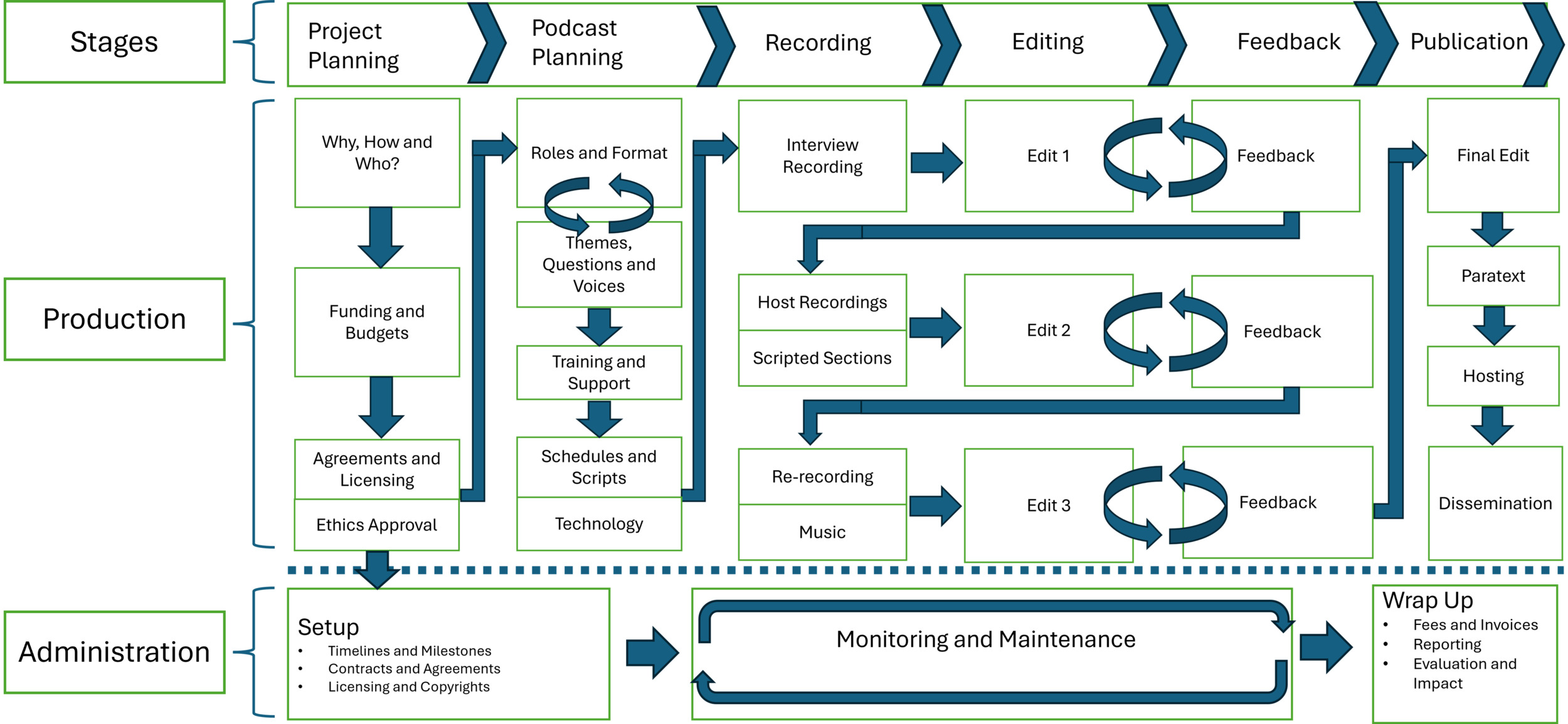
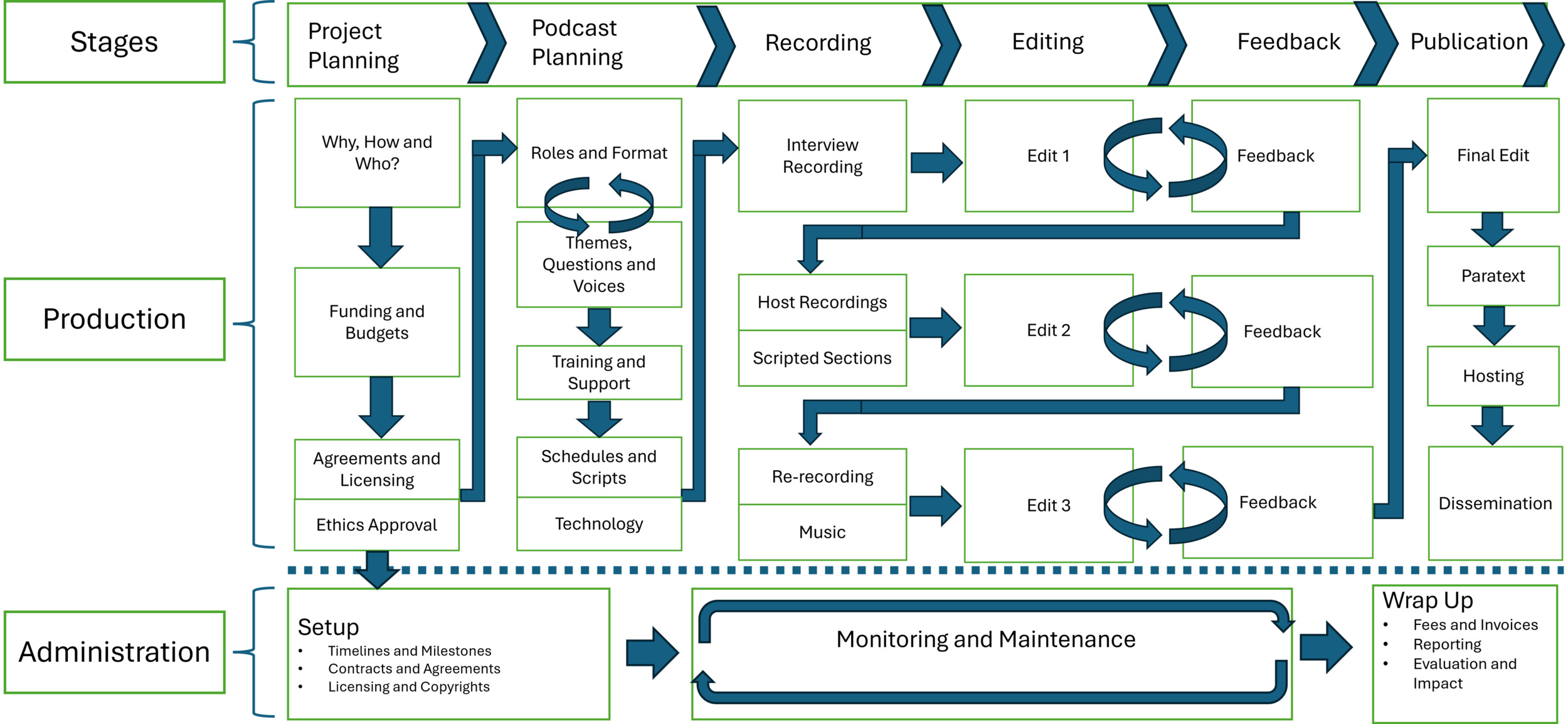
Drawing on our documentation of the Access Folk Podcast, Figure 1 visualises the stages and workflows involved in co-producing a podcast. The diagram features the activities undertaken during production and administration under six key elements. Although it is easy to focus on the production strand, the underpinning administrative tasks take considerable time and effort, with the potential to “significantly undermine trust” between partners and researchers if mismanaged (Vince-Myers, 2025, p. 25). Although the flowchart tracks a relatively linear model, our process mirrored Day et al., in being inherently “iterative and reflective”, and continuously responding to inputs through the production process (2017, p. 209).
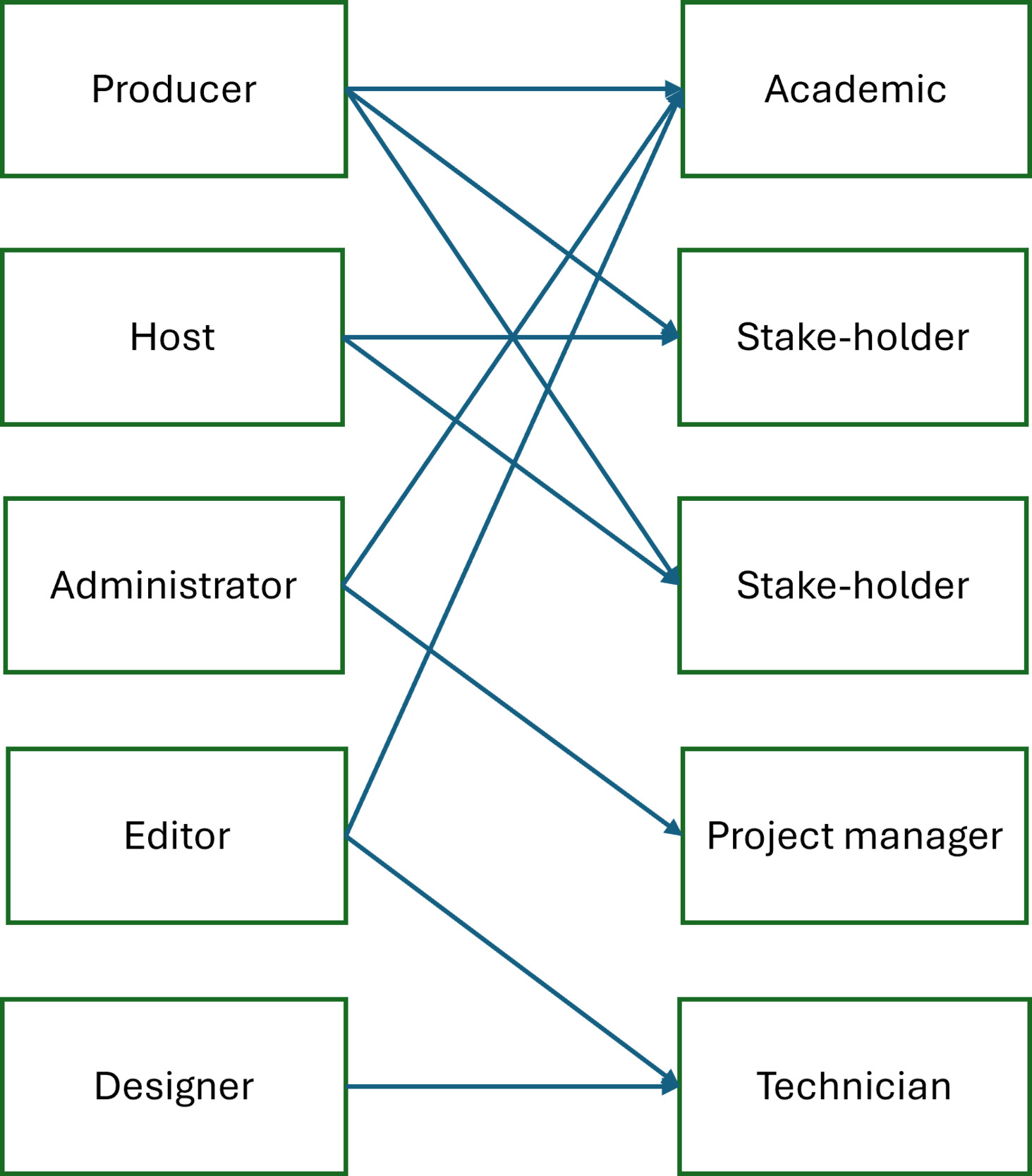
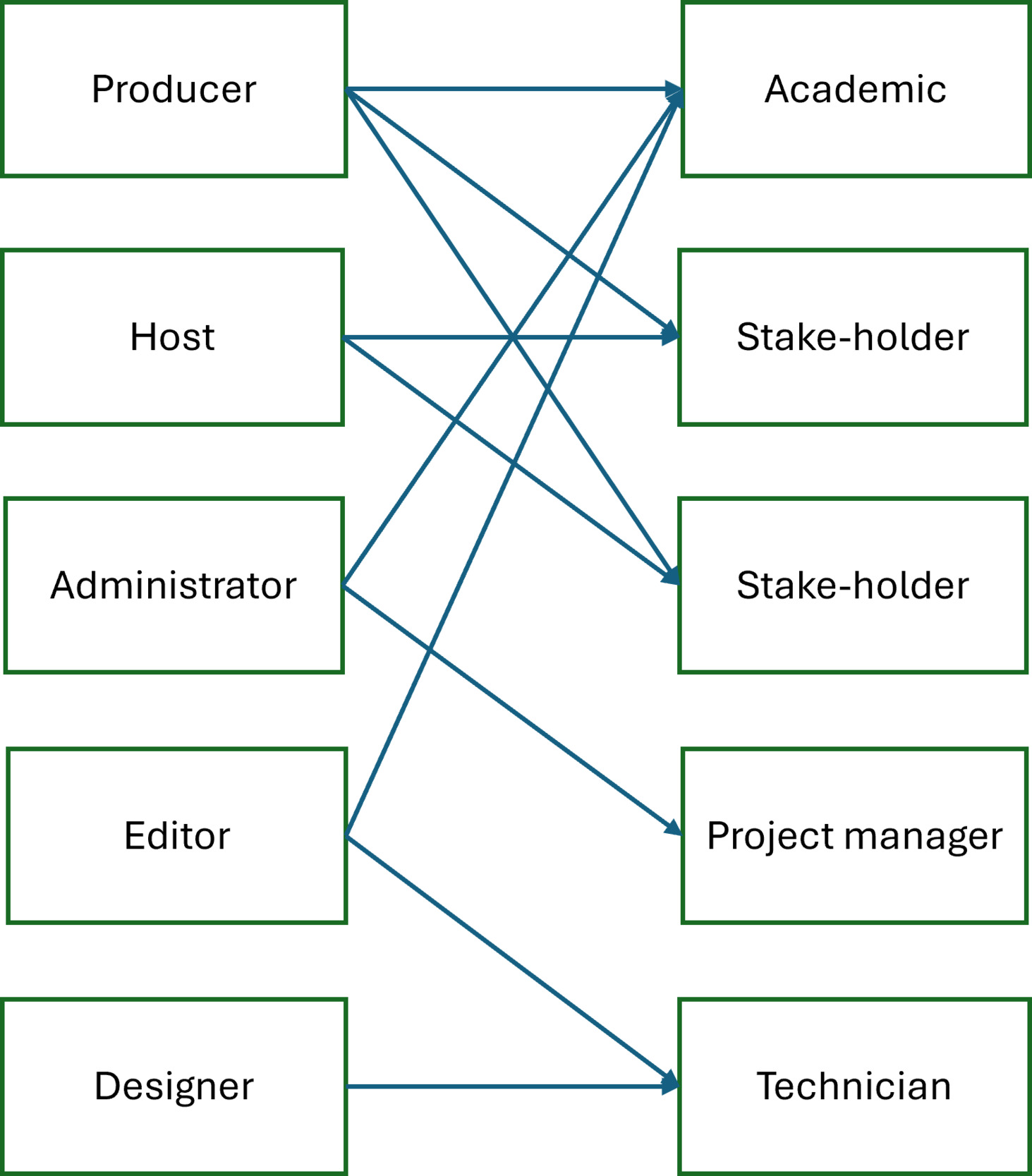
It is important to take into account the different roles shared across a podcast production team. Our flowchart assumes five key roles: producer, host, administrator, editor and designer, which in our case was covered by a team of five people. Figure 2 helps to visualise who does what and where there are shared responsibilities, which in turn can flag potential capacity issues as a smaller team would require the same roles to be covered but with a higher workload.
Overall project planning
The Access Folk Podcast was a direct response to research-participant feedback and offered a means of more widely disseminating and broadening responses to our co-written research report (Butler et al., 2023).
We opted for a stakeholder hosted format. This enabled multiple voices to interpret and comment on report findings, as well as prioritizing a natural flow of conversation over a highly produced and scripted presentation of findings. We had two hosts in mind and, after confirming funding and budgets, approached them early on to confirm their involvement.
Comprehensive and clearly articulated budgets are important, especially when working with external collaborators. We were fortunate to be able to apply for internal funding for public engagement purposes supplemented by our project grant. However, regardless of funding source, budgets must account for all aspects of production, including fees associated with audio licensing, hosting, and dissemination (for example, social media advertising) (see also, Copeland & McGregor, 2021, p. 44).
For work based within a research institution, like a university, there are often strict rules and guidelines relating to, if, how, and when partners can be paid. In our case, the institutional processes of payment and contracting for individuals took considerably longer than anticipated, even though we attempted to account for these processes in our planning. Many Higher Education Institutions (especially in the UK) are poorly set up for co-production with individual stakeholders (Vince-Myers, 2025). We should not assume that co-production partners offer their time and expertise in-kind, and fair remuneration is important to counterbalance some of the inherent power dynamics in participatory research. In the UK, the National Institute for Health and Care Research provides useful (and regularly updated) guidelines for paying research participants (NIHR, 2024). We also considered stakeholders’ field of work and what constituted reasonable remuneration.
As our podcast was about music making, we were keen to include relevant music examples. Including music can support a consistent sonic identity but needs to be licenced properly through relevant channels (such as PRS for Music in the UK). We were able to talk directly with artists and rights holders to confirm licensing agreements because we featured performers with whom we had existing relationships.
Other activities we factored in at the planning stage included institutional ethics approval. Most research and research adjacent work in universities requires some form of ethics review. It is good to ensure that approvals are in place before the start of production, as processes can be time consuming.
Finally, the project planning needs to consider the administrative support required post-funding application and approval. Working within the wider Access Folk project we were fortunate to be supported by a dedicated project manager ensuring smooth delivery of administrative tasks. The lower strand of the flowchart (fig 1) outlines the administrative setup and ongoing administration of the project supporting the production.
Podcast production planning
Whereas the project plan may have been outlined to fit with institutions and funder requirements, the production stage will require more flexibility. Once the production team is assembled - in our case the two hosts, myself and Access Folk colleagues - the plan provides guidance but there needs to be enough space to allow for a joint production plan to emerge.
Key questions to negotiate at the beginning of this stage include roles and expectations. A work schedule and timeline are essential to avoid overwork and ensure that there are support and remuneration available as needed.
Even if a host-based format has already been agreed, negotiation may still be needed to decide how this will work in practice. Will there be interviews or guests, how will the hosting work? Deciding on a format and set episode structure can help. Although the number of episodes will, to some degree, be determined by the funding and time resources available, the process of agreeing on themes and interviewees also plays an important role in shaping structure and scope.
We relied on a shared shortlisting framework to aid joint decision making (tab. 1). This framework helped us agree not only on who to include, but how to establish themes and flow through the podcast series. Drawing on the team members’ networks, we were quickly able to confirm most interviewees’ participation, with the academic co-producer taking the lead where connections were not already established.
Training and support needs for collaborators (and, indeed, researchers) were also factored in. The Access Folk Podcast’s hosts were both artists with performance experience though neither had previously hosted or produced a podcast. Both had some proficiency in using sound technology but little experience of conducting interviews. In addition to discussion about good interview practice, the hosts had access to online interview skills resources (Wettermark et al., 2024). We also had support from our Communications Officer, who functioned as sound technician, to establish a model for consistent recording practices.
The production team all had great enthusiasm for the project and to mitigate overwork we used timelines and shared online documents which allowed us to work asynchronously and from dispersed geographic locations. We recorded as much as possible in a few blocks rather than produce episodes sequentially. This enabled the host co-producers to do any face-to-face work at set points and avoid pressure to be available at short notice. This approach also meant that the academic co-producer took responsibility for outlining the episodes’ editorial framings based on initial agreed priorities.
Recording, Edits and Feedback
Co-production runs through the whole process of creating a collaborative podcast. However, it is in the process of recording, editing and feedback that the iterative and reflective process really comes to the fore. The flowchart (fig.1) suggests three cycles of recording, editing, and feedback, but how many iterations are needed will depend on project needs.
Most of our podcast episodes were recorded online using video conferencing recording functions. Hosts and interviewees also recorded themselves concurrently offline to mitigate connectivity problems and ensure sound quality in the final edit. The interviewees were sent a copy of our research report before the interview. The interviews rarely addressed the report’s findings directly, but it provided a starting point for the hosts to develop strands of questioning to situate the findings within the interviewees’ specific circumstances. For example, in episode 2, musician and disability activist John Kelly tells Oliver that he feels the report engages the social model of disability with regards to physical access issues but for John, attitudinal barriers like fear and prejudice, are more problematic. This in turn opened up a wider conversation with Oliver around their shared experiences as disabled artists.
Interviews were typically between 30-60 minutes in duration but needed to be cut down to around 10 minutes to fit within our planned 25 minute-episodes. The hosts highlighted themes in the interviews that they considered most important, any significant quotes or narratives, and provided rough timings for relevant interview segments to the editor. The first edit was a rough cut based on host suggestions and executed by the academic co-producer. The goal at this stage was to include as much from the hosts’ wishlists as possible while retaining connections to the research and ensuring a flow through the interview.
The rough cut was then shared with the hosts and interviewees to confirm accuracy, including inviting comments on the edits made. In most cases there was little disagreement but much discussion as the interview sections would determine the hosts’ conversations in each episode. In all cases the interviews contained far more relevant material than could be used. An ongoing conversation around priorities and the overall narrative was key for shaping editorial choices. The timestamped rough cut was handed over to the editor, who used the original audio files to create the high-quality final version of the interview recording.
Once the content of the interview was confirmed, the hosts agreed on and developed the themes of their discussions framing the interview. They opted to use cues (not full scripts) to keep their conversations flowing but on topic. The academic co-producer drafted scripted set sections where necessary to conform to the needs of funders and institutions. These sections were then edited for style by the hosts and recorded for repeated use across all episodes. All recordings were forwarded to the editor with timestamps for sections to cut, move or replace as needed. The edited version was shared with the production team for comments. In several cases the hosts noted that sections needed clarification or errors rectified. They re-recorded the relevant sections and forwarded updated content to the editor.
Finally, licensed music was incorporated into the episode and shared with the hosts, and a few outside listeners for feedback. Any necessary last edits were made and the final version agreed.
Publication
A podcast is more than simply a set of audio files. The podcast paratext - visual designs, logos, shownotes, transcripts, and other media - are crucial for the podcast format (Beckstead, 2025). Such texts ensure online findability and a sense of identity for potential listeners. We had design support from within our team to create a logo (fig. 3), and I provided episode descriptions and information about licensing and funders. To promote both access and search engine findability, we used AI to auto-transcribe episodes, which were edited as needed (Walker & Bratcher, 2025).
The final audio files and supporting material can be hosted on a project website but findability is aided by using a public podcast platform. In our case, we used a free PodBean account which allowed us to connect with several podcast players via the hosting platform’s RSS feed. To ensure a sustainable long-term preservation, the podcast was archived in the University of Sheffield’s research data repository (Hield, 2024).
Even if a full series of podcasts are recorded at the same time, release schedules should consider audience needs. That is, instead of dropping the full series, sharing a single episode at a time may help to increase engagement. We released episodes weekly over the summer music festival season as our target audience, we assumed, would be spending time travelling between festivals and (hopefully) listening to podcasts. Depending on the audience, it is worth considering targeted paid advertising via social media platforms as this has potential to reach beyond the team’s networks.
Project wrap up is typically the responsibility of the administrator and academic producer. This involves ensuring that all participants have been paid, archiving or culling documents as needed, and reporting to the funder. If needed, this is also the time to conduct any impact measurement activities. We found that conducting individual evaluations with everyone involved gave further insight in the co-production process and helped us develop our practices further in the second podcast series.
Conclusion
Co-producing a podcast is not easy. It takes a lot of time and effort. It also demands that academics let go of their often-assumed roles as interpreter and holder of knowledge. Cook notes that “like all methodologies, podcasting is only appropriate for certain topics with certain groups of people, has inbuilt limitations and could be used productively or not alongside other approaches” (2025, p. 24). In our case, we found that co-producing podcasts with stakeholders as hosts allows for a productive form of research dissemination and an innovative form of stakeholder engagement with the research. The format also allowed listeners to encounter the research through the voices of peers and as such supported a lower threshold of engagement with the findings.
Most academic podcasts are unlikely to grace the top podcast download charts. Moreover, any number of streams and downloads will not tell the whole story of a podcast’s value for research impact nor how it affected people involved in the process (Persohn & Branson, 2024). In the final episode, Joanie and Oliver sign off with a few personal reflections on what they learned through the podcast production:
“How are you feeling at the end of it all Oliver?”
“I do feel that institutionally the folk community still has quite a way to go, and there are steps that can be made to improve access to folk music and particularly folk singing, but it feels like we have taken steps towards at least recognizing the issues that are endemic when it comes to said access.”
“Yeah … I do understand what you mean. In terms of these practices that have grown up over the time. It was certainly massively enlightening for me … realizing that what we may consider the unbroken lineage of English folksong is just basically two generations old as it’s presented now, in terms of going back to the second [1960s folk] revival…, and that’s really helped me understand that kind of, it’s up for grabs.” (Bones et al., 2023)
As singers who have worked hard to stake their claim in the English folk singing scene, the podcast gave the hosts an opportunity to highlight issues and experiences which will be shared by many others in the scene. Importantly, they note that when we are able to see and break down institutionalised and conceptual barriers, folk singing is, as Joanie puts it, “up for grabs” for all.
With our hosts’ final reflections in mind, I argue that by using the podcast format, not only as a tool for dissemination, but as an opportunity for stakeholders to reflect back on the research, to add layers, to explain, critique, endorse or even make fun of research findings, the podcast can have a real impact on what we as researchers choose to do next. As such, podcasting goes beyond a medium for dissemination and becomes a methodological tool which helps us reflect on findings and develop stronger participatory research practices.
Acknowledgements
The author wants to thank the hosts and co-producers Joanie Bones and Oliver Cross and all interviewees featured in the podcast, Rowan Piggott who did the sound editing and design and Dr Helen Grindley who provided administrative support throughout the project. The wider Access Folk team, Prof. Fay Hield, Dr Rebecca Draisey-Collishaw and Dr Kirsty Kay, have provided important feedback on the podcast production and this report. Access Folk’s research and podcast production is funded by UKRI’s Future Leaders Fellowship (MR/V023837/1) and the University of Sheffield’s Public Engagement Development Fund.
Data supporting this publication can be freely downloaded from the University of Sheffield research data repository at https://doi.org/10.15131/shef.data.c.7126222, under the terms of Creative Commons (CC BY, BY-ND-NC, BY-ND-SA) licences.