
Introduction
This tutorial is intended for researchers who have the humility and disposition needed to work in historically under-resourced communities with racially, culturally, and socioeconomically diverse participants. The purpose of this tutorial is to provide an overview of a structured, yet flexible procedure to foster relationships between researchers and participants throughout a data collection and analysis process.
This tutorial describes our community-engaged approach to building trust, generating data, and validating research findings within a short time frame. The tutorial draws primarily from a community-engaged project that was designed to generate findings for internal use by the community partner organization. For this reason, our Institutional Review Board (IRB) was made aware of the project, but not required to approve it, so details about participants and the specific context of our implementation is purposely absent from this tutorial. We hope, however, that our description of our process is rich enough to benefit researchers involved in neighborhood or community-based projects. The process that we describe assumes an existing relationship between a community partner organization and the participants in the study. For instance, this process will work well with researchers partnering with a community organization or nonprofit with a history of working with residents. Without an existing relationship, additional time and steps would be needed to build the trust necessary for this process to work.
Background
This project took place in two neighborhoods located less than five miles from the center of a large, metropolitan area in the U.S. The first neighborhood is predominantly African American, with a median household income below the national average. Most of the housing in the area is single-family homes. There is very little retail in the area, but there are many industrial properties. Although there have been revitalization efforts in the area, crime remains a concern for residents. The exact boundaries for the community are debatable, but an estimate of the population is a little less than 1,500 residents.
The second neighborhood is roughly 43% white, 47% Black, and 5% Hispanic, with a median household income well above the national average. The population in this neighborhood is considerably larger than the first neighborhood (roughly 5,000 residents) and has a longer history of targeted investments, including mixed-income housing, retail, and social services. These investments have contributed to a reduction in poverty and crime, but they have also resulted in the displacement of some residents. The number of white residents living in the area has increased along with property values.
The partner organization is located in the first, smaller neighborhood but works with both neighborhoods. The organization is committed to investing in each community’s civic infrastructure. We as researchers worked with the organization on a project to improve one of its initiatives to this effect. The partner organization recruited residents to work on this initiative with us: two residents representing the first (smaller) neighborhood, and six residents representing the second neighborhood. Some were native and/or long-term residents and others were relative newcomers to the neighborhoods. Participants included business and property owners, formal and informal community leaders, and community organizers, many of whom were highly invested in the success of the businesses, institutions, and organizations in their communities. The collective goal of this project was to streamline processes within the partner organization to better reflect improvement goals within the community, and to ensure fidelity with execution in future projects. We kicked off the project with a virtual meet and greet to discuss the project goals, participants’ expectations, and overall research design.
Positionality of the Authors
The first author identifies as a Black parent and education scholar committed to place-based research. She first connected with the community partner when working on a project with a previous employer. After joining the faculty at her current institution, she maintained a connection with this partner because of her interest in their approach to community development work. She and the community partner had multiple conversations about how to extend an existing grant-funded project that she was working on with an investment in the partner organization’s work. Both authors participated in some of the organization’s open house events to learn more about their work in the community. About one year after first connecting with the organization, they identified a small, short-term trust-building project to work on together.
The second author is a Black social worker interested in the experiences of persons involved in community engagement and development through research in predominantly Black communities. She was intrigued by the opportunity to understand long-term effects of community planning and development through the experiences of individuals who were immersed in the community space. She became engaged with the community partner through her role as a doctoral student and graduate research assistant at her current institution. She pursued this opportunity because of previous involvement in professional roles centered on civic engagement and social empowerment in similar environments in another location. The nature of the project allowed her to connect her scholarly interests with her professional background.
Approach
Both authors share a disposition toward conducting research with community members, not on them, with the understanding that the degree of participation can vary by context. Their approach is inspired by Columbian sociologist Orlando Fals-Borda’s understanding of participation, which evolved from a participatory model where researchers work for the people, to one where research is carried out by the people, then ultimately to one where the researchers work with the people (Díaz-Arévalo, 2022). This evolution is broken down further in the International Association of Public Participation (IAP2)'s Spectrum of Public Participation (Brooks & Dunscombe, 2020). The stages along the spectrum are inform, consult, involve, collaborate, and empower. Each stage is characterized by a goal, a promise to the public, and sample techniques used to accomplish its goals.
-
Inform provides information to community members, with a promise to keep them informed using techniques like fact sheets, websites, and open houses.
-
Consult aims to garner feedback, with a promise to listen and acknowledge concerns and provide feedback on how their input influenced decision making. The techniques used at this stage include public comment, focus groups, surveys, and public meetings.
-
Involve aims to work directly with the community, with a promise that their “concerns and aspirations” are reflected in feedback. The strategies here include workshops and “deliberative polling” (p. 48).
-
The goal in the collaborative stage is to partner with community members at every stage of decision making. Techniques used here include citizen advisory committees, consensus building, and participatory decision making. The “promise” made to community members is, “we will look to you for advice and innovation in formulating solutions and incorporate your advice and recommendations into the decision to the maximum extent possible” (p. 48).
-
The empower end of the spectrum places final decision making in the hands of the community and promises to “implement what [the community members] decide” (p. 48).
This tutorial employs techniques that are closer to the collaborative end, with the recognition that limited time and relationships with community members at times have us operating more closely to consult and involve. Empower, while an ideal goal, is not the stage that we can always operate in. Participants’ limited ability to engage in research when facing other demands, power dynamics among institutional stakeholders, and funding challenges can impact the ability to fully engage, or yield final decision making to community members (Lucko, 2024; Stuart, 2022). Nevertheless, our goal is to move along the spectrum to the more radical modes of participation to ensure that our findings accurately reflect the perspectives of participants.
Community-based research is most authentic when the voices of residents are involved not only in the data collection phase, but the subsequent processes used to analyze and validate findings. Many research practices do not incorporate structured opportunities for community input on data interpretation, leading to potential disconnects between conclusions and lived experiences (Israel et al., 2012; Minkler & Wallerstein, 2008; Santos & Goss, 2025). We used three methods for community engagement, bookended by an initial project kickoff and a final presentation. Although these methods are already established in the literature, our tutorial is unique in that it describes how we combined these methods to holistically generate data and validate the participants’ experiences. The methods were selected by the researchers, in consultation with the partner organization, and are described below.
Kitchen Table Methodology
Kitchen table methodology is an informal, relational approach to research that values genuine dialogue and trust building in familiar, comfortable settings, typically around a kitchen table or in another comfortable environment (Smith, 2012). It allows researchers and participants to engage as equals, creating space for open dialogue, shared stories, and mutual understanding. This method breaks down hierarchical barriers typically found in research between researchers and participants, fostering an environment where participants feel heard and valued (Bishop, 1996). By centering on connection and empathy, kitchen table methodology yields insights that are authentic to participants’ lived experiences and respects their voices within the research process (Fletcher et al., 2024).
Neighborhood (Dialogue) Walk
Drawing on the dialogue walk approach (Brooks & Dunscombe, 2020), the neighborhood walk can be used as an alternative, or supplement to the kitchen table methodology, or as another method for relationship building before attempting to conduct more structured data generation (i.e., focus groups or consensus building exercises). Neighborhood walks can complement a community mapping process when time permits for additional engagement with community members.
Community Validation
Community-based validation, or community validity, is a research technique that actively involves community members to ensure that findings accurately reflect their experiences, knowledge, and priorities (Israel et al., 2012). By amplifying marginalized voices and addressing systemic power imbalances, this methodology fosters collaborative relationships between researchers and participants (Minkler & Wallerstein, 2008). Researchers present findings for feedback, encouraging community input and refinement. This culturally sensitive process emphasizes relationship building and trust, empowering communities to shape research outcomes based on their actual needs rather than external assumptions (Castleden et al., 2008; Smith, 2012). Community validation differs from “member checks.” Member checks may be used to verify information individually or in small groups, or before or after completing data collection, with each decision having its own set of ethical implications (Birt et al., 2016; López-Zerón et al., 2021). Community validation, however, is “that degree of common understanding and awareness of a particular social reality” (Ibhakewanlan & McGrath, 2015, p. 4). We see community validation as a way of determining not just what is true for an individual participant or group of participants, but what is true for a community.
Tutorial
Although each of the three methods is discussed in the literature, we use this space to describe how to adapt their use for a project with a short (less than three-month) turnaround, and with only two opportunities to meet with participants in person. Again, given the short timeline and limited opportunities for engagement, this process will not be effective without an existing relationship between the community partner organization and the participants.
Step 1: Project Kickoff Meet and Greet
Goal
The goal of the kickoff meet and greet is to establish early trust and transparency between researchers and participants (Brooks & Dunscombe, 2020).
Preparation
Meet with the community partner organization before the project kickoff to ensure alignment with the project timeline, goals, and process. Consider working with the community partner to create a slide deck that can be presented during the virtual kickoff meeting. Decide on who will discuss which aspects of the presentation to the community members.
Implementation
We recommend a one-hour virtual kickoff to the research project, organized by the community partner. The community partner serves as a bridge and introduces the researchers as trusted partners in the research. The researchers should use this as an opportunity to connect with participants on a personal level and explain how the project will develop. We recommend the following be included on the agenda:
-
Introductions/ ice breakers
-
Overview of project and research activities
-
Meeting norms and logistics (e.g., expectations for timely arrival, compensation if applicable)
-
Open discussion for feedback about timelines and research activities
It is important at this stage to manage expectations; there are no guarantees that the findings will produce, immediately or long-term, all of the changes that might be recommended as a result of the project. Transparency at every stage of the research process is critical to maintaining the researcher’s credibility regardless of how the community partner may choose to operate later. We choose to make it clear what our relationship is to the partner organization—(e.g., we are not paid by them nor do we work for them) so that participants know if and where any potential conflicts of interest may exist.
Key Lesson
Relationship building and establishing trust between the researcher and participants requires clear communication and transparency. This step normalizes two-way communication where participants are encouraged to share perspectives that shape later research processes (Minkler & Wallerstein, 2008).
Step 2: Kitchen Table Talks
Goal
The goal of the kitchen table talks is to create a comfortable space for participants to openly discuss their experiences with the research problem.
Preparation
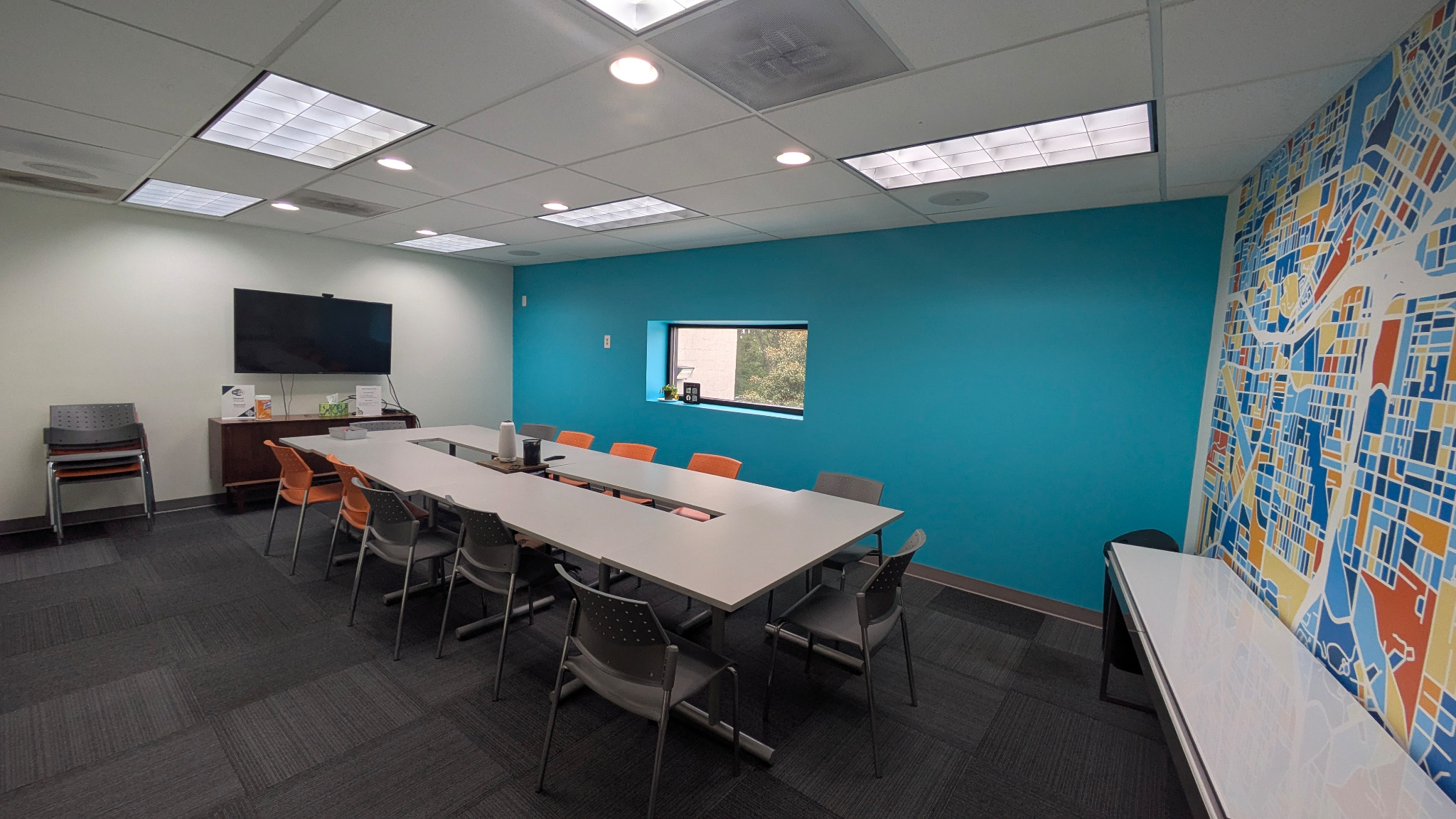
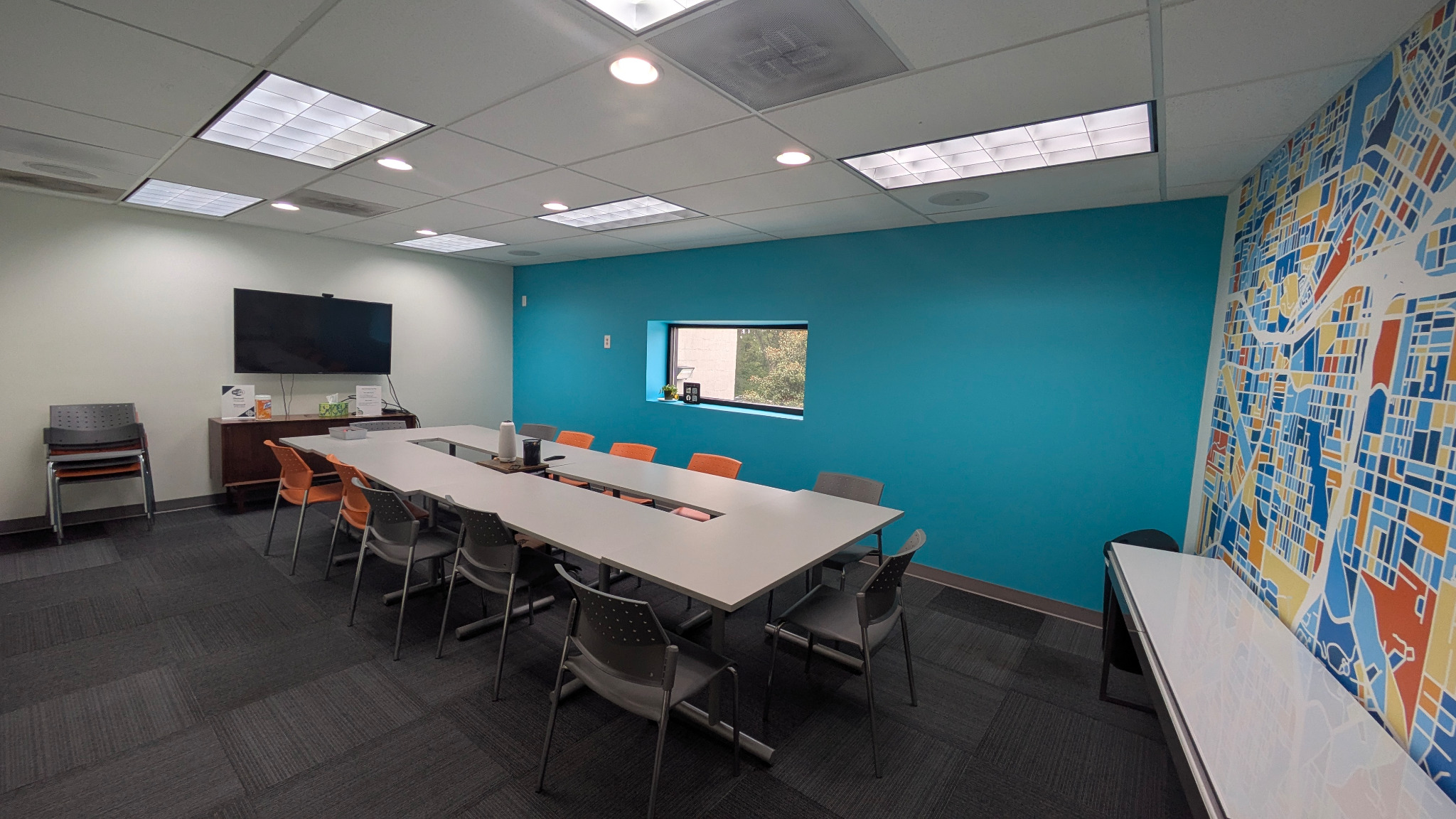
Work with the community partner to identify a location and catering options for the kitchen table talk. Consider restaurants or caterers that are based in the community and owned and/or operated by people living in the community. When possible, allow participants to select their own meals in advance, or at a minimum, solicit dietary restrictions. Set up the meeting space to maximize visibility and participation (e.g., arrange tables and seating in a U or oval shape). Figure 1 shows how we arranged one of our two meeting spaces. We used the long table on the right (in the rear of the room) to set up food so that it was accessible without taking up working space.
For the conversation itself, develop a set of interview questions that align with the overall research goals. Be prepared with a notebook and pen and audio recorder. Having a second notetaker is often helpful.
Implementation
Plan on at least one hour for the kitchen table talk, depending on the size of the group and the logistics related to catering a meal. Start with open-ended questions that can be answered while participants are eating, or while waiting for food to arrive. Some possibilities include:
-
Can you tell me a little more about yourselves?
-
Can you tell me a little more about your neighborhood?
-
What do you love about living here?
Allow the conversation to flow naturally as with any semi-structured qualitative interview method, staying mindful of the direction of the conversation and the questions that need to be addressed within the time allotted. Ask permission to record the conversation. Consider starting the meeting without the recording to allow participants to relax and connect with others and the researchers before starting. Weigh this decision against the possible loss of data, and be prepared to take notes that can be revisited later once the recording is on. Throughout the conversation, listen for references to places that might be worth seeing on the neighborhood walk to follow.
Key Lesson
The informality of the kitchen table setting encourages unfiltered and honest dialogue.
Step 3: Neighborhood (Dialogue) Walks
Goal
Neighborhood walks contextualize the topics discussed in the kitchen table session and offer greater understanding of the environment and experiences of participants.
Preparation
This session immediately follows the kitchen table talk. During the talk, make note of places that might be of interest during the walk. It can be helpful to print and/or study copies of a map of the neighborhood beforehand if the researcher is unfamiliar with the community.
Implementation
Immediately after the kitchen table talk, participants can guide the researchers through the neighborhood. If all wish to participate, the researchers can divide into groups. If only a few participants are available, it may be best to go on the walk as one group. The kitchen table talk will serve as the inspiration for where to go. We prefer to allow participants to show us what they find most interesting, but depending on the research goals, researchers can ask the participants to show them certain places as well. Participants will likely refer back to the kitchen table conversation when identifying certain landmarks or other unique features in the community. Residents are especially adept at pointing out markers of gentrification, displacement, and exclusion (e.g., restaurants and stores that cater to white and/or wealthier families), as well as disinvestment (e.g., neglected lots or undesirable industries), and how these contribute to their daily experiences living in their community.
Ask for permission to record the conversation during the walk. As you walk, make verbal notes into the recorder that will help you locate where you are at certain points in the recording. For instance, if a community member points out a particular landmark that happens to be at the intersection of Main Street and Walnut Street, note that verbally (e.g., “Main and Walnut”). After the walk, revisit the printed maps while listening to the recording to map out the route that was taken and other points of interest. Although video recording is another potential option, we have not chosen to use it to ensure that participants who are not in the study are not accidentally captured by the video. Of course, audio captured of non-participants has to be excluded from research findings as well.
Key Lesson
Through neighborhood walks, researchers obtain a deeper understanding of community dynamics and how spatial factors shape participant experiences.
Step 4: Community Validation Session
Goal
Community validation provides an opportunity for community members to review, refine, and approve findings developed by resident experiences throughout the preceding steps.
Data Preparation
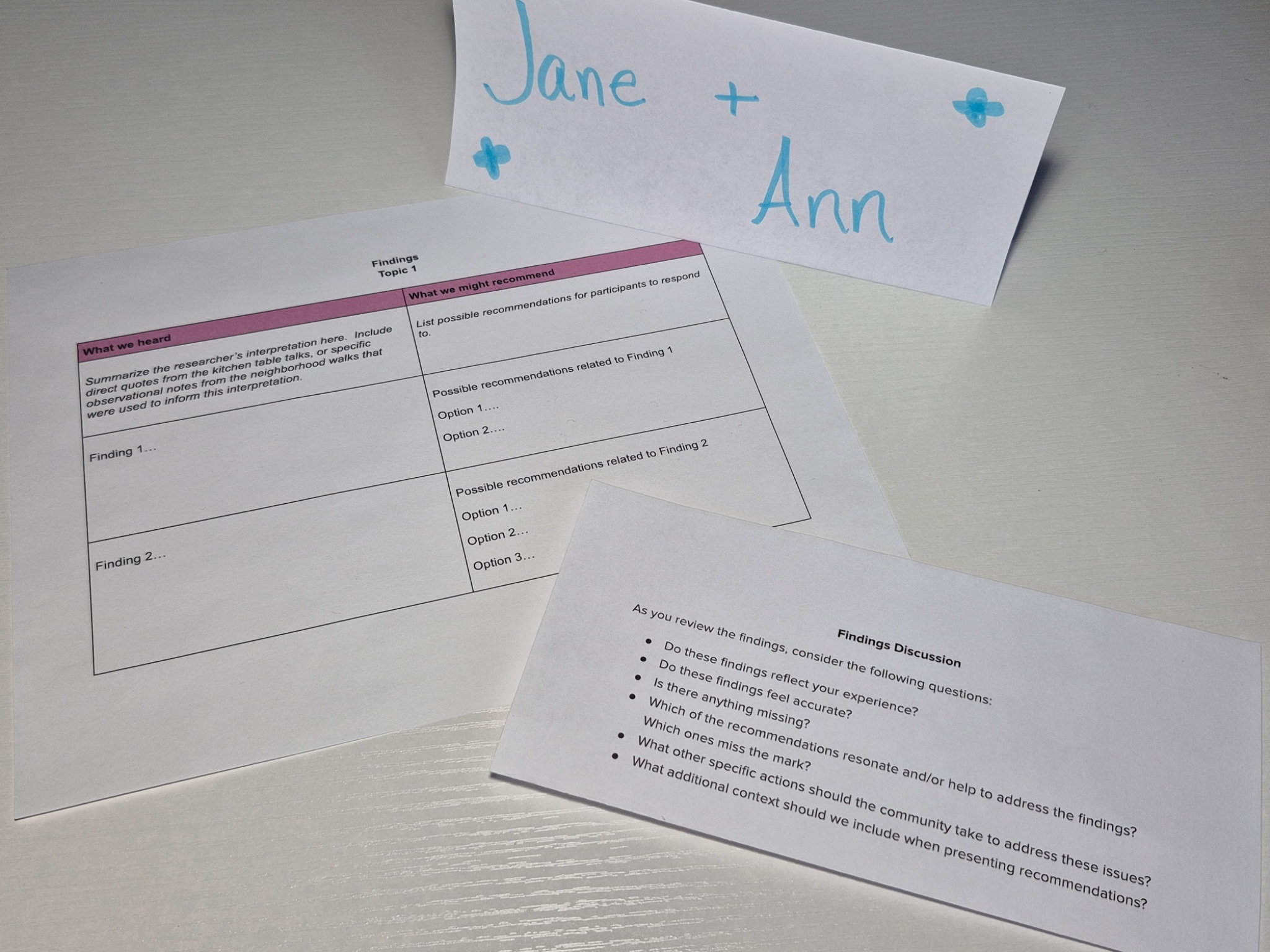
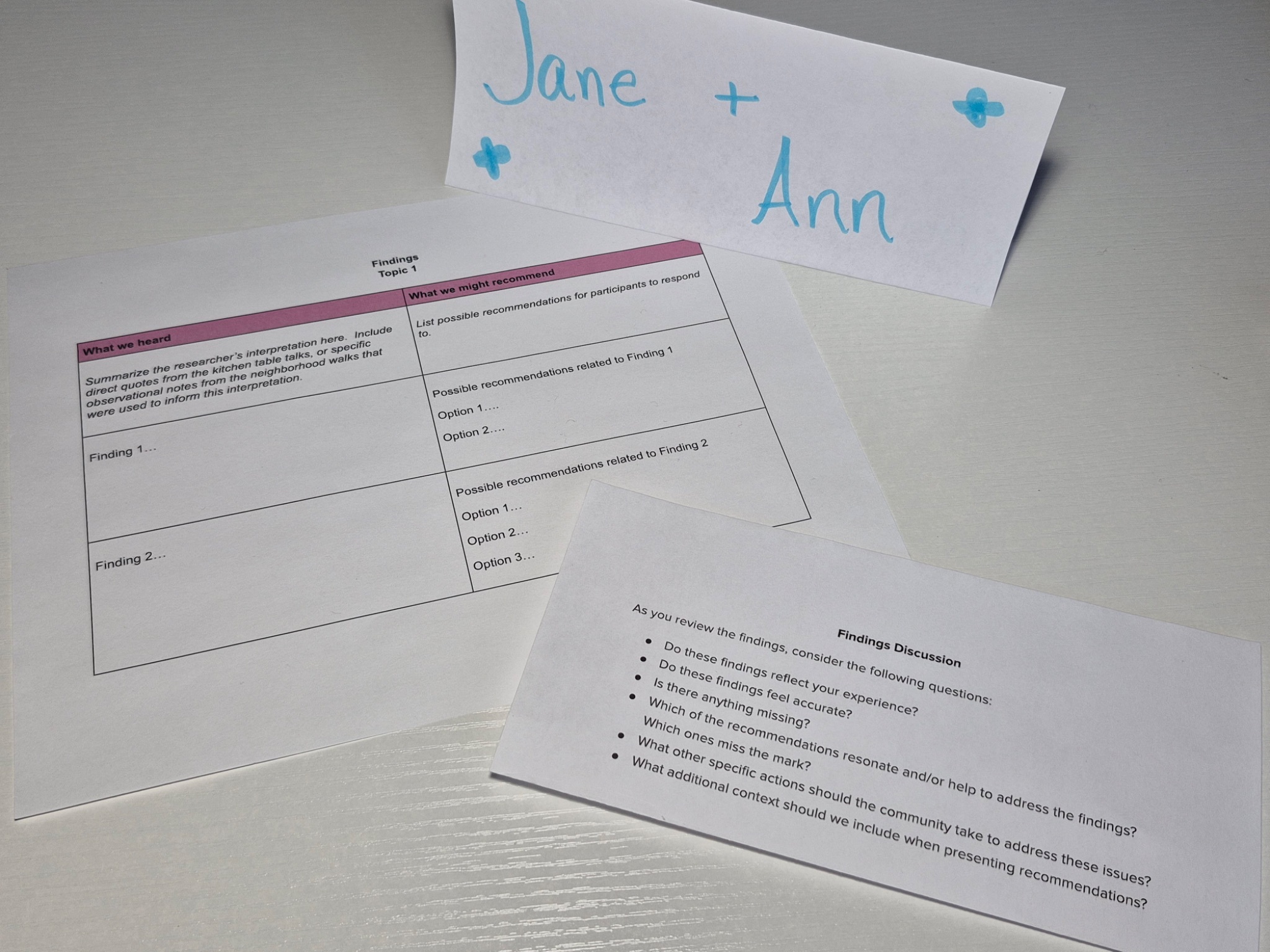
After analyzing data from the kitchen table conversation and neighborhood walk, sort the data by topic or theme. For each topic, create a table with two columns. On the left, write “What we heard” and on the right write “What we might recommend.” Under “What we heard,” include direct quotes from the kitchen table talks or specific observational notes from the neighborhood walks. Under “What we might recommend,” list possible recommendations for participants to respond to. Each topic should be on a different sheet or set of papers. Only give one set of findings to participants at a time. We chose to color-code each set to make it easier to distinguish which set of findings we were working with at any given time (See Figure 2.)
Have a laptop and projector ready to project the findings on an overhead screen so that the researchers can edit the documents in real time with participants.
Participant Preparation
Assign participants to work in pairs or small groups of three. Have name tents prepared so that they can easily find their group and their seat. Have the following set of reflection questions printed for each group:
-
Do these findings reflect your experience?
-
Do these findings feel accurate?
-
Is there anything missing?
-
Which of the recommendations resonate and/or help to address the findings? Which ones miss the mark?
-
What other specific actions should the community partner take to address these issues?
-
What additional context should we include when presenting recommendations?
Other questions that we did not ask but could be included are:
-
Were any of the findings particularly important to you?
-
Are there any other recommendations that you would add?
Implementation
This session will likely require at least two hours to do well, depending on the number of participants and the number of research findings. A possible process is below:
-
Briefly explain to participants how the data was analyzed by the researchers.
-
Explain the goal for the day, that the participants will review what the researchers heard for accuracy, reflect on the possible recommendations, and add additional recommendations and/or remove anything that they disagree with.
-
Before discussing findings, establish some community agreements for how to approach the discussion. Some agreements we offer include: Please remember to listen respectfully, make space for others to share, and whatever is shared in the group, stays in the group. We recommend inviting participants to add additional agreements before getting started.
-
To begin the findings discussion, consider using think-pair-share. Have participants take a few (maybe 2-3) minutes to review the findings, then allow a slightly longer period (maybe 5-6 minutes) for them to discuss the findings with their partner or group members. Finally, open up the discussion for the full group. Seek to build consensus around what the findings say, and what recommendations should be made.
Address one topic/theme/category at a time, starting with the ones that you suspect will be the least controversial. It is helpful to establish some quick “wins” early so that the session can feel productive. Discuss each finding and potential recommendations. Allowing the participants to make the recommendations is ideal, but in situations like ours where time was a constraint, the researchers should have some ready to propose as well. This does not preclude the participants from offering their own recommendations; in fact, it is important to make space for participants to offer their own recommendations apart from what the researchers propose.
Key Lesson
Validation sessions help bridge the gap between research and community needs, to ensure that the findings reflect the intention of the organization in relation to expressed community concerns.
Step 5: Final Presentation
Goal
The goal of the final presentation is to share the research findings with all invested stakeholders.
Preparation
After the community validation session, researchers will refine their findings and develop the final report for the community partner organization and the community members. We recommend providing the report to both groups at least one week before the final presentation to allow for time to read and reflect on the findings. We also recommend preparing a presentation of findings that does not assume that all stakeholders have had an opportunity to review the report.
Implementation
As with any research presentation, focus on highlighting key findings and recommendations and leave plenty of time for discussion afterward. Even though the researchers are presenting a “final” report, remain open to feedback that may suggest that the report may still require edits, but take caution. If the validation process was conducted with fidelity, allowing only select voices to determine what needs to change without full participation and consent from community members who might not be present could serve to invalidate the findings.
Conclusion
While community validation is ideal, organizations and researchers often face constraints due to timing and funding that make direct participant engagement challenging (Minkler & Wallerstein, 2008; Stuart, 2022). The processes developed for this tutorial were developed under such constraints–the collaboration with the community partner experienced delays that pushed the start of the project toward the end of the researchers’ grant funding cycle. Because the partner organization and the researchers wanted to ensure compensation for participants, we only had three months to complete the entire process.
With careful planning and ongoing dialogue, even research conducted within short time frames can yield meaningful, authentic findings. By integrating kitchen table talks, neighborhood walks, and community validation sessions, researchers can take steps to ensure that findings accurately reflect the lived experiences of participants. These steps allow for improved trust in research processes for future engagement. Ultimately, community-based research processes encourage long-term collaboration between researchers and community stakeholders. This framework can be adapted to various community research settings, providing a valuable resource for researchers, practitioners, and community organizers who seek to develop more inclusive and participatory research practices.