
Introduction
Photovoice is often conceptualised separately from the broader agenda to decolonise research methodologies. This paper addresses this methodological problem by advancing a conceptual framework to decolonise photovoice.
My motivation to decolonise photovoice emerged when working at a race equality organisation in South London (2013-2017), where I regularly engaged with the local authority and voluntary organisations to promote race equality. In one meeting, the presence of Nepalese elders in outdoor public spaces was discussed. I suggested that the community gathering outdoors frequently was linked to the lack of community centres or spaces to meet. However, a participant responded with a racialised trope: “they were outdoors a lot because their sons were taking drugs”. In another meeting, someone try to convince me that Hinduism and Buddhism, the religions that the Nepalese community largely identified with, amounted to the ‘same thing’. I challenged both racist narratives, however, given that whiteness is credential (Ray, 2019), I sensed that I was not being taken seriously. In response, I initiated a participatory action research (PAR) project using the method photovoice, enabling the community to narrate their own story.
I used the method photovoice because it has been widely used with minoritised communities (Coemans et al., 2019). However, photovoice is often situated in the social sciences, which in turn, can be traced to the colonial period, when research was mobilised to serve imperial power (Bhambra, 2014; Esson et al., 2017; Rudolph et al., 2018; Scheurich & Young, 1997; Tuhiwai Smith, 2012). On the one hand, it made sense to turn to research, as it can be a useful tool to challenge racist narratives. But on the other hand, there is a risk of reproducing colonial logics embedded within epistemologies.
To address the tension, in this paper I look back at my experience of conducting photovoice to challenge racist narratives in London. When I conducted the project, I was a community-based research practitioner, rather than an academic. Consequently, whilst my intention was in promoting the decolonisation of photovoice, I did not have the access to the academic literature that now informs my thinking. The rationale for this paper is therefore retrospective, it looks back at my experience to more fully build a decolonising methodology.
To build a decolonising photovoice methodology, this paper first demonstrates the conceptual separation of photovoice from decolonising methodologies, supporting critiques that the method lacks theoretical clarity (Coemans et al., 2019; Evans-Agnew & Rosemberg, 2016; Prins, 2010; Switzer, 2018). Second, it examines the academic literature on the conceptualisation of photovoice, decolonising methodologies, and emerging scholarship attempting to decolonise photovoice. Third, drawing on these insights from decolonising methodologies, it introduces a conceptual framework consisting of three interconnected principles to decolonise photovoice. Fourth, by adopting an autoethnographic approach, it reflects on field experience in a London-based case study. Through this reflexive lens, I theorise on the affordance and limits of decolonising photovoice.
The conceptualisation of photovoice
Photovoice was developed and conceptualised in the 1990’s by Wang and Burris (1997). Typically, cameras are given to individuals of a community group, who take pictures to visually narrate their lived experience (Sutton-Brown, 2014; Wang & Burris, 1997). In photovoice projects, the researcher becomes a facilitator with the twin aims of privileging the voice of participants and decentring the researcher as the expert. Cameras are used by participants to contextualise their lived experience in both the public and private realms, and the social spatial environment around them (Catalani & Minkler, 2010; Sutton-Brown, 2014). The method fosters dialogue where participants discuss the meaning and aesthetics of photos with each other, and with the facilitator-researcher to create reflexive narratives (Byrne et al., 2016; Evans-Agnew & Rosemberg, 2016; Sutton-Brown, 2014).
There are a growing number of articles and reviews about the conceptualisation of method (Balmer et al., 2015; Byrne et al., 2016; Evans-Agnew & Rosemberg, 2016; Fantini, 2017; Lal et al., 2012; Sutton-Brown, 2014). The method is mainly conceptualised as a tool for social justice and specifically informed by participatory action research, feminist theory, and documentary photography (Evans-Agnew & Rosemberg, 2016). The feminist dimension of the method centres around agency so that women take the pictures, using their gaze, and conduct the research themselves. Photovoice is also known as creative visual method, which have also been praised for effectively displacing a dominant gaze, questions the colonial idea of the authoritative objective method, opens a space for plural interpretations, and disrupts the fetish of the formal written word (Meer & Müller, 2023).
Photovoice is often associated with participatory action research (PAR) tradition. Broadly speaking, PAR is closely associated with liberation movements in Latin America, and community-based projects across the globe, inspired by the work of Paulo Freire’s Pedagogy of the Oppressed (Fals-Borda & Rahman, 1991; Freire, 2000). In this tradition photovoice is linked to the principle that oppressed communities are the experts of their own life. As such, photovoice validates local and subjugated knowledges, and facilitates a space for community dialogue to exchange perspectives about the oppression that they are collectively facing. Through collective analysis, communities can then organise strategies to create actions to stimulate positive social change (Evans-Agnew & Rosemberg, 2016; Singhal et al., 2007). Similarly, photovoice has also been influenced by Community Based Participatory Research (CBPR), and in this context, cameras were given to participants as part of a process of knowledge development and exchange for social change to occur (Hergenrather et al., 2009).
Practically, photovoice combines feminist and PAR approaches to document the lived experience of groups who are seldom heard. Focusing on marginalised groups is a central component in the conceptualisation of the method. To illustrate, the method has been used to document the lived experience of refugee children (Oh, 2012), disabled people and their experiences of accessibility and navigation of spaces (Dassah et al., 2017), environmental justice for racial equity (Hassen, 2025), to examine and tackle oppressive racialised immigration policies (Singh et al., 2023) and to advance gender equality (Coemans et al., 2019). It has also been used as a process of learning for marginalised groups to generate critical consciousness of oppression and advocate for social change (Singhal et al., 2007). Photovoice has also been noted to be effective in tackling stereotypes and racism directed at Black and people of colour (Goessling, 2018; Jahangir et al., 2022; Maclean & Woodward, 2013; Ornelas et al., 2009; Sethi, 2016).
Whilst there are clear benefits of using photovoice, there are number of limitations. Photovoice has been critiqued for the oblique way in which researcher select images, and how images can be taken out of context and misrepresent individuals or communities (Switzer, 2018). Also, Prins (2010), points out that it is naïve to assume that a camera flatten outs power relations between researchers and participants, and questions the assumption that a participant of photovoice is completely free of the researcher’s influence. Similarly, Meer and Talia (2023), commenting on creative and visual methods more generally, have argued that messy power relations continue to characterise research processes.
Similarly, PAR methodologies, which photovoice is often bound to, have been critiqued as the question of power between the researcher and the researched is often overlooked or under theorised (Evans-Agnew & Rosemberg, 2016). The influential book, ‘Participation: The New Tyranny’ offers an empirical and theoretical critiques of participatory approaches, especially the ways in which participation promotes voice and action, but fails to transform oppressive structures and ideologies, and thus contradicts the claim that participation empowers, and could, instead, burden participants (Cooke & Kothari, 2001). Furthermore, PAR claims on the one hand, that it amplifies the voice of marginalised groups but on the other hand, often the ‘writing up’ of the study consolidates the voice of the professional middle class researcher (Hasan-Bounds et al., 2020; People’s Knowledge Editorial Collective, 2016).
Photovoice and decolonising methods are often conceptualised separately
In a recent review of photovoice studies which employed feminist approaches, the authors found that there was a lack of theoretical clarity in how researchers engaged with the method, particularly in articulating its connections to challenging hegemonic gender inequalities (Coemans et al., 2019). The concerns they raise lead them to suggest that the theoretical conceptualisation of photovoice requires further development (Coemans et al., 2019). Others have also argued that photovoice remains under theorised, and on occasions, can be used uncritically (Evans-Agnew & Rosemberg, 2016; Prins, 2010; Switzer, 2018). For instance, Prins (2010) has theorised that photovoice could serve as a tool of surveillance and social control, thereby calling for more critical engagement with the method’s potential to further social justice.
Given that the method is often mobilised to advance social justice, it would be reasonable to assume that there is significant overlap between decolonising and social justice ideas. However, the method is under-theorised from a decolonial perspective, and it is not entirely clear why that is the case. It could be argued that the method does not necessary need decolonising for every research project, especially as the method has been praised for being sensitive to power relations. However, the method became popular within research settings approximately ten years before the seminal book, Decolonising Methodologies, Research, and Indigenous People (Tuhiwai Smith, 2012). It could be argued, therefore, that photovoice has been conceptualised and become widely used before decolonising approaches started to seriously turn the academic discourse on methodologies.
Furthermore, there could be the assumption that the method does not need to be decolonised as there are already significant overlaps between the ideas of decolonising methodologies, PAR and photovoice. For example, all emphasise a collaborative approach that centres the voice of marginalised individuals and communities, so that communities determine the direction of the knowledge production and actions for change (Fals-Borda & Rahman, 1991; Fine, 2016; Kindon, 2003, 2016; People’s Knowledge Editorial Collective, 2016).
However, whether PAR is inherently decolonising remains contested. On the one hand, PAR is rooted in a deep critique of western social science and its methodologies. It recognises that the knowledge project is historically tethered to cultural imperialism (Jordan & Kapoor, 2016). PAR is also considered to be decolonising in that it challenges power structures, recognises that research is rooted in the erasure of the Other, affirms plurality, self-determination, and ensures that communities have power and agency to make decisions throughout the research process (Meer & Müller, 2023; Omodan & Dastile, 2023). On the one hand however, Tuck and Yang (2012) show that Freirean foundations of PAR do not explicitly align with decolonial theory.
Moreover, PAR has been appropriated as technical research tool by corporate neoliberal capitalist forces, such as the World Bank. This raises concerns about co-optation and thereby disrupts the dominant, and often uncritical assumption, that PAR is always directed towards radical or transformative politics (Jordan & Kapoor, 2016). These tensions reveal the need for critical engagement with the foundations of PAR, especially so from a decolonising perspective.
A review of the academic literature illustrates a disconnect between decolonising methodologies and photovoice. The conceptual disconnection is evident when using Scopus and PubMed to search the academic literature using the terms photovoice and decolonisation, which yielded only five articles. A separate search combining photovoice and theory returned forty-eight articles, none of which included the term decolonisation in their abstracts. Further analysis of all reviews of photovoice (Balmer et al., 2015; Byrne et al., 2016; Catalani & Minkler, 2010; Coemans et al., 2019; Dassah et al., 2017; Evans-Agnew & Rosemberg, 2016; Fantini, 2017; Lal et al., 2012; Sutton-Brown, 2014) confirmed that a decolonial perspective of photovoice is largely absent from the field.
This absence is further corroborated by Cubero et al. (2024) in their systematic review of photovoice with migrant communities. They found that only 3 out of 65 (4%) papers included a post/de/anticolonial or feminist approach in their frameworks. They also found that most photovoice publications were produced in the Global North, and that 40% of literature produced in the Global South involved a US university. These findings suggest photovoice studies and their publications are contingent on the dominant western knowledge economy, which undoubtedly impoverishes decolonial thought (Cubero et al., 2024; Robinson & Kelley, 2021).
Furthermore, Vining and Finn (2024) conducted a systematic review to explore the theoretical and practical rational of using photovoice as a decolonising method with indigenous community in North America. They identified that there was a lack of consensus on what constituted decolonising research and how it could be operationalised in practice. They also reviewed the potential of decolonising photovoice and found that the academic literature was unclear on how to achieve this. Significantly, they identified a clear gap on how photovoice could be used for decolonising research that was contextually appropriate for indigenous communities in north American settler colonial states. Their analysis illustrates the importance of ensuring that decolonising photovoice is grounded in place, culture, and is sensitive to the specificities of anti-racist politics.
Decolonising methodologies
This section unpacks the key ideas that underpin decolonising methodologies, so that they can be understood and applied to furthering the conceptualisation of photovoice. The need to decolonise methods emerged from the recognition that race, as a technology of power serving white supremacy, was a constitutive part of knowledge production during the colonial period. Colonial knowledge systems made hegemonic claims to history and modernity as an exclusive and universal European project, systematically erasing and delegitimising ‘Other’ forms of knowledge. As a result, European epistemologies became dominant and universalised (Bhambra, 2014; Ngũgĩ wa Thiongʼo, 1992; Tuhiwai Smith, 2012). These colonial dynamics in research were further compounded by the historical exclusion of African Americans from the early development of sociological cannon, which further contributed to the construction of a ‘white sociology’ (Bhambra, 2014).
Colonial epistemologies also reflected and reinforced Europe’s racialised view of the colonial subject. Epistemologies were built on the discredited idea that Europeans were fully human and inherently superior, and the rest of the world and nature were less than human and inferior (Fanon, 1991; W. D. Mignolo, 2017; Wynter, 2003). As a result, colonial subjects were denied their humanity and social life force, they were instead objects and subjected to a epistemic death (Grosfoguel, 2002, 2011; Lugones, 2014; Medina, 2017; W. Mignolo, 2011; W. D. Mignolo, 2007b, 2007a). Moreover, women experienced compounded erasure through intersecting colonial and gendered power relations (Said, 2003; Spivak, 2023; Tuhiwai Smith, 2012).
Fanon describes the denial of the category of human as the ‘zones of non-being’ (Grosfoguel & Rodriguez, 2018). Grosofugel and Rodiguez draws from Fanon’s ideas to describe how ontological and epistemological erasure embedded in colonial knowledge systems negates the colonial subject ways of being and knowing precisely because they are considered non-human, and thus rendering the ‘zones of non-being’. Similarly, Tuhwiani Smith (2012) discusses how research during the colonial period reduced the colonial subject to an object. They write:
“the object of research do not have a voice, and do not contribute to research or science. In fact, the logic of the argument would suggest that it is simple impossible, ridiculous even, to suggest that the object of research can contribute to anything. An object has no life force, no humanity, no spirit of its own, so therefore cannot make an active contribution”.
Bhambra (2014) argues that sociology requires a deep appreciation of the historical context and the imperial conditions which have shaped the discipline. Bhambra advocates reconstructing sociology with race at its core (Bhambra, 2014). Similarly, critical race scholars in geography argue that not enough attention is being paid to the way in which racialisation shapes geographical theory, practice, and institutions (Radcliffe, 2017). In geography, decolonisation is thus a call to decentre whiteness, recognise that knowledge is not universal and is always in relationship with power (Baldwin, 2017; Elliott-Cooper, 2017; Esson et al., 2017; Jazeel, 2017; Noxolo, 2017; Radcliffe, 2017; Tolia-Kelly, 2017).
Connell (2018) outlines three concerns for sociology to advance the agenda of decolonisation. The first concern is the recognition that the global knowledge economy, discourse, is one of inequality, where the global North dominates the discipline. As such, addressing this inequality is central to decolonising the discipline.
The second concern is focused on who asks the questions and the types of methodologies used. Connell (2018) argues that those affected by colonisation, racism and patriarchy ought to drive knowledge production using existing or new methodologies. Similarly, for Tuhiwai-Smith (2012), decolonisation requires mobilising methodologies as tools that support marginalised communities narrate their experiences in a genuine and authentic way. Grosfoguel (2011) explicitly discusses the connection between decolonisation and racialised groups, and comments that:
“decolonial studies offers to think ‘from and with’ these ‘others’ subalteranised and inferiorized by Eurocentric modernity, offering to define their questions, their problems, their intellectual dilemmas, ‘from’ and ‘with’ these same racialized groups. This would give rise to a decolonial methodology of social science and humanities” (Grosfoguel, 2011).
As such, centring marginalised communities and facilitating a space for their knowledge production, ways of being, and doing within the research processes is critical part of reconstructing epistemologies (Gordon, 2014; Grosfoguel, 2011; Scheurich & Young, 1997). Moreover, creating space for oppressed groups to exercise agency, voice, and narrate their lived experiences is also an essential component of decolonising research.
Connell’s third concern requires recognising the plurality of knowledge systems, and decentring of Eurocentric epistemologies (Connell, 2018). This requires the active promotion of cultural diversity and its associated knowledge practices marginalised by colonial power. It will also require the cultivation of spaces that allow for dialogue between plural knowledges, rather than negating or advancing one knowledge system over the other, and thereby facilitating epistemic justice and plurality.
The scholarship around decoloniality is evolving and contested, which presents a challenge for decolonising methodologies. Moreover, for many indigenous communities, decolonising is fundamentally about reparations of lands and territorial sovereignty, which were violated under historical colonialism and perpetuated by settler-colonialism (Radcliffe, 2017; Tuck & Yang, 2012; Tuhiwai Smith, 2012).
Tuck and Yang (2012) argue and caution that decolonisation is being loosely attached to worthy social justice projects, yet they fail to appreciate the profound political transformation that is associated with the core of decolonisation movements. In their assessment, some decolonisation claims, rather than build a transformational political landscape against coloniality, are instead, metaphoric, creating a sense of escape from colonial violence. They provocatively remark that “decolonisation brings about the repatriation of indigenous lands and life; it is not a metaphor for other things we to do to improve our societies and schools” (Tuck & Yang, 2012).
Decolonising photovoice
Fricas (2022) and Vining and Finn (2024) have made significant contributions towards decolonising photovoice. This paper complements and extends their critical scholarship by adding further nuances to the conceptualisation of photovoice as a decolonising method. Vining and Finne (2024) in making their case to decolonise photovoice propose that decolonising research involves shifting power to the local level, contesting ideas around expertise, fostering critical reflexivity, interrogating research motives and impacts, and to work towards transforming sociopolitical structures through community-driven actions.
Vining and Finn (2024) propose four points to decolonising photovoice specifically for indigenous communities. This involves: 1) identify policy pathways for the research process; 2) conduct the research through existing community structures and if those are not available to ensure resources are made available to create those; 3) include indigenous peer researchers throughout the research cycle and 4) ensure that there is a follow-up component to evaluate the long-term impacts and ascertain the ongoing decolonisation effect. The authors also argue that decolonisation must extend beyond academic inquiry, in that it ought to further equity in tangible and community-driven ways (Vining & Finn, 2024).
Fricas (2022) devised an anticolonial framework for photovoice, that requires researchers to seriously engage with foundational concepts of colonialism, postcolonialism, decolonisation, and anticolonialism. The anticolonial framework also involves elevating epistemologies of the South, being attentive to power dynamics, attending to concerns of oppressed groups, questions the frames of knowledge production and validity, and ensuring a space for true empowerment, agency, and refusal (Fricas, 2022). Similarly, Cubero et al. (2024) argue that photovoice researchers ought to reverse colonial, sexist and racist bias, especially regarding language around migrants.
Building on these contributions, and in dialogue with broader decolonial scholarship, the following sections advances a conceptual framework grounded in three interrelated principles to guide photovoice towards a decolonising direction and praxis.
Three interlinking principals to decolonise photovoice
Principal One: Building a decolonising consciousness.
The first principal to adopt to decolonise photovoice is conceptual. It calls on the researcher to mindfully engage with the need to historicise epistemologies to confront and transform colonial logics. A failure to appreciate the colonial history of research, a form of colonial amnesia, could further cement the ‘methodological whiteness’ and ‘methodological stasis’ of research (Bhambra, 2014; Hui, 2023; Scheurich & Young, 1997). To reverse colonial amnesia photovoice studies ought to critically foreground the historical heteropatriarchal and race logics that are fundamental in creating research structures, approaches, and ways of being, doing and knowing, and how these continue to show up in research practices in the present.
As such, decolonising photovoice is fundamentally directed towards dismantling the legacies and ongoing colonial logics within the research process, structures, and the global knowledge economy. Whilst challenging the global knowledge economy is a vital part of decolonising research, it is the beyond the practical scope of this paper.
Practically, and the local scale, decolonising photovoice means that the researcher will need to critically engage and deeply study the discourses of colonisation, post-colonialism, decolonisation, anticolonialism, anti-racisms, and queering research, to develop a deep decolonising consciousness. By adopting this principal the researcher will cultivate decolonising sensitivities needed to disrupt the reproduction of racisms and coloniality within research (Fricas, 2022; McDonald, 2017; Singh, 2016).
Principal two: To build an intersectional anti-racist consciousness, intentionally include and foreground those harmed by colonial logics, and to hold space to intentionally address intersectional racisms.
The second principal in decolonising photovoice is focused on the intentional inclusion and foregrounding communities from the global south and north harmed by intersecting colonial and gendered logics. By doing so, it challenges the ongoing colonial and gendered erasure of voices in research and society more broadly.
This principal also involves developing an intersectional anti-racist consciousness. This intersectional consciousness honours difference and avoids homogenising communities. By doing so it enables the researcher to recognise how racism operates intersectionally with gender, sexuality, class, disability, and other axes of difference, and importantly to respond to these dynamics within the research process.
Practically, this involves creating intentional and sensitive spaces within the methodology where marginalised groups can analyse and discuss how intersectional racisms shapes their lived experience. How and when this principal ought to be conducted is contextual, situated, needs-led, and emerges from the community group that the research process is engaged with. As such this principal involves ongoing pedological conversation between the researcher and the community, grounded in deep listening and collective reflection. These collectively reflections on the way in which intersecting oppression shapes the lived experience will also involve coproducing strategies to tackle it.
Principal three: reversing colonial ways of being, doing, and knowing within research processes.
Principal three combines the conceptual with the practical to reconstruct the foundations of photovoice. Conceptually, it acknowledges that Eurocentric ways of being, doing and knowing were imposed on research process. European epistemologies replicated colonial logics in that non-Europeans were less than human, thereby erasing histories, knowledge systems, and diverse ways of being and doing. Within these frameworks, the researcher reproduced racial and gendered hierarchies, and positioning themselves as the sole creators of knowledge and rendering the non-European to an epistemic death, and thus, and an object of study.
As such, reversing the colonial ways of being, doing and knowing within research process is critical site of epistemological reconstruction. This principal also means the practitioner ensures conceptual and practical space for what Tuhiwai Smith (2012) calls the ‘social life force’ of the subject, which was historical erased by colonial epistemologies. Practically, this means ensuring that the subject is central within research process so that the subject’s life force has power to self-narrate, have agency, and where non-European cultures, ways of being, doing, and knowing are affirmed.
Moreover, a key aim of principal three is to destabilise the Eurocentrism that underpin colonial epistemologies. As such this involves being careful and conscious with ways of being and doing of research so that it does not replicate colonial cultures of extraction, racial and gender hierarchies, and European cultural norms, particularly capitalist model of middle-class professionalism and the distant, neutral, ‘objective’ researcher.
Applying this principal universally is challenging, as it requires a coproduced, nuanced, and emergent approach to research facilitation. Practically, however, this principle means intentionally creating space within research process that are rooted in care, joy, conviviality, closeness, relationality, and affirms cultural diversity, difference and plural knowleges. Embedding practices such as deep listening, collectivising, and fostering a sense of community and mutual respect, are also crucial.
This principal also involves conducting the research in community languages, ensuring that there is appropriate multicultural food available, ensuring that the research process does not undermine non-western festivals, religious, spiritual, and cultural important events. Moreover, this principle also requires negotiating and affirming difference, rather than erasing it. As such, being attentive to the intersection power of whiteness, class, patriarchy, caste, dominant cis gendered male masculinities, heteronormativity, and ableism within the research process is also vital.
Case study of decolonising photovoice: methodological reflections from the field
This section discusses a case study which informs the basis for theorising and reflecting on decolonising photovoice. This project emerged as part of a broader research project that explored the social life of benches (Rishbeth & Rogaly, 2018). It is important to state that when I conducted the field work for this project, I was a community-based research practitioner, rather than an academic. Consequently, whilst my interest was in promoting the decolonisation of photovoice, I did not have access to the academic literature that now informs my thinking.
The rationale for this paper is therefore retrospective, it looks back at my experience to build a decolonising methodology. In essence, this paper emerges from practice, and theorising decolonising photovoice from that standpoint. As such, rather than show or discuss the photos that were taken by the community, I therefore adopt an autoethnographic approach (Butz & Besio, 2009; Ellis et al., 2011) and draw from my ‘headnotes’ (Wall, 2008) to make sense of my field experience of using photovoice to tackle racist narratives made about a minority community in the summer of 2018. Through this reflexive lens, I theorise on the affordance and limits of decolonising photovoice.
In this paper, decolonising photovoice is premised on a framework of three interlinking principles. To fulfil principal one of the decolonising photovoice methodology, I engaged in informal study to deepen my decolonising consciousness. This involved immersing myself in the literature around decolonising, and actively participating in seminars and study spaces on anti-racisms, anti-caste politics, and intersectional feminism. This ongoing work has been foundational and deepens my understanding and commitment to dismantle and reconstruct research.
To align with principal two of decolonising photovoice, this project included a community subjected to racisms, the recently arrived migrant Nepalese community in Southeast London. Furthermore, a key aspect of decolonising methodologies is to develop trustful partnership with community-based organisations that directly worked with communities. At the time of the project, I was based in an office that shared space with an NGO that solely focused on supporting the rights and social welfare of the Nepalese community locally. We were co-located for around two years, so we regularly discussed the racism that the community was facing. The staff and community group were keen to be part of this project, and we discussed how the work would unfold, and regularly met to ensure that it was collectively coproduced.
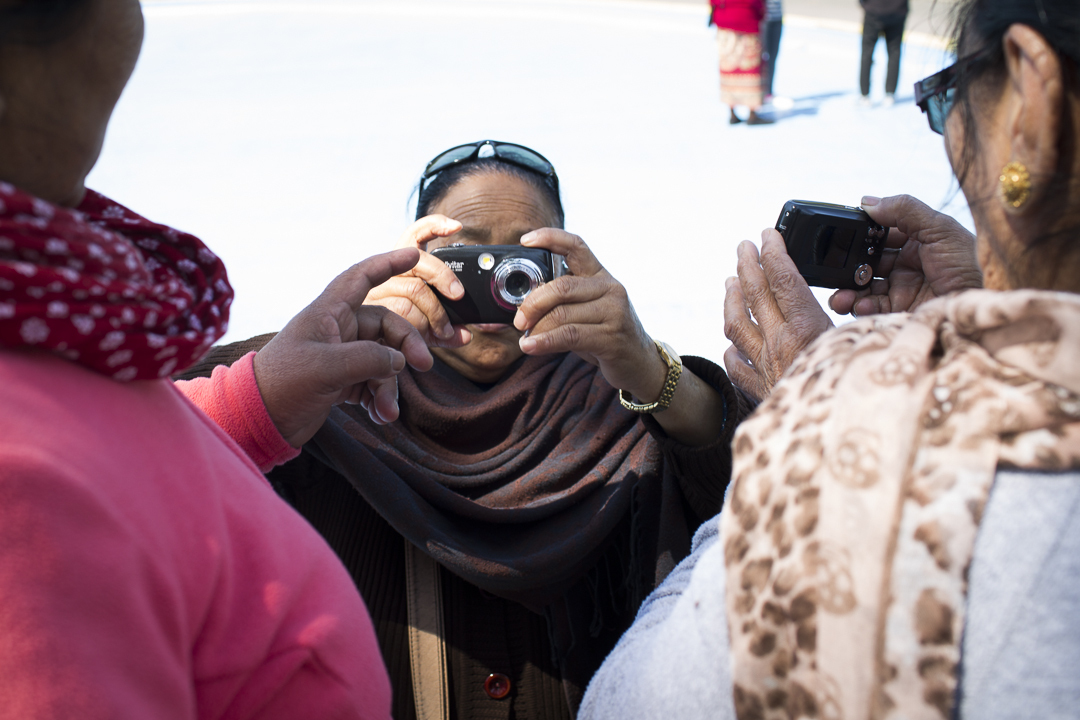
Principal three involves transforming Eurocentric ways of being, doing and knowing within epistemologies. To contradict the social and epistemic death that characterises racialised epistemologies, the research team created space for the social life force of participants. Practically, this involved creating a space and providing cameras for participants and to learn about photography (see figure 1). After becoming comfortable with cameras, each week, over an eight-week period, participant took photos about their lived experience of living in the area.
Each week, participants took photos about their lived experience of the living in the area and shared their photos with the group. Each participant, through their photos, shared their narratives, ensuring participant’s voices and social life force were centred throughout the process. The space was also a learning forum, where each participant learned from each other and thereby becoming conscious of individual and collective oppressions in bodies and space. Consequently, this also tackled the hierarchies between researchers and the participants.
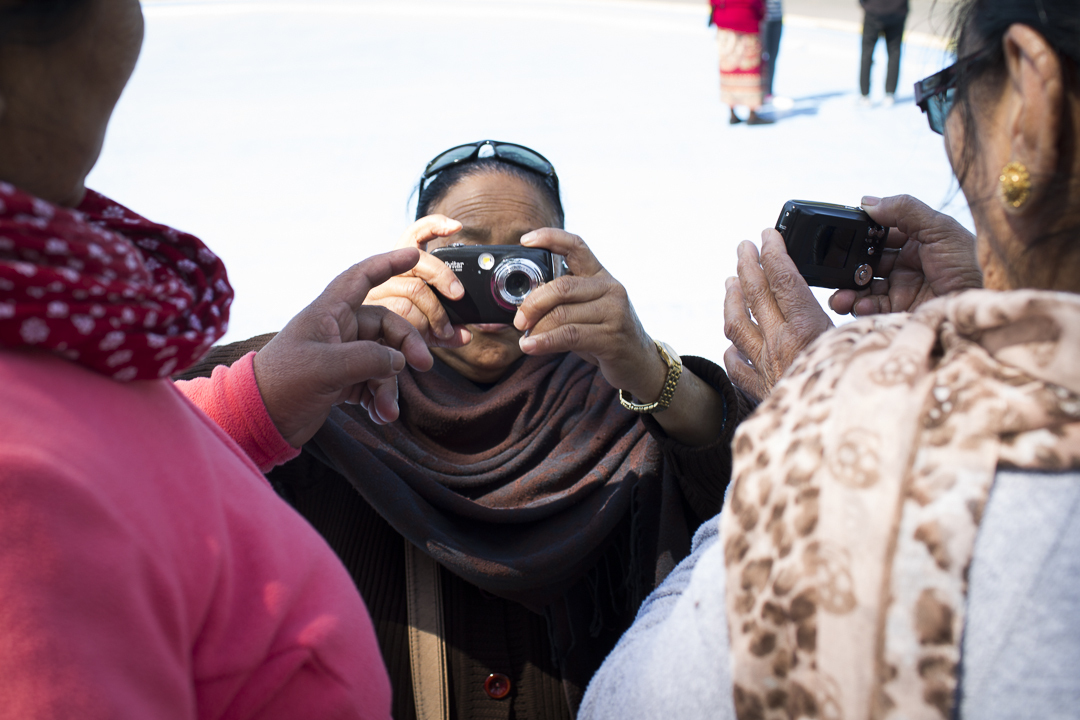
Principal three also involves creating space within research process that are rooted in care, joy, closeness, relationality, and affirms cultural diversity and difference. For instance, the NGO that we worked with regularly delivered English classes for elderly Nepalese women in the local area. We joined the English classes and supported the learning of the elders with their English; we conducted the photovoice project after it. Being part of the English classes facilitated trust building, conviviality, closeness, collective community building and disrupted the logics of research as purely extraction.
To further embody principle three, the research team was comprised of two Nepalese speakers and the project was conducted in a community language, Nepali. Although I do not speak Nepali, the participants communicated with me Hindi, which I can understand at a basic level, and I spoke to the elders through translation. For each session, where possible, we provided South Asian food and ensured that we were convivial and addressed our participants in manners that respected elders, so that our ways of being and doing aligned to South Asian cultural customs. On many occasions the elderly women also bought in food to share with each other and the research team. We made time to eat together and built community. This convivial spirit, often written out of methodological theory, is central to decolonising methodologies, which seeks to disrupt dominant Eurocentric ways of being, doing and knowing.
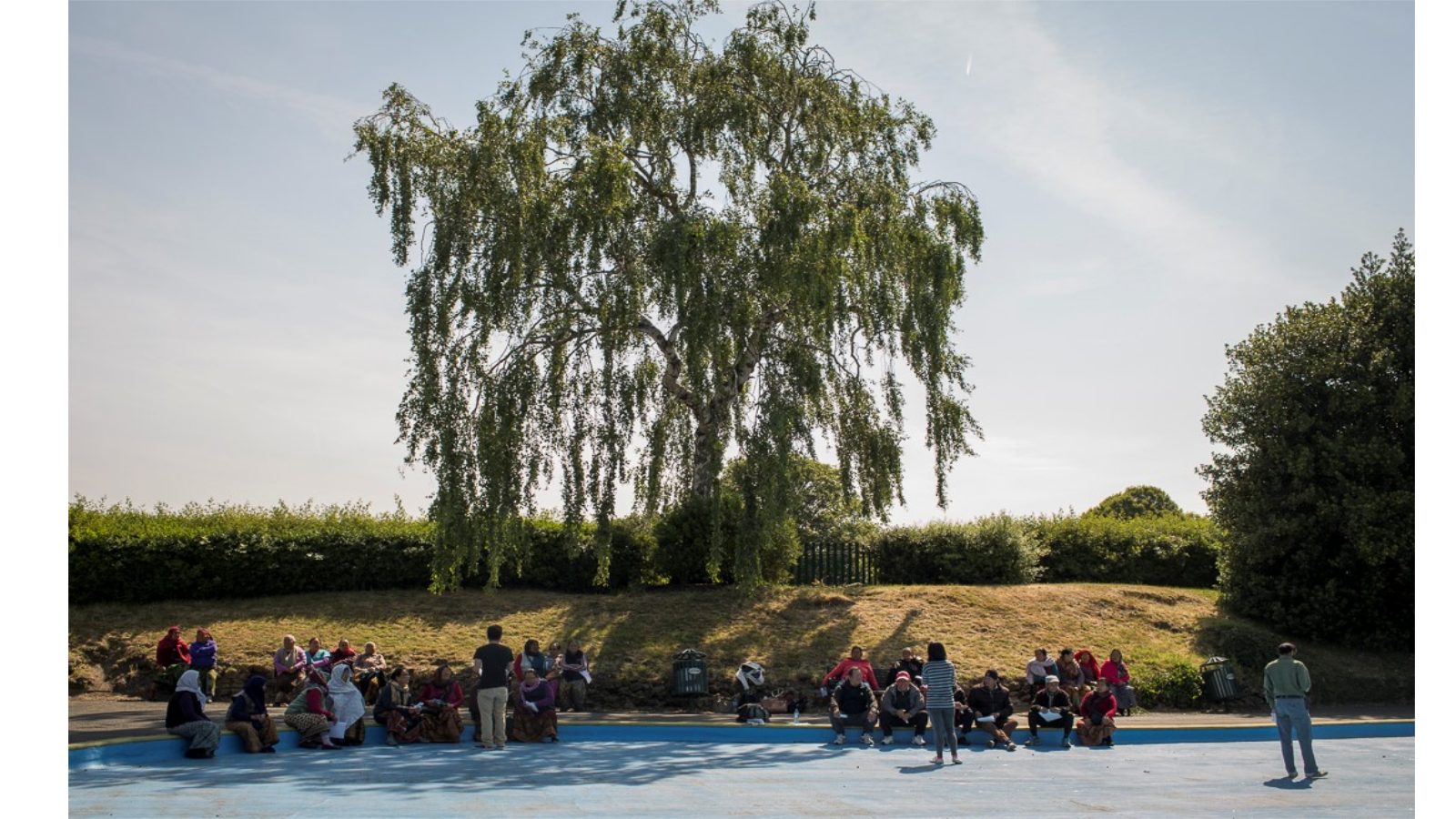
Principal two requires paying attention to difference within communities to avoid homogenising the community and to foreground intersectionality. For example, I was aware of literacy challenges in rural areas in South Asia is quite common. Through community engagement, the research team found out about a group of elderly Nepalese women who regularly met at a local park and who did not attend English classes due to literacy challenges. They expressed interest in the project, so we conducted workshops in the local park during the summer (see figure 2).
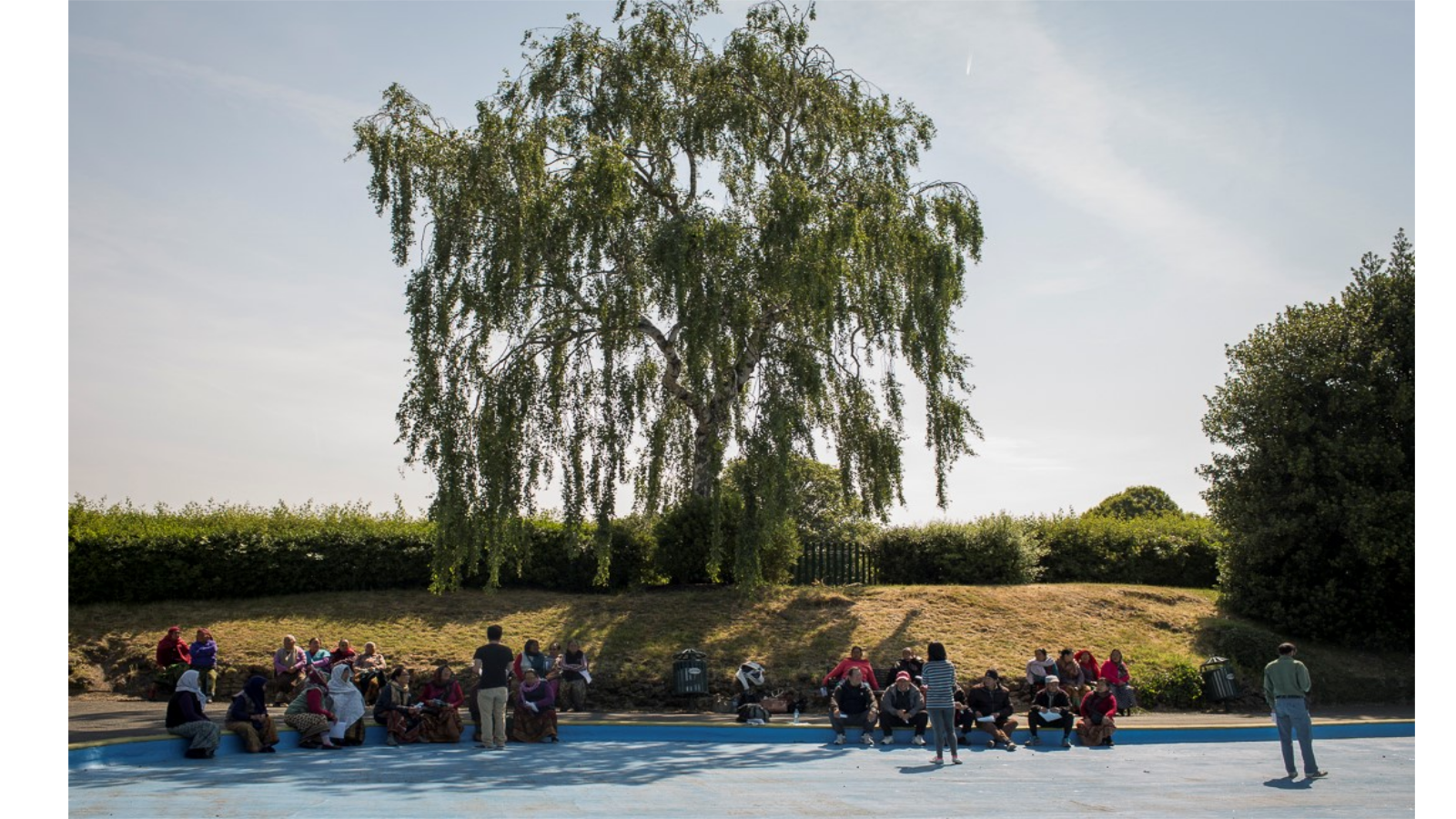
Through the pictures they took, we discussed their experiences of living in South London. The women spoke of feeling lonely as they could not speak English to people in the locality, and of the importance of spending time together, to challenge the loneliness that they faced. They also talked about missing their children, who in the main, lived in Nepal, and the poor housing conditions that they lived in in southeast London.
Principal two of decolonising photovoice foregrounds intersectional racisms, and importantly develops actions to tackle it. We therefore held careful conversations about the racism and sexism faced by the community and civil and legal remedies that could be used to confront these injustices. The participants reported that they were missing their children and longed to invite them to the country. But they were not sure how to do that, so we identified an immigration solicitor and organised a workshop between them. The immigration advisors stressed however that immigration law would not grant the ‘right to remain’ to their children as many of their children were now adults. It was also another example how race inflicted their lives in that racialised immigration policies and racialised bordering (de Noronha, 2019; Small & Solomos, 2006) denied their family union.
Many of the women reported that they were living in poor housing conditions, often in houses of multiple occupancy (HMOs). We therefore organised a workshop with a housing rights organisation, who provided a legal expert and discussed their housing rights. However, advancing housing rights at the individual level often involves tackling landlordism head on, but it was advised that this could leave individual women vulnerable to eviction, so the housing rights charity and the organisation that I worked for informed the local authority of this systemic housing rights situation. The local authority assured us that it would review its policy on HMOs.
Towards the conclusion of the project, the exhibition was curated with the intention of engaging with key stakeholders from both the statutory and voluntary sector, so that they could understand more about the community, and where the community could also share their narrative, from their gaze, and their voice. A diverse audience attended the exhibition, and the Nepalese community were able to articulate their lived experience, effectively countering the racist narrative that were made about the community in the meetings that I attended prior to the project. However, it is important to critically reflect on the limitations of such interventions. Whilst the exhibition provided a space for counter-narratives, it remains difficult to ascertain whether it led to any shifts in the views and opinions held by individuals in powerful institutions.
Discussions on decolonising photovoice
This study conceptually proposed a framework of three interlinking principals to decolonise photovoice, and this section will discuss the affordance and limits of this framework. Principal one, developing a decolonising consciousness, was relatively straight forward to implement as it involved ongoing process of critical study and reflection. Principal two, developing an intersectional anti-racist consciousness, and including and foregrounding those harmed by coloniality was achieved through deliberate methodological direction. Principal three, reversing colonial ways of being, doing, and knowing, and centring marginalised communities to allow for their social life force, were also implemented through research design and practice.
However, principal two and three presented tensions, uncertainty, contradictions, and revealed obvious power relations between the researcher and participants. Principal three involves intentionally creating space rooted in care, joy, and relationality. There was space for deep listening, collectivising, sharing food together, fostering a sense of community, and closeness. Critically, there was space for the social life forces of participants so not to replicate gendered and racial hierarchies embedded with colonial epistemologies.
Yet, reversing colonial ways of being, doing and knowing was difficult to hold in practice, and there was uncertainty how to meaningfully implement it on the ground. Radcliffe states that decolonising is ‘always complex and highly contentious’ (Radcliffe, 2017). Whether these principles decolonise photovoice is undoubtedly contentious. My field reflections illustrate messy, tense, and the fraught practice of decolonising photovoice. The messy and fraught tensions that surfaced throughout the research process are further discussed below.
Reflexivity and negotiating intersectional anti-racisms
Principal two of decolonising photovoice required developing an intersectional anti-racist consciousness, and to foreground space for communities to address racisms intersecting with other oppressions. Whilst this was broadly achieved, it is also important to stress that the community did not approach the research team to challenge racist narratives, and therefore raises a power dynamic.
However, if I was to approach the community in a methodological race neutral way, that would have moved the project towards a post-race direction. By doing so, the research would wrongly assume that race in the UK has no material, performative or discursive power (Boulila, 2019; Lentin, 2016, 2018). Assuming and setting up a process informed by a post-race position would also be equally problematic, methodologically fraught, and foreclose working on the intersectional power of race. Recognising this dynamic, I maintained an open framing so that the community and their lived experience could direct the project whilst encouraging a space for dialogue around intersectional racisms.
These reflections suggests that one of the critical imperatives behind decolonising photovoice is to the face race historically and in the present, rather than unwittingly assume a post-racial position. Whilst cultivating an intersectional anti-racist consciousness is essential, it needs to be done reflexively. This means that intersectional racism is not only foregrounded, but importantly, emerges from a bottom-up dialogue between the researcher and the community. Such an approach fosters collective analysis, affirms community agency, and ensures that actions against intersectional racisms are rooted in the lived experience of place.
The power of positionality, and the circuits of whiteness within decolonising photovoice practice
Prins (2010) has argued that cameras does not necessary flatten power relations between participants and researchers. Positionality of the researcher often influences research and can even contribute to the ‘othering’ participants (Rose, 1997). The problematics of white positionality within research has been widely discussed. The positionality of brown middle class cis males within decolonising is less theorised, however, and therefore suggest that questions around power relations within decolonising practices could be underdeveloped.
D’Arcangelis (2018) states that ‘the researcher can be seduced by the idea that self -reflexivity, if done ‘well’ from the start, forestalls and prevents the undue influence of the researcher over the research process and results’. The author argues that the ‘white/settler’ subject’s claims of self-reflexivity can obfuscate the power relations that constitute that subject’s position, often white and middle class and, as such, it is a ‘fantasy to transcend it’ (D’Arcangelis, 2018). Further complicating this, D’Arcangelis (2018) contends that self-reflexivity focuses on ideas of self, the individual, and reflects the logics of modernity and arguably, therefore, reproduces the logics of coloniality/modernity epistemologies. This critique raises important questions about whether self-reflexivity risks maintaining methodologies in a colonial statis. These complications suggest that decolonising photovoice will also require a deeper interrogation on what constitutes a truly decolonial reflexivity.
In my case, self-reflexivity, despite my non-whiteness, does not negate my middle-class position, nor does it negate my proximity to whiteness. This proximity is shaped by class and growing up in the country which equips me with a set of navigational knowledge, language, and skills to initiate, access networks, raise funds and carry out the project. By being situated in a professional middle class environment gave me greater proximity to whiteness and its resources. For instance, the researcher’s proximity to powerful white institutions such as the Arts and Humanities Research Council and to white academics that frequently obtain funding were instrumental in securing resources for this project. Whilst this may be viewed as strategic anti-racism, it also reveals the circuits of whiteness within this decolonising practice.
The class difference between myself and the participants were self-evident during and more pronounced after its conclusion. To illustrate, the middle-class cultural capital wrapped up in my positionality differentiates me from the Nepali women I was working with, despite my working-class heritage. My class position, gender, and secure immigration status underscore the tensions between conceptual aspiration of decolonising photovoice and the material realities of power relations in practice. Whilst I practiced self-reflexivity, it did not erase this structural difference. The project ended about six weeks after the exhibition, and I rarely cross paths with the elderly women. We have become segregated from each other, and this undoubtedly linked to our class positions being so different. In fact, this project itself deepens my middle-class position by reinforcing my professional credentials and arguably cementing my labour within academia and NGOs (Hasan-Bounds et al., 2020).
Despite the project’s decolonising intentions, whiteness continued to circulate, particularly in the exhibition phase. Kassim (2017) reflecting on their attempts to decolonise the museum, notes that exhibitions are often constructed under the assumption that the audience will be white, thereby privileging the white gaze (Kassim, 2017). At our exhibition, we invited representatives from the local authority as they had the power to address structural issues such as housing. However, the structural authority of local government is built on a set of historical cultural practice of whiteness, rendering it a racialised institution that often perpetuates racial inequalities and advances the broader project of whiteness (Bonnett, 1997; Ray, 2019). Whilst the gaze of the photos was from brown gendered bodies, the gaze that it was directed to was the white gaze to alleviate it of its ignorance. As such whiteness was subtly recentred, or at the very least, circulated through this intervention.
These reflections underscore the dissonance between conceptual aspirations of decolonising methodologies and their practical enactment. Bhattacharya (2016) argues that there is no pure decolonial spaces, that colonising and decolonising discourses always exist and intermingle. In this study it was difficult to disentangle decolonising process from institutions reproducing whiteness. As such, claiming that decolonising photovoice moves it to a utopic horizon free of colonial logics is deeply problematic.
Instead, decolonising photovoice and methodologies in general, perhaps, requires, what Donna Harraway remarks, ‘staying with the trouble’, and recognising and foregrounding the intersectional power of whiteness, class, gender, caste, ableism, heteronormativity, and other power relations that circulate within research processes. Decolonising therefore, requires a strong commitment to reflexivity that does not seek purity or resolution, but rather embraces the tensions, the mess, the complexity, and contradictions inherent in decolonising work.
Given the messy and fraught nature of decolonising photovoice in practice, several critical questions emerge for future research and methodological development. These include: In what ways does taking a strong decolonising approach with photovoice reshape power relations between the researcher and community? What does decolonising reflexivity look like? How can reflexivity within decolonising photovoice frameworks meaningfully engage with questions around gender, class, and other intersecting power relations? In other words, what notable changes are there in reflexivity and negotiating positionally when conducting a decolonising photovoice practice, and how can this be integrated into a methodology? In what ways can decolonising methodologies foster long-term solidarities across class divides, rather than reproducing them?
Whilst decolonising photovoice disrupts the pathological white gaze of individuals, structural racism remains intact, and thereby presents the political and material limits of the application of decolonising photovoice. These limits of research underscores Audre Lorde profound remarks, “the masters tools will not dismantle the masters’ house. This may allow us temporarily to beat him at his own game, but they will never enable us to bring about genuine change”.
Lorde encourages us to go deep inside ourselves and to be aware of our differences (Lorde, 2017). The challenge of decolonising photovoice, therefore, requires looking outwards at the way that oppressive colonial logics continue to structurally operate in society and research, and inwards, into our difference, to ‘colour the field’, and to interrogate how power of gender, class, heteronormativity, ableism, and whiteness circulates within our own practice, our bodies, in our ways of being, doing and knowing. As such, decolonising photovoice is not an event or a utopic destination, rather, it is an ongoing process of disruption, reflection, reimagining, ‘staying with the trouble’, alongside political organising to abolish structural racisms materially.
Conclusions
Photovoice is widely conceptualised as a tool for social justice, influenced by feminism, participatory action research, documentary photography and anti-oppressive research practice. However, photovoice has been critiqued for lacking conceptual clarity and the method is often associated with sociology and geography, which have been widely critiqued from a decolonial perspective. This paper also shows that photovoice, arguably because its association with PAR, has been largely conceptualised independently of the growing body of work on decolonising methodologies.
This paper brings photovoice and decolonising methodologies literatures into conversation and applies the insights into a framework of three interlinked conceptual principals to decolonise the method. Principal one is focused on developing a decolonising consciousness to foregrounds the historic and current heteropatriarchal and race logics that are bound to research.
Principal two is focused on building an intersectional anti-racist consciousness. It also ensures the inclusion and foregrounds those harmed by colonial logics and to hold space to intentionally discuss and tackle intersectional racisms.
Principal three seeks to reverse Eurocentric colonial ways of being, doing, and knowing within research processes. This principal also requires facilitating the ‘social life forces’ of marginalised communities within the research process, so that there is space for voice, aliveness, joy, self-narration, agency, community, refusal, and affirms cultural diversity. By doing so, decolonising photovoice situates the research process in the geo-politics of knowledge, and thus affirm cultural and language diversity, epistemic justice, and pluralism.
However, the conceptualisation of decolonisation when put into practice intermingles and coexists with colonial, imperial, and white supremacy logics that characterise the geographies of London. As this study demonstrates, circuits of whiteness were reproduced and subtly recentred within the practice of decolonising the method. Furthermore, power relations characterised by class, gender, immigration status between the researcher and the participants were self-evident, and often messy. Given these complex, fraught, and messy layers and Tuck and Yang (2012) critiques around decolonisation as a metaphor, it is difficulty to claim that this photovoice research project is decolonising. Rather, this study argues the practice of decolonising photovoice is fraught, messy, complex, and entangled with the very colonial forces it seeks to disrupt.
Acknowledgements
I would like to thank all the participants of the project, for making this project joyful and meaningful. This project was made possible, and I am grateful for the funding we received from the Arts and Humanities Research Council for the "Bench Project’ conducted by Dr Clare Rishbeth. I would also like to thank Greenwich Inclusion Project and Skills and Care Greenwich. I also like to thank Samprada Mukhia and Safal Mukhia who helped immensely with the field work, and Ayesha Manazir Siddiqi, Dr Kavita Bhanot, Dr Priscilla Claeys and Dr Adrian Evans for proofreading and providing critical feedback on the article.