
I
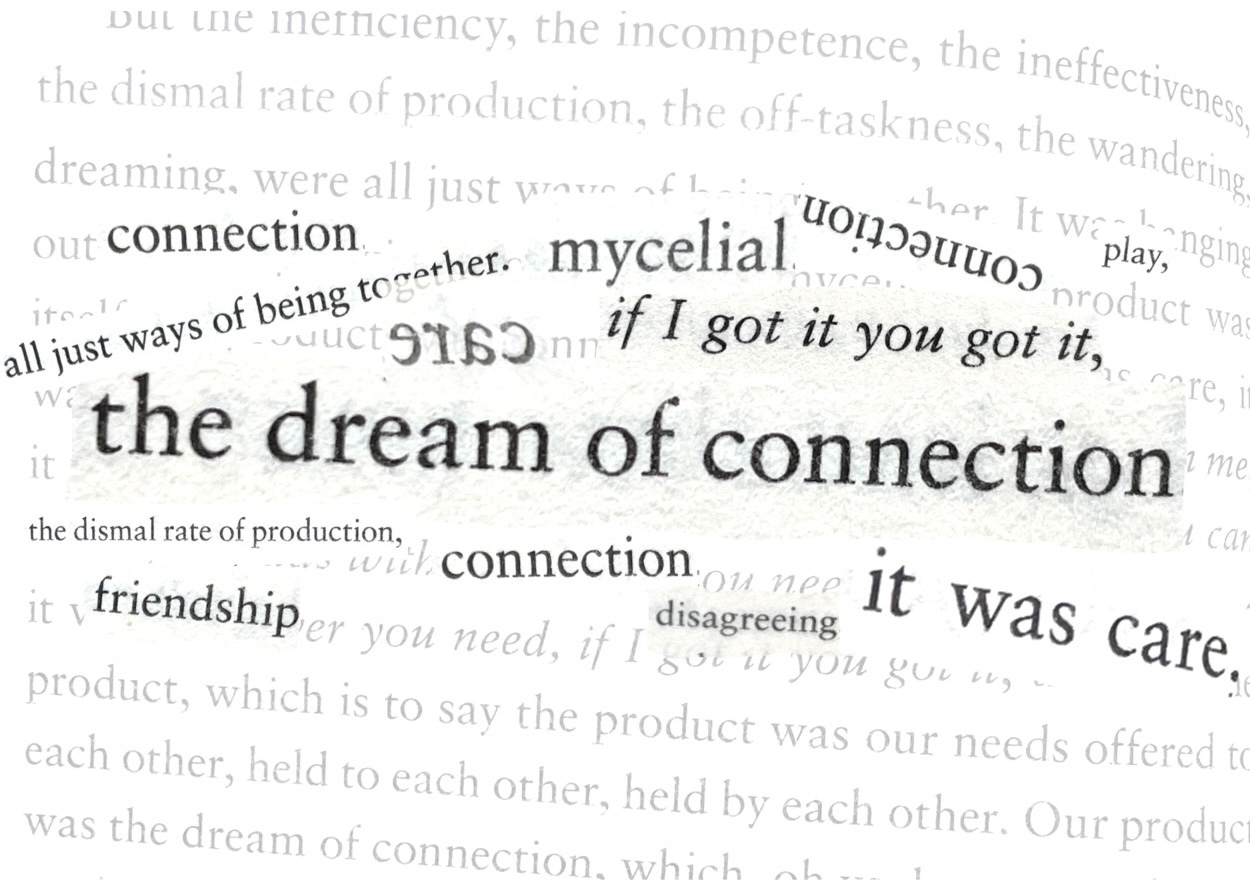
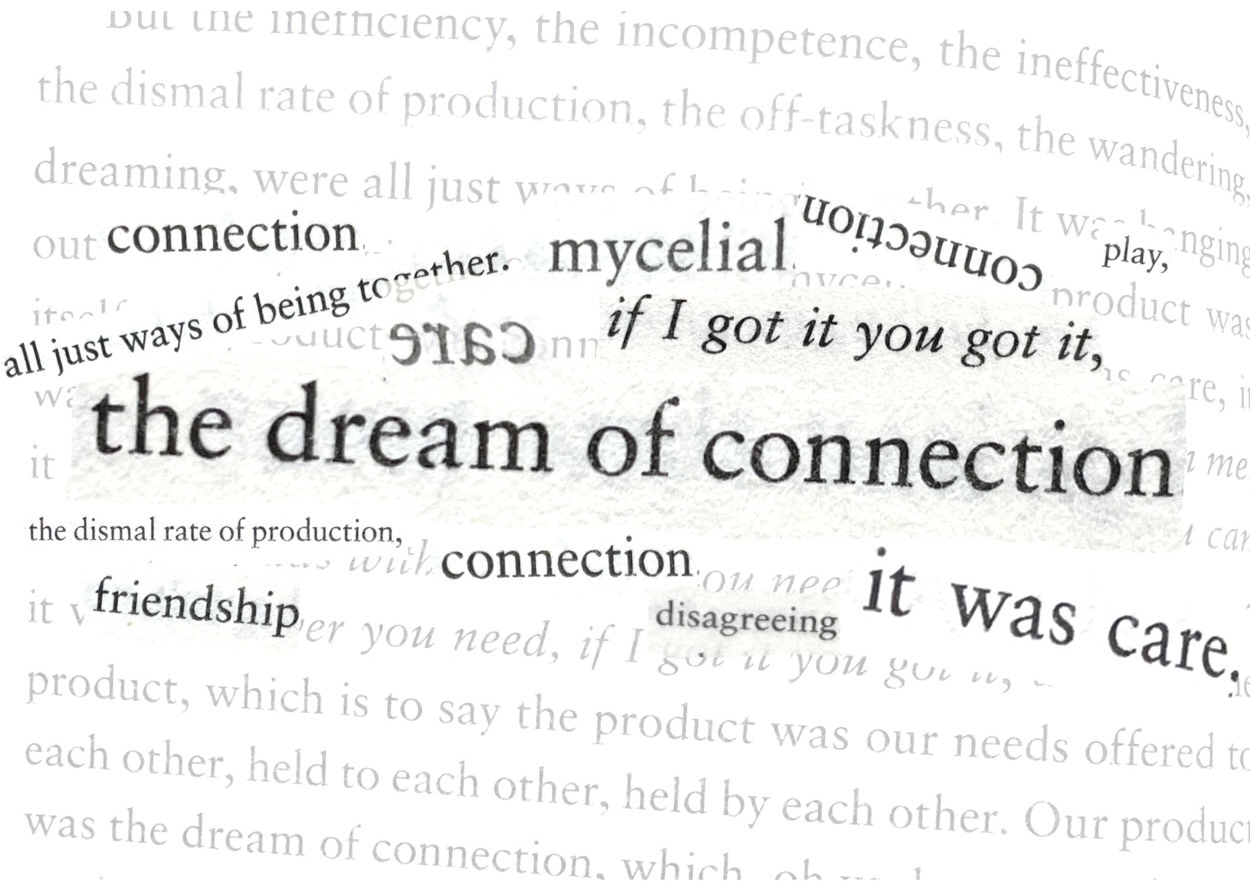
The inefficiency, the incompetence, the ineffectiveness, the dismal rate of production, the off-taskness, the wandering, the flabbiness, the consensussing, the play, the listening, the dreaming, were all just ways of being together. It was hanging out, it was growing closer, it was mycelial, its product was itself, its product was connection, friendship, it was care, it was I’m making jam on Saturday if anyone wants to join me, it was let me help with hauling the limestone, it was you can leave your kids with us as long as you need, it was take my car, it was whatever you need, if I got it you got it, that was the product, which is to say the product was our needs offered to each other, held to each other, held by each other. Our product was the dream of connection, which, oh yeah, we were living.
–from Inciting Joy, by Ross Gay (2022, p. 104)
Our goal in this paper is to move acts of connection and care from the unexamined, perhaps implicitly devalued margins of participatory research to the center. To the heart of the work, where, we argue, they already are.
II
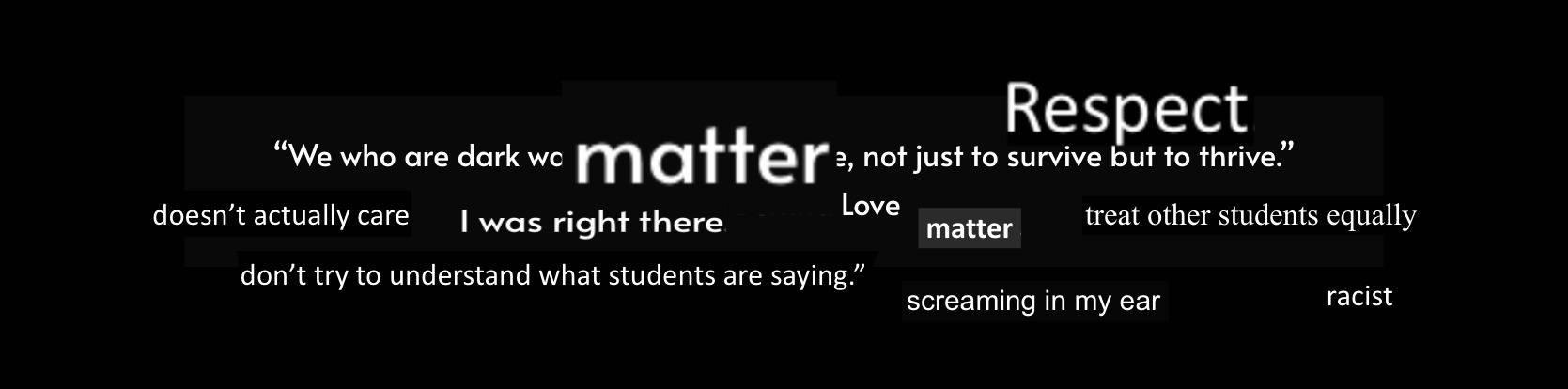
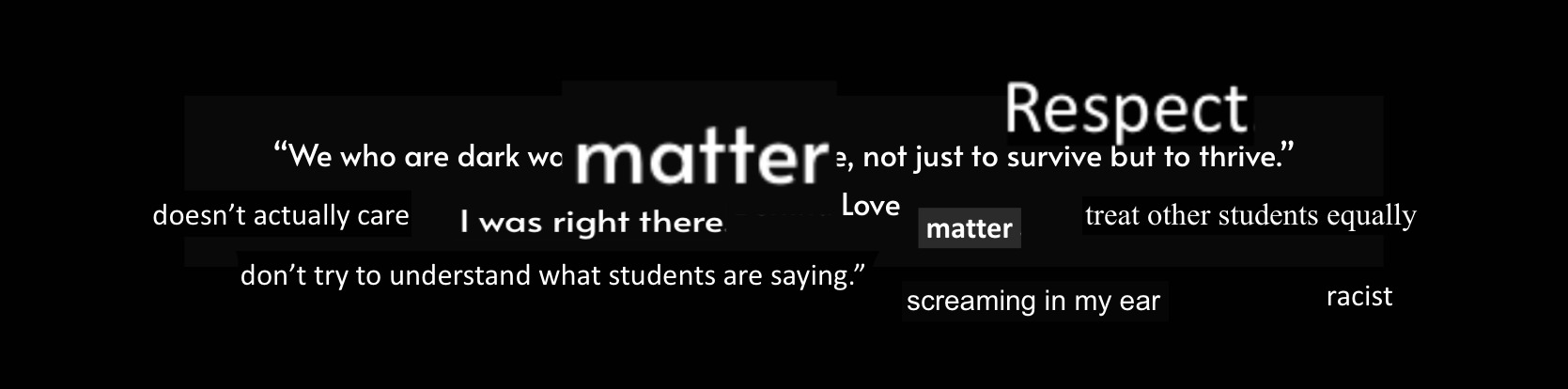
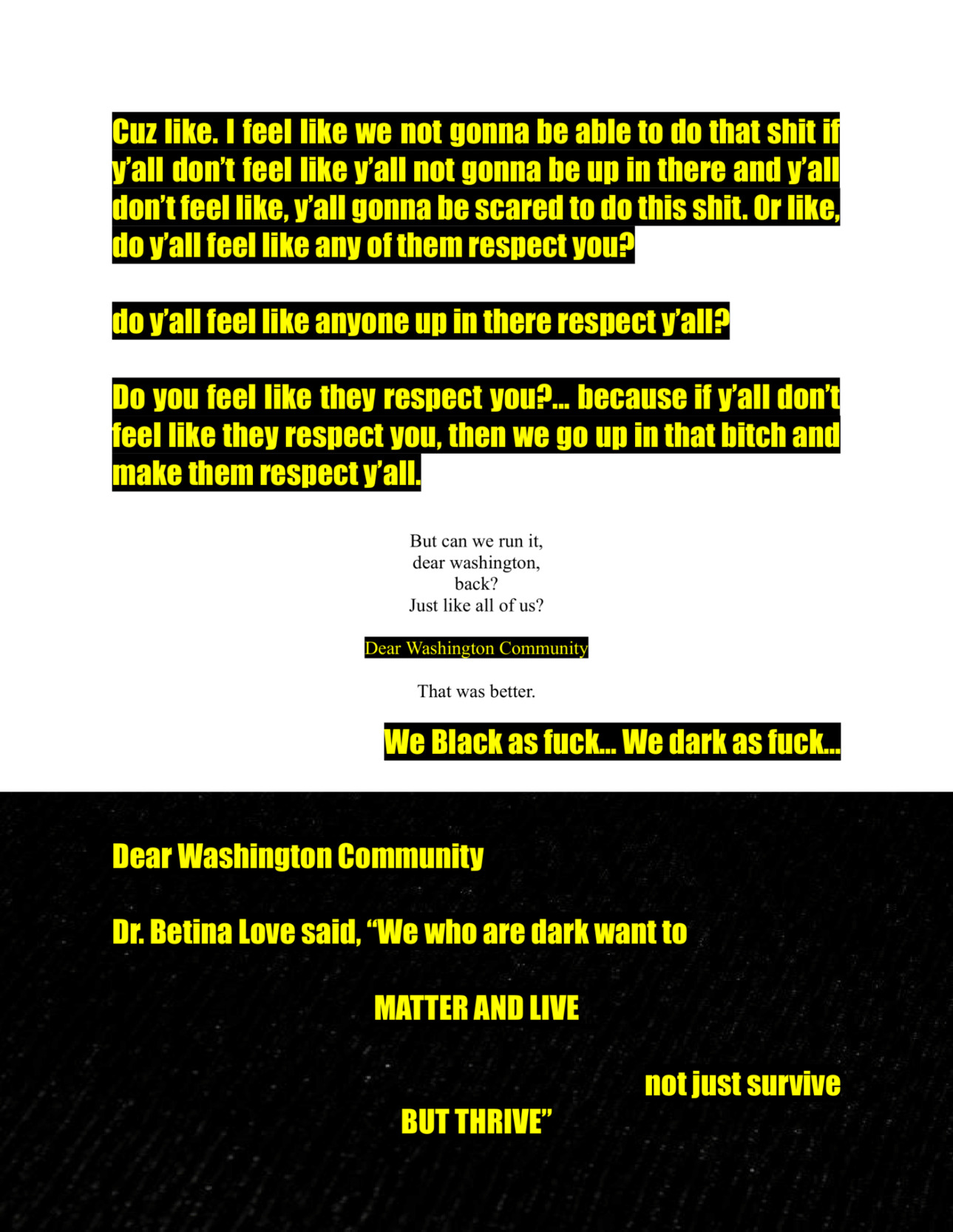
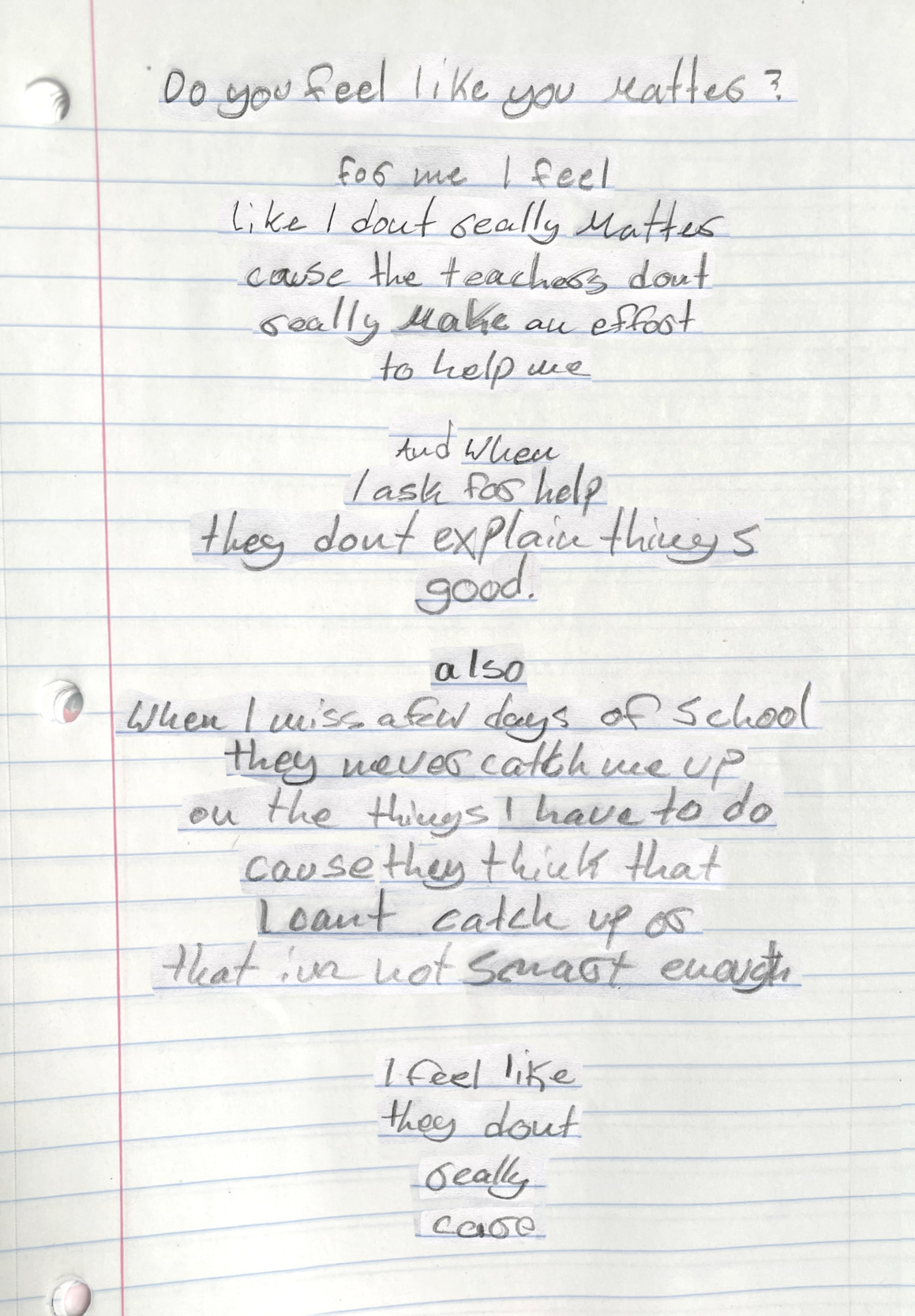
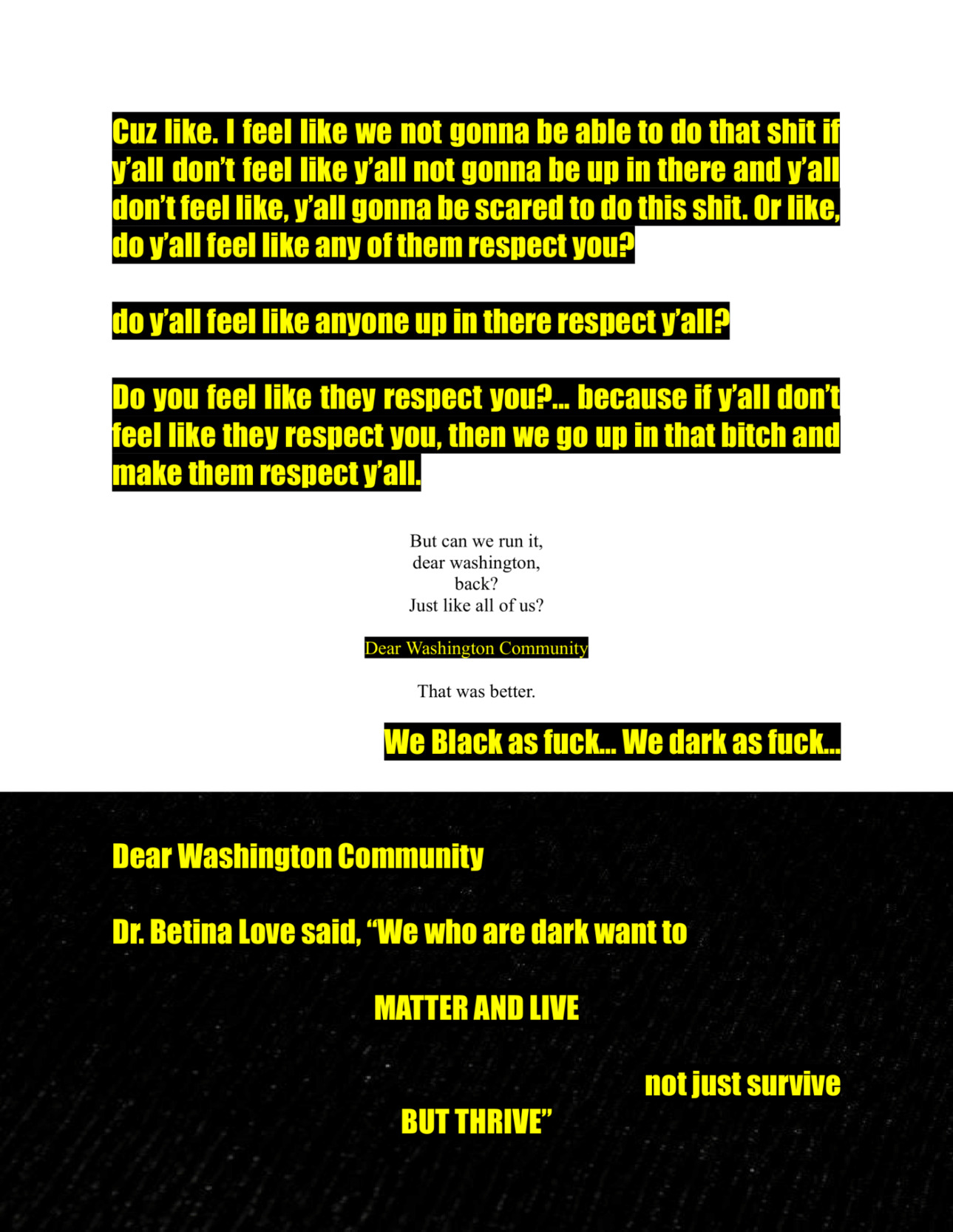
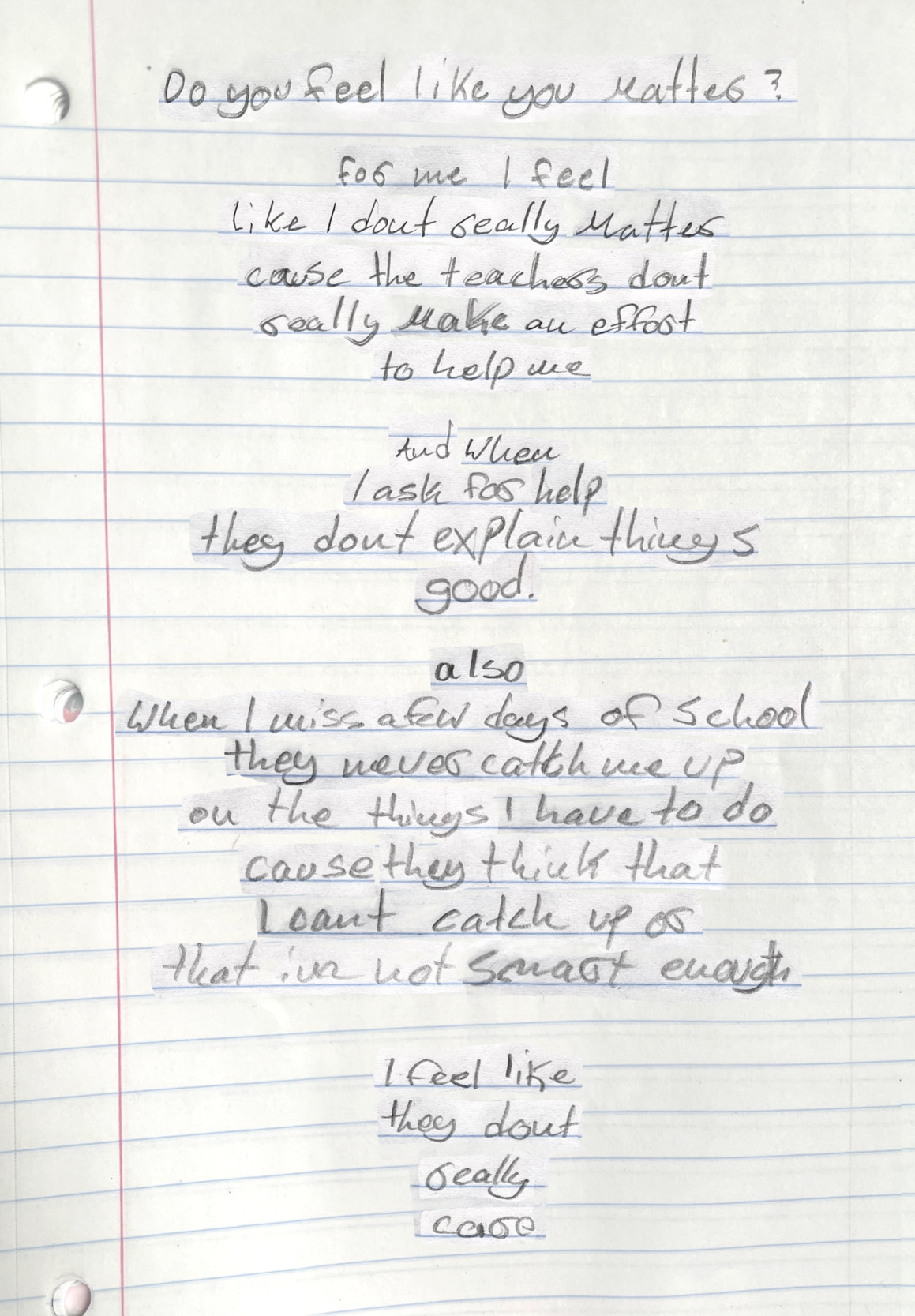
In an open letter to their school community, youth co-researchers on the project we report on here wrote: “We feel like we don’t matter because of certain people and experiences we have had during our time at [Washington] Middle School.” They went on to detail routine assaults on their humanity, ranging from peers’ casual use of racial slurs to teachers’ neglect, stereotyping, and harassment. A Black boy described being policed in the hallway by an adult on the “student support” team, who continued to yell “right in my ear” even after he explained that he was dizzy and on his way to the nurse. A young Latina described having her questions in class brushed aside, because teachers “think that I can’t catch up or that I’m not smart enough.” A Hmong girl shared how a teacher turned to her for help pronouncing words in Cantonese, a language neither she nor her ancestors spoke. These and the other stories in the youths’ letter add to the chorus of voices testifying that for students of color, schools are frequently sites of dehumanization (e.g., Dead Prez, 2000; Dixson & Rousseau, 2005; Gutiérrez et al., 2002; LaMotte & Wallace, 2016; U.S. Commission on Civil Rights, 2019). This underscores the pressing need for an ethic of care and connection both in schools and in education research with youth of color.
III
Participatory methods aim to address social problems in ways that center the knowledge, experiences, and agency of those most affected by the focal problems (Wilson et al., 2023). Such methods fit our project well, given our goal of “re-mediating” education for youth of color in U.S. schools (Gutiérrez & Vossoughi, 2010). In line with other participatory researchers, we view developing critical consciousness and promoting activism among youth as essential to this work, and we view young people as social actors who already have essential expertise (Cammarota & Fine, 2008; Ozer, 2017; Vines et al., 2025).
We argue that beyond conducting research and acting on findings, the practice of participatory research must include learning and enacting more humanizing ways to be together in a world that constantly challenges the fullness of our humanity. We endeavor to expand conversations about participatory research by articulating connection and care as some of the most important processes participatory work can provoke.
Connection and care are affective, social, political, and epistemological processes. They are located in our relationships and interactions with others. We feel them in our hearts, minds, and bodies. They can simultaneously reflect and bring into being power relations that are more egalitarian and more communally oriented than are typical in both formal schooling and research. All of this represents knowledge and ways of knowing that are too often devalued in favor of productivity and efficiency (O’Brien et al., 2022). As Gay (2022) wrote, “inefficiency … off-taskness … play … listening” can be vital “ways of being together,” of enacting care for one another and living “the dream of connection” (p. 104).
IV
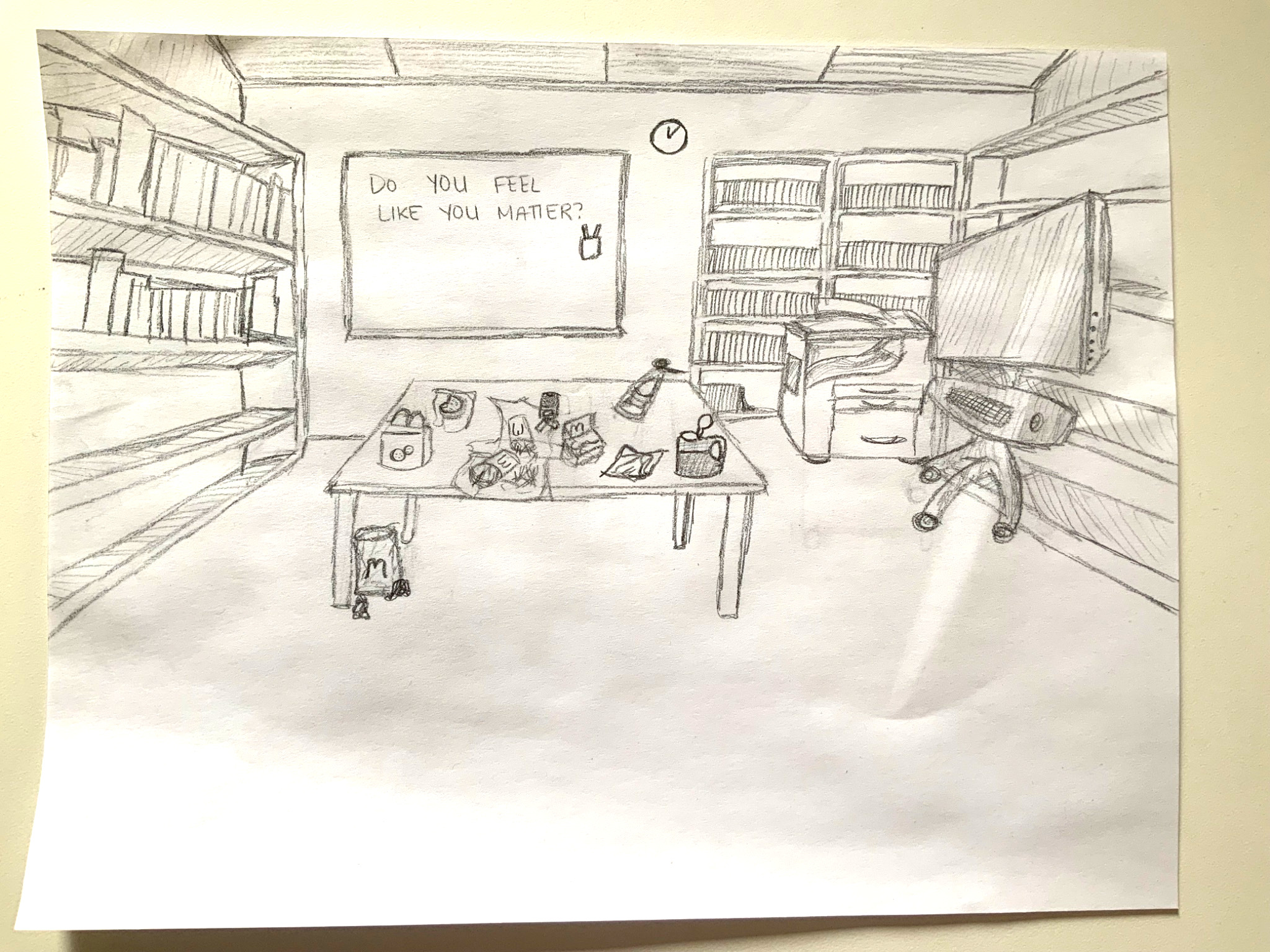
We draw on our experiences with a participatory project that was rooted in relationships and connections that spanned histories and communities extending far beyond linear or instrumental project boundaries. Committing to being pulled, pushed, changed by one another’s gravity was an act of care that made new, previously unimaginable trajectories possible.
The project had two phases. In the first phase, Nicole, Chundou, and Saron worked with a group of middle school kids of color as co-researchers and co-designers of what began as an initiative to advance equitable mathematics instruction at their school, which we call Washington (a pseudonym). Washington served nearly 800 students, the majority of whom identified as White, and it had a reputation as a “good,” high-achieving school. Yet Nicole’s experiences as a Chinese American in the U.S. Midwest and as a parent of a Washington student led her to have concerns about the experiences of students of color there. She recruited Chundou as a graduate student researcher on the project, not only because of their advisor/advisee relationship but also because of Chundou’s connections to the school community. As refugees fleeing the wake of the Secret War in Laos, Chundou’s family had settled in a neighborhood where many youth attended Washington, and Chundou had been working as a youth programs volunteer at the neighborhood community center as a way of giving back. Saron had also been working at this community center through Americorps, and Chundou recruited her as an undergraduate research assistant (rather than another graduate student, as Nicole had budgeted) because she was known and trusted by kids we had started to work with at Washington.[1]
Seven kids participated in the project: Javari, a Black boy; Rhyme, a Black girl; Maria, Elena, Ximena, and Ayleen, who identified as Hispanic and Latina girls; and Ashley, a Hmong girl (all pseudonyms). A teacher nominated Elena and Javari for the group. Chundou recruited Ashley and Ximena at the community center. After a few weeks, Ashley, Ximena, and Elena invited Maria and Ayleen to join the group, and Javari invited Rhyme.
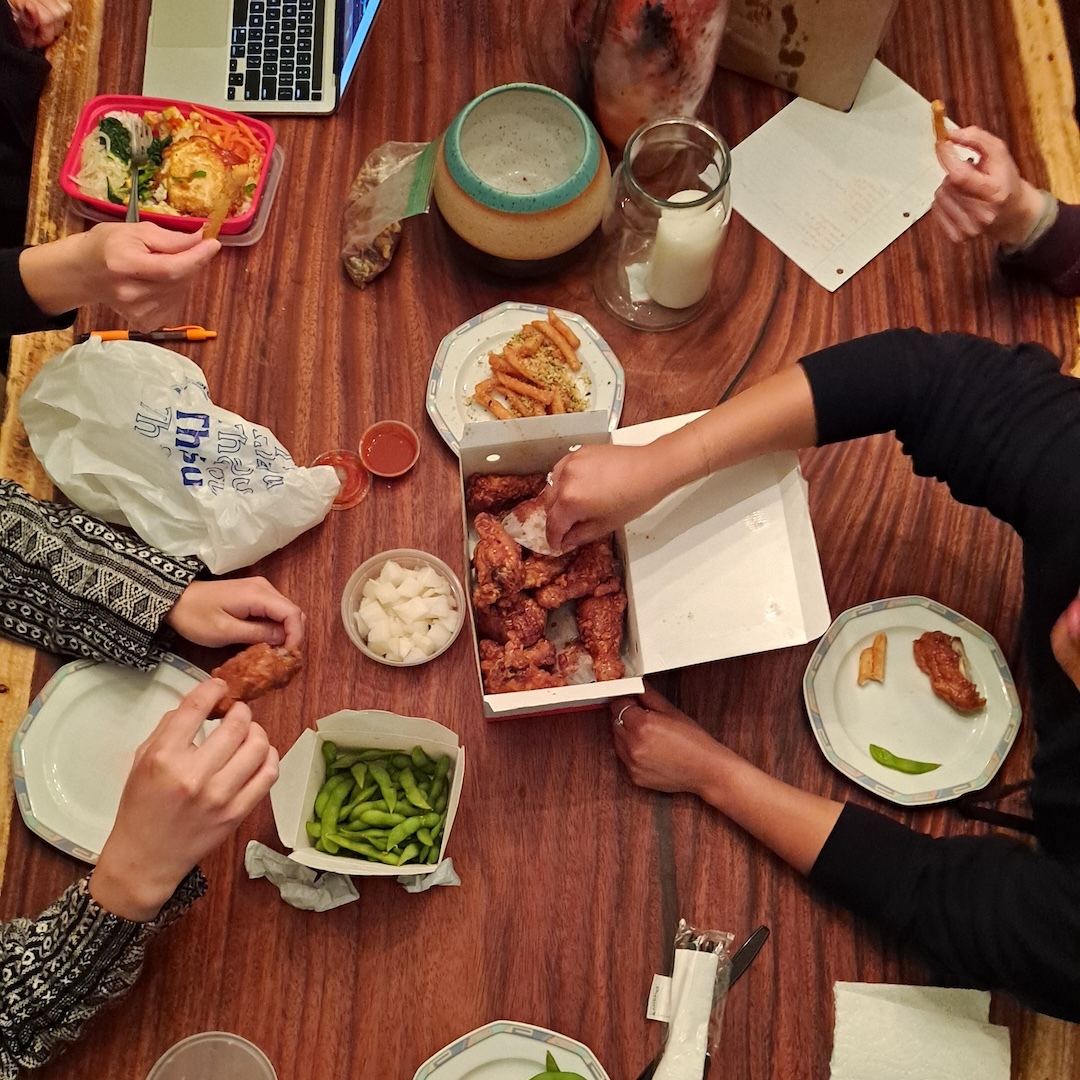
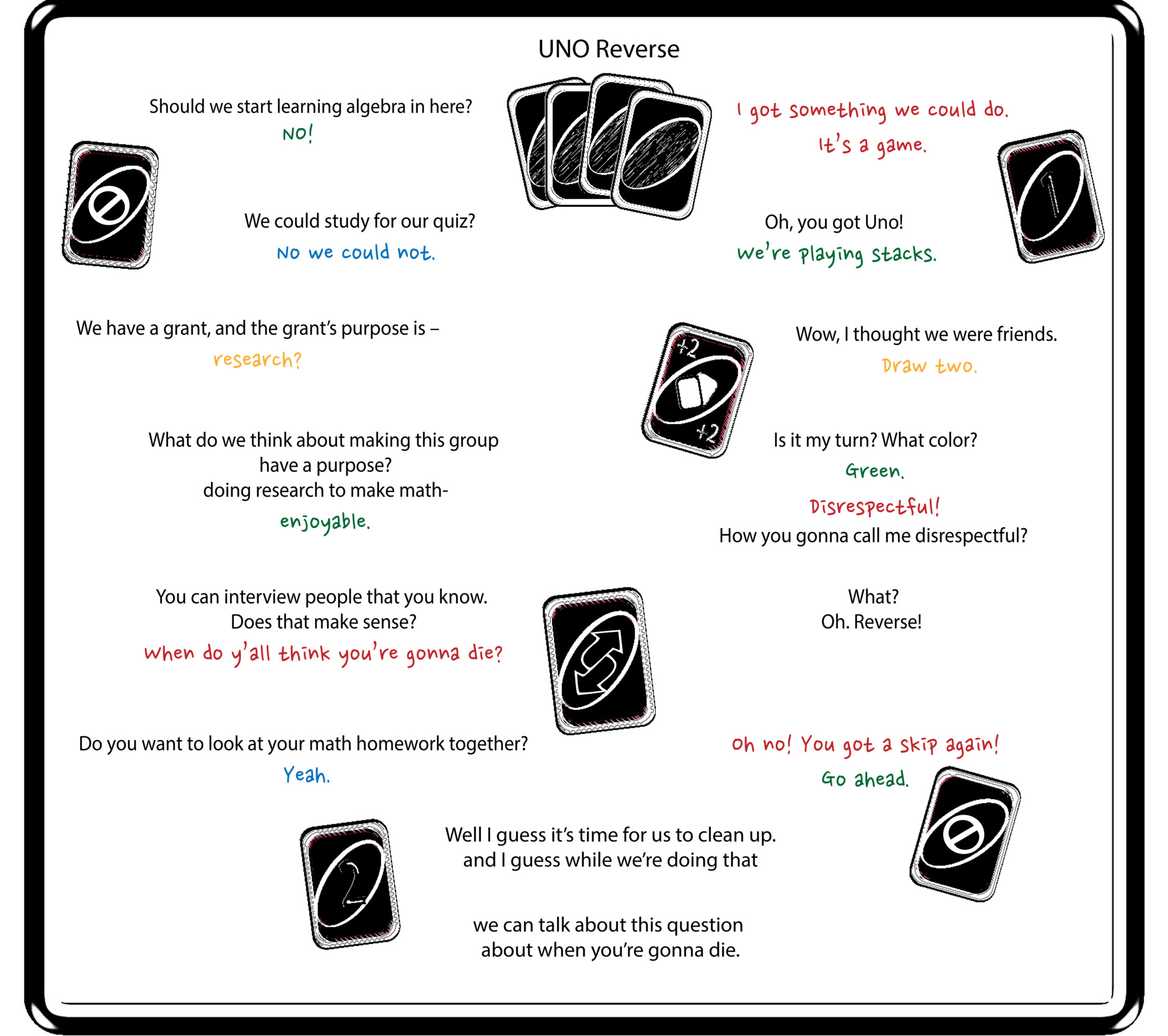
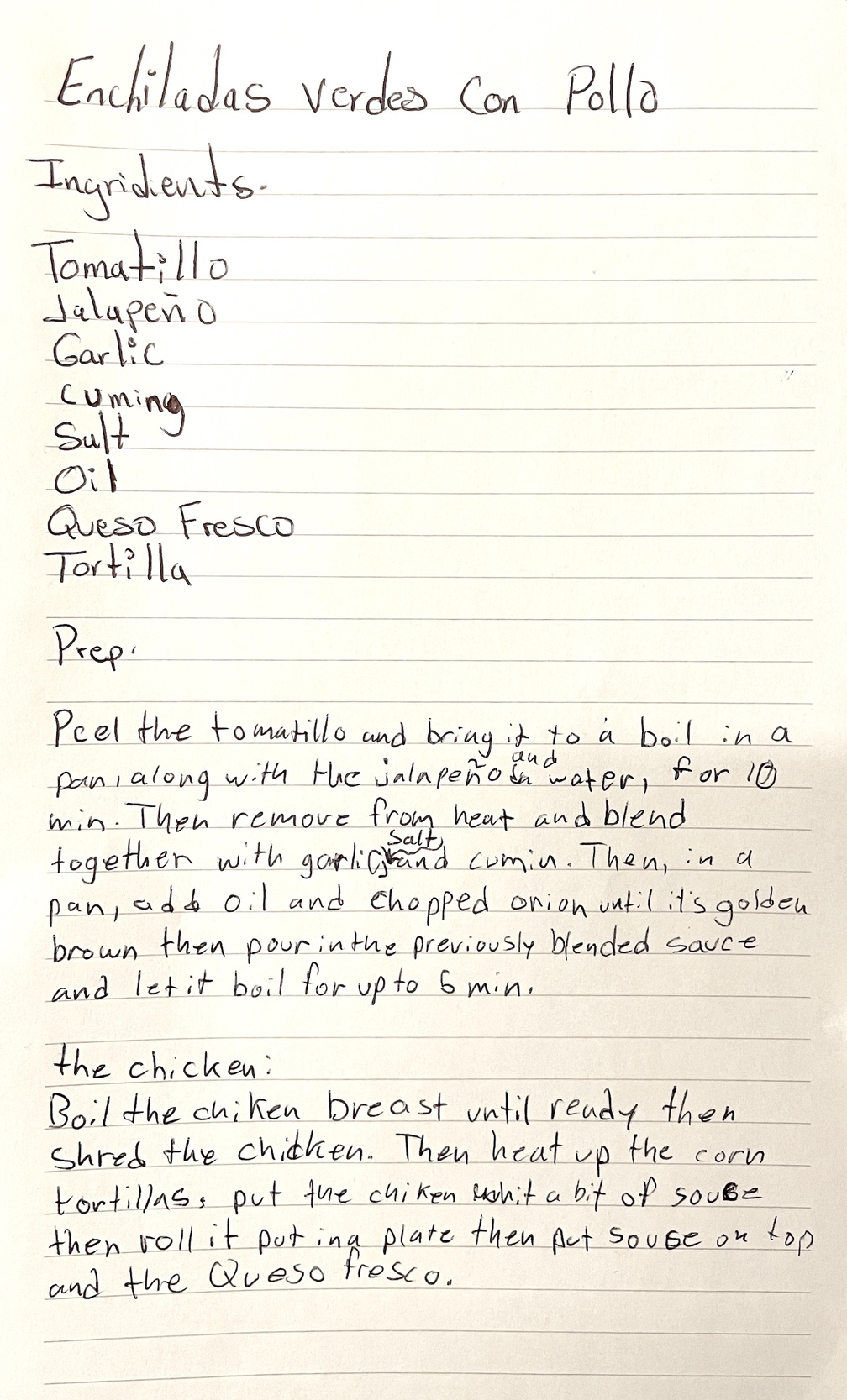
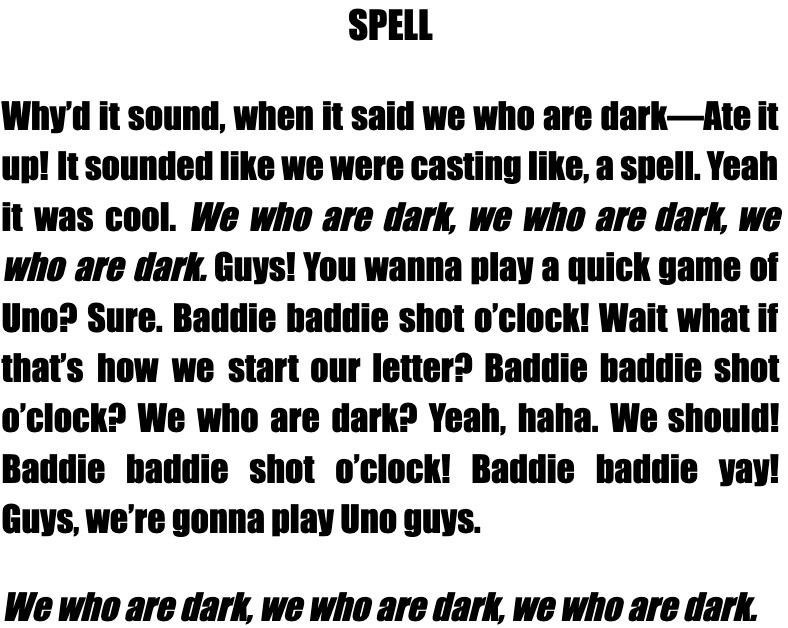
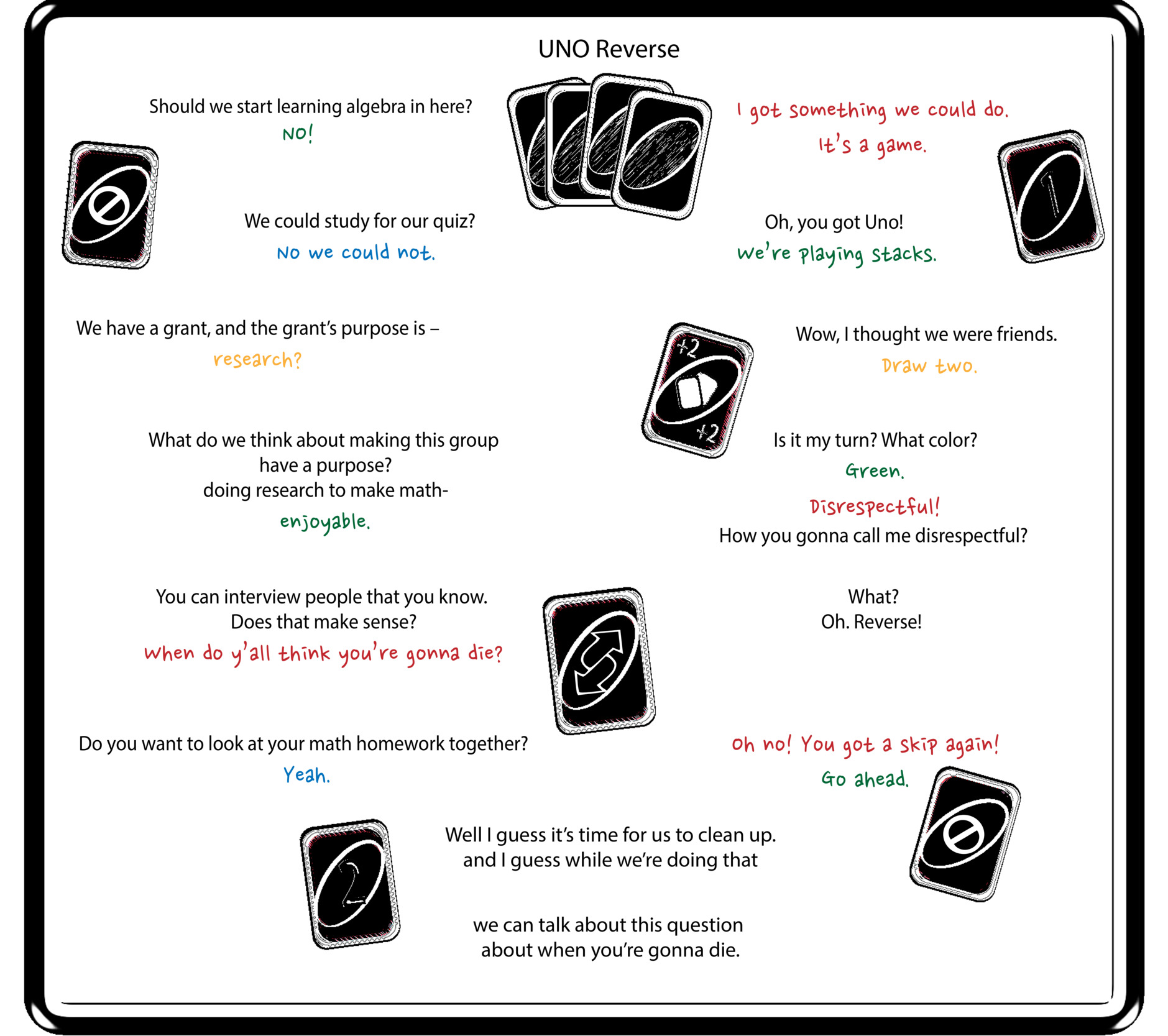
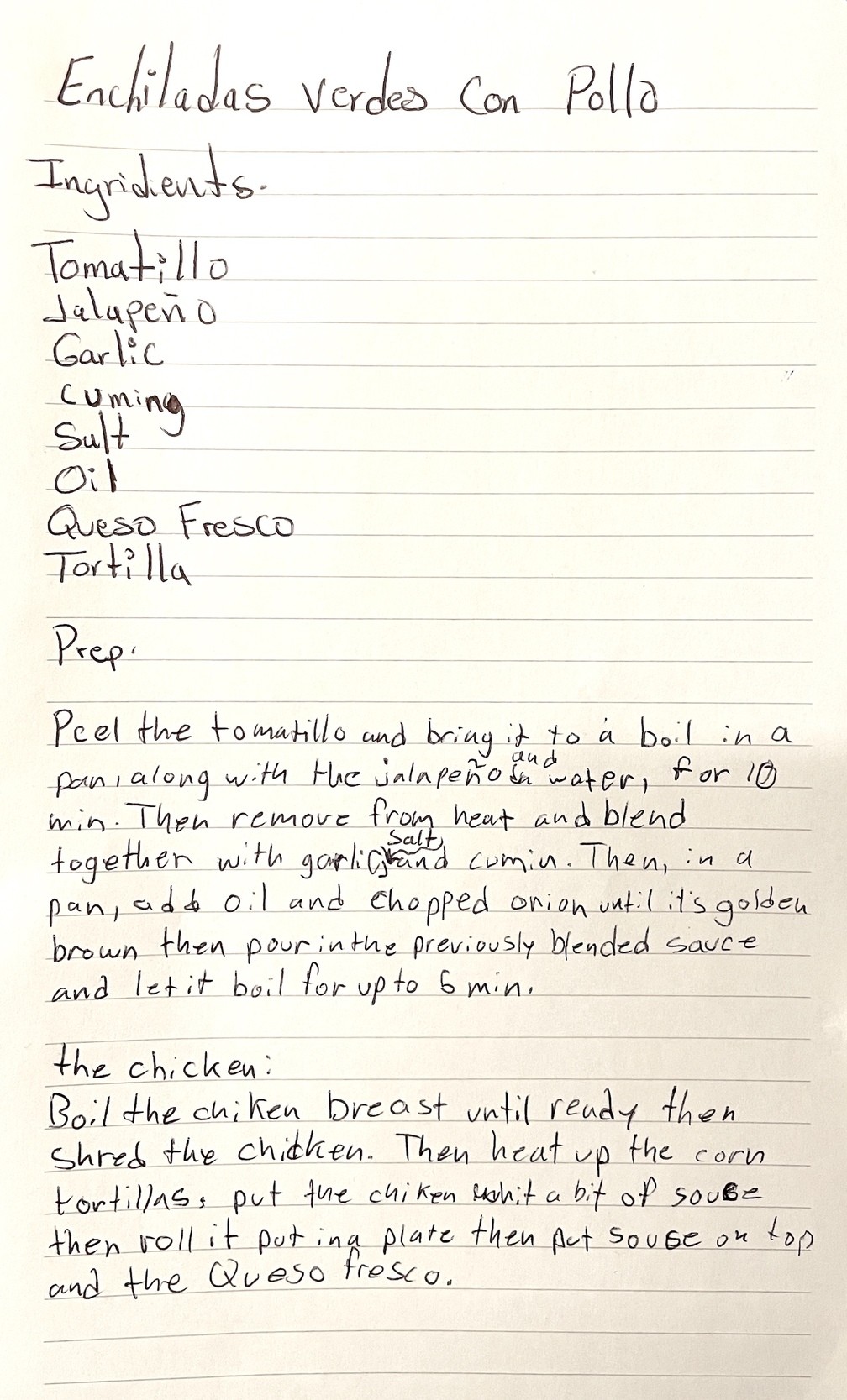
Our group met weekly at Washington for a year, during lunch and recess. In line with our participatory paradigm, the kids shaped our research focus, routines, and practices. They were free to come and go as they wished. In a previous collaboration, Nicole and Chundou had learned that we wanted our work with kids to be less like “doing school” and more like “dinner at auntie’s house,” drawing on experiences we had had growing up in large, tightly knit families (Hmong American in Chundou’s case, Chinese American in Nicole’s). In line with this desire, we brought sandwiches, fries, and cookies. The kids reciprocated, bringing their mom’s enchiladas, bags of Takis, and scraps from the cafeteria. Javari also occasionally brought games (a deck of UNO cards was his favorite). In this and many other ways, care flowed in every direction—not only from adults to kids, or from officially recognized “researchers” to research “subjects” (see also Farsakoglu & Djampour, 2021).
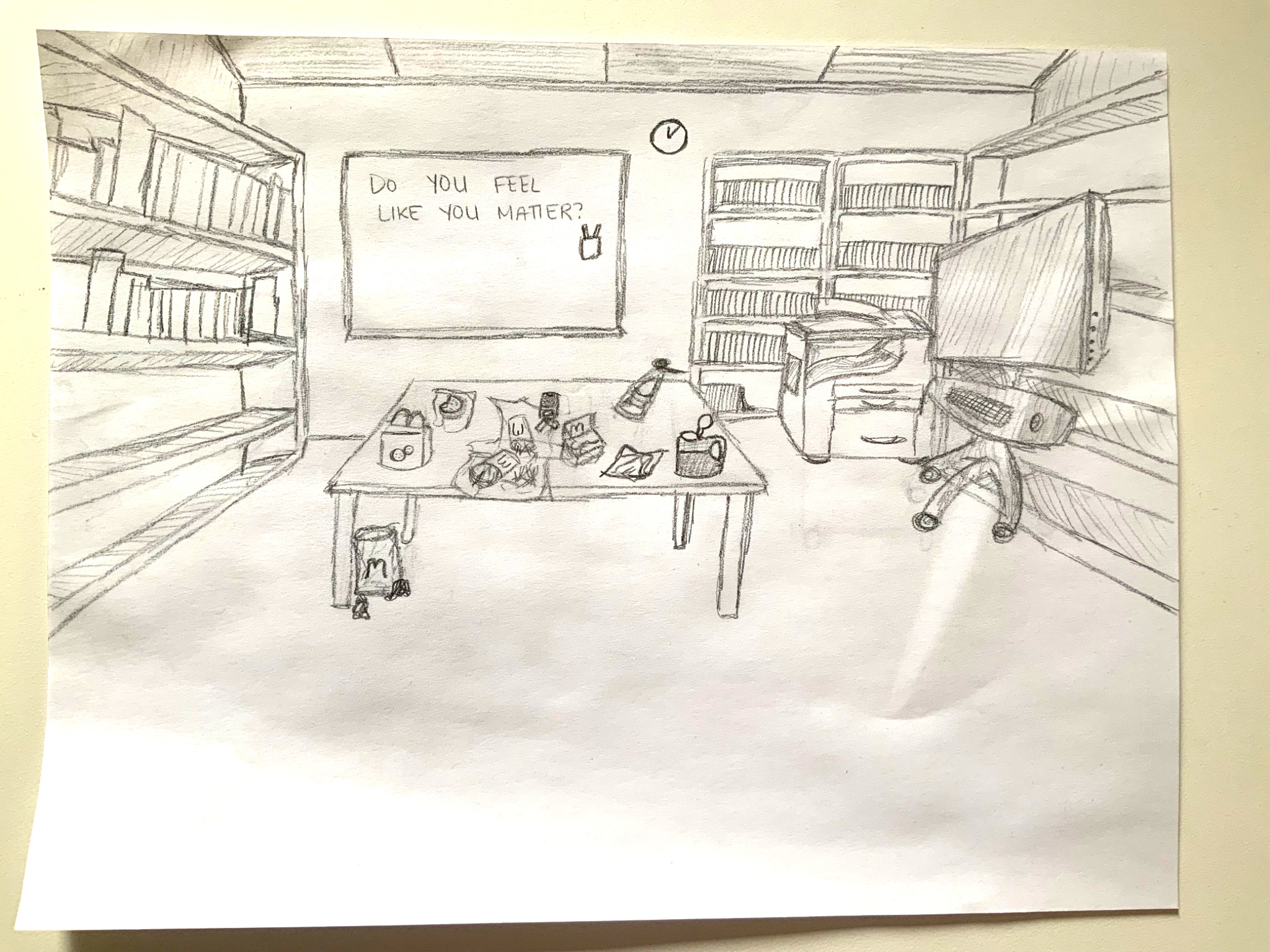
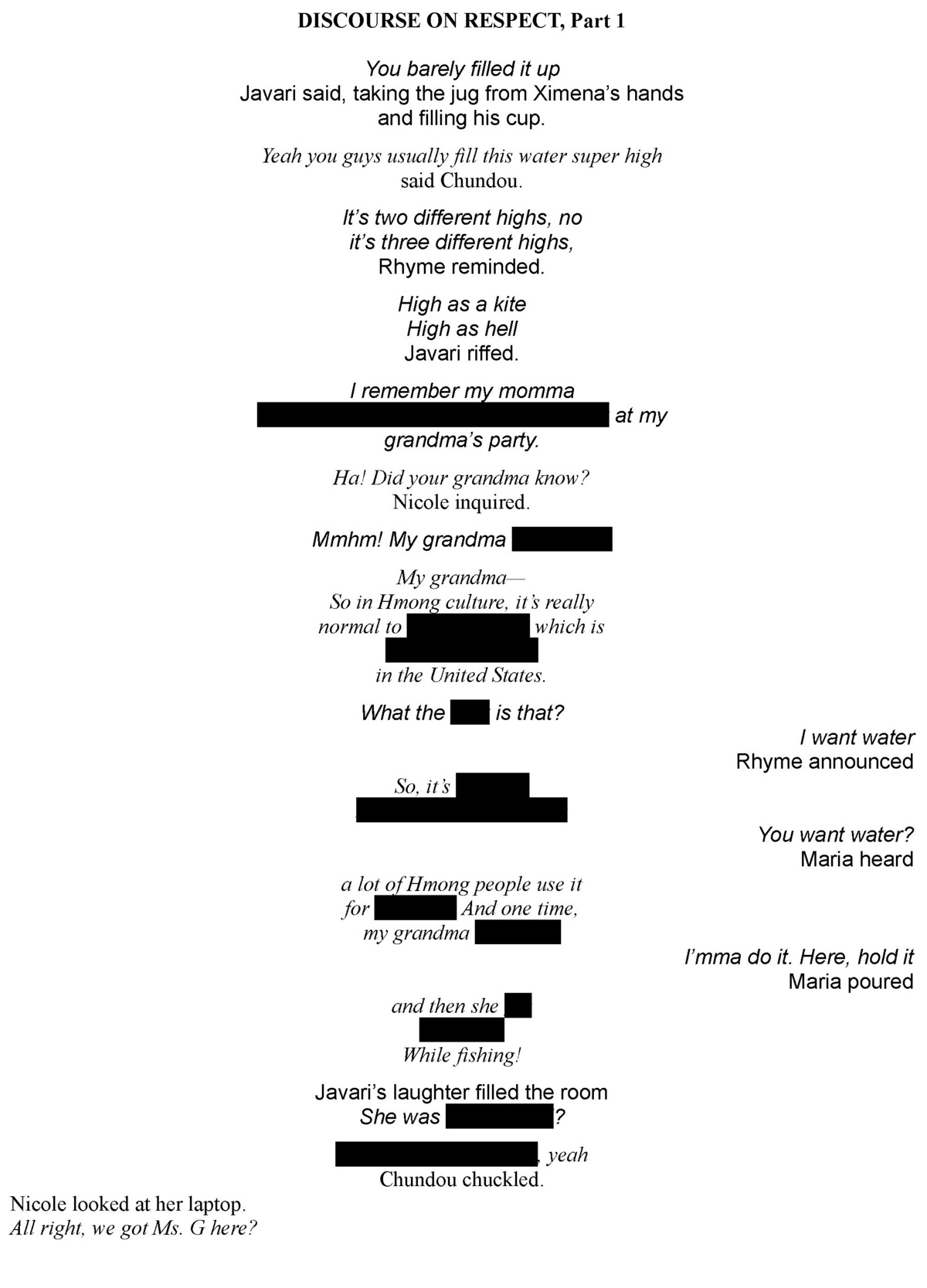
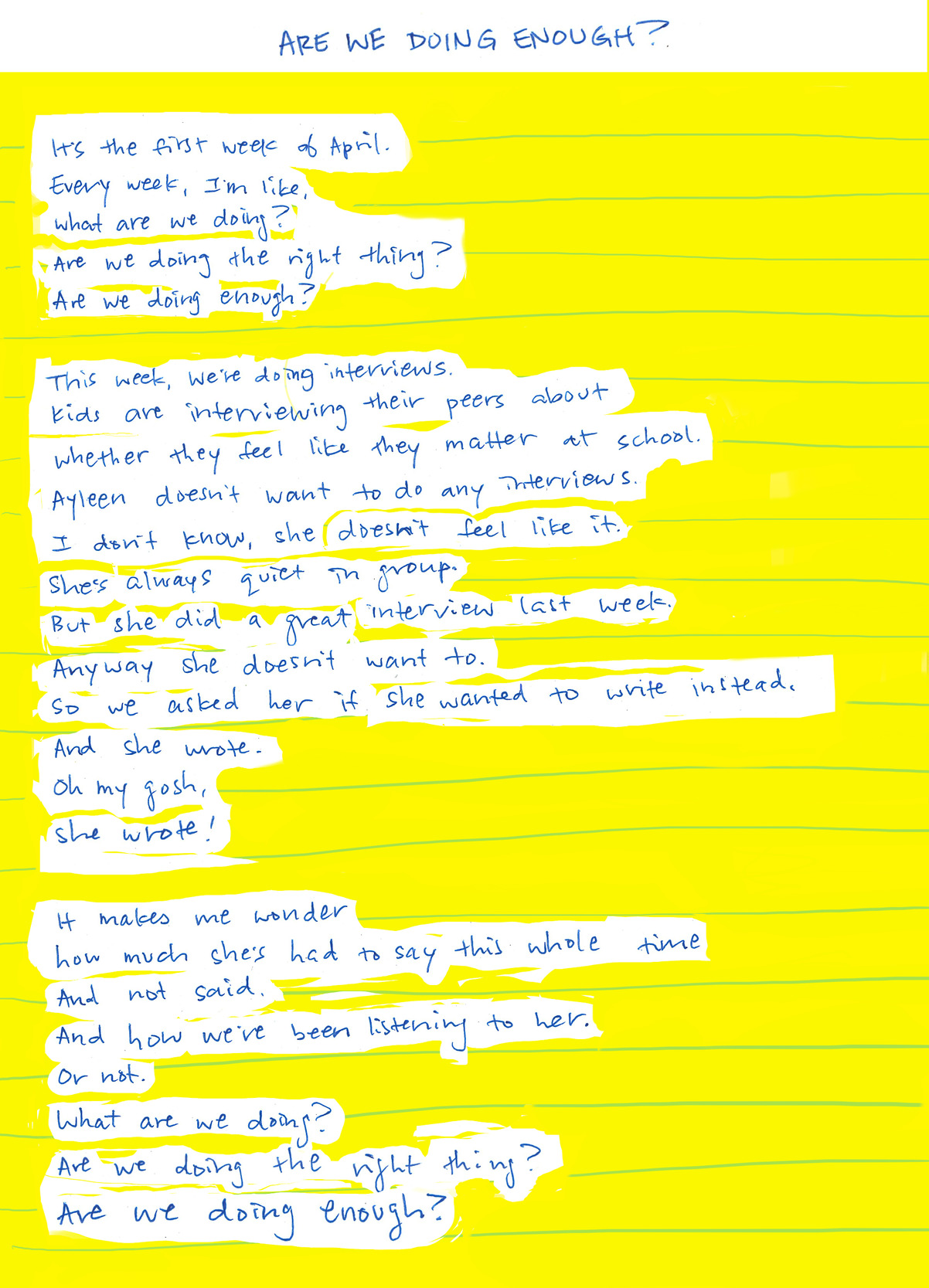
We spent a lot of time hanging out, playing UNO, getting excited about who was beefing with who, swapping stories about grandmas engaging in illicit activity, and sharing food. And, with our encouragement, cajoling, and technical support, the kids became co-researchers of “mattering” for students of color at their school (Love, 2019)—a focus that was more meaningful to them than the initial problem of equitable mathematics instruction (which had been rooted in Nicole’s background as a mathematics educator and mathematics education researcher). They co-designed and conducted interviews, wrote their open letter, and performed their letter in front of the principal. One way to understand the project would be to investigate its formal products, following the product-oriented approach that scholarship on community-engaged and participatory action research often takes (e.g., Cammarota, 2011; Raygoza, 2016). Without discounting such an approach, we focus here instead on the interactions and relationships within the team, not as means to other ends but as acts of resistance, transformation, and learning in and of themselves (see also O’Brien et al., 2022).
V
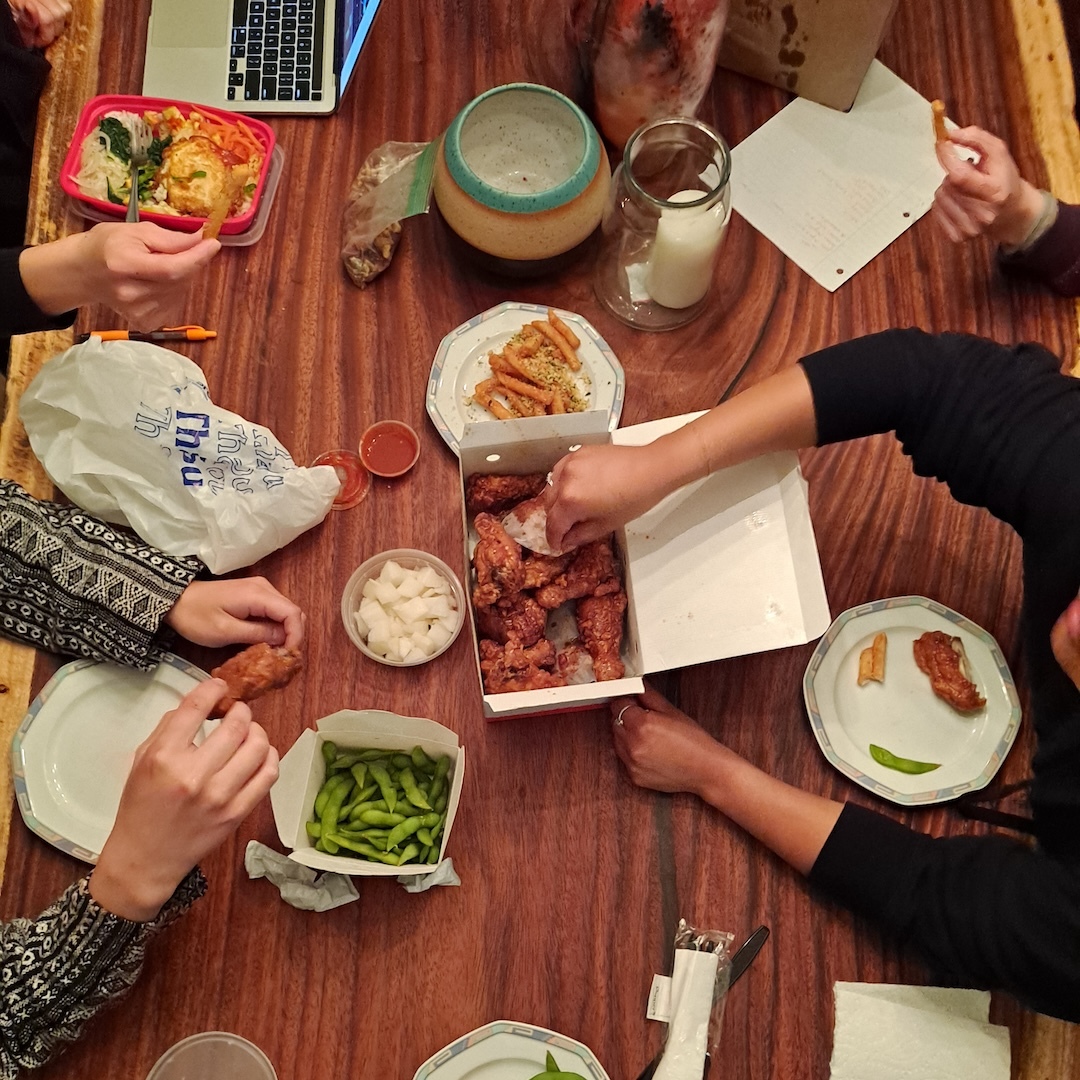
The second phase of the project—which focused on analyzing relationships and interactions in the first phase—echoed, mirrored, riffed off what we had done in the first, even as team membership changed. The kids graduated from Washington and mostly moved on from our project. Meanwhile, Carly, Rosanne, Sofia, and Siqi joined us for some initial discussions about participatory research, and all decided to stick around to analyze our data and write with us. They were all interested in learning more about participatory methods, and were all connected to Nicole in some kind of mentoring relationship. And all were looking for a research community. For several months, the seven of us (eight, if you count Carly’s baby) sat around Nicole’s dining table eating za’atar spiced popcorn and chocolate chip cookies, talking about the range of outcomes participatory research can produce and the types of relationships it can foster—transactional, instrumental, mutually supportive, affirming, pedagogical, anti-hierarchical, and/or transgressive, breaking the usual rules of school and research. We read articles, shared stories, played with the baby, analyzed audio recordings and transcripts of the Washington team’s meetings, and co-constructed the poems we present here as well as many others. Our connections to each other helped us make potentially risky moves, such as choosing to focus on something as “soft” as care, questioning each other’s interpretations of our data, and experimenting with poetry.
Thus, care and connection were gravitational forces that oriented us to each other and to our work throughout our time with the kids and our later analysis and writing. On the scale on which our project operated, care and connection were not sufficient to achieve systemic change. Nor were they always tidy or straightforward to enact. But they were vitally necessary to our efforts to bring another world into being. Our goal here, we repeat, is to move acts of connection and care from the margins of participatory research to the center. To the heart of the work, where, we argue, they already are.
VI
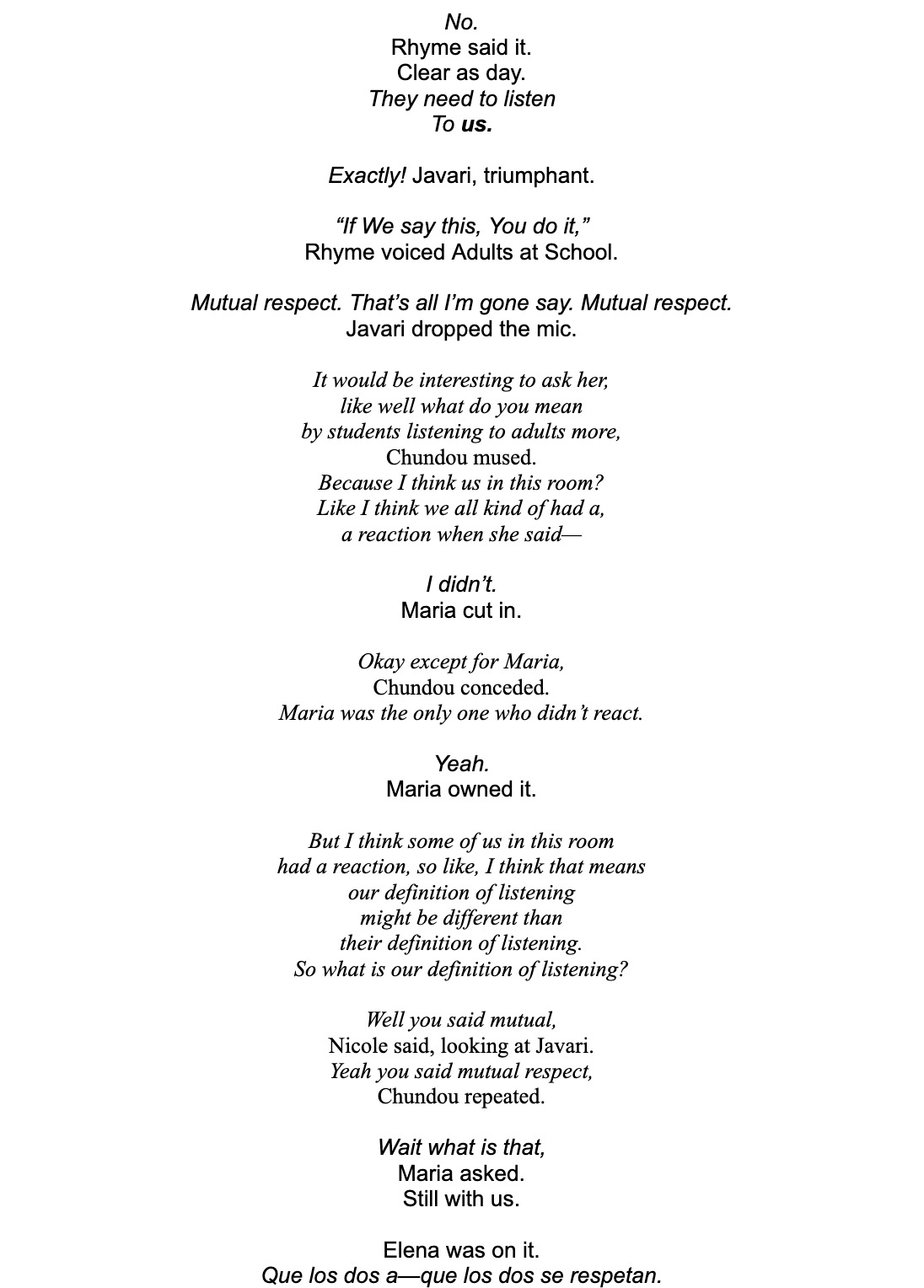
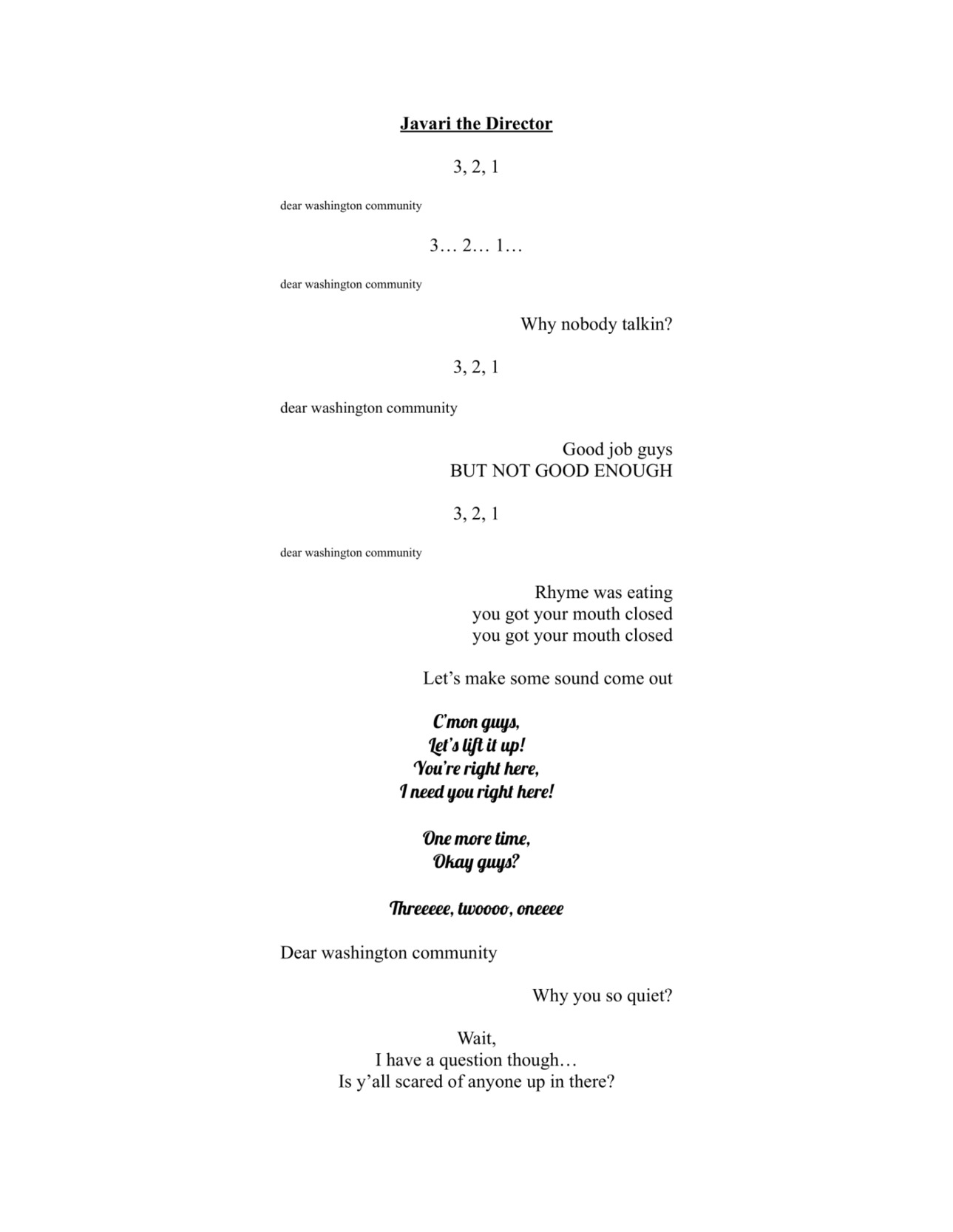
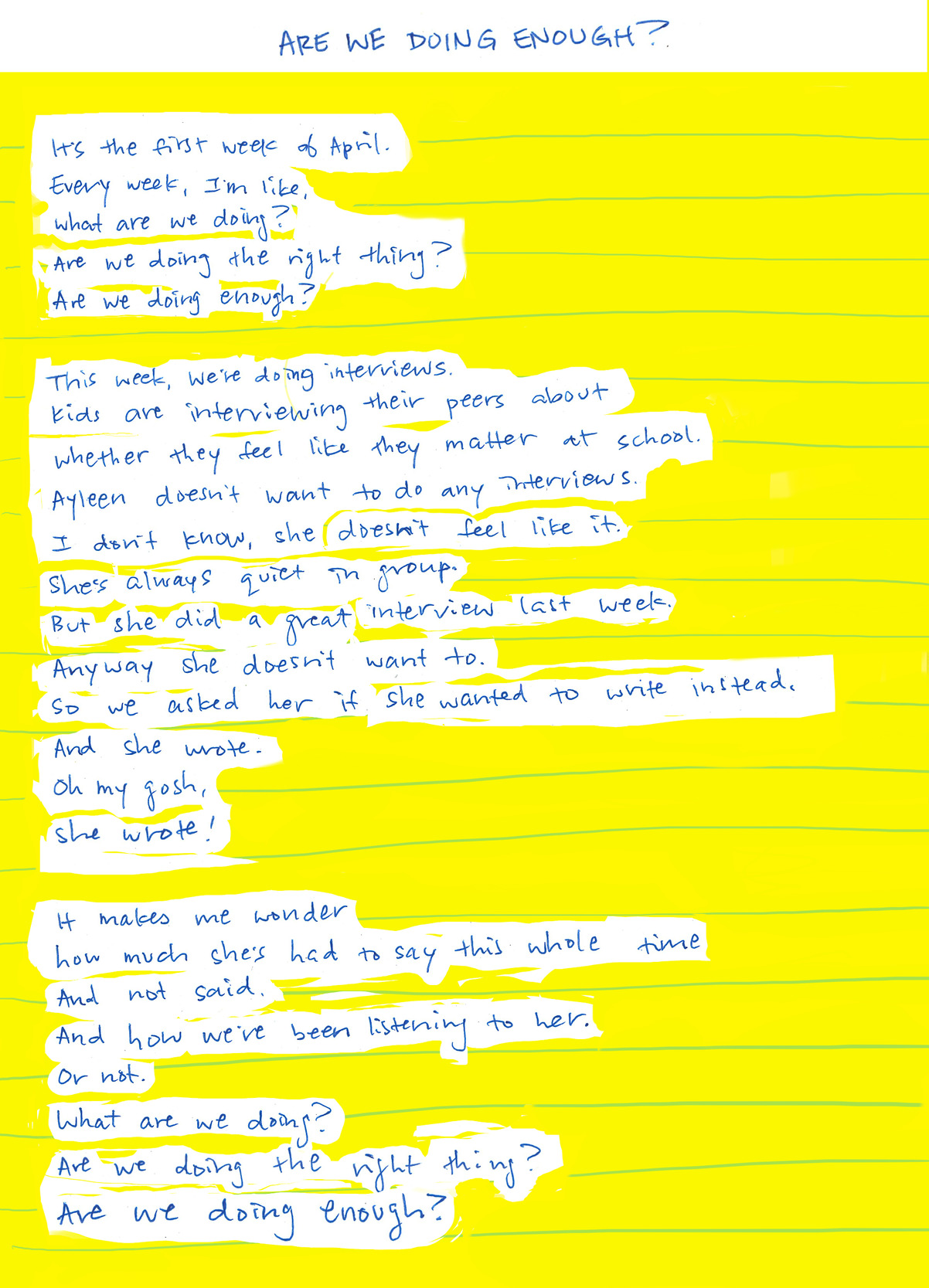
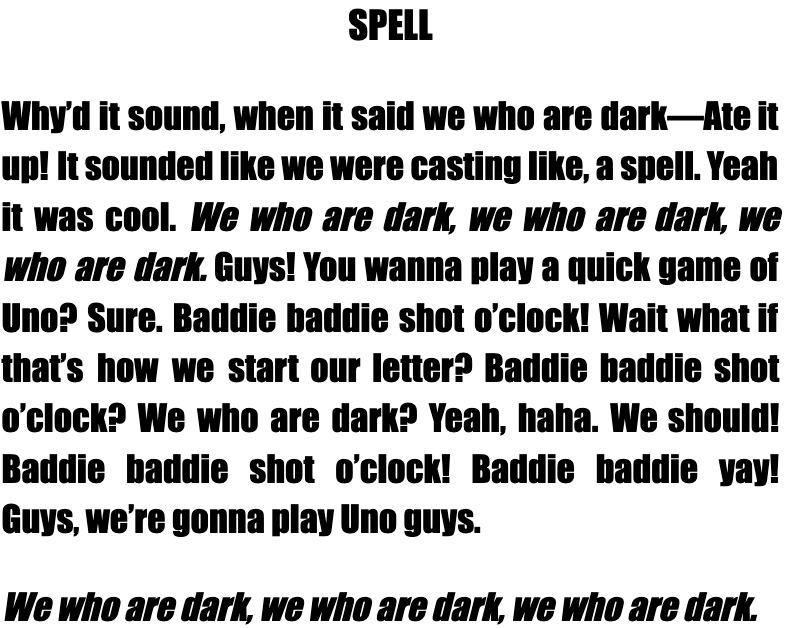
We present our meditations on connection and care as they manifested in our participatory work with the kids through a collection of poems. We constructed our poems through a process of poetic inquiry (Prendergast, 2009), drawing on audio recordings, transcripts, and other artifacts from our work at Washington. We shared the poems with youth co-researchers we had kept in touch with (Maria, Elena, and Javari), asking if they felt that the poems represented their experiences of care and connection in our group accurately. They all agreed that they did. Javari’s response was itself poetic:
reading this, I had one word in my mind
and it was right
I felt that word
through every single word
down to the period
I don’t know how
you were able to capture
so many feelings
in your words
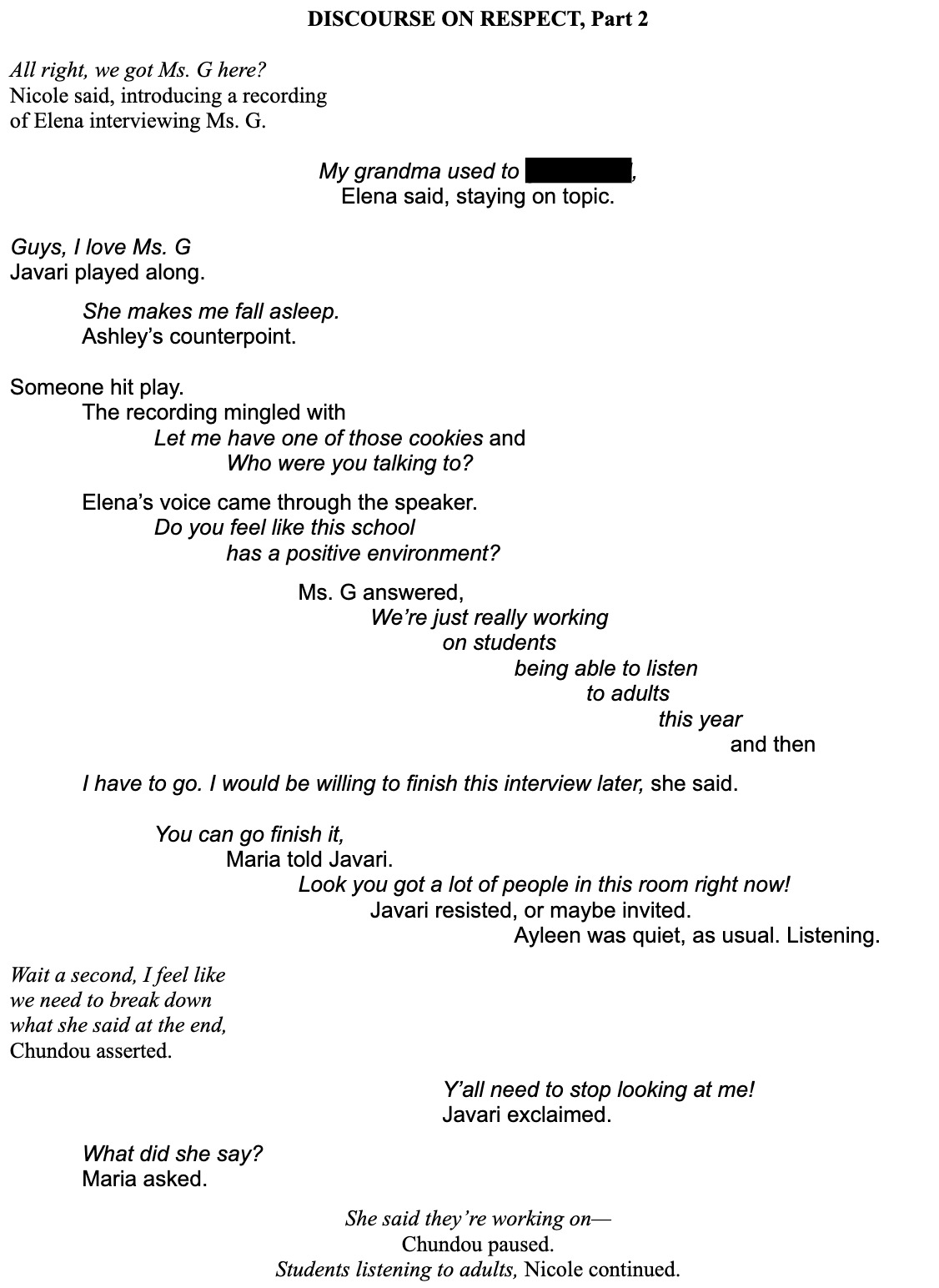
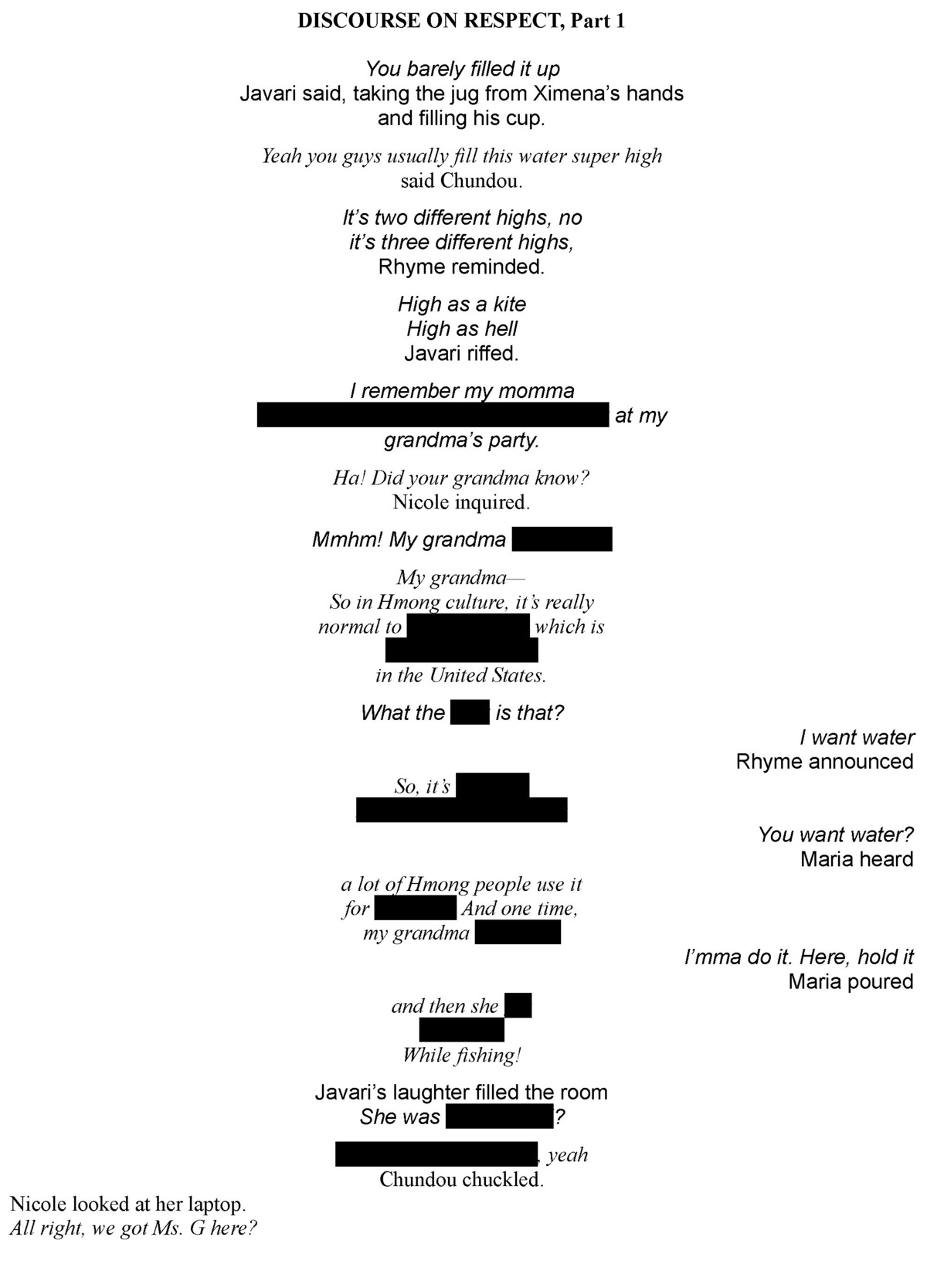
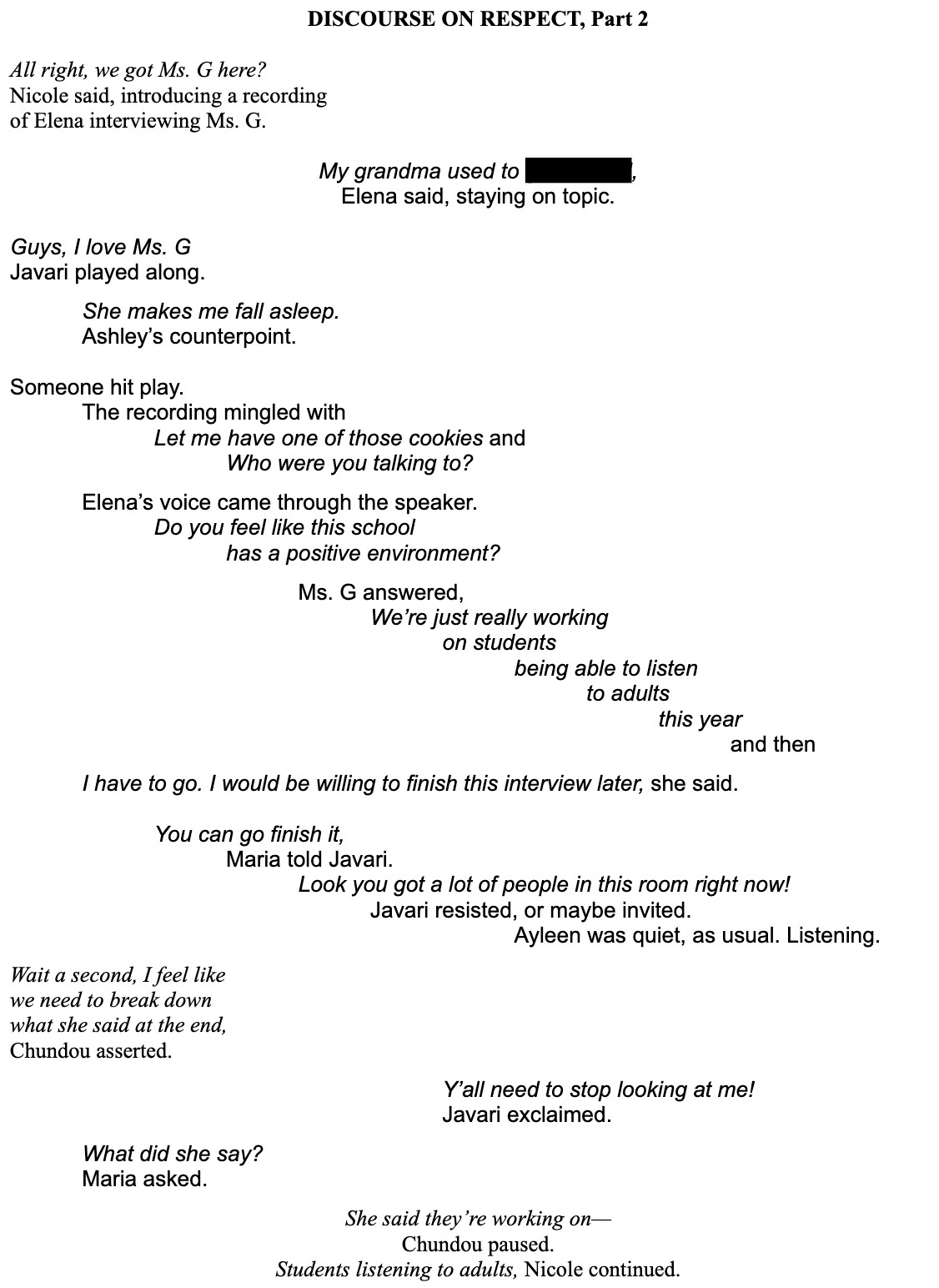
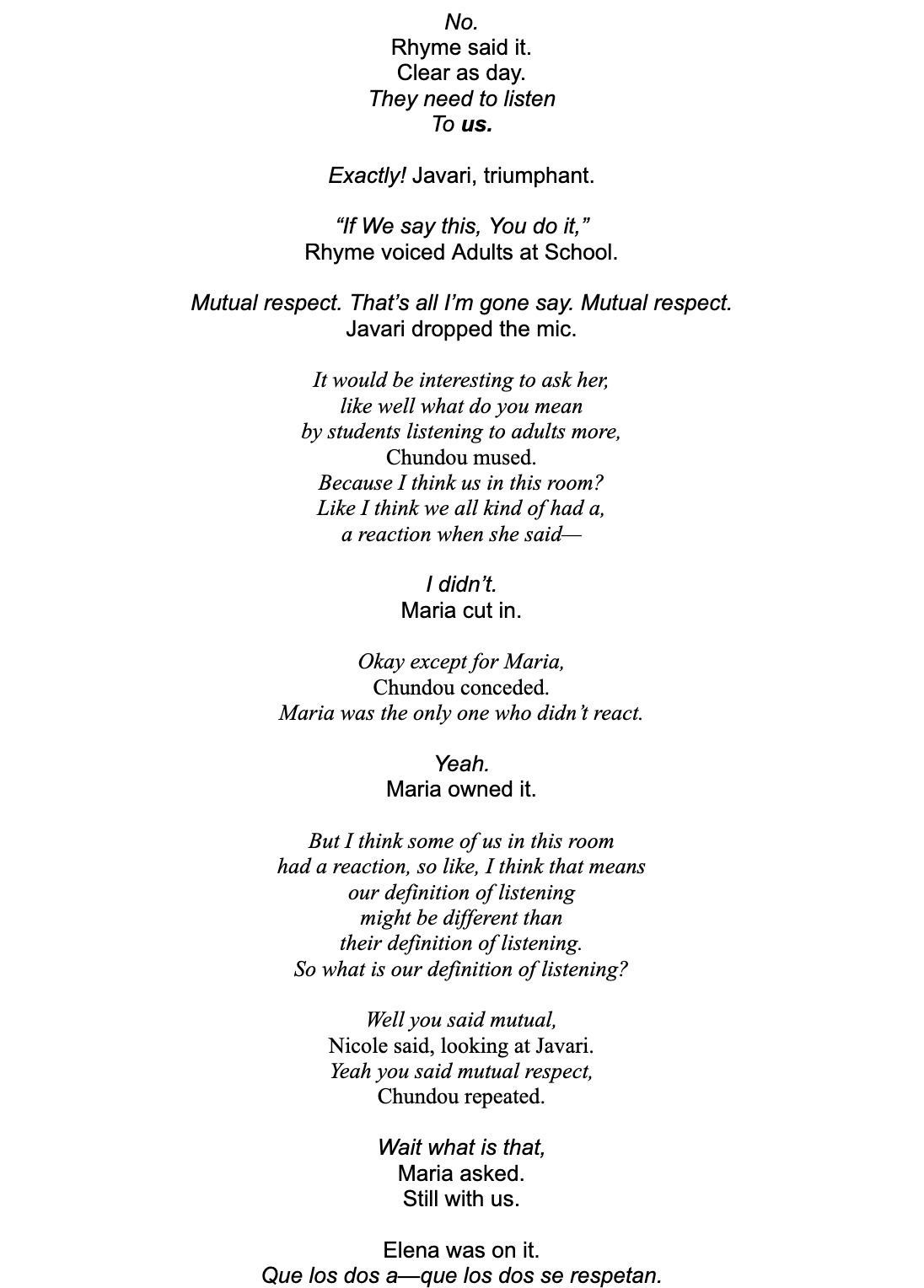
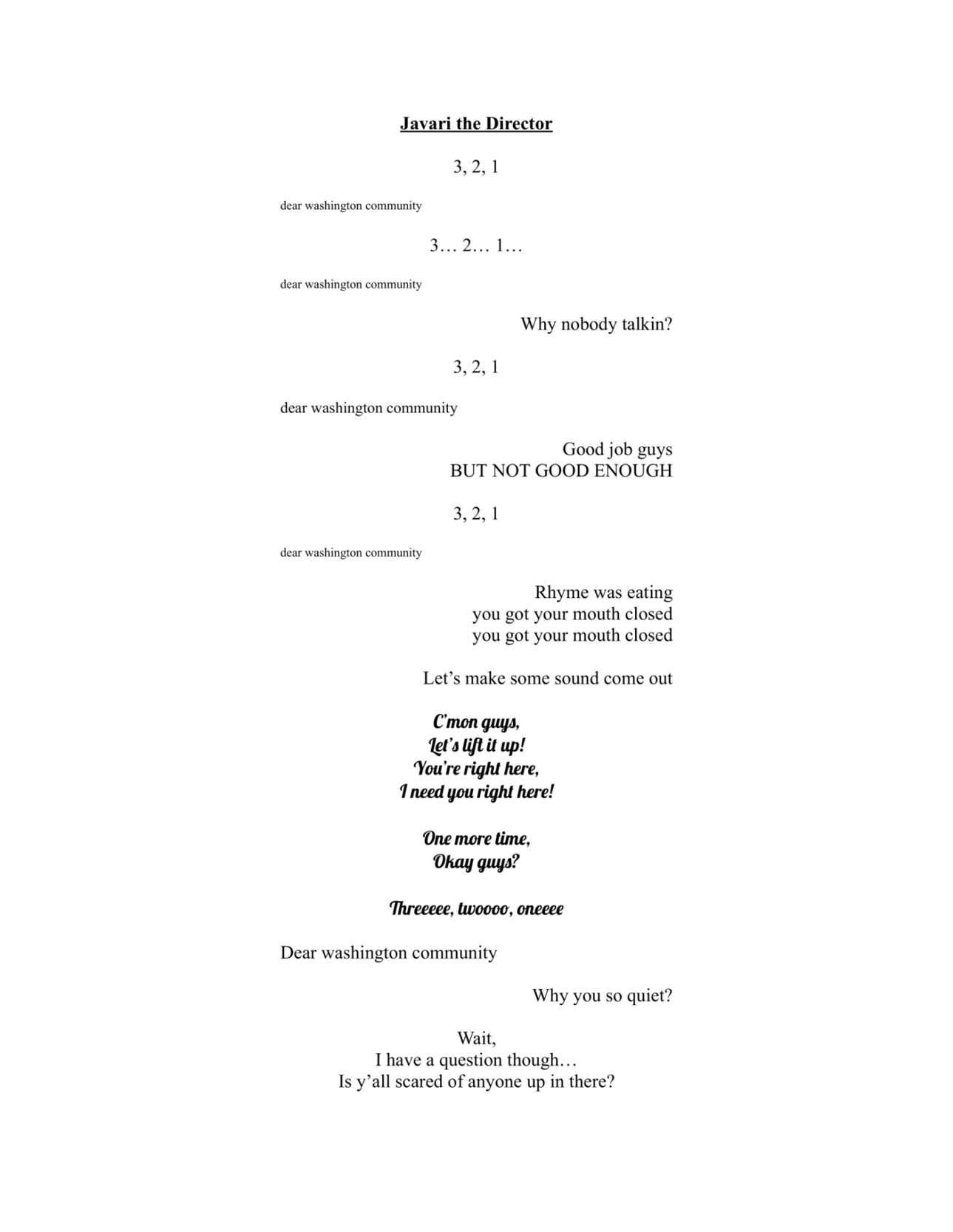
With these poems, we attempt to convey various ways that both adults and youth actively participated in extending care to and forging connections with one another, from sharing food, games, and vulnerable experiences, to leading activities, to listening well.
We chose to use poems for several reasons. First, as Audre Lorde (1984) wrote, “It is through poetry that we give name to those ideas which are, until the poem, nameless and formless—about to be birthed, but already felt.” Speaking in particular about women, as a queer Black woman herself—that is, speaking about those whose knowledge and power have been subordinated, pushed to the margins, denied—Lorde wrote, “The farthest external horizons of our hopes and fears are cobbled by our poems, carved from the rock experiences of our daily lives.” Similarly, Shawn Ginwright (2008), citing Robin Kelley, has articulated poetic knowledge as an “‘emancipation of language and old ways of thinking’ that ruptures banal and mundane experience of struggle and in doing so reveals insight and ways to imagine a new social order.”
In addition to accessing felt but as yet unnamed ideas, creating emancipatory knowledge, and imagining a new social order, poems provide a way to convey truths about layered and non-linear phenomena, centering transmodal qualities of “form, intensity, rhythm, and movement” (Petitmengin, 2007, p. 64) that make up the nature of felt experience. To find the poetry inherent in the words of conversations is to lift and reinvigorate the vibrancy of a moment lived together. We invite readers to let these poems wash over them, allowing the analytic stance typical of social science to dissolve, letting feeling come to the fore.
An audio version of the poems, inspired by Petchauer and Brown (2023), is available in the Supplementary Files. We encourage readers to access it for a different experience of care and connection in our work.
VII
VIII
IX
X
XI
XII
XIII
XIV
XV
Our intention is that our poems should stand on their own. Our goal with them is to portray diverse forms of connection and care in participatory research, and to convey their weight and value. We encourage others who work in participatory paradigms to ask themselves how they are making room for connection and care in their own research, not just as means to other ends but as manifestations of the social transformations participatory work aims toward. We encourage allowing conversations to wander, making space for many forms of participation, and attuning to one another, recognizing that different people experience the work differently.
Finally, we hope we have connected with you, dear reader, in a field of words, yes, words / and feelings / textures / moods / for which words are but shadows / gestures toward / light.
Author Note
The Mattering Collective is an intergenerational group concerned with what it means for children, youth, and families of color to matter in schools. Nicole Louie1 convened the group. Its first members were Chundou Her,1 Saron Fenta,2 and students at Washington Middle School (a pseudonym). Carly Ferguson,1 Rosanne Luu,1 Sofia Tancredi,2 and Siqi Huang3 joined the Collective for analysis and writing at a point when youth participation had tapered. It was Chundou’s idea to use poetry to represent our work. From there, all of the individuals named here contributed equally to conceptualizing this paper. Nicole, Chundou, and Sofia played primary roles in drafting and revising the text. All of us, including three of our youth partners, reviewed the manuscript, provided feedback, and approved the final version.
1 Department of Curriculum and Instruction, University of Wisconsin–Madison
2 School of Education, University of Wisconsin–Madison
3 School of Education, University of California, Berkeley
Funding
Our work was supported in part by a CAREER award from the National Science Foundation to PI Nicole Louie, and by bridge funding from the University of Wisconsin-Madison School of Education upon the early termination of funding from NSF. Any opinions, findings, and conclusions or recommendations expressed in this paper are our own and do not necessarily reflect the views of the funders.
Corresponding author
Please address correspondence regarding this manuscript to Nicole Louie, 225 N. Mills St, Madison WI, 53711, United States of America. Email: nlouie@wisc.edu
We use the word “kids” in an effort to humanize our youth co-researchers as much as possible. Terms such as “middle school students” and “youth co-researchers,” while more commonly used in research, are more reductive and somewhat distancing. With “kids”—a word we use in our daily lives as teachers, parents, and aunties—we aim to help readers connect more deeply with these growing, striving human beings and their complex, multifaceted humanity.