
Introduction
The promotion and tenure process, which involves evaluating faculty contributions for career progression, is an important component of academia. Review practices for faculty promotion and tenure vary between and within academic institutions, but there are general consistencies in the activities that are valued in the review process. The three areas for which faculty performance can be evaluated include: research/scholarship, teaching/education, and service. It has been noted that most faculty believe that significant contributions in research are necessary for promotion and/or tenure and that excellence in the other two areas would be insufficient (Gardner & Veliz, 2014; R. G. Green, 2008; Harley et al., 2010; Schimanski & Alperin, 2018; Youn & Price, 2009). Weiser has made the case that rarely is service alone sufficient for either promotion or tenure, and unless a faculty member is seeking promotion or tenure based on teaching/education, teaching and service are minimally documented or examined in the packages that are submitted for review (Weiser, 2012). An increased focus on the teaching and service categories, as well as the inclusion of scholarship beyond publication in high-impact journals, is important to encapsulate the wide range of activities from faculty and to consider direct impact on the field through collaborations with partners and communities. At schools and programs of public health specifically, where activities related to community-engaged scholarship, workforce development, leadership on coalitions/committees/panels, and the dissemination of best practices outside of peer-reviewed journals, are required for public health accreditation and aligned with the goals of the field, it is vital that promotion and tenure policies adapt to align with these activities.
The importance of including factors beyond traditional research and teaching in faculty promotion and tenure has been explored by many over the last several decades. In 1990, Ernest Boyer, through the Carnegie Foundation for the Advancement of Teaching, published a report titled Scholarship Reconsidered: Priorities of the Professoriate, which explored how faculty time is rewarded and activities that are most valued. The report included results from the 1989 National Survey of Faculty, which included data collected from 5,450 university faculty members on the importance of different factors in tenure decisions at their institution. Over 30% of all survey respondents were in strong agreement that their institution needed better ways outside of publications to evaluate faculty scholarly performance. Within health science faculty, the percentage who strongly agreed with that statement was 52% (Boyer, 1990). Boyer proposed a model of scholarship that included four categories, one of which was the scholarship of application (or engagement) (Boyer, 1990, 1996).
Several public health organizations and associations developed recommendations and called for schools and programs of public health to improve their contributions to public health practice. The Institute of Medicine (IOM; now known as the National Academies of Sciences, Engineering, and Medicine) made its case in the Future of Public Health report published in 1988. They emphasized the need for schools of public health to establish links with governmental public health departments to meet public health workforce training needs and provide opportunities for faculty to “undertake professional responsibilities in these agencies”. The report goes on to state that research from schools of public health should be broadly disseminated, apply in real-life settings, contribute to solving public health problems, and include applied research activities (e.g., program evaluation and implementation research) (Institute of Medicine, 1988). The IOM reemphasized this in The Future of the Public’s Health in the 21st Century report (IOM, 2003). Additionally, others have highlighted the need for improved dissemination of research findings to policy-makers and public health practitioners and of incorporating broader dissemination in promotion and tenure considerations (Brownson et al., 2018).
In 1999, the Demonstrating Excellence in Academic Public Health Practice report was published by the Association of Schools of Public Health (ASPH; now the Association of Schools and Programs of Public Health [ASPPH]). This report, prepared by ASPH’s Council of Public Health Practice Coordinators, was the first of its kind to establish a framework for recognizing and evaluating scholarly activities related to public health practice within academia. The report emphasized that public health practice activities like community engagement, policy development, and program evaluation, should be regarded with the same consideration as more traditional faculty activities like research and teaching. The report also called for academic institutions to provide additional resources for faculty to engage in public health practice and to recognize practice-based activities as scholarship in promotion and tenure decisions (ASPH, 1999). ASPH’s Council of Public Health Practice Coordinators further demonstrated their commitment to academic public health practice by authoring three publications on how schools of public health could demonstrate excellence in the three areas of public health practice: practice-based research (Potter et al., 2005), practice-based teaching (Atchison et al., 2006), and practice-based service (Potter et al., 2009). Around the same time, deans at schools of public health created the Practice Committee within ASPH so that public health practice would remain a core focus of academic public health institutions.
Despite the multiple calls for strengthening the presence of public health practice in academic public health and incorporating practice in the promotion and tenure of public health faculty, knowledge of how (and if) schools and programs of public health have changed their promotion and tenure procedures is lacking. Steckler and Dodds (1998) detailed how the University of North Carolina School of Public Health (now the Gillings School of Global Public Health) changed their promotion and tenure guidelines to include practice. Aday and Quill (2000) proposed a framework for assessing practice-oriented scholarship. There are other examples of how universities are incorporating faculty involvement with community engagement and translational science into promotion & tenure guidelines. Examples include collaborating with community-based partners to develop and implement projects, as well as developing products like training materials, community forums, and newspaper articles based on collaborative work (Calleson et al., 2005; Changfoot, 2020; Gittelsohn et al., 2020; Marrero et al., 2013). Additionally, some literature exists on how schools of public health are celebrating and integrating into public health practice (Butler et al., 2008; Erwin et al., 2023). Although these stories are helpful, there are limited current case studies and data from schools/programs of public health that specifically describe the incorporation of public health practice into faculty promotion and tenure guidelines.
The Council on Education for Public Health (CEPH), the accrediting body for schools and programs of public health, requires accredited schools and programs to have at least one measurable goal related to public health practice. CEPH’s accreditation criteria also detail the need for accredited units to participate in applied practice and service activities (CEPH, 2016). Despite these requirements and the calls from professional associations, academic public health is largely composed of research-trained faculty without public health practice experience (Anderson et al., 2021; Butler et al., 2008). Based on a 2005 symposium, “Perspectives on Transforming the Field of Academic Public Health Practice,” Butler et al. (2008) synthesized and published themes that emerged from the symposium presenters and panelists, composed of renowned public health scholar-practitioners. Panelists noted that a large proportion of PhD-trained public health faculty are educated and experienced in research rather than practice, and that faculty with practice-based expertise remains rare. More recently, Anderson et al. (2021) found that out of 3,064 faculty at 60 schools of public health, approximately 10% (320 out of 3,604) were considered clinical-track. Clinical-track faculty in schools of public health are traditionally non-tenure track faculty hired for their professional experience and practice-based knowledge, who focus more on practice-/community-oriented work, in contrast to tenure-track faculty, who primarily focus on research and grant funding.
To better understand how public health practice is valued and used to advance faculty (through promotion and tenure) in academic public health, a survey of individuals working in academic affairs and public health practice at accredited schools and programs of public health was conducted. The survey described in this article answers two questions: (1) what is the perceived value associated with various public health practice activities by individuals working at schools/programs of public health? and (2) what are the public health practice activities included in considerations for faculty promotion/tenure at these institutions? The survey provides data that, to the authors’ knowledge, does not currently exist and addresses an important gap for schools/programs of public health. Leaders of schools/programs of public health can use the findings to inform their promotion and tenure criteria or guidelines and improve the integration of public health practice into their institution.
Methods
Survey Development
A survey was developed that incorporated questions related to respondent characteristics, respondents’ perceived value of public health practice activities at their school/program of public health, and their institution’s activities around public health practice in faculty promotion and tenure guidelines. The survey was adapted from a pilot project conducted in the spring of 2024, with a similar purpose, among administrators at schools of public health in Texas. The pilot was used to refine the questions to yield more meaningful results for the survey that was used in the project described here. After the survey was edited based on the pilot, it was shared with representatives from various academic public health institutions and professional organizations for their feedback.
The survey collected no identifiable information on respondents, but to help categorize the data, questions regarding the respondent’s unit of accreditation (school of public health or public health program), the respondent’s area(s) of responsibility, the respondent’s primary title/role, their academic faculty track (non-tenure, tenure track, tenured, or none/not applicable), their membership on faculty promotion/tenure committee, and the presence of a public health practice track/line or area of excellence for faculty at their school or program, were included.
To understand the value of practice activities in promotion and tenure and the value of specific activities, a survey was developed using examples of 13 public health practice activities based on the ASPH reports on practice-based research (Potter et al., 2005), practice-based teaching Atchison et al., 2006), and practice-based service (Potter et al., 2009). The 13 activities were grouped into four categories and respondents were asked to rank the items in each category based on their own perception of the perceived value of the activities for promotion and/or tenure within their school or program. Table 1 includes a list of the four categories and the activities that were a part of each.
After ranking within each of the four categories, respondents were asked to identify three out of the 13 activities in the survey that they perceive to be the most valued by their school/program for faculty promotion and/or tenure.
The final question asked which of the 13 practice activities are included in the faculty promotion and/or tenure guidelines in their school. This question included options on whether their promotion and tenure guidelines are vague about practice or do not include practice at all. Participants could select any number of responses that applied for this question. There was also room for respondents to share any comments or experiences regarding the value and/or use of public health practice at their school/program of public health.
Survey Distribution
The survey was distributed via email to 225 individual faculty/staff members at schools and programs of public health who are members of the Association for Schools and Programs of Public Health (ASPPH). All 225 individuals who received the survey were employed at institutions that are accredited by the Council on Education for Public Health (CEPH), the main accrediting body for schools/programs of public health. Survey recipients were those listed as their institution’s representative for either academic affairs/education or public health practice in the ASPPH membership directory in March 2025, allowing for up to two respondents per school or program. Public health practice representatives were selected based on the nature of their role/interest at their institution, and academic affairs/education representatives were selected for their involvement/leadership in working with faculty at schools/programs of public health (in schools of public health, faculty affairs responsibilities often fall under academic affairs). The survey population included representatives from both United States-based and international schools and programs of public health; however, since no identifiable information was collected in the survey, it is unknown what locations are represented in the results.
For any institution that had more than one individual identified as a representative for either academic affairs/education or public health practice, members of the study team conducted online searches to identify the most appropriate person to respond to the survey questions (for example, if a faculty and staff person were listed for public health practice, the survey was sent to the faculty). Individuals who received the survey link but believed they were not the appropriate respondent were able to forward the link to a more suitable person at their institution. Additionally, any public health practice faculty/staff whose sole responsibility was placing students in internships, practica, and other practice experiences were excluded from the study, based on their response to a survey question regarding this specific responsibility.
The survey was sent to the identified potential respondents in April 2025. The survey was open for three weeks and respondents were sent two reminders before the survey closed. Out of the 225 potential respondents, 55 completed responses were received for a response rate of 24.4%. The Institutional Review Board at the University of Texas Medical Branch reviewed and approved this study (IRB #25-0067; April 4, 2025). The following statement was added to the introduction paragraph of the survey for consent to participate: “By continuing to complete this survey, you are providing your consent to participate in this study. If you do not wish to participate, please close the survey window at any time. Your responses will remain anonymous and confidential. Your participation is voluntary in this research study.” Survey data was collected using QuestionPro (QuestionPro, n.d.) and analysis was conducted using QuestionPro’s analytics functions and Microsoft Excel (Microsoft Corporation, 2024).
Results
Respondent Characteristics
Of the 55 responses, 33 individuals work at a school of public health (60%) while 22 work at a public health program (40%). The 22 respondents from public health programs were asked to identify in which type of school/college they are housed. Responses included a variety of school/college types, but the most commonly identified were medicine (6; 27.3%), health and/or human sciences (5; 22.7%), nursing and/or health professions (3, 13.6%), and veterinary medicine (2; 9.1%). The six remaining programs were housed within schools/colleges of social work, biological sciences, health/human services, and population health.
When asked which area(s) the respondent is the primary person responsible for, 31 (37.8%) stated academic affairs/educational programming, 26 (31.7%) stated public health practice, 14 (17.1%) stated faculty affairs, and 11 (13.4%) stated other, which included areas/positions like department chairs, community engagement directors, and program directors. Respondents could indicate responsibility in multiple areas, as academic public health faculty often have responsibility over more than one area. Table 2 includes a breakdown of study participants by their public health accreditation unit and area(s) of primary responsibility.
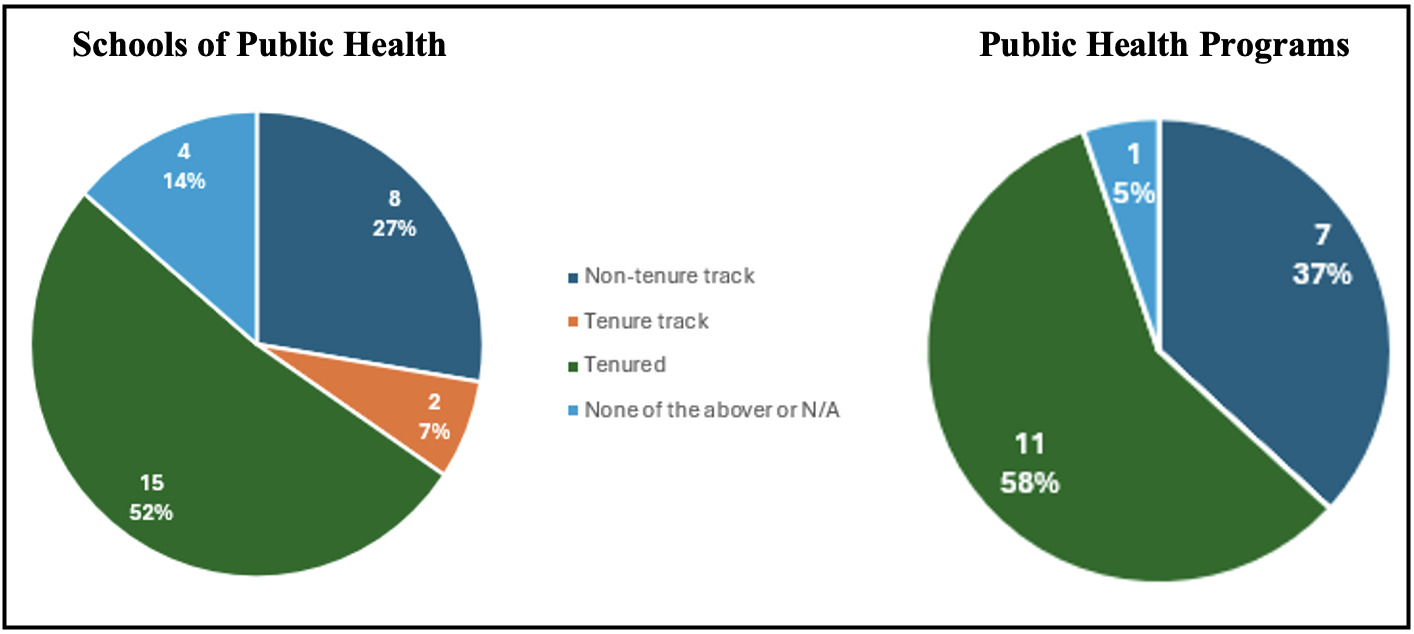
When asked what academic faculty track they were on, 60.5% of respondents (26 out of 43) stated that they were tenured. Compared to schools of public health (27.0%), there were more participants from public health programs (37.0%) who said that they were non-tenure track.

Approximately 45.8% of survey respondents (22 out of 48) stated that they are a member of a committee that makes decisions about faculty promotion and/or tenure at their school or program of public health. Of those 22 individuals, 16 are voting members on the committee and 6 are non-voting members.
School/Program Promotion and Tenure Guidelines around Public Health Practice
When asked if their school or program had a public health practice track/line for promotion and/or tenure OR public health practice as an area of excellence for promotion and/or tenure, 50.0% of respondents for this question (27 out of 54) stated that their school has neither. Table 3 includes a breakdown of the existence of public health practice faculty track/line or area of excellence by unit of accreditation.
Perceived Value of Public Health Practice Activities for Faculty Promotion/Tenure
Dissemination Activities
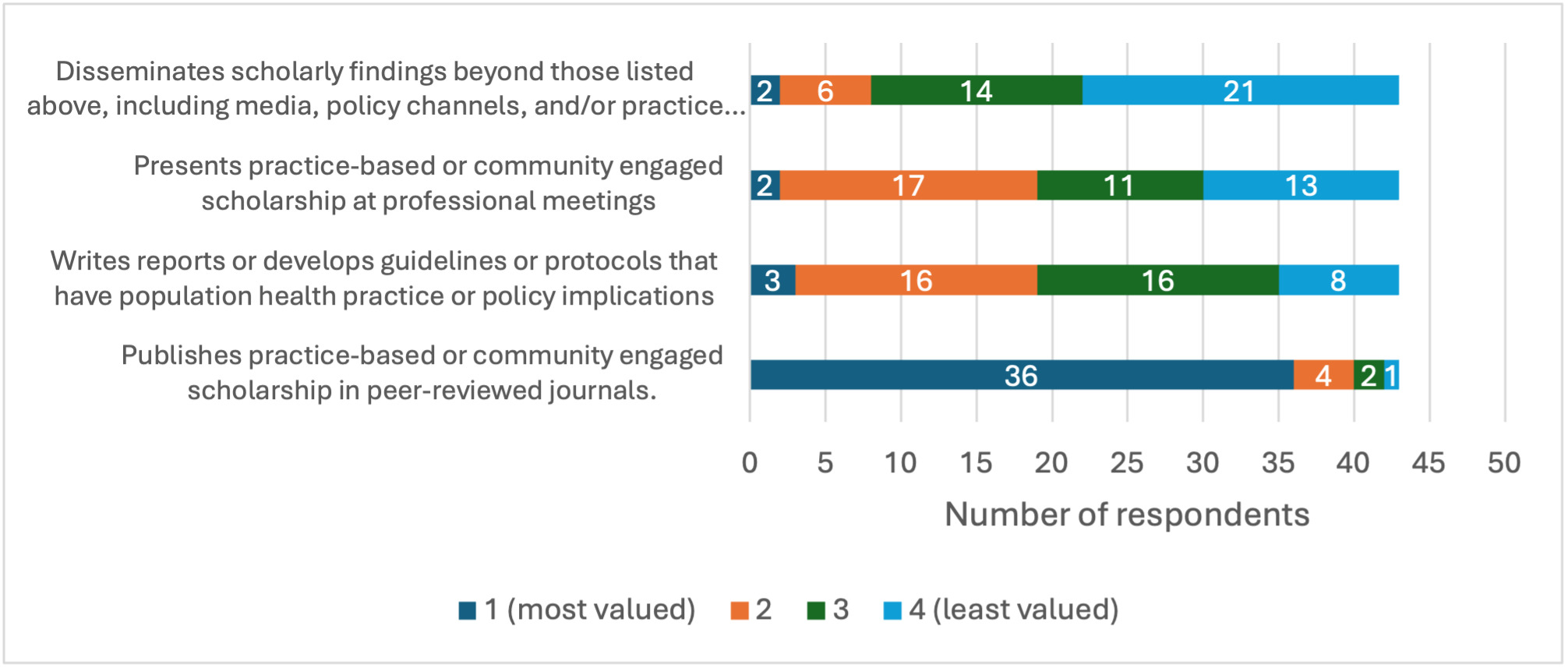
The dissemination activity that was found to be perceived as the most valued by survey respondents was “publishes practice-based or community-engaged scholarship in peer-reviewed journals” (ranked as the most valued activity by 36 respondents). The lowest valued dissemination activity was “Disseminates scholarly findings beyond those listed above, including media (TV, print, or podcast), policy channels (briefs, testimony), and/or practice or community partners”. Figure 2 shows the distribution of value rank scores by dissemination activity.

Training/Education Activities
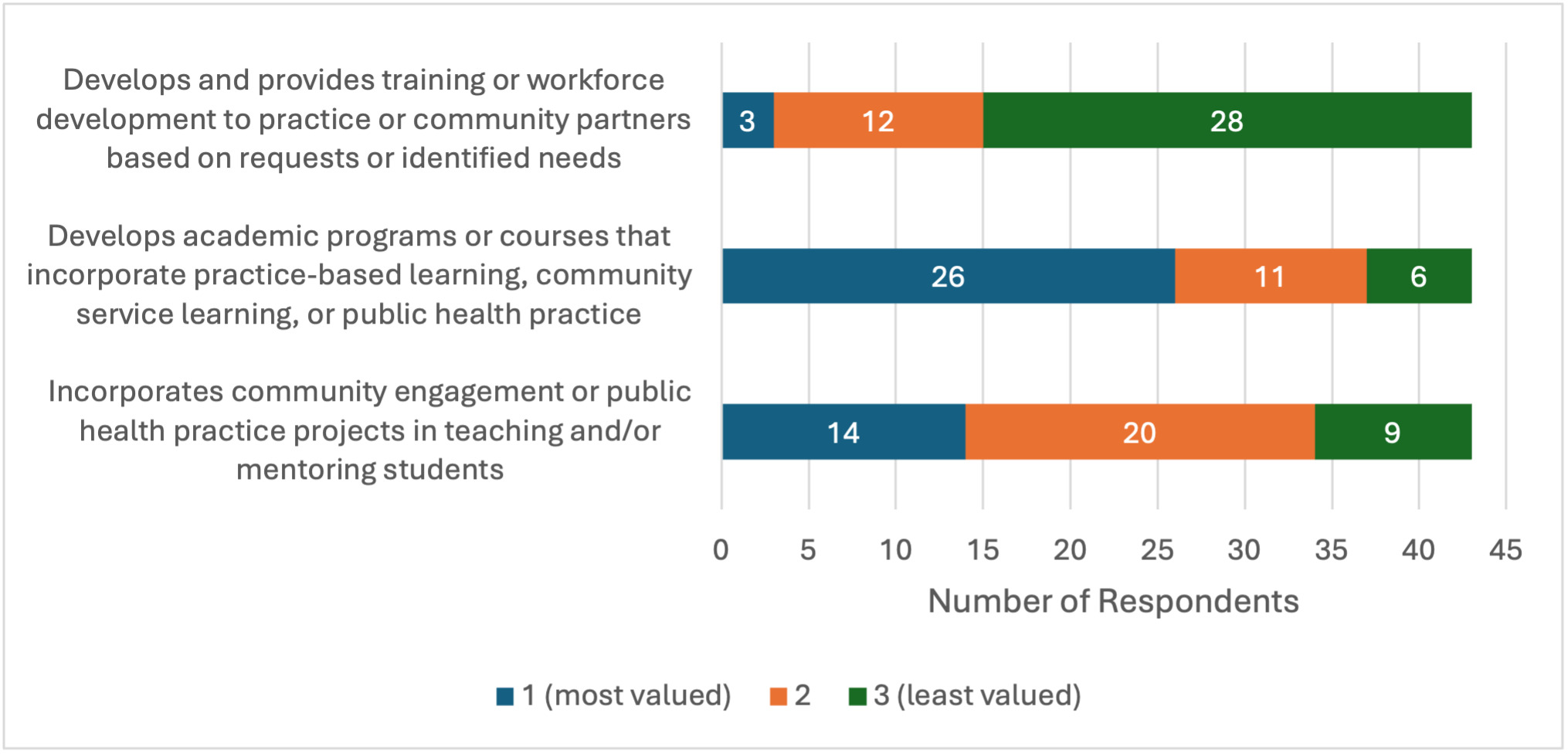
Among the three training/education activities, “develops academic programs or courses that incorporate practice-based learning, community service learning, or public health practice” was identified as the most valued. The training/education activity with the lowest perceived value was “Develops and provides training or workforce development to practice or community partners based on requests or identified needs”. Figure 3 shows the distribution of value rank scores by training/education activity.

Leadership Activities
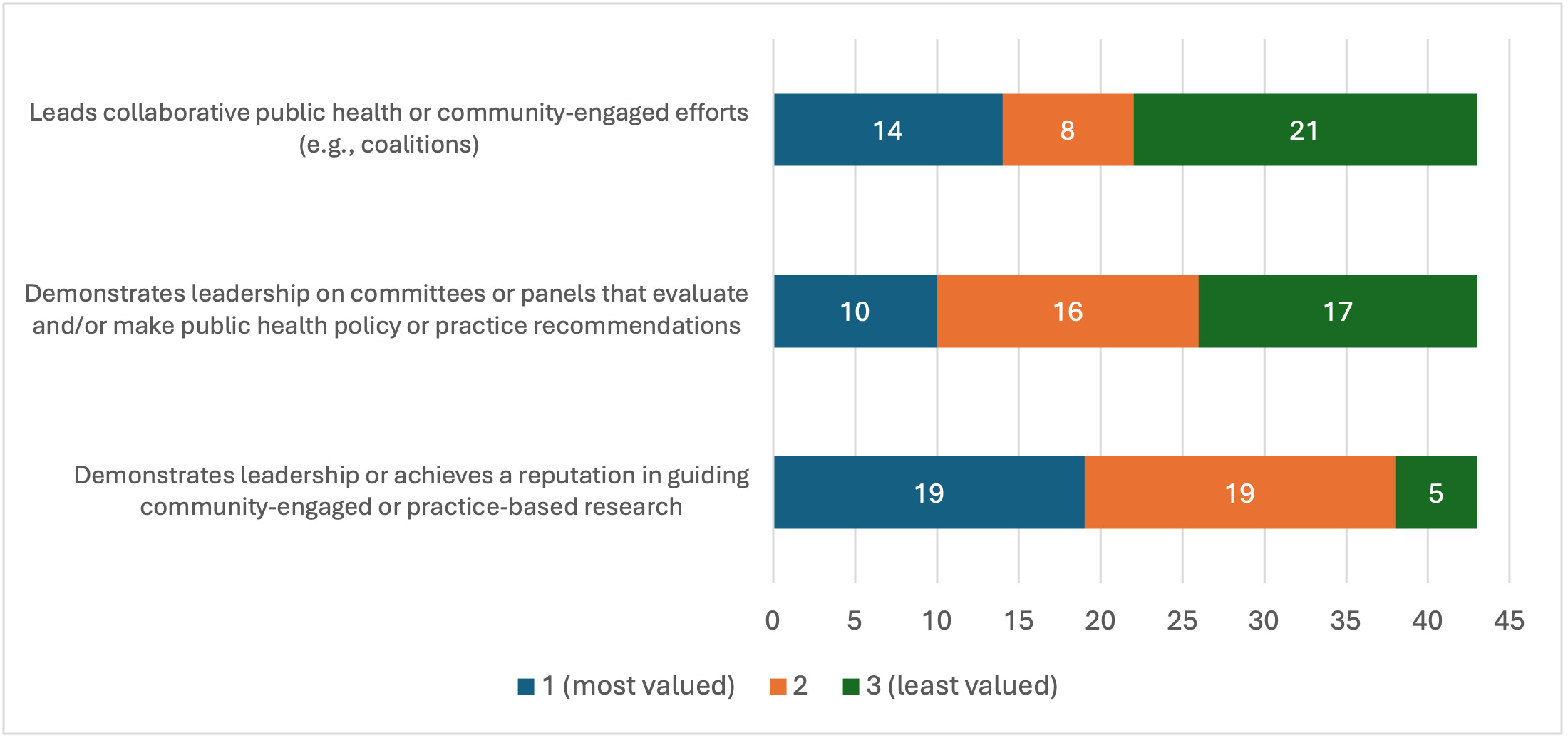
The three leadership activities showed the least variation in distribution. Among the three leadership activities, “demonstrates leadership or achieves a reputation in guiding community-engaged or practice-based research” was identified as the most valued. Figure 4 shows the distribution of value rank scores by leadership activity.

Other Activities
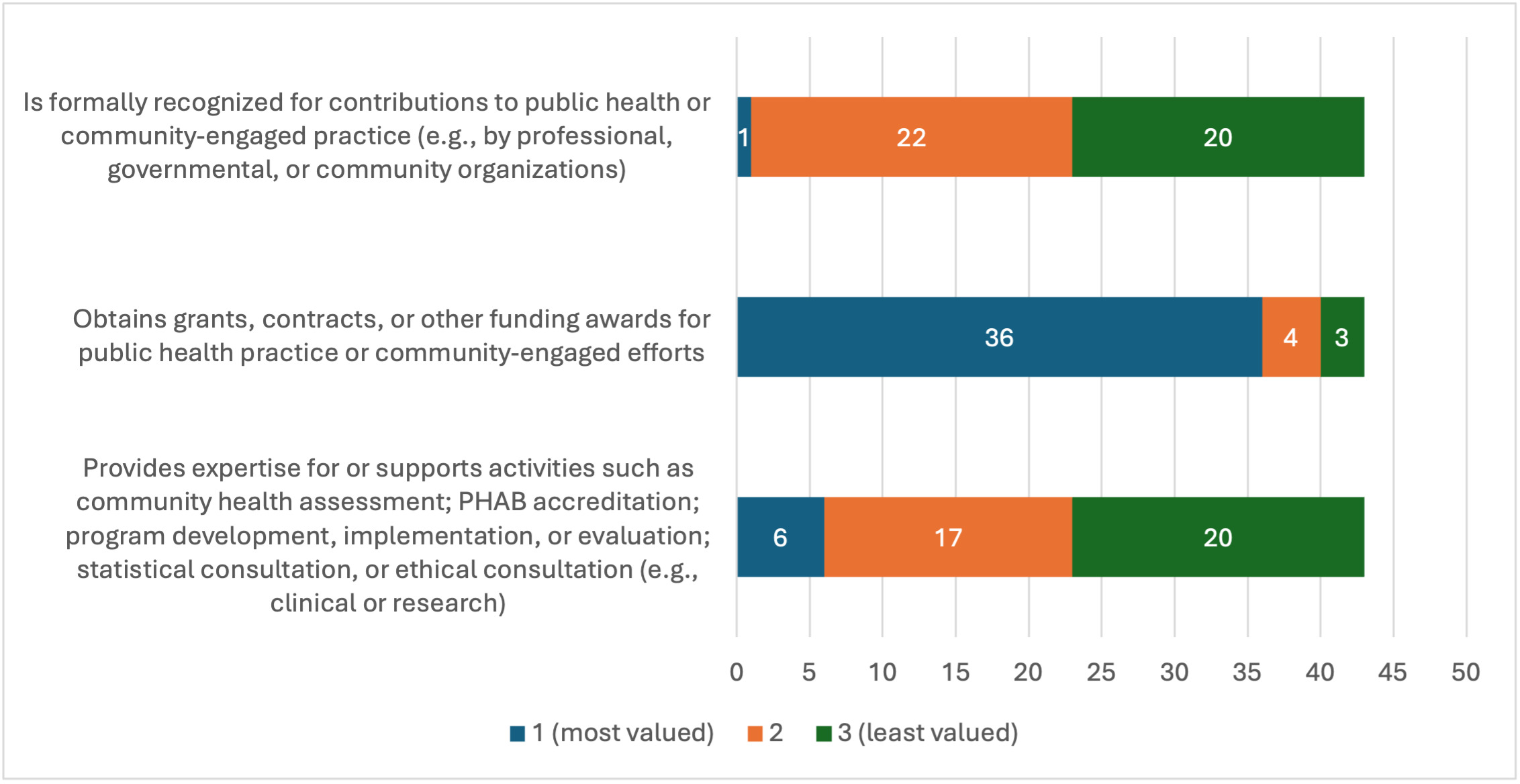
In the final category, the activity that was identified as the most valued based on respondents’ perception was “Obtains grants, contracts, or other funding awards for public health practice or community-engaged efforts”. For this activity, 36 out of 43 respondents ranked it as the most valued. The activity with the lowest value in this category was “Is formally recognized for contributions to public health or community-engaged practice (e.g., by professional, governmental, or community organizations)”. Figure 5 shows the distribution of value rank scores by activity.

Most Valued Practice Activities Overall
Across all categories, the activities that were ranked as the most valued were: 1) publishes practice-based or community-engaged scholarship in peer-reviewed journals (ranked in top three activities by 40 participants) and (2) obtains grants, contracts, or other funding awards for public health practice or community-engaged efforts (ranked in top three by 31 participants).
Public Health Practice in Promotion and/or Tenure Guidelines
Of the 42 responses to this question, all but two (95.2%) stated that their school/program of public health has incorporated public health practice activities into their faculty promotion and/or tenure guidelines. Both respondents who said that public health practice is absent from their institution’s faculty promotion/tenure guidelines are employed at a public health program.
Additionally, although public health practice was found to be mostly present in the promotion and tenure guidelines in schools and programs of public health, 38.1% of respondents (16 out of 42) stated that their institution’s promotion and tenure guidelines are vague about practice. Vagueness had a higher prevalence in public health programs (6 out of 15 – 40.0%) compared to schools of public health (10 out of 27 – 37.0%).
When asked about the specific public health practice activities that are incorporated into the promotion and/or tenure guidelines at the respondents’ institutions, the activities that are associated with more traditional academic faculty responsibilities (like disseminating findings to academic audiences and obtaining grants) were the most present. Table 5 details the activities that were identified to be present in promotion and tenure guidelines by unit of accreditation and overall.
Discussion
This study contributes preliminary insights into how public health practice activities are valued and reflected in faculty promotion and tenure guidelines across CEPH-accredited schools and programs of public health. While multiple reports and professional associations have advocated for greater inclusion of public health practice and community-based scholarship in academic public health, the findings reveal a disconnect between these recommendations and their implementation. Importantly, the data presented here address a critical gap in the published literature by showing how public health practice activities are perceived and used in faculty advancement within academic public health institutions.
The findings show that, even in public health practice and community-based scholarship, publishing in peer-reviewed journals and obtaining grants and contracts, are still most valued and used in faculty promotion and tenure. They also suggest that while many schools and programs have incorporated public health practice into their promotion and tenure guidelines, the nature and extent of these inclusions are often unclear. Almost 40% of survey respondents indicated that practice activities are vaguely addressed in their institution’s guidelines, and nearly half reported that their institution has neither a public health practice track/line for faculty or a formal area of excellence in practice for promotion and tenure. Public health programs reported greater ambiguity than schools of public health. However, schools and programs should ensure that their criteria/guidelines for public health practice are clear for any faculty who wish to advance for this type of work.
Our findings demonstrate that activities targeting academic audiences, through publications in peer-reviewed journals, are perceived as the most valued dissemination activity. While this aligns with long-standing academic norms, it falls short of capturing the breadth of activities that constitute meaningful public health impact. Because of the perceived value and current reward structure for faculty promotion and tenure, public health practice activities, including the development of practice-based evidence, can be seen as inferior or resulting from less rigorous methodology (Ammerman et al., 2014). Green et al. (2009) postulate that the mental framing around the rigor of practice-based work results in significant delays in translating research into practice, with an estimated time lag of about 17 years for 14% of research evidence to be translated into practice. Better approaches are needed that result in greater impact, producing more than an academic product such as a peer-reviewed publication that has minimal reach into the practice community. Overall, the lack of incentive to disseminate findings through alternative channels (like through policy briefs, media, or community channels) that can directly inform policy and practice is important since those are the audiences that public health should prioritize (Brownson et al., 2018; Levin et al., 2021). While peer reviewed publications are a standard measure for research success in academia, particularly in the United States, others argue for and use more holistic frameworks that include societal impact (Hengel et al., 2024; Kelly & Given, 2023; Metzger et al., 2025; Ozer et al., 2023).
While respondents reported high value in developing academic courses for students that integrate components of practice-based learning, the lowest valued activity in the education/training category was development/involvement in workforce development or in the training of current public health professionals. This finding demonstrates another important discrepancy since schools and programs of public health have been called on to move beyond student instruction and be actively involved in improving the competence of current public health professionals working in the field (Butler et al., 2008; CEPH, 2024; Hawley et al., 2007; Ned-Sykes et al., 2015). Given the need to strengthen the public health workforce (MacKay et al., 2024; Morabia, 2024), academic institutions can lean into the opportunities available to build the knowledge and skills of the current workforce outside of the traditional classroom setting.
Another activity that was reported to have high value overall and within its category was “obtaining grants or contracts for practice or community-engaged efforts”. This finding suggests that funding remains a primary concern in academic public health institutions and is a key factor associated with faculty advancement. Relatedly, it is encouraging that over 70% of respondents indicated that obtaining practice-related funding is included in their institution’s current promotion and tenure guidelines. Additionally, 62% reported that dissemination of practice-based findings to academic audiences is also recognized. These findings suggest that a shift may be underway in academic public health to focus more on practice-based funding and work, particularly at institutions with a stronger orientation toward community engagement and public health practice. As institutions explore a shift towards practice, it is important to note that schools of public health often have more autonomy in shaping their internal academic culture and may be better positioned to implement reform around faculty promotion and tenure than public health programs which are housed in broader academic units such as schools/colleges of medicine, health sciences, or health professions.
As mentioned previously, many faculty working in academic public health are tenure track faculty who are in positions that emphasize traditional research over engagement with practice (Anderson et al., 2021). Without adequate training, institutional support, or clear pathways for advancement through practice, public health faculty will likely be underprepared and under-incentivized to contribute to applied public health. This points to the need for schools and programs of public health to broaden their efforts around faculty development and reimagine faculty advancement in a way that recognizes and rewards practice-based efforts. One example of faculty development is offering workshops on translational research. Institutions with funded Clinical and Translational Science Awards (CTSA) programs through the National Institutes of Health (NIH) National Center for Advancing Translational Sciences could work with their CTSA to provide these workshops and facilitate faculty participation in translational research activities (NIH, n.d.). In schools of public health, faculty translational research development could emphasize the T3 and T4 phases, with a focus on disseminating and implementing evidence-based guidelines, policies, and practices, advancing community and population health, and strengthening societal impact (Fort et al., 2017). Other examples include schools and programs of public health offering seed grants to faculty that support practice-based pilot projects with community and/or governmental partners and using faculty/staff whose roles focus on public health practice to facilitate connections between partners and faculty to co-develop projects.
Our findings suggest that schools and programs of public health would benefit from revisions of their promotion and tenure guidelines to more explicitly include public health practice. To be useful, guidelines must move beyond vague references of service or community engagement to articulate clear expectations for practice-based activities. It may also be beneficial for schools and programs to create faculty tracks/lines or areas of excellence for faculty who are dedicated to public health practice. Doing so would allow faculty who come from a more practice-oriented background or mindset to find their place within their institution and may encourage faculty who come from a more traditional academic mindset to engage in public health practice activities. Since our data show that many schools and programs have incorporated public health practice into faculty promotion and tenure processes, greater documentation and dissemination of these models are needed to provide guidance for those seeking to advance similar shifts at their own institutions.
This study has limitations that should be noted. First, the relatively low response rate (24.4%) limits the generalizability of the findings. Additionally, the fact that individuals who are primarily responsible for public health practice and/or academic affairs were selected may have skewed the results. It is also possible that the link could have been forwarded to others within the institution since it was distributed via email. Also, because the data relied on perceptions rather than actual outcomes, no definitive conclusions can be drawn around the actual influence of public health practice on faculty promotion and tenure decisions. With the noted limitations, the findings are relevant for academic public health institutions. Future research on this topic could analyze promotion and tenure outcomes data from public health schools and programs and examine actual promotion and tenure guidelines documents.
There has been important progress in incorporating and acknowledging public health practice in the promotion and tenure of public health faculty. However, academic institutions must do more to ensure that practice-based activities from faculty are valued equitably with more traditional academic activities like publications and grants. To better align faculty promotion and tenure guidelines with public health practice activities, schools and programs of public health can involve faculty and administrators from practice or clinical tracks in both the development of these guidelines and in the faculty review process. Aligning promotion and tenure pathways with the goals of public health is essential for ensuring all faculty members are supported and recognized, strengthening the impact of schools and programs on public health practice, and ultimately improving community and population health outcomes.