
Introduction
This article is based on a longitudinal, interpretive case study of community-engaged practices at a regional state university in the Midwest region of the United States. It details how the Promotion and Tenure (P&T) policies were revised and implemented to recognize and value Community-Engaged Scholarship and Artistry (CESA) from the perspectives of those most impacted by the policy change— community-engaged faculty members. The article also includes critical reflections from the co-authors who facilitated the policy change process before closing with a summary of findings and recommendations.
In the spring of 2023, the Office of Community Engagement at Central Midwestern University (pseudonym) asked me (lead author) to design a three-year study to examine the university’s institutionalization of community-engaged practices, including recognizing community-engaged scholarship and artistry in P&T. This effort coincided with broader changes to P&T policies. Preliminary study design discussions with community-engaged faculty revealed the value of an article that describes their experiences with promotion and tenure, their understanding of the policy change process, and the potential challenges to successful implementation. Including the views of community-engaged faculty offered valuable insights into department traits, politics, attitudes towards CESA, and the integration of participatory research values and methods. As I conducted the first round of interviews with community-engaged faculty members, I recognized that the policy change facilitators—the president of the faculty senate and the vice provost of academic affairs—were best positioned to depict the policy change process. This effort is intended to inform faculty and administrators seeking to institutionalize community-engaged scholarship and artistry, and to contribute to our understanding of community-engaged policy development and implementation in higher education.
Incentivizing CESA
Community engagement is a collaborative enterprise that hinges on knowledge-exchange relationships between Institutions of Higher Education (IHEs) and external communities (Holland, 2009). Universities collaborate with communities to fulfill their civic mission by addressing social issues (Farner, 2016) while generating mutual benefits for both partners (Swearer 2018). According to Bridger and Alter (2006), “The engaged university works in partnership with local people to facilitate the broad range of community interaction that fosters individual and social well-being” (p. 170). As faculty and community members engage with one another about the larger society, their relationships are strengthened, and both groups can reflect on their values and make different choices (Butin, 2007). However, the history of university-community engagement includes examples of communities being treated as laboratories (Bringle et al., 1999) or spaces for facility expansion and economic exploitation (Rosario-Moore & Rosario-Moore, 2022). Therefore, universities should nurture community-engaged scholars who are prepared to develop healthy collaborations with community members and local organizations (Bringle & Hatcher, 2002).
While universities are revising structures to reward community-engaged scholarship (Saltmarsh & Wooding, 2016) and challenge traditional models of scholarship (Holland, 2009), there are significant obstacles, including a lack of recognition and support in the promotion and tenure process (Ellison & Eatman, 2008; Saltmarsh et al., 2009, 2015). Prior research has demonstrated that reward systems across doctoral and research universities undervalue faculty engagement (Colbeck & Michael, 2006; Furco, 2001; Jaeger & Thornton, 2005; Moore & Ward, 2010; O’Meara & Jaeger, 2019). In addition, studies have found that involvement varies by discipline and type of engagement activity (Abes et al., 2002; Antonio et al., 2000; Doberneck & Schweitzer, 2017) and that disciplinary norms rather than institutional norms shape faculty participation in community engagement (Antonio et al., 2000; Ward, 2003; Zlotkowski, 2005). Without academic recognition and reward, faculty members are unlikely to engage in sustained community-engaged scholarship in large numbers (Stanton, 2012).
Traditional faculty reward models assume that faculty members generate valid knowledge through research agendas validated through peer-reviewed publications, recognition by discipline-based associations, and grant funding (Saltmarsh & Wooding, 2016). For some faculty members, engaged scholarship represents a challenge to traditional modes of learning and knowing (Whiteford & Strom, 2013). To change traditional reward models, administrators and faculty must successfully diffuse both ideas and practice across the university (Holland, 2009). Therefore, this article describes the policy change process, the agents’ theory of change, and the perspectives of community-engaged faculty to explore the diffusion of ideas and practices within the context under study. Because the revisions to the T&P policy were only recently implemented at the time of the study, the larger mixed-methods study includes a second data collection scheduled two years after the initial implementation.
Central Midwestern University
Central Midwestern University (CMU) is a public institution of higher education chartered in the late 19th century in a mid-sized city in the American Midwest. It is designated a Hispanic-serving institution, is classified as a Carnegie Research Intensive (R2), and has maintained the Carnegie Community Engagement Classification since 2015. It has a total enrollment of about 15,000 students across eight academic colleges. Historically, the university’s Office for Community Engagement (OCE) had been focused externally on developing revenue-generating partnerships and supporting local nonprofits, and internally on recognizing community-engaged scholarship through an annual award.
In the aftermath of the COVID-19 Pandemic, the university president called for an action plan that moved the university from an engaged university to a national model of excellence in community engagement. In response, the Chief Engagement Officer established the Centering Engagement Driving Impact Task Force to engage in dialogue with the broader campus community to better understand their knowledge, attitudes, and activities related to community engagement. Based on that inquiry, they generated goals that included nurturing a community-engaged culture by defining community engagement and supporting institutional efforts to be more inclusive of community engagement in P&T processes. This article is linked to that initiative, as we seek to document and promote practices and strategies to institutionalize community-engaged scholarship and artistry at similar institutions.
Methodology
Participatory methodologies and the interpretive paradigm assume that social realities are multiple, evolving, and constructed (Gregg et al., 2010). According to Reason and Bradbury (2008, p. 1), participatory methodology denotes an “orientation to inquiry” in which the justification for inquiry is not necessarily rooted in fixed methods, but in the significance and utility of engaging research partners in the production of knowledge (Bergold, 2007). This article reframes and restructures the data from the first phase of a longitudinal interpretive case study (Walsham, 1995) of CESA at CMU to describe the P&T policy change process and share perspectives of community-engaged faculty. During Fall 2024, the lead author conducted semi-structured interviews with community-engaged faculty (n=15). Participants were recruited through two methods: snowball sampling, drawn from a network of CESA-engaged faculty and administrators linked to the Engagement Roundtable (Parker et al., 2019), and purposeful sampling (Suri, 2011), conducted through a questionnaire fielded to all full-time faculty (N = 600). Participants were included based on their indicating that they participated in or facilitated (as administrators) CESA. The following table presents the disciplinary characteristics of participants, along with their pseudonyms. Ethical obligations regarding privacy and confidentiality prevent the authors from providing further information about the participants.
Habermas (1974) observed that “in the process of enlightenment, there can only be participants” (p. 40). However, participation’s characteristics, qualities, and limits are contextual and contested. Likewise, hierarchical structures are embedded in communities, influencing the research process (Johnson & Mayoux, 1998; Mansuri & Rao, 2004). Duran (2018) prompts us to consider:
Who is participating, for whom are we participating, in what spheres are we participating, to what ends are we participating, and perhaps most important of all, who or what is limiting participation in shaping our lives? (p. 29)
In this case, we examine a shared process within a community defined by participation in a university tasked with knowledge production. Participatory methodology assumes that community members are not themselves trained researchers and that investigators are endowed with institutional and epistemological power to shape the representation of the phenomenon. As university employees and community members, we are constrained by the relations within the university, both structural and normative.
Furthermore, as researchers, we are bound by an ethical responsibility to protect the confidentiality of participants, which precludes us from including all participants as co-researchers and authors. While we acknowledge that this inquiry does not involve all faculty participants as co-researchers, we have included representatives of the administration and the faculty who have been active participants in the design and implementation of the policy change process.
The purpose of this paper is not to instigate institutional change within the community of study, as in a traditional participatory methodology. Instead, we are documenting, describing, and reflecting on the policy change process so that administrators and faculty at comparable institutions can draw guidance in designing and implementing their own efforts. We share the voices of participants whose perspectives on this process vary, scaffolded by context but with limited analysis to maintain multiperspectivity and multivocality in our representation of the results (Cook, 2012; Russo, 2012; Unger, 2012).
Community Voices: Community-Engaged Faculty
When asked about the university’s contribution to CESA, a faculty member attributed the strong cultural commitment to community engagement to a collaborative faculty culture and a non-traditional student body. Elizabeth, a faculty member in public administration, described the social and cultural context.
There are a lot of faculty at this institution that have open-door policies and are extremely collaborative… the faculty community here is really good and the students here genuinely value community-engagement regardless of what the university is doing. ]
Community-engaged faculty described their departmental and disciplinary disposition towards CESA, revealing significant differences between departments based on both disciplinary orientation and departmental and college-level politics and personnel. Alina, a professor of education, indicated a high level of support for CESA in their department.
I sense that there is strong support for CE research in my department. I know at least one person is engaged in some good CE research, but I’m not sure anybody has done it to the level I do, which includes making school-based people co-researchers. I talked about this in my interview process because I wanted to make sure I would be supported, since the publication process can be slow.
Fiona, a social scientist, described a generational gap in her department between more traditional scholars and those who were engaged in CESA.
We have a number of people in our department who do community-engaged work and we also have some people who think that it is not scholarship and should not be recognized as such. This reflects larger debates in sociology, but it is also generational. You don’t have many programs training traditionalists, but because of hiring freezes we have a bulge of [older faculty] who are getting to retirement age.
Rafael, a faculty member in Science and Engineering, described how recognition at the college level was restricted to more traditional measures of research productivity.
The Dean of our college put out a request for faculty activities that they want to highlight at the beginning of each school year. They asked about publications and research grants. It was all funding-related types of stuff and publications. So, it’s just the traditional model of what universities count as important, and that was a clear message to me that I don’t count.
When asked whether they thought the changes to P&T would be successfully implemented at the department level, some participants reflected on their own productivity and promotion experiences.
Valerie, a professor of Art and Design, described how she managed more traditional modes of artistic productivity, jury shows, with community-engaged projects.
I am an overachiever. So, I was able to manage those [community-engaged] projects in addition to my own studio practice as I was going up for tenure. But I don’t think everyone can have two parallel practices. It isn’t sustainable.
Nina, a faculty member in social sciences, reflected on her former department chair’s support for her community-engaged scholarship.
When I went up for full professor , I felt like I didn’t have enough publications. Still, my chair at the time encouraged me because I had all of this community engagement, and she thought the university was heading in that direction.
A faculty member in Performing Arts indicated that the recognition of CESA by university leadership had not influenced the P&T criteria in their department.
Not much has changed in how our tenure promotion is evaluated since I joined the department. The biggest measure is who is in competition for the job that you got. So who is in competition for the job of director, or who is in competition for the job of scenic designer, or who is in competition for the leading role? Right? Is it a nationwide search? Is it a state-wide search? Is it a county-wide search? That’s usually the metric by which our work is compared. (Amir)
Some community-engaged faculty theorized the role of disciplinary socialization, external funding, and professional organizations.
Mona, a faculty member in Education, described how community-engaged learning was central to her interdisciplinary orientation.
You know, coming from this interdisciplinary humanity, social science area, and then especially kind of with my education background like that seems like we learn that stuff from the beginning and we don’t have to have a special lab for doing that, because our classrooms are the actual labs for doing that.
A Professor of Health Sciences emphasized how the federal grant requirements encouraged community-engaged scholarship and communication in their department.
So, we have a lot of faculty members in our department who are grant-funded. And I think that’s a very good spotlight on our unit that they have this grant funding. Most of the grant funding involves some level of community engagement. And so I would definitely say that you know its value added. (Tiana)
Another faculty member in Health Sciences explained how a professional association evaluated faculty participation in community-engaged projects.
The Council on Education of Public Health has all sorts of criteria where they assess our strengths, and one of those is the number of collaborative projects that faculty might be working on– whether it be educating community members, conducting interventions, or providing research services or trainings. (Edward)
While some participants indicated that CESA-related criteria were already integrated into their departmental handbooks, faculty from more traditional departments expressed doubt that bylaw changes would be implemented successfully.Rafael indicated that the their college did not value CESA so it was unlikely that the department would be responsive.
I’ve read the [bylaw changes], but I don’t believe they will actually happen in our system, the way it’s structured right now. Because the colleges do not value it, I think they just won’t know how to measure or compare [CE scholarship]. They count papers that are published, and they discount other papers no matter what the journal is sometimes and no matter how many people read it.
Bradley, a faculty member in public administration, described the dynamics in his department:
We are one of those departments that uses a spreadsheet, but I feel like our department does pretty well. There are some vestiges among the department where they want to see a regression output in every article… so I think there is still some policing around what is considered valid.
A senior faculty member, Loretta, described the policy variation across colleges and departments.
You’ve got some departments where they’re like, ‘we already capture community engagement as part of our research, teaching, and service. We treat it holistically.’ And then others are like, ‘we don’t want it anywhere’. I don’t think you’re gonna overcome that.
Faculty members offered recommendations for effective policy implementation at the university and departmental levels. Renee, a faculty member in Social Sciences called on more material support from the university.
I think the fundamental issue is resources. The way to make it palatable to a lot of these departments is to have some money attached to it. Show me your budget and I’ll show you your priorities… I think this is also a function of being in a resource-limited environment.
Loretta described how she advocated for CESA recognition within their department.
I have done a lot of work in with individual members of my Personnel Committee… I would push back when they would say ‘Oh, does this count’, or ‘what is this?’ And they know or think empirical research only meant quantitative research. And so I know in some of those conversations they admitted their lack of knowledge to me. They’re like, Oh, thank you, for you for expanding on that. And now they are big advocates.
Valerie indicated that she was hopeful the policy changes would make a difference in Art and Design.
I think that if we the Faculty Senate’s changes get implemented in our school that would be a huge thing because I think it is a natural pairing for artists to be engaged with communities. But it just hasn’t been valued so people don’t want to spend their time on it if they are working towards tenure.
Lindsay expressed optimism that the changes would be implemented in her department before describing how the College Council blocked a prior attempt at department-level policy changes.
Personnel committee members in our department have tried to change the handbook so that more diverse types of research are recognized and counter towards P&T. The last time those changes went to the college council, they denied them because they said they were not rigorous enough.
Overall, participants’ comments suggest that despite the advocacy of university leadership and faculty-led policy changes, implementation may encounter resistance from more traditional faculty at both the college and departmental levels.
In the next section, the co-author (Ben Creed) describes the policy change process from the perspective of the Faculty Senate. We then offer critical reflections on the policy change process from co-authors Alicia Schatterman (Academic Affairs) and Ben Creed, before concluding with a brief discussion of what was learned from the process and its potential implications for similar institutions.
Description of the Policy Change Process [Faculty President]
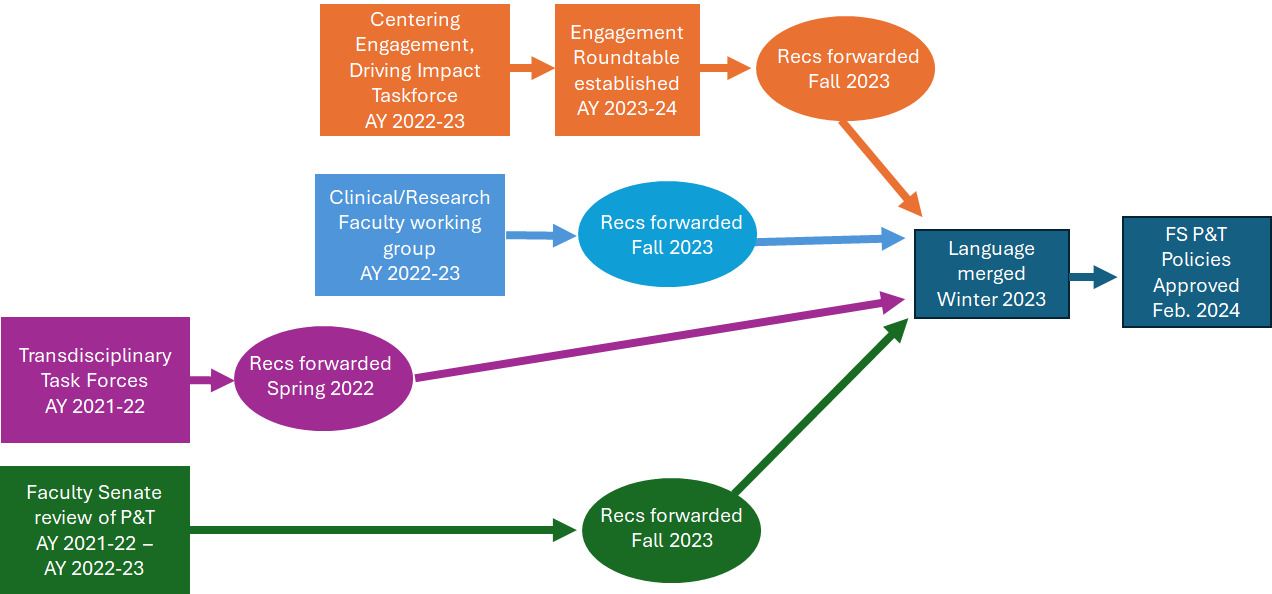
The policy changes to P&T came to pass through multiple workstreams and cycles of campus-wide engagement. While the ultimate vote and passage of the changes to P&T occurred in February 2024, the movement started in Fall 2020. The Faculty Senate established an ad hoc Social Justice Committee (SJC) in Fall 2020 in response to social justice issues raised by the Black Student Town Hall meeting and an Antiracism Forum held over the summer. Part of the SJC’s charge was to understand the lived experiences of faculty and to identify and ameliorate systemic racist policies, procedures, and practices. The committee recognized the P&T process as a policy that needed to change.
The SJC drafted a report outlining a plan of action to investigate the P&T system at NIU, aiming to advance greater equity, inclusivity, and transparency. We wanted to implement a continual review and improvement process across the university. From Fall 2021 representatives from all college councils, college senates, and academic deans. Meanwhile, the SJC met regularly with the Provost and their staff, as well as representatives from the faculty union, to understand better the procedures and conditions surrounding the policy change.
During the 2021-22 academic year, the university established the Transdisciplinary Task Force to develop policy recommendations that support scholarship and artistry spanning traditional disciplines and boundaries. The committee issued recommendations for promotion and tenure policies, joint appointments, and memoranda of understanding. During one of the SJC’s meetings with the provost, the idea of developing a bundled package of changes was discussed. This package was designed to promote equity and inclusivity in the P&T process, aligning P&T policy with the university’s mission, vision, and values.
During the following academic year (Fall 2022), a new working group was formed to make recommendations regarding the inclusion of clinical and research faculty in P&T policy. Although research and clinical faculty were historically eligible for promotion, no university policy defined the process or criteria. The lack of a university policy meant that colleges and academic unit policies controlled the process, leaving clinical and research faculty to advocate for their promotion. Hence, there were minimal instances where clinical or research faculty were promoted beyond their initial appointment. Given these inequitable conditions, the Clinical Faculty and Research Faculty Working Group was tasked with developing recommendations that would expand university policy to cover these types of faculty while allowing for their evaluations and processes to recognize the unique scope of work expected from their roles. The group further clarified the guiding principles of equity and inclusion by defining an equitable promotion and tenure system as one that serves all faculty categories and recognizes contributions based on roles, duties, and disciplinary approaches. These recommendations were shared in a campus-wide conversation and incorporated into the P&T reform package (Figure 1). Figure 1

The package included a stated commitment to local control of decision-making in the process. Stakeholders agreed that faculty in academic units are best suited to evaluate faculty members’ effectiveness and contributions, with college-level determinations being next best, and university-level decisions being furthest removed. This decision would have significant implications for the implementation of policy reforms.
The reform efforts I have described thus far were not explicitly linked to university-community engagement. However, the formation of the Center for Engagement’s Taskforce in AY 2022-23, charged with institutionalizing community engagement and increasing the university’s impact, produced a report that recommended reviewing and updating the promotion and tenure system to identify and name community-engaged scholarship and artistry as valid, valued, and valuable. See summary of changes below (Fig. 2):
The report also recommended the formation of the Engagement Roundtable, a shared leadership group focused on coordinating and promoting community-engaged projects, research, and pedagogy. Through my participation in the Engagement Roundtable and my one-on-one conversations with our Chief Engagement Officer (CEO), it was clear that this area for policy improvement aligned with the broader set of changes. The inclusion of community-engaged scholarship and artistry fit the three guiding principles of ensuring our promotion and tenure system was equitable, retained local decision-making control, and aligned with university goals.
With this realization, I began working with the CEO to identify exemplar policies; I reviewed institutions nationwide that changed their policies to incorporate community-engaged scholarship, contacted faculty senate presidents at institutions in our state and across the country (through the National Council of Faculty Senates). I wanted to learn from what others have done or chose not to do. Within the broader package of amendments and in conversation with other involved individuals, I began weaving community-engaged scholarship and artistry into the preamble to our promotion and tenure bylaws. In this work, community-engaged scholarship is included among the academic outputs seen as valid and valued by the institution. Community-engaged work was added as possible evidence within each evaluation category: research/scholarship/creative activity, teaching/librarianship, and service/leadership. The draft language was shared with key individuals, including the Provost, the CEO, the VP for Academic Affairs, and a group of community-engaged faculty. After their feedback was received and incorporated, I shared the whole package of by-law changes with the Engagement Roundtable for review and input before sharing the complete package of policy changes with the Provost, Vice Provost for Faculty Affairs, union leadership, deans, the SJC, and those who had been instrumental in developing the various aspects throughout. Once a final draft was completed, the package was brought forward to the Faculty Senate Personnel Committee (FSPC). This body is delegated the responsibility to review and make a recommendation for the full Faculty Senate to consider all changes to the academic personnel process at the university level. After their review and recommendation to move the package forward, the full set of amendments was reviewed and approved by the Faculty Senate.
Once the bylaws were amended, I went back out on a roadshow to all college councils and college senates, the deans, the union, and several academic units to share the changes, answer questions, and provide support. My goal was to support the implementation of the changes to our bylaws. This has included providing exemplar documents from other institutions or academic units within our institution to deans and department chairs. I have also worked with the VP for Academic Affairs to review and make recommendations on the current academic unit policy. We continue to work to ensure all of campus is aware of the changes and understands the new requirement that all levels of promotion and tenure policy must be reviewed at least every five years to ensure they are in alignment with the university policies and to make plans to address gaps - including how community-engaged work is recognized outside of the P&T process.
Critical Reflection [Academic Affairs]
Community engagement came naturally as a faculty member for 15 years in an applied social science discipline. It was not only welcomed by my colleagues but also expected to link theory and practice for students. This is very discipline-specific. However, even though community-engaged scholarship is very much part of our disciplinary expectations, there were many discussions around equivalent traditional scholarship and engaged scholarship. The bylaws of my college recognized community-engaged scholarship as part of teaching, research, and service for several years. How each unit addressed engagement in their bylaws was unit-specific without an overarching mandate.
The changes that were made over the past few years, particularly the university-level inclusion of engaged scholarship for promotion and tenure, are a strong signal of the university’s support for this work. Promotion and tenure cases still originate locally, using unit bylaws first to gain support for a tenure and promotion case. After that decision, the case is sent externally, and then a vote proceeds to submit to the college for review. At every step of the way, the local unit has the most discretion and strength to support a case or not. Some units may be supportive of engaged scholarship, but until a particular case comes up using a revised set of bylaws at the local level, the case is not certain to be successful.
College councils, responsible for college review of tenure and promotion cases, rely on precedent to support these cases. Without precedent, under revised guidelines, they will likely be cautious to support them. So, university-level and college-level support and policy are needed, as well as college-level. Still, the real test is how support is shown at the local level to provide a strong case for promotion and tenure as the case progresses.
College council members must be tenured faculty. They may have very traditional perspectives or attitudes about community-engaged scholarship. Until a case based on engaged scholarship under new unit, college, and university guidelines arises, it is difficult to predict the level of college support for that case. While these councils ultimately advise the dean, they have a significant role in tenure and promotion cases.
As mentioned, there are disciplinary aspects to how engaged scholarship is treated from the local level on up. This disciplinary perspective may also not be shared by all tenured faculty members and can even create factions within a unit, thereby stalling or inhibiting tenure and promotion cases that include engaged scholarship in teaching, research, and service.
Critical Reflection [Faculty President]
Communication is the biggest challenge, followed closely by helping individuals understand how community-engaged work is not just ‘a little bit of extra service’. Despite consistent communication through multiple channels (e.g. Provost communications; my participation in and discussion of community engaged work in the President’s State of the University address; multiple messages to faculty senators and to the union; direct engagement with all college chairs via the college senates; direct engagement with all departmental personnel committees through the college council; and so on), there are still far too many faculty members that don’t know that promotion and tenure policy changed, generally, and even more that don’t know that community engaged work has been specifically named. Further, despite the requirement for all units and colleges to engage in a review of their policies, many are resistant to engaging in the changes.
There is also a lack of understanding of what community-engaged work is and what it is not. Many disciplines see all that they do as ‘community-engaged,’ while others see no way that their work could ever be community-engaged. As such, both take a similar approach to the changes, taking no action to ensure that community-engaged work is considered valid and valued. This manifests in community-engaged faculty running up against a system that has been updated at the university policy level. At the same time, implementation across colleges and academic units lags behind. Essentially, a faculty’s community-engaged work may not count in their academic unit’s decision framework, which prevents them from moving up to the college level or to the university level in the promotion and/or tenure evaluation.
Community-engaged faculty in traditionally oriented departments have little recourse in the short term except for beginning (or continuing) to advocate for community-engaged work to be ‘correctly’ valued within the criteria used to evaluate their promotion and/or tenure case. Authorship credit in community-engaged articles has emerged as a common source of friction in the P&T system. Many community-engaged publications may have multiple authors, including community partners, to recognize their contribution, while solo-authored publications are valued in the academic unit. Similarly, some units maintain lists of journals that count, excluding outlets that publish community-engaged scholarship. As such, faculty members either have to be more productive (by creating both a manuscript for locally accepted journals and one incorporating community-engaged work) or deprioritize reporting results back to the partner community and stakeholders.
A primary reason we successfully included community-engaged work in the promotion and tenure system at the university level is that we focused on developing common sound principles to ground the change. We did not pitch it as “community-engaged work is missing, so we need to add it,” and there are likely impacts on equity, alignment, and ensuring local decision-making remains central. Instead, we focused on the principles of having a fair, transparent system that worked for faculty and aligned with their role on campus and university goals. Then we said community-engaged work is one way to achieve a better system.
As an institution, we continue to provide support to colleges, academic units, and relevant committees, educating them and addressing their questions on the work. I have shared various versions of ‘what has changed’ with deans, chairs, faculty, and others. This is likely to be a 5-year process, at least for the ‘initial implementation.’ I have been in conversation with our Chief Engagement Officer about identifying our faculty’s community-engaged activities that are clearly aligned with our institution’s mission, vision, and values. We are examining where we need to improve academic unit and college policies and identifying examples of faculty who produce impactful work that does not ‘count’.
Finally, a challenge with our omnibus approach is that community-engaged policy changes are sometimes seen as ‘second order’ or as something to be addressed in the future. This may enable some departments to prioritize other aspects of policy change, such as clinical faculty promotion or ensuring policy reviews are completed on time.
Summary of Lessons and Implications
Policy changes to P&T should not proceed without institutional study and sustained engagement with internal and external stakeholders.
- This process should establish a set of common principles and definitions for CESA.
CEASA-related policy changes to P&T are more likely to pass when bundled with policy changes that directly address faculty concerns and reflect university values.
CESA Advocates should recognize that college-level council members play a significant role in implementing or resisting policy changes.
CESA advocates should be prepared for a sustained communications campaign and engagement to successfully implement and socialize changes to P&T policy.
Successful implementation benefits from proactive CESA advocates within more traditional departments.
Successful implementation is more readily facilitated when the university and professional organizations provide technical and material support for CESA.
Conclusion
This case demonstrates that a multi-pronged, faculty-led effort bolstered by leadership and administrative support can drive changes to P&T policy at the university level. Ironically, democratic governance and local control may enable resistance to implementation at the departmental level. Without policy mandates, community-engaged faculty and administrators would be wise to pursue long-term implementation campaigns that include communications strategies tailored to disciplinary variation. Community-engaged faculty in departments oriented towards traditional scholarship are key change agents who might advocate for change in formal settings while using relational strategies to build coalitions within their departments. At the university level, leadership should consider whether the budgetary commitment to CESA recognition aligns with the university’s values, as additional department-level resources may facilitate the implementation of equitable promotion and tenure (P&T) policies.