
Introduction
Two decades of research demonstrates significant disparities in tenure outcomes for scholars conducting Community-Based Participatory Research (CBPR), Participatory Action Research (PAR), and community-engaged research (CEnR) (Foster, 2010; Jordan et al., 2009; Marrero et al., 2013; Teufel-Shone, 2011). Faculty report that these forms of research are undervalued by committees: work is mischaracterized as “service,” lengthier timelines for partnered research are unappreciated, and the more flexible foundation funding that often supports this type of research is less valued than traditional federal funding sources (Minkler et al., 2003; Wendling, 2023). The scholarly literature consistently speaks to the fact that faculty of color, often driven by a commitment to address inequities and foster social change, engage in CBPR, PAR, and CEnR at a higher rate than their White male counterparts (Antonio, 2002; Baez, 2000; Miller et al., 2018). While community-engaged work is frequently characterized by strong connections to the needs and priorities of marginalized communities, making it both impactful and culturally relevant (Palmer, 2025; Stanley, 2006; Worthen et al., 2019), such scholarship is often undervalued in traditional tenure and promotion processes (Calleson et al., 2005).Thus disparities in tenure and promotion may be particularly stark for minoritized faculty, who are both more likely to conduct research with marginalized communities aimed at social change, and to also face structural biases in advancement (Ahmed, 2012; Cate et al., 2022; Masters-Waage et al., 2024).
Authors’ Positionality Statements
As co-authors, we bring unique and complementary perspectives to this manuscript. We are three Full Professors at San José State University (SJSU) who are respectively, a participatory action researcher in the field of public health, a community-based participatory researcher in the field of social work, and an applied clinical researcher in the field of nutrition. While we each have interdisciplinary collaborations, we have only worked with each other through our service on our college’s Retention, Tenure, and Promotion (RTP) Committee. Each of us has served on various levels of RTP review and mentored junior faculty in developing their dossiers. While we deeply respect one another’s commitment to providing fair and equitable review for our colleagues, we have not always agreed with each other on how to rate a particular candidate’s effectiveness. Interpretation of policies is inevitably shaped by reviewers’ own professional backgrounds, epistemological orientations, and lived experiences. Moments of disagreement became critical points for reflection and discussion, ultimately helping us identify areas where additional guidance or clarity could support more equitable evaluation. In serving together, we have learned from each other’s perspectives and identified spaces where we can improve departmental and university policies, enhance training for faculty candidates in dossier preparation, and better prepare reviewers to conduct holistic evaluations.
Our impetus for writing this paper is different. In this section, we briefly introduce ourselves, explain our positionality with respect to this article, and describe our motivation for contributing to this special issue.
Miranda Worthen
I am a white woman, educated in elite institutions and a lifelong activist frequently in opposition to those institutions. Both my parents had advanced degrees and I had extensive support in navigating these institutions. My life has also been shaped by being born with a rare genetic syndrome and navigating the world with disability. Raised by my mother to politicize my experience within the feminist and disability rights movements, I never bought into the separation of research, advocacy, and experiential knowledge that pervaded the institutions where I obtained my degrees. My primary professional identification is as a participatory action researcher, though my work spans both traditional and PAR approaches. I have been doing PAR for twenty-five years, working several years on a PAR study prior to even taking my first class in epidemiology, the discipline of my PhD. I sought out my position at SJSU because my department had a rich history of supporting CBPR researchers and I believed my approach to research would be valued. This has, indeed, been my experience.
When I began the tenure process, I viewed my own engagement with institutional power as a game - one that I knew the rules for and felt confident I could win. As I got to know colleagues with different backgrounds and experiences with evaluation, and was educated by them in deeper critical analyses, I grew to understand how my many forms of privilege (class, race, generational) allowed me to view this process as a game while people I loved experienced it as violent. I grew to better understand Audre Lorde’s famous observation that “the master’s tools will never dismantle the master’s house. They may allow us temporarily to beat him at his own game, but they will never enable us to bring about genuine change” (Lorde, 2007, p. 112).
This growing understanding of my own privilege and the harm caused by these evaluative processes led me to develop an explicit commitment to mentorship of other PAR and engaged faculty and to transformation of our system through improving policies, using my power within committees to challenge dominant paradigms and apply these better policies, and seek out other spaces in which to disrupt the move toward broader metrification of impact. Internally and in community, I experience a tension between taking an institutional pragmatist approach (cognizant of my own position of power within this institution) while wanting more radical change. In her article, Biting the University That Feeds Us, Eve Tuck writes, “I want us to figure out which parts of the university can be made useful for communities, and to figure out how to dismantle the parts that are not” (p.165) (Tuck, 2018). For me, the opportunity to work on this article provides a way to extend my efforts outside of my institution and offer both this analysis and these ideas to those who might help us figure this out.
Soma Sen
I identify as an Asian Indian woman, born and raised in India, and currently serving as a faculty member in the discipline of Social Work at SJSU. My life has been shaped by migration across cultural, geographic, and institutional landscapes. This journey has deepened my awareness of privilege, marginalization, and the spaces in between. I carry with me the layered influences of my upbringing in a collectivist society, the gendered norms of a patriarchal culture, and the professional ethos of social work rooted in social justice and equity.
My caste and class location in India afforded me certain privileges namely, access to quality education from the best Institutions in India, fluency in English, and opportunities to be trained in R1 institutions in the USA. What afforded me these opportunities is the fact that I have been trained in Eurocentric and positivist paradigms that are hegemonic to the American Institute of higher education. Being a Full Professor has granted me access to institutional resources, platforms, and decision-making power, yet as a community-engaged researcher I had to operate within structures deeply influenced by Eurocentric epistemologies that prioritize individual authorship, rapid outputs, and written scholarship over the slower, relational, and multimodal forms of knowledge valued in many communities.
Adding to that my experiences as a woman of color navigating entrenched patriarchal structures both at home and in America has exposed me to the constraints of gendered expectations, both overt and subtle. These early encounters with inequity that ranged from limitations on mobility to implicit assumptions about my leadership have informed my enduring commitment to challenging structural oppression in all its forms. I have borne witness to many of my colleagues of color not being recognized for their tremendous contributions in uplifting their communities through their scholarship. As a reviewer at the various levels of the institution it is my opinion that one of the greatest challenges an institution faces is adjusting or changing the institutional schemata that is influenced by traditional epistemological processes. While SJSU has recognized that the traditional schemata needs to shift and has amended the RTP guidelines to include community-engaged scholarship, we are far from institutionalizing change of processes that continue to relegate the voices of community engaged researchers to the voices of subalterns. I am always motivated by the question that was asked many years ago by Gayatri Spivak – Can the subaltern speak (Spivak, 1999)? Thus, this paper is my humble effort to provide practical guidelines to ensure that subalterns do speak until they are no longer considered a subaltern.
Kasuen Mauldin
I am an Asian American woman, born in Hong Kong, with formative years in Texas, and now rooted in California, where I have established my academic career at SJSU. My academic background is in the basic sciences (chemistry and biochemistry), shaped by bench-lab training at R01-funded research institutions where traditional markers of research excellence were emphasized. My transition to applied clinical nutrition research was driven by my desire to translate scientific knowledge into meaningful improvements in real-world health care. After earning my PhD in Molecular and Biochemical Nutrition, I completed training to become a Registered Dietitian. My current work centers on improving nutrition care through producing scholarly works that inform evidence-based practice and preparing the next generation of diverse clinicians.
Although I do not conduct CBPR, I have developed a deep appreciation for its value through my service on RTP committees. I have come to further recognize how institutional review processes can inadvertently devalue forms of scholarship that are slower paced, more collaborative, and/or rooted in community partnerships. My own experience navigating the RTP process at SJSU was marked by its lack of transparency and potential for bias. My motivation for contributing to this manuscript stems from a desire to bridge understanding between traditional research and CBPR approaches. I write as a conventional researcher who recognizes the critical contributions of CBPR scholars. I hope to support other RTP reviewers, especially those trained in traditional paradigms, in learning how to evaluate CBPR scholarship fairly and equitably.
Background
For the purposes of this article, we refer broadly to the family of approaches that have at their core shared power between academic researchers and community partners and are aimed at producing social change as well as new knowledge (Wallerstein, 2021). This includes CBPR, PAR, and CEnR approaches; we will refer to these approaches collectively as community-engaged research. Though not the focus of this article, we note that Indigenous research and decolonizing methodologies share a similar ethic of community inclusion, participation, power sharing, reciprocity, respect, and orientation toward social change and transformation (Smith, 2012, 2018). These approaches and methodologies each are on a continuum from deeply participatory and engaged to tokenistic or consultative. In this article, we are focusing on how to navigate the retention, tenure, and promotion process for researchers who are on the far end of this continuum towards deep partnership, engagement, participation, and action (Belone et al., 2016; Key et al., 2019).
Among the defining characteristics of these research approaches is the focus “on a process of sequential reflection and action, carried out with and by local people rather than on them” (Cornwall & Jewkes, 1995, p. 1667). These approaches contrast with traditional research approaches through the “location of power in the research process” (Cornwall & Jewkes, 1995, p. 1667). Indeed, deliberate power sharing between academic researchers and community partners in community-engaged research affects how the research is conceptualized, conducted, and disseminated (Cornwall & Jewkes, 1995). In addition, these methodologies aim to advance social change, often by improving and reducing inequities (Baum et al., 2006). Table 1 summarizes the key differences and similarities between traditional research and CBPR/PAR/CEnR research approaches (Baum et al., 2006; Cornwall & Jewkes, 1995; Duea et al., 2022; Vangeepuram et al., 2023; Vaughn & Jacquez, 2020).
In order for community-engaged research to be effective, academic researchers must build foundational relationships with their community partners, and this is time-intensive. Thus faculty members who conduct this type of research may spend the first years of their appointments setting the stage for sustainable research agendas. Because these forms of research focus on action and social change, the outputs are frequently in non-traditional formats (e.g., toolkits, training manuals, policy briefs, documentaries, etc.) that are more accessible to community members. Tenure/promotion reviewers must acknowledge the long-term nature and non-traditional outputs of community-engaged research approaches. Faculty candidates must provide a framework for reviewers to assess their process-based milestones and document the impact of their non-traditional outputs.
Challenges in Evaluating CBPR/PAR/CEnR Researchers
Community-engaged research by its nature challenges the traditional notions of knowledge making processes and thus when viewed through the lens of Eurocentric epistemology, raises the questions: who does knowledge belong to, whose knowledge counts, and how can it be validated. Kristie Dotson’s concept of epistemic oppression provides a critical framework for understanding the challenges faced by community-engaged scholars, particularly those from marginalized groups (Dotson, 2014). Epistemic oppression, as Dotson (2014) defines it, refers to the persistent and systematic exclusion that hinders an individual or group’s ability to participate fully in epistemic practices and knowledge production.
In the context of RTP, this means that certain ways of knowing, especially those rooted in marginalized or non-Eurocentric traditions, are often undervalued, dismissed, or rendered invisible within dominant academic structures. Dotson’s framework draws attention to how institutional norms, such as the prioritization of individual-centric narratives or rigid hierarchies of evidence, can silence alternative epistemologies (Dotson, 2014). These Institutional norms can be considered a manifestation of the institution’s cognitive blueprint or schema. Dotson (2014) cites Bartuneck and Moch in defining organizational schemata which influences the ethos of an organization, including a shared understanding of institutional values. We argue that these values in turn are reflected in institutional policies including the one for Tenure and Promotion. Thus, for any faculty and particularly faculty of color whose epistemological processes are grounded in collectivist traditions, this type of oppression is compounded by the expectation to conform to Eurocentric ideals of authorship, authority, and knowledge validation.
In addition, traditional research is often dualistic in nature and separates the researcher from the community or problem they are studying (Dwyer & Buckle, 2009; Hill & Dao, 2021; Muhammad et al., 2015). In community-engaged research, such boundaries are fluid and often require renegotiating of what constitutes such boundaries, thus making it difficult to present fixed outcomes when writing a dossier narrative (Egid et al., 2021; Wallerstein et al., 2019). Such participatory epistemology is difficult to capture in traditional dossier narratives that tend to be individual-centric, objective, and static (Franz, 2011; Israel et al., 1998) In addition, RTP reviewers must consider how many current and next generation of scholars are increasingly public in their scholarly identities, often synergistically integrating community engagement and social justice into their research, teaching, and service (Post et al., 2023).
In our experience, an individual-centric dossier does not provide the opportunity to explore the broader social, contextual, and relational factors that influence project outcomes of community-engaged work. Even though community-engaged research approaches are rooted in the ideals of social justice, cultural humility, and respectful and authentic partnerships between the academic and their community partners, there is limited scope for highlighting these principles in a dossier narrative that follows the Eurocentric traditions of upholding the primacy of individuals over a collective. In fact, without an intentional focus on the dynamics of power, misrepresentation or misappropriation of the community can pose an ethical and epistemological challenge in writing about community-engaged research in the academic setting. Finally, academic institutions continue to prioritize traditional epistemological methodologies that are linear and hierarchical (Smith, 2018). It can pose a serious challenge for any community-engaged researcher to adequately capture the iterative, emergent, and context-specific knowledge-making process of a particular community-based participatory research, participatory action research, or community-engaged research project within the scope of a traditional dossier narrative (Wallerstein & Duran, 2010).
In addition to the challenges that are inherent in writing about such work in an individual-centric dossier, faculty of color often struggle with tenets of individual-centric dossier which seeks the authority of the narrator in claiming the narrative. The idea of self-promotion, both the norm and the expectation in the narratives, is often in direct contradiction to the cultural tenets of harmony, interdependence, and shared knowledge that many faculty of color from collectivist cultures have been socialized into. By integrating Dotson’s lens into the evaluation of community-engaged scholarship, academic institutions can move toward more equitable assessment systems that honor the relational, context-specific, and justice-oriented nature of this work (Dotson, 2014). This perspective underscores the ethical imperative of resisting such epistemic injustices and calls for evaluative practices that recognize and legitimize multiple ways of knowing. This point has perhaps been made most clearly by Indigenous researchers, including Linda Tuhiwai Smith (Smith, 2012, 2018) and Eve Tuck (Tuck, 2018). Tuhiwai Smith identifies the tension between what “impact” means to Indigenous researchers and what “impact” means to University systems trying to measure and value research: “In many ways, impact is exactly what Indigenous research is designed to achieve, but perhaps the social transformations being sought by many Indigenous approaches are not quite what research measurement is trying to capture” (p.22).
As a concrete and personal illustration of this point, Soma struggled to write such a narrative for four years until she found a way to write the accomplishments that satisfied to a certain degree both the expectations of an individual-centric narrative and still stayed authentic to her cultural beliefs. However, when she shared this narrative with her father, his response was that the statements were too prideful.
One should note that not all faculty of color might struggle with such dissonances. Many of these faculty have been trained in Eurocentric writing and are comfortable in highlighting their uniqueness, strengths, and achievements.
In this article, we will first describe the policies and practices at SJSU regarding retention, tenure, and promotion. Second, we use Miranda’s dossier narrative, annotated by Soma, as an in depth case study of effective description and documentation of a candidate’s PAR research. We follow this example with general recommendations for candidates illustrated with examples from two additional candidate narratives (one a CBPR scholar and the other a CEnR researcher). We are grateful to our colleagues who graciously and eagerly shared their narratives with us to include in this article and provided feedback on an early draft of this manuscript. Third, we will discuss limitations and considerations in the way our university policy has facilitated or hindered fair review. Finally, we conclude with recommendations for other universities regarding policies to support fair review of candidates who conduct community-engaged research, for reviewers when considering this type of researcher for retention, tenure, and/or promotion, and for candidates about how to communicate about their scholarly work.
San José State University RTP Policy and Practice
In 2012, the SJSU Academic Senate began assessing the existing RTP policy. The Senate determined that the policy, which had been in force since 1998, lacked clear criteria, was insufficiently flexible, and that the process was widely perceived to be unfair. A major revision was adopted in 2015 (S15-8; see appendix). This RTP policy was developed through shared governance, incorporating feedback from faculty committees, administrators, and other stakeholders. In 2021, an amendment (amendment E) was approved to provide more clarity on how to evaluate candidates whose research, scholarship, or creative activity (RSCA) can be classified under the category of “scholarship of engagement.” The impetus for these revisions was to improve equity in holistic review, especially for scholars of color and researchers from minoritized communities, who were more frequently conducting forms of participatory research engaged with marginalized communities. The aim was to recognize the valuable scholarly contributions of faculty who conducted community engaged work and to provide guidelines for defining and evaluating such work. By definition, scholarship of engagement involves the application of expertise to address significant societal, professional, or academic issues and must demonstrate reciprocity and collaboration with external communities. The policy states that disciplinary experts/peers must evaluate the scholarship produced from this work, and “such evaluations should characterize the broad impact, scope, or significance of the work, whether within academic fields or beyond” (S15-8 Amendment E). In addition, “significant contributions that would not otherwise be peer-reviewed should be evaluated in this manner” (S15-8 Amendment E). The updated S15-8 RTP policy expands the scope of scholarship for RTP consideration. While imperfect, we believe SJSU’s policy can serve as a model for other universities seeking to more holistically and fairly review candidates who use community-engaged approaches. In turn, strengthening policies to better assess the impacts of community-engaged research may increase the likelihood that faculty on the tenure line will engage in this type of work, which we believe is important for achieving transformative change.
S15-8 guides evaluators in applying fair processes by describing standards to evaluate the various categories of achievements and providing guidance on how to apply these criteria in the three areas under review: academic assignment/teaching; research, scholarship, and creative activities (RSCA); and service; and the synergy between and among the three. For this manuscript, we are primarily interested in the RSCA portion of this policy. Below is a description of how this particular section of the policy is structured.
2.3.1. Describes the nature of contributions in this area, highlighting the fact that any such expected contributions would vary across disciplines.
2.3.2 Provides guidance on what is considered Scholarly Achievements.
2.3.3 Provides guidance on what is considered Artistic Achievements.
2.3.4 Provides guidance on what is considered Professional Achievements, which typically is evaluated under service, unless departmental guidelines say otherwise.
2.3.5 Provides guidance on what is considered Scholarship of Engagement. It specifically states that scholarship of engagement requires the application of expertise; otherwise the contributions should be evaluated under Service. (The following Box 1 provides additional details.)
2.3.6 Provides guidance in how to apply criteria to evaluate RSCA. The policy expects the same criteria to be applied to traditional scholarship and scholarship of engagement.
Tenure-line faculty are evaluated in the areas of academic assignment, RSCA, and service each year of their probationary period. Under ordinary circumstances, a tenure-line faculty member goes through a “mini-review”, where they prepare a short summary of achievements, which is evaluated at the Department level by an elected committee and, depending on the department size, by the Department Chair, and by the College Dean. These “mini-reviews” take place in the spring of the candidate’s first, second, fourth, and fifth year of their tenure track appointment. In the fall of their third year, candidates prepare a dossier for a retention review and in the fall of their sixth year the candidate submits a tenure and promotion dossier. Retention, tenure, and promotion dossiers are reviewed at the Department level by the Department committee and usually the Department Chair, at the College level by an elected College committee and the College Dean, and University level by an elected University committee. The Provost makes the final retention, tenure, and promotion decisions. Associate Professors going up for promotion to Full Professor typically submit a dossier in their fifth year in rank and they are reviewed by each of the same levels as the retention and tenure reviews.
Tenure and promotion reviews at each level result in a ranking of Unsatisfactory, Baseline, Good, or Excellent for each of the three categories of achievement. In order to be granted tenure and promotion in the ordinary time frame (as opposed to candidates who have elected to go up for promotion early), a candidate must achieve Excellent in either academic assignment or RSCA and at least Baseline in the other two or can achieve Good in any two categories and at least Baseline in the third. Candidates seeking promotion to Full Professor must achieve Excellent in two categories and Baseline in the third or Excellent in one category and Good in the other two categories.
RTP evaluators at all levels are required to complete a RTP Committee Training course before starting their appointment each year. The course, created by SJSU’s Office for Faculty Success in collaboration with University Personnel and the Office of Diversity, Equity, and Inclusion, is designed to equip faculty members with the knowledge and skills needed to serve as evaluators in the RTP process and highlights updates to applicable policy. The course is structured into three sequential modules, each requiring participants to complete a brief assignment before progressing. This training aims to ensure evaluators are well-prepared to apply RTP policies equitably, engage in fair evaluations, and consider the broader impacts of faculty identity and external challenges in their review. The training was designed to explicitly address known disparities in how minoritized faculty have been evaluated (Barrera, in press).
The training explicitly encourages reflexivity, asking evaluators to reflect on their own experiences of tenure and promotion, and to ask themselves questions like “what are the racial and gender demographics of your academic field? Are you from a minoritized group? Whatever your answer, how might that have shaped your experience of tenure and promotion?” (Barrera, 2024). The training asks reviewers to center the institution’s mission and values in their holistic review of candidates.
Mission: As the first public university in the west, we proudly serve Silicon Valley. Inclusion, creativity, and innovation drive our teaching, research, and service in an experiential learning environment where all students belong and become leaders and contributors to a globally diverse workforce transforming our community and the world.
Value 1: We are champions for student success.
Value 2: We are urban-minded and community-centered.
Value 3: We are visionary and disruptive.
Value 4: We are inclusive and equity-minded.
Value 5: We are trustworthy and act with integrity and accountability.
Value 6: We are collaborative.
Notably, the training course reviews research on “historically underserved faculty, with a particular focus on women of color” documenting the roles of presumed incompetence, isolation and exclusion, cultural taxation and emotional labor, less mentorship and sponsorship, and epistemic exclusion on the retention, tenure, and promotion process and outcomes (Barrera, 2024). It offers specific guidance on how to mitigate against errors in evaluation and attribution and how committees can hold members accountable to equitable evaluation practices. It leaves evaluators with the question “what can you do as an elevator to bring an equity lens to your review of candidate materials?” (Barrera, 2024).
In addition to the training that is provided for faculty reviewers, the campus Center for Faculty Excellence and Teaching Innovation offers a summer-long course for faculty to guide them through preparing their dossier, offers one-on-one support for faculty at all stages of review, and can connect faculty candidates with mentors outside of their departments to support them in the RTP process. The Center has also developed an online course to guide faculty through the RTP process. The course includes (1) Information about the RTP Policy and Procedures, (2) Guidance on how to write a compelling narrative, (3) How to organize evidence of achievement in our online dossier system, (4) How to address special considerations, such as the interruption caused by the COVID-19 pandemic, and (5) Examples of dossier narratives and short videos from faculty about their experiences with RTP.
Despite this required training for reviewers and the stated values of our university and administration, our experience serving at each level of review is that interpretation of policy in evaluating candidates still prioritizes traditional scholarship and forms of service, and has a Eurocentric and quantitative bias. While our training is outstanding, not all committee members fully absorb the lessons or integrate the instructions, thus requiring candidates who conduct community-engaged research to build a stronger case than someone doing more traditional scholarship. We recognize that the expectation that faculty who conduct community-engaged research bear the burden of explaining how their work should be understood and interpreted within the scholarship of engagement policy is yet another domain in which these faculty shoulder a disproportionate responsibility and that this burden is likely to fall most heavily on women and people of color who are more likely to be conducting community-engaged work.
Documenting Community-Engaged Research in Tenure and Promotion Narratives: Practical Recommendations and Examples
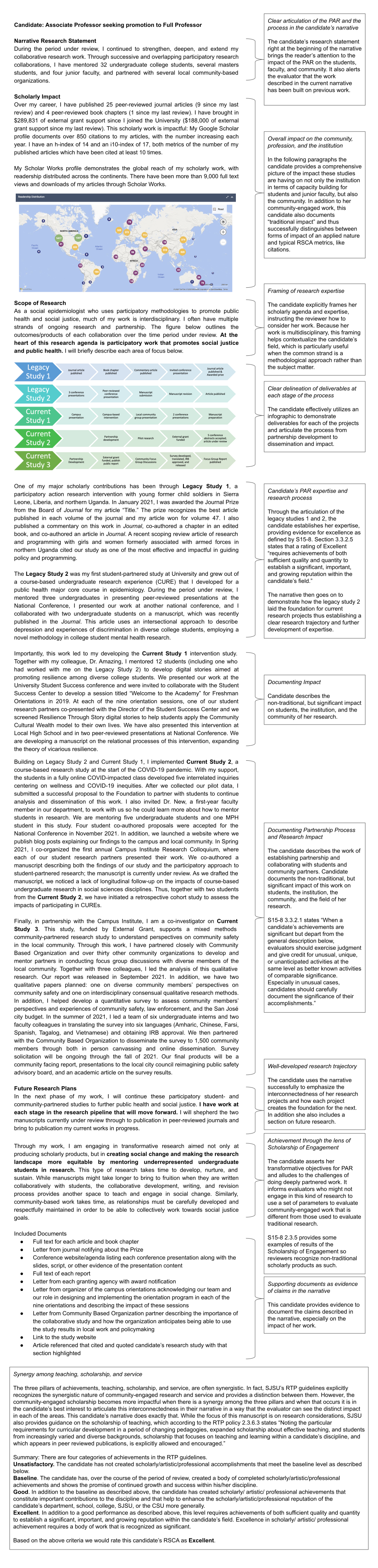
One of the most important pieces of the RTP dossier is the candidate’s narrative, which helps to frame the reviewer’s understanding of the candidate. At SJSU, candidates write one overall narrative and have the option of including separate narrative statements about their academic assignment or teaching, research, and service. In this section, we first provide one in depth example of a narrative, using the research narrative Miranda wrote when she was seeking promotion to Full Professor. Soma annotated this narrative with her assessment and the connections to applicable RTP policies (Figure 1). Building on this case study, we then make recommendations for candidates in crafting their narrative to facilitate fair evaluation, illustrating these recommendations with quotes from the narratives of two junior faculty seeking tenure and promotion who were mentored by Miranda as they developed their dossiers.

For one of the junior faculty candidates described below, being a CBPR researcher is central to her scholarly identity; for the other junior faculty candidate, community-engaged research is one aspect of her research program. Both candidates have published peer reviewed research articles, but their cases are strengthened through illustrating trajectories and documenting impact using the Scholarship of Engagement policy.
Framing The Scholarly Agenda Within Community-Engaged Research Paradigms
Our first recommendation is that candidates explicitly frame their scholarly agenda within the scholarship of engagement, CBPR, PAR, and/or CEnR. This framing helps reviewers understand the distinctive methodological approach and values that inform the candidate’s work.
In Candidate 1’s narrative, she clearly positions herself within the CBPR tradition: “As a public health community scholar, my research orientation is rooted in community-based participatory research (CBPR), where the basis of my research ethos is to work collaboratively with communities as research partners.” This direct framing immediately signals to reviewers the methodological orientation that guides her research approach.
Similarly, Candidate 2 identifies “the Scholarship of Engagement” as a “secondary interest,” explaining her commitment to “continuing to deepen my community involvement in research and evidence-informed decision making.” This framing helps contextualize her work with a campus center in the production of an annual applied advocacy report as a form of engaged scholarship rather than a service activity.
Articulating Products, Deliverables, and Evidence of Impact
Our second recommendation is to guide reviewers by describing how they should understand the products, deliverables, and evidence of impact of the research on the discipline, field, or community. This is particularly important for community-engaged research, which may prioritize the development of non-traditional scholarly outputs over traditional peer-reviewed journal articles.
Candidate 1 effectively illustrates impact when discussing her collaborative research with county agencies: “My contributions as an academic partner on applied research projects with community and county agencies has immediate impact on policy and practice.” She provides a specific example of impact: “One early direct impact of recommendations from this report is the submission of a request for $175,000 from the County Board of Supervisors District 1 to create programming to teach patients their health care rights.”
Candidate 2 similarly demonstrates impact by noting: “In just the first few months, the 2024 report resulted in more than a dozen media stories (print, television, and radio) and several townhall discussions with elected officials and community leaders.” This highlights how her work extends beyond traditional academic impact metrics to influence public discourse and policy discussions. Both candidates provided evidence in the dossier to back up these claims made in the narratives.
Situating Projects in the Research Process
Our third recommendation to candidates is to situate their projects within the research process, including noting any delays and how the research trajectory builds on past accomplishments. This context is essential for community-engaged research, which often requires significant time for partnership development.
Candidate 1 directly addresses this challenge: “Both the time-intensive nature of CBPR, particularly in the early stages, and substantial limitations and delays caused by the pandemic, lengthened the time required for my research to come to fruition through peer-reviewed publications and outside funding.” This explanation helps reviewers understand why community-engaged research might show different productivity patterns than traditional research approaches.
Candidate 2 situates her research trajectory by explaining: “My research trajectory is strong. As previously stated, I am the lead author for the 2025 report and I have three projects in early development,” helping reviewers understand both completed work and future directions.
Explaining Expertise in Community-Engaged Methodologies
Our fourth recommendation is to craft a narrative that explains the candidate’s expertise and how it connects to community-engaged methodologies. This helps establish the candidate’s methodological expertise and leadership, which is required by SJSU’s Scholarship of Engagement policy (see Box 1, section 2.3.5) and may also help reviewers distinguish engaged research from service.
Candidate 1 positions herself as “an expert in community-based participatory research,” noting that her research portfolio includes “serving as a CPBR methodological consultant in collaborative research with other scholars” and “conducting applied research with county and community partners using CBPR methods.” She also provides evidence of peer recognition of her methodological expertise: “my partnered research with public health colleagues at SJSU and at other universities is intentional and an important component of my research trajectory. For example, I recently worked in collaboration with… a preeminent CBPR scholar to develop and implement a CBPR micro-course on community engagement.” This explicit framing, with supporting evidence, establishes her methodological expertise and demonstrates recognition by peers.
Candidate 2, for whom community-engaged scholarship is one facet of her research program, situates herself within an “interdisciplinary field related to public health, advocacy, social justice, and education.” For this candidate, her research agenda focuses on “how solutions to problems are developed and implemented, including community organizing, advocacy, and policy development.” This framing of her scholarly expertise provides the necessary context for interpreting her work on an advocacy report through the Scholarship of Engagement policy.
Articulating Synergies Between Research, Teaching, and Service
Our fifth recommendation is to describe synergies between teaching, research, and service, making explicit where community engagement should be considered research versus service. This helps reviewers understand the integrated nature of community-engaged scholarship, which at our University, is viewed positively.
Candidate 1 demonstrates synergy by explaining how her community partnerships enhance her teaching: “I have also drawn on my public health practice and research experience to provide leadership in significant course redesign efforts in the undergraduate program,” showing how her research relationships facilitate experiential learning opportunities for students in a service-learning course. This candidate also explains how her research collaborations have led to high-level service opportunities:
Because of the community-engaged health equity research I conducted in Santa Clara County, I have had many opportunities to build new connections with community partners and be of service to them when they are in need of my expertise. I have been invited to consult on high level projects such as US Congresswoman Zoe Lofgren’s proposal to create the Status of the Latina in Santa Clara County report and Santa Clara County Board of Supervisor Sylvia Arena’s commissioning of a Latino Community Health Assessment multi-stakeholder task force. Both of these collaborative opportunities have the potential to impact the services and resources community members receive to advance health equity in Santa Clara County and the involvement of San José State University faculty and students in these important initiatives.
Candidate 2 effectively articulates these synergies: “At the margins and in the center, there is synergy in my work and commitments.” She explains how her teaching, research, and service mutually reinforce each other, naming exemplar achievements in each of these three categories to demonstrate the way in which they synergistically strengthen one another: “My scholarly activities and research expertise directly influence my teaching and service. For example, I developed an advocacy class, which draws on my experience with the Advocacy Report. I also lead our school’s participation in an annual statewide policy conference, bringing students to Sacramento to learn advocacy and policymaking for public health.”
Providing supporting documentation
Like most universities, SJSU has moved on from cumbersome binders and now contracts with a commercial vendor, Interfolio, for a secure online platform for uploading, maintaining, and managing candidate dossiers. As a commercial product, the dossier structure was developed for traditional research documentation. For example, our platform has a drop-down menu for candidates uploading their research materials to identify the type of material with the following options: Journal Publication, Book, Case Study, Chapter/Monograph, Creative Performance, Creative Production, Electronic Media, Proceedings Publication, Presentation, Poster Presentation, Review, Patent, Software/Hardware, Technical Report/White Paper, Work of Journalism, Other. It can be frustrating for candidates whose products are community-engaged to select the appropriate label from this set of descriptors. Yet, like all candidates, documentation for claims made in the dossier and supporting materials to assist in the evaluation of achievements is essential. Indeed, in our experience as reviewers and reading the letters to candidates written by Chairs, Deans, and the Provost, one of the most common problems with dossier preparation (not just for engaged researchers) is the failure to provide sufficient evidence to support claims made in the dossier. At our institution, this feedback is often provided during the third-year review, and offers the candidate an important opportunity for early feedback on the need for documentation, framing, and clarity.
In her tenure dossier, Candidate 1 included traditional scholarly outputs and evidence to support peer evaluation (e.g. peer review journal articles, conference presentations, documentation of award receipt from a scholarly conference), as well as materials that provided support for the assertion of her strong and growing reputation as a CBPR scholar. This latter category included multiple letters from community partners describing the impact of her applied expertise in their collaboration and on the community, letters of invitation to collaborate that identify the candidate’s reputation as a community-based researcher and in the community as the reason for the invitation, and links to some of the non-traditional forms of dissemination her CBPR research had produced (e.g. community-facing digital stories).
Candidate 2 created a summary page documenting the impact of each annual Advocacy Report. For each year’s report, she provided the citation and hyperlink for news media coverage of the report and the press release or other official documentation for the elected official’s town hall meetings discussing the report. These forms of documentation supported reviewers in their appraisal of the impact of these scholarly products.
These examples from successful tenure narratives demonstrate effective approaches to documenting community-engaged research contributions. By explicitly framing work within engagement paradigms, articulating impacts beyond traditional metrics, contextualizing research timelines, establishing methodological expertise, highlighting synergies across academic roles, and documentation of the impacts of these scholarly achievements, candidates can effectively represent the value and significance of their community-engaged scholarship to tenure and promotion committees.
Recommendations to Support Fair Retention, Tenure, and Promotion Evaluation
In light of our perspectives and the literature, we have recommendations for institutions that already have a commitment to equitable practices and appreciation for community-engaged research. Some of these recommendations build on the advice for dossier narrative preparation already described in the section above. Our recommendations grow from our focus on CBPR, PAR, and CEnR research and researchers, but are synergistic with recommendations largely from the humanities fields regarding publicly engaged scholarship (Ellison & Eatman, 2008). While our recommendations can be applied to all RTP processes, they will be more effective for institutions with established cultures of inclusivity and a commitment to reducing epistemic oppression (Dotson, 2014). All institutions benefit from having core values rooted in diversity, equity and inclusion and this is a necessary starting point before fair and equitable RTP processes can be implemented.
Recommendations for Universities
-
Establish a University policy on Scholarship of Engagement and forms of community-based, community-engaged, and participatory research.
-
Universities should define CBPR, PAR, and CEnR research in official policy, outlining their scope and providing documentation guidelines for RTP. Consider holistic evaluation, allowing recognition of community-engaged work to synergistically span across teaching, research, and service.
-
Identify explicitly what forms of scholarship and evidence of impact are acceptable. Consider, for example, how community-centered dissemination (e.g. reports, presentations) should be viewed compared to more traditional academic outputs (e.g. peer reviewed journal articles, book chapters), or how community-engaged scholars can document evidence of impact outside of traditional metrics (e.g. citations or journal impact factors).
-
-
Train RTP evaluators to assess community-engaged forms of scholarship.
-
Training should align RTP committees to support evaluators in applying policies consistently when assessing community-engaged research and facilitate committee discussion when evaluative assessments diverge.
-
Training should explicitly include anti-bias content, including how the work of minoritized scholars has been undervalued.
-
-
Support community-engaged researchers in understanding how to communicate their research within the frameworks of existing policy.
-
Create and maintain training and communities of practice for faculty at each stage of review.
-
Develop a centralized process for mentorship of faculty in the RTP process; this encourages access to mentorship across the university and may provide opportunities for mentorship outside the department or college.
-
Be intentional about including community-engaged researchers, especially women of color, in formal mentorship programs.
-
Recommendations for Evaluators (Barrera, 2024)
-
Educate yourself on the nature of community-engaged research.
-
Understand applicable policies and how to apply them to non-traditional scholarship.
-
Consider impactful outputs that may not be traditional or peer-reviewed.
-
Examples of such outputs include toolkits, training manuals, policy briefs, documentaries, community reports, public exhibits, or digital storytelling.
-
Assess contributions based on impact on communities, public discourse, and policy - not only citations or journal impact factors.
-
-
View your role as a part of a committee and not as an individual.
-
Hold each other accountable - ask for evidence from other evaluators for their assessments and refer back to policies.
-
Invite alternative perspectives rather than rushing to achieve consensus.
-
-
Recognize your role as an evaluator in upholding or shifting the culture of the RTP process.
-
Consider how your feedback helps colleagues identify new goals, set clear expectations, and identify benchmarks for their next level of review.
-
Ask yourself, “What can I do as an evaluator to bring an equity lens to my review of candidate materials?”
-
Recommendations for Candidates
-
Clearly explain your research process, including partnership development, deliverables, outcomes, and impacts.
-
Annotate your narrative with references to the evidence included in your dossier to support claims made about community-engaged processes and impacts.
-
Work closely with community partners to solicit and include a meaningful letter for RTP consideration to explain processes, deliverables, outcomes, and impacts that may be less well understood by reviewers than traditional scholarship (e.g. have a community partner explain what they did with a report and the impact it had on changing practice).
-
-
Describe your role.
-
The ethos of community-engaged approaches is typically to share credit widely and deflect personalized attention in favor of partnership. This is often in opposition to the individual assessment process of the RTP review. Seek to clearly describe your own contributions to a project, situating your role within the broader partnership. Be as explicit as possible.
-
Consider obtaining external letters of support from community partners that explain your role in the research collaboration.
-
-
Create a visual and/or infographic to explain your research process or demonstrate the impact of your research. Examples include:
-
Evidence of downloads/views of dissemination products (e.g. Count or geographic reach of report downloads)
-
News coverage (Google news search)
-
Photos of community events or testimonials
-
A timeline of project milestones linked to project deliverables
-
-
Enlist the help of a “critical friend” or mentor to review your materials.
-
A “critical friend” is someone who can ask questions in a way that encourages reflexivity, critiques your drafts, and supports and encourages you to strengthen your case (Ali et al., 2023). This type of friend or colleague is important to have throughout your academic journey, but especially while putting together your dossier and narrative.
-
Seek mentorship specifically from community-engaged scholars at your university for guidance on how you can use existing policy to support your review, tenure, or promotion case.
-
Limitations and Considerations
The narrative and recommendations presented in this article need to be considered within the limitations of the context from which we share our perspectives. First, our insights are derived from our experiences at a single university (SJSU), from one college (College of Health and Human Sciences). Core values at SJSU that shape our university’s mission include being community- and equity-minded and promotion of diversity and inclusion. SJSU has a longstanding history of community engagement and roots in social movements and teaching. Our university’s culture supports more equitable and fair RTP evaluation processes. We recognize that this dynamic is not necessarily representative of other institutions.
In addition, SJSU has community-engaged faculty-researchers who have successfully navigated the RTP process and are in positions of authority. These faculty further facilitate a culture of inclusive RTP processes. This foundation may not exist at other institutions, thus the starting point may not be to implement the recommendations we present in this article but rather to initiate or build a culture of inclusion.
We also acknowledge that our perspectives are reflections of our past and current experiences. The article focuses on successful candidates and dossiers, rather than reflections from candidates who were unsuccessful or focusing on experiences of reviewers who have witnessed bias go unaddressed. These would be valuable areas for continued scholarship. We also recognize that there is currently a period of uncertainty regarding the future of research, especially community-engaged scholarship. This may limit the future generalizability of our observations and recommendations.
Finally, these recommendations are to support fair evaluation of candidates who are doing deeply engaged research. While rare, we have encountered candidates who invoke the language of CBPR, PAR, and CEnR to justify a lack of tangible outputs, when not actually doing deeply engaged or community-based work. We hope our recommendations also help reviewers understand what they can expect from candidates who do engaged work and how to provide constructive feedback early in the process. Our intent with this manuscript is to encourage faculty to anticipate institutional expectations and to translate their work in ways that make its impact legible within the context of formal review.
Conclusion
Wherever you are situated - as a candidate, reviewer, or university administrator - if you care about community-engaged research, then you have a role to play in policy development, revision, and implementation to strengthen the context to provide fair and equitable evaluation of community-engaged researchers. Transparent policies support candidates as well as reviewers, and signal to everyone what type of work is valued.
Acknowledgements
We appreciate Dr. Vicky Gomez and Dr. Anji Buckner-Capone for sharing their RTP experiences with us and allowing us to use quotes from their dossiers. Dr. Magdalena Barrera developed the RTP training course and we appreciate her perspective on this course’s significance and thank her for allowing us to include the course outline in this manuscript.