


Globally, teachers face high levels of occupational stress, which negatively affects both teacher retention and educational quality (Beltman, 2021). In the Global South, these challenges are compounded by systemic inequities, socio-economic hardship, and resource-constrained school environments that intensify daily stressors (Ebersöhn, 2019; Msosa, 2020; Theron, 2016b). Although various interventions have been developed to support teacher well-being, many originate in Global North contexts and are based on individualistic assumptions, resource-heavy implementation models, and professional development paradigms that often misalign with the socio-cultural and structural realities of Global South education systems (Devries et al., 2022; Ebersöhn, 2019). These interventions are unlikely to achieve sustainable impact, as they may not fully reflect the relational dynamics, communal support systems, and cultural values that shape teachers’ lived experiences (Devries et al., 2022; Ebersöhn, 2019). Without grounding in local knowledge and day-to-day school realities, top-down programmes risk becoming misaligned or difficult to sustain (Rogers et al., 2023).
This study addresses these limitations by exploring a community-led, culturally responsive alternative. It introduces the Isithebe Social Connectedness Intervention - a school-based intervention collaboratively developed with South African primary school teachers. Guided by the research question, “How can a participatory, social connectedness intervention with teachers in peri-urban primary schools in a challenged educational context inform knowledge on teacher resilience?”, the study contributes to filling a significant gap in the literature. Namely, there is limited empirical evidence on low-cost, community-driven interventions that meaningfully respond to the contextual realities of teachers in the Global South (Ebersöhn, 2019; Rogers et al., 2023).
The Isithebe intervention was designed to foster teacher resilience by strengthening social connectedness through culturally resonant, expressive arts-based activities. It was developed using a Participatory Reflection and Action (PRA) process, an approach that involves community members as active co-creators in identifying challenges, reflecting on lived experiences, and collaboratively developing context-specific responses (Chambers, 2004; Ebersöhn & Ferreira, 2012). Grounded in principles of local agency, experiential knowledge, and iterative adaptation, PRA ensures that interventions are not externally imposed but rather emerge from within the communities they aim to serve. Accordingly, Isithebe was not based on imported models but evolved from the lived realities, values, and collective aspirations of South African teachers. This embeddedness exemplifies the principles of relevant science, ensuring that the intervention was firmly rooted in the socio-cultural context of under-resourced and high-stress school environments (Ebersöhn, 2019; Kloppenborg et al., 2024; Msosa, 2020; Theron, 2016b).
Central to the intervention was the use of arts-based methods as accessible and emotionally expressive tools for building professional and social connection. Three factors informed the adoption of this approach. First, expressive arts enable participants to articulate emotional complexity and shared meaning through symbolic, often non-verbal, forms - a key strength in contexts of trauma or resource-related stress (Maujean et al., 2014; Stepney, 2017). Second, these methods are low-cost, familiar, and adaptable, making them especially suited to the constraints and affordances of Global South education settings (Devries et al., 2022). Third, the Isithebe Kit - containing locally sourced materials such as beads, clay, and decorative tools - was conceptually inspired by the isiZulu term Isithebe, referring to a communal tray used during shared meals. This metaphor highlighted collective nourishment, care, and unity, aligning with Ubuntu principles and reinforcing the intervention’s Afrocentric emphasis on mutual support.
The participatory process ensured that the intervention was not only culturally grounded but also embedded within the rhythms of school life. Teachers co-designed activities, reflected on their relevance, and adapted facilitation to suit their contexts. The programme integrated both implicit support (e.g., emotional validation, psychological safety) and explicit support (e.g., peer exchange of strategies and classroom tools) (Ebersöhn et al., 2020). These forms of support legitimised teachers’ context-specific knowledge and created space for professional identity, relational strength, and reflective practice (Devries et al., 2022; Rogers et al., 2023).
Within the field of teacher development, arts-based participatory methods are increasingly recognised for their ability to promote both individual and collective resilience. They position teachers as both subjects and producers of change - critical in settings where marginalisation and policy neglect are common (Martinez-Vargas, 2024; Weerasinghe & Siriwardana, 2024). The Isithebe intervention applied this model through monthly gatherings featuring expressive activities detailed in the Isithebe Manual [1], such as the relationship voucher box, teacher circle recipe book, and teacher journey bracelets. These sessions were paired with reflective dialogues and alternated between single-school and multi-school formats, fostering both intimate trust and wider professional networks. Though centrally structured, the intervention was implemented flexibly, allowing teachers to tailor it to their needs and local norms.
The study contributes to the fields of teacher resilience by offering a replicable, sustainable, and afrocentrically aligned model of relevant, responsive, and responsible science. In developing Isithebe, teachers’ voices and experiences were pivotal in shaping a programme tailored to their socio-economic, cultural, and educational contexts. This collaborative framework aligns with cultural responsiveness principles, ensuring that the intervention addressed the realities of schools in marginalised settings (Ebersöhn & Ferreira, 2012; Theron & Theron, 2014). By drawing on local knowledge and social capital, the intervention exemplified responsive science - a low-cost, scalable approach rooted in community-based resources and relational strength (Ebersöhn, 2019; Theron, 2016a). Locally sourced tools and peer networks were instrumental to its relevance, uptake, and sustainability (Gu & Li, 2013; Mansfield et al., 2018).
Furthermore, the intervention embraced responsible science by positioning teachers not as passive recipients, but as co-creators and implementers (Freire, 1970; Peixoto et al., 2018). Teachers were encouraged to shape and lead the intervention and foster a stronger sense of agency and professional identity (Day & Gu, 2013; Gu, 2018). This empowerment is rooted in Afrocentric values of collective agency, particularly Ubuntu, which emphasises interconnectedness and shared purpose as key pillars of resilience (Ebersöhn et al., 2020; Ungar, 2012). Through this approach, Isithebe offered a practical, culturally aligned framework for supporting teacher well-being and promoting sustainable, community-driven change.
Contextual Background of the Isithebe Intervention
Grounded in the Relationship-Resourced Resilience (RRR) framework and co-designed through PRA, the intervention aimed to enhance teacher resilience by fostering social connectedness. This section is intended to support replicability and should be read alongside the Isithebe Manual [2] (Ebersöhn et al., 2020), which provides detailed guidance on activities, facilitation methods, and session sequencing.
The Isithebe intervention was developed in response to the long-standing challenges experienced by teachers in under-resourced South African primary schools, particularly those in peri-urban communities. The study was implemented in six purposively selected Quintile 3 public schools in the Eastern Cape - one of the most socio-economically challenged provinces in South Africa (RSA, 1996; Statistics South Africa, 2018). As such, this context served as a meaningful and demanding setting in which to pilot a relationally focused, school-based intervention aimed at improving teacher well-being.
The intervention was grounded in the RRR framework (Ebersöhn, 2012), which conceptualises resilience as a relational and context-responsive process. It positions access to social and institutional resources as central to individuals’ capacity to adapt to adversity. In keeping with PRA methodology, the intervention was co-designed with the teachers it intended to support. This participatory approach ensured the cultural relevance and contextual fit of the programme. The term Isithebe, taken from isiZulu, refers to a communal tray used to serve shared meals. This concept of shared care and collective strength shaped both the symbolic meaning and the practical design of the intervention.
Methodology and Design
This study adopted a concurrent mixed-methods research (MMR) design to explore the development and impact of the Isithebe intervention on teacher resilience. Anchored in a pragmatic epistemological stance (Barnes, 2012), the research integrated qualitative and quantitative methods to examine changes in relational, emotional, and contextual dimensions over time (Gravetter & Forzano, 2018; Johnson et al., 2014; Zartman, 2012). The MMR approach supported simultaneous data collection and continuous triangulation of teacher perspectives, researcher observations, and survey data, enhancing the trustworthiness and contextual sensitivity of the findings (Creswell & Plano Clark, 2011; Doyle et al., 2016).
The intervention was co-developed using a PRA methodology that positioned teachers as equal partners in the research process. Rather than implementing a predetermined framework, the project unfolded through iterative, dialogic collaboration. Teachers actively shaped the intervention’s structure, content, timing, and facilitation strategies to reflect their lived experiences and relational contexts. This participatory ethos was sustained throughout all phases of the research, from baseline consultation to intervention implementation, and finally, collective reflection and adaptation.
Study Phases and Timeline
The research unfolded in three interrelated phases: pre-intervention, intervention, and post-intervention. The pre-intervention phase, conducted in September 2018, involved baseline data collection from 36 teachers across six public primary schools. Teachers completed demographic and resilience questionnaires and engaged in participatory activities such as group mapping and artefact-making. These activities were not only used for data generation but also served as foundational tools for co-design, enabling teachers to collaboratively identify contextual stressors and sources of support within their professional environments.
During this phase, schools democratically nominated teacher facilitators, kit managers, and logistics coordinators, with the understanding that these roles would rotate throughout the intervention. This early distribution of leadership responsibilities laid the groundwork for shared ownership and sustainability. Teachers were also introduced to the Isithebe Kit, which contained session guides, facilitation prompts, expressive arts materials, and modest vouchers to support refreshments during monthly gatherings. Teachers reviewed the materials for clarity, usability, and cultural relevance, and their feedback informed revisions to terminology, activity sequencing, and facilitation style. The participatory structure of the initial planning session is detailed in Table 1, which outlines how the March training session embedded shared learning, collective planning, and role negotiation from the outset.
The intervention phase officially commenced in March 2019 with a six-hour collective training session led by project researchers and registered psychologists. This session introduced teachers to the theoretical foundations of the intervention, resilience, social connectedness, and Ubuntu, and modelled the facilitation of an Isithebe session using the Clay Modelling activity. Teachers were given space to discuss, critique, and adapt the facilitation model to better suit their school contexts.
From April through July 2019, monthly sessions were implemented in an alternating format: school-based sessions aimed at deepening collaboration among colleagues, and cross-school gatherings designed to expand peer support networks and communities of practice. Teachers played a central role in facilitating these sessions, which followed a semi-structured format grounded in expressive arts activities and reflective dialogues guided by the Isithebe Manual. The intervention design was intentionally flexible and adapted in real time based on teachers’ feedback and emerging needs. One such example of adaptation occurred when the originally planned “Friendship Survival Kit” activity was perceived as overly abstract. In response, a teacher proposed a new activity, later titled “Growing Together”, which involved planting and decorating succulent pots as metaphors for resilience. The activity, proposed during a WhatsApp group discussion, was adopted across schools and formally integrated into the intervention. This exemplified how adaptation was encouraged as a form of collaborative ownership and embedded responsiveness (Ebersöhn & Ferreira, 2012).
The post-intervention phase, conducted in September 2019, involved the re-administration of the same resilience and connectedness questionnaires used during baseline data collection, as well as a final reflective session. Teachers revisited previously created artefacts, discussed the intervention’s personal and professional significance, and co-developed ideas for sustaining peer-led Isithebe sessions beyond the formal research period. These reflections provided insight into the relational and emotional dimensions of impact, as well as practical strategies for long-term continuation. Photographs 1 - 4 depict the qualitative data generation activities that occurred during both the pre- and post-intervention sessions, capturing the participatory nature of the process.

Fidelity and Adaptation
While the intervention was supported by structured session plans and fidelity prompts, adaptation was not only anticipated but welcomed. Teachers were initially encouraged to record reflections in notebooks supplied within the Isithebe Kit. However, due to time constraints and administrative demands, many teachers found this approach impractical. Instead, they proposed using a WhatsApp group to share images and written reflections after each session. This solution emerged organically from participants and proved to be a more inclusive and sustainable mechanism for tracking participation, enabling asynchronous communication, and maintaining momentum between sessions.
The WhatsApp group became an important space for peer validation, artefact sharing, and informal mentoring across schools. These digital records, combined with ongoing feedback gathered during reflection meetings, allowed the research team to monitor implementation consistency without imposing external oversight. This adaptation exemplified the PRA model’s responsiveness to context and prioritisation of relational accountability over standardised compliance. Photographs 5–8 show images shared by teachers via the dedicated WhatsApp group, capturing moments from their gatherings as implemented and documented in their respective schools.
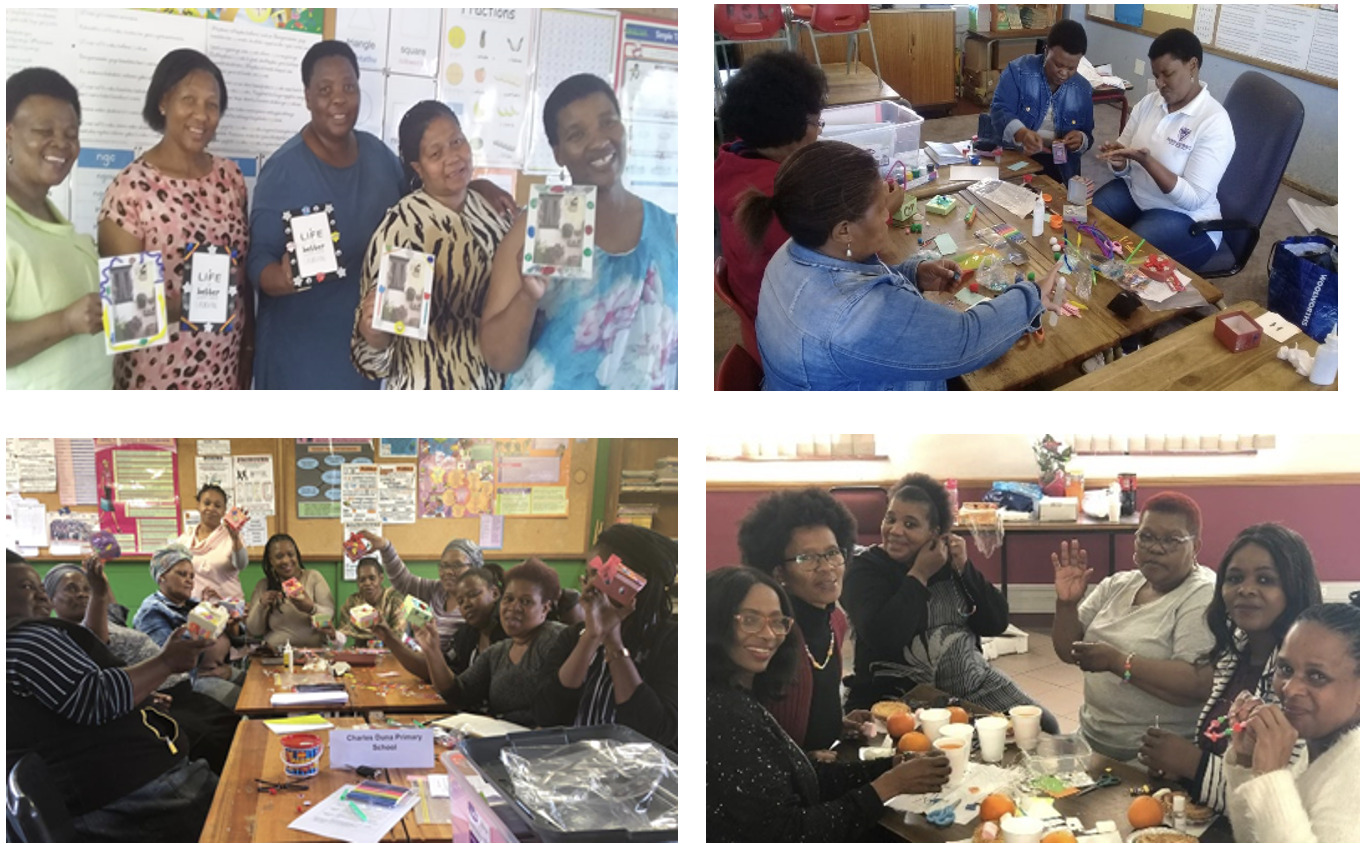
Intervention Activities
Each Isithebe session was crafted to engage symbolic, emotional, and cognitive dimensions of teacher well-being. Core activities, such as the Relationship Voucher Box, Teacher Circle Recipe Book, and Teacher Journey Bracelets, invited participants to explore experiences of support, stress, and professional identity through hands-on creative expression. These artefacts served not only as personal reflections but as prompts for collective dialogue, empathy-building, and mutual learning.
Sessions followed a sequenced structure outlined in the Isithebe Manual, but teachers were encouraged to tailor delivery to fit their specific school dynamics. The alternating format of school-based and cross-school sessions allowed teachers to build both depth within their local teams and breadth across the broader educator network. This dual structure reinforced a sense of solidarity and expanded teachers’ relational resources. A summary of the session sequence and structure is provided in Table 1, which outlines the month-by-month progression of the intervention and highlights the participatory elements embedded in each phase.
A key enabler of continuous dialogue and adaptation was the use of a dedicated WhatsApp group, initiated by teachers. This group evolved into a rich participatory space for feedback, encouragement, documentation, and problem-solving. Teachers used the platform to share photos of their artefacts, pose questions about facilitation, and celebrate moments of connection. Researchers monitored the group for insights but did not moderate it, allowing it to remain an organic, teacher-owned space. The decision to use WhatsApp as a central documentation and reflection tool emerged when it became apparent that post-session journaling in notebooks was not feasible given the teachers’ workloads. The digital space offered a low-barrier alternative that preserved the participatory spirit while adapting to the practical constraints of the context.
The PRA methods used for data generation were also fully participatory. Each session included guided reflective dialogues, metaphor-building exercises, visual mapping, and collaborative ranking. These activities were facilitated by teachers themselves and often modified to suit the tone and rhythm of each school. For example, during the Teacher Circle Recipe Book activity, some schools adapted the session to include both food recipes and metaphorical ‘recipes’ for resilience and classroom harmony. This modification was later taken up by other schools, showcasing how good ideas spread laterally through the teacher network rather than being imposed top-down.
Emergent themes and artefacts from each session were shared and reviewed in follow-up meetings, WhatsApp discussions, and mid-point debriefs. Teachers participated in theme verification and member-checking, ensuring that the data analysis was rooted in their own interpretations of the meaning and relevance of the activities (Doyle et al., 2016). In this way, the data generation process was not simply about collecting stories, but about co-constructing a shared understanding of resilience, support, and professional identity in a challenging educational landscape.
The participatory methodology itself became a mechanism for building resilience. The act of being involved in shaping, implementing, and reflecting on the intervention appeared to affirm teachers’ agency and professional worth. As conceptualised in the Relationship-Resourced Resilience (RRR) framework, resilience is not solely an internal trait but is sustained by access to meaningful relational resources (Ebersöhn, 2012). The Isithebe intervention treated participation not as a research method alone, but as a relational practice that actively supported the formation of these resources. Participation created opportunities for leadership, mutual validation, and co-learning—essential components of a resilient professional community. Rather than treating resilience as an outcome to be measured, the research design foregrounded resilience as an emergent, dynamic capacity fostered through collective engagement, reflective practice, and cultural resonance.
Discussion
Occupational stress among teachers is a global concern with serious implications for retention and educational quality. In Africa, however, research on teacher resilience remains limited, particularly in resource-constrained settings where systemic inequities compound stress. This study sought to address that gap through the Isithebe social connectedness intervention - a low-cost, school-based programme grounded in Afrocentric values and participatory development. By fostering emotional and professional support through expressive arts, Isithebe aligns with the principles of relevant, responsive, and responsible science.
The participatory design of Isithebe exemplified relevant science, ensuring that the intervention resonated with teachers’ cultural and professional values. This alignment is rooted in the theoretical foundation of PRA, which emphasises context-responsive, co-constructed solutions that emerge from community engagement (Chambers, 2004; Ebersöhn & Ferreira, 2012). Drawing on Ubuntu, the programme fostered mutual care and relational well-being, anchoring teachers’ experiences in a shared socio-cultural framework. This cultural congruence enhanced both engagement and perceived value, with teachers reporting that activities reflected their realities and contributed meaningfully to their sense of purpose and belonging. The conceptualisation of Ubuntu in the intervention draws from Afrocentric epistemologies that prioritise collective identity and interconnectedness as key elements of psychological and professional resilience (Ebersöhn, 2019; Theron & Theron, 2014).
The intervention also embodied responsive science, adapting to the practical constraints of under-resourced schools. Teachers responded positively to familiar, hands-on activities such as beadwork, clay-modelling, and recipe book creation, while less interactive tools like the “Friendship Survival Kit” proved less engaging. This adaptive, feedback-informed process mirrors findings from similar Global South interventions, including GBV-focused arts programmes in Uganda (Devries et al., 2022), resilience-based community partnerships in Ghana (Ofori-Atta et al., 2020), and participatory education work in India and Brazil (Martinez-Vargas, 2024), all of which emphasise the value of cultural resonance and flexible delivery in sustaining participation. This practical responsiveness was also guided by the RRR (Relationship-Resourced Resilience) framework, which frames resilience as emerging from access to social relationships and contextual resources, thereby informing the selection and adaptation of activities within the Isithebe intervention (Ebersöhn, 2012).
As a model of responsible science, Isithebe positioned teachers as co-creators and implementers. This approach not only respected their agency but enabled them to adapt the programme to their school’s dynamics. Here, the PRA methodology again played a critical role - its focus on local leadership and knowledge validation directly informed the decentralised and peer-led structure of the intervention. Teacher ownership contributed to the intervention’s sustainability and empowered participants to continue supporting one another beyond formal sessions. Similar participatory frameworks, such as nature-based community engagement in Kenya and Indonesia (van der Vaart et al., 2022), demonstrate how collective leadership and local adaptation foster long-term impact in complex educational settings.
Rooted in Afrocentric epistemologies and structured through PRA, Isithebe helped teachers extend social connectedness competencies across systems. Many reported increased implicit and explicit support not just to peers, but also to learners and families - evidence that the intervention nurtured relational resilience at multiple levels. The strengthening of relational trust, confirmed by both qualitative reports and statistically significant increases in post-intervention trust scores, supports the claim that Isithebe enhanced teachers’ capacity to build and sustain meaningful support networks. This finding directly links to the RRR framework’s assertion that trust and connectedness serve as key relational resources enabling resilience in high-adversity contexts (Ebersöhn, 2012).
The study also offers practical implications for schools and educational systems. Teachers valued the opportunity to engage in regular, intentional interactions that enhanced a culture of collaboration and care. By leveraging culturally grounded, low-cost activities, Isithebe provides a scalable model for improving teacher well-being in under-resourced contexts. It demonstrates how informal, teacher-led spaces, such as those fostered through WhatsApp engagement, can complement formal interventions and embed new practices into daily routines. The WhatsApp group, although informal, functioned in line with PRA principles of iterative reflection, dialogue, and co-learning, extending the participatory space beyond the physical sessions.
Sustainability is a key strength of Isithebe. Its reliance on low-cost materials, familiar cultural practices, and peer-led facilitation ensured that it could be implemented without external dependency. Teachers’ growing confidence in leading activities further reduced the need for ongoing researcher support and increased the potential for long-term continuation and local scaling. Such sustainability is a central goal of responsible science, which advocates for embedded, community-owned interventions capable of functioning independently of external actors (Ebersöhn et al., 2020; Freire, 1970).
Nevertheless, this study is not without limitations. The sample was limited to six Quintile 3 schools in the Eastern Cape, restricting the generalisability of findings. Only 22 teachers completed the post-intervention questionnaire, limiting statistical power. Voluntary participation may have introduced self-selection bias, and the lack of a control group restricts claims about causality. Additionally, although the WhatsApp group provided rich insight into engagement, data collection across schools was uneven, and more consistent documentation could have enhanced analytic rigour.
Despite these limitations, the study contributes to a growing body of work supporting participatory, culturally relevant interventions in Global South contexts. It aligns with research from Ghana, Uganda, Sri Lanka, and Latin America (Devries et al., 2022; Ofori-Atta et al., 2020; Rogers et al., 2023; Weerasinghe & Siriwardana, 2024), reinforcing that locally embedded, arts-based, and peer-driven approaches can enhance teacher resilience even under significant structural constraints. By aligning with the principles of relevant, responsive, and responsible science the intervention created an empowering space for teachers to reconnect with one another, reclaim their professional identity, and build sustainable systems of mutual support. This outcome supports the theoretical stance that resilience in education is best cultivated through relational, participatory, and culturally embedded processes, as argued throughout this paper.
Conclusion
The Isithebe Social Connectedness intervention illustrates that enhancing teacher resilience through expressive, arts-based activities is both feasible and impactful within resource-constrained educational contexts in the Global South. Grounded in Afrocentric values, the intervention demonstrated the power of culturally resonant, low-cost strategies to foster meaningful social support systems within schools. Consistent with the principles of relevant, responsive, and responsible science, the intervention was embedded in local realities, adaptable to context-specific challenges, and empowering to the teachers who co-created it.
Throughout the intervention, teachers engaged in collaborative, arts-based activities that promoted community building and relational trust. These engagements contributed to both emotional well-being and strengthened professional identities, forming a protective buffer against the pressures of teaching in under-resourced schools. The alignment between social connectedness and cultural identity proved critical, highlighting the importance of designing interventions that are not only context-sensitive but also values-driven. The iterative refinement of the programme based on teacher feedback also demonstrated responsive science in action. This flexibility contributed to the longevity and resonance of the intervention, reinforcing the idea that locally adaptable designs are essential for the long-term viability of social support initiatives in education.
Crucially, Isithebe embodied responsible science by positioning teachers not as passive recipients but as active agents of change. Their role in designing, facilitating, and sustaining the intervention was central to its success. By embedding teacher agency and cultural meaning-making into the programme, the intervention cultivated a resilient professional community capable of maintaining and evolving its impact over time. This model holds valuable lessons for similar initiatives, showing how empowerment and ownership can support the ongoing development of well-being practices in schools. As education systems in the Global South continue to face structural and psychosocial challenges, initiatives like Isithebe provide a practical and theoretically grounded pathway to creating resilient, supportive teaching environments that can thrive beyond the lifespan of externally supported interventions.
Data availability statement
The raw data supporting the conclusions of this article will be made available by the authors, without undue reservation.
Ethics statement
The studies involving humans were approved by the Faculty Committee for Research and Ethics at UP. The studies were conducted in accordance with the local legislation and institutional requirements. The participants provided their written informed consent to participate in this study. Written informed consent was obtained from the individual(s) for the publication of any potentially identifiable images or data included in this article.
Conflict of interest
The authors declare that the research was conducted in the absence of any commercial or financial relationships that could be construed as a potential conflict of interest
Acknowledgements and Funding
This research was funded by the Synergos Institute and the Centre for the Study of Resilience (CSR) at the University of Pretoria, whose support made this research project possible.